
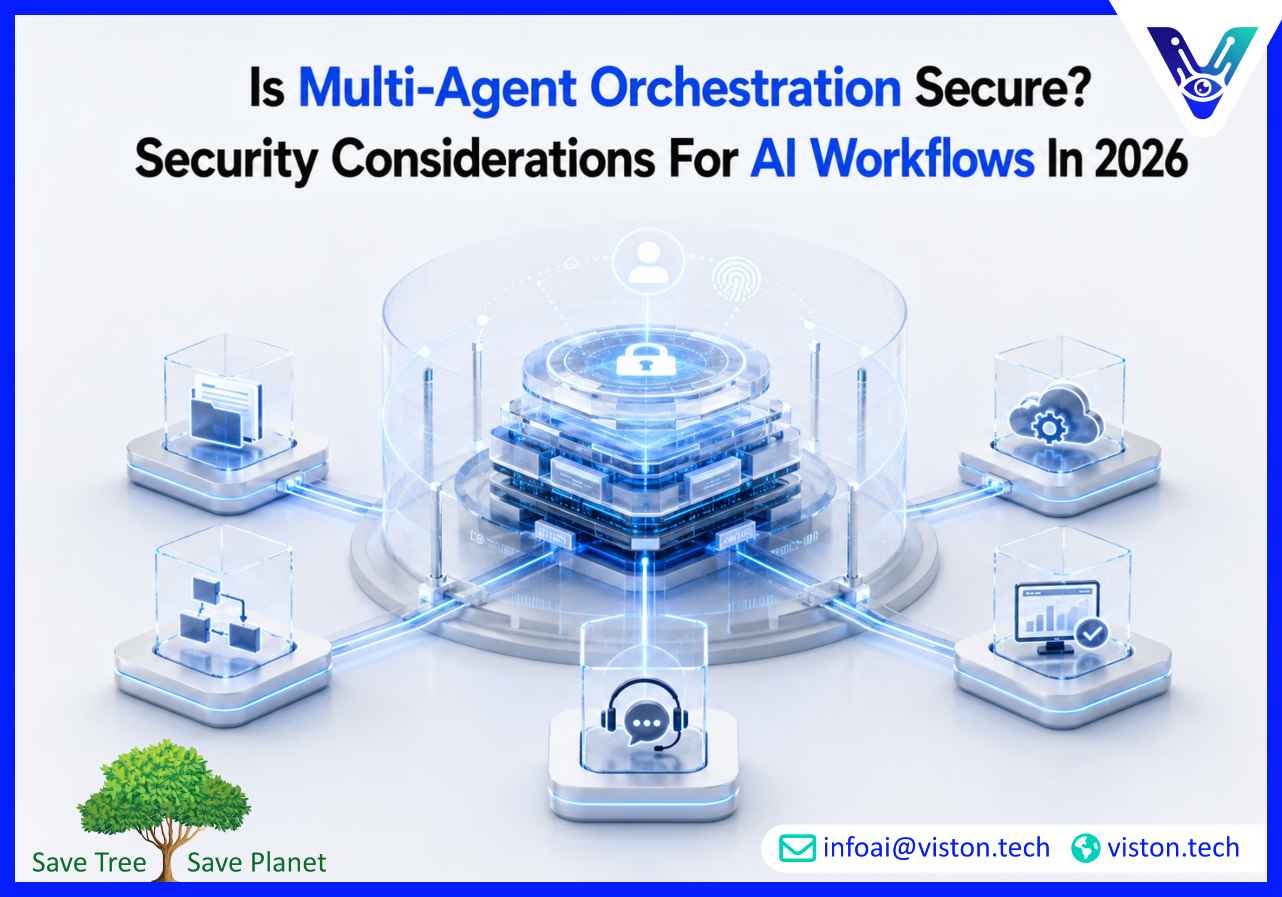
As businesses adopt AI-driven automation, security has become one of the most important questions surrounding multi-agent orchestration. Organizations want to benefit from coordinated AI agents without exposing sensitive data, creating compliance risks, or losing operational control. Understanding how security works within multi-agent systems is essential before implementation.
Multi-agent orchestration refers to coordinating multiple AI agents that work together to complete business processes. These agents may access databases, enterprise applications, APIs, documents, customer records, analytics platforms, and communication tools.
The security of a multi-agent orchestration system depends less on the AI models themselves and more on how the overall architecture is designed, governed, monitored, and controlled.
A secure system typically includes:
When implemented correctly, multi-agent orchestration can be as secure as other enterprise software systems while offering greater automation and operational efficiency.
Modern AI agents can perform actions rather than simply generate content. They can update records, trigger workflows, retrieve customer information, process documents, initiate communications, and interact with enterprise platforms.
This increased capability creates additional responsibilities for businesses.
Organizations implementing multi-agent orchestration in 2026 are increasingly focused on:
Security is no longer viewed as a technical feature alone. It has become a business requirement that directly affects trust, compliance, and operational continuity.
If agents receive excessive permissions, they may access information beyond their intended responsibilities. Poor permission management can expose customer data, financial records, proprietary information, or confidential business processes.
The principle of least privilege is critical. Every agent should only access the data and systems necessary for its specific role.
AI agents that execute actions without sufficient validation can introduce operational risks. Examples include modifying records, sending customer communications, processing transactions, or triggering workflows incorrectly.
Organizations should establish approval workflows and human review checkpoints for high-impact decisions.
Multi-agent systems may interact with external content, documents, websites, emails, or customer inputs. Malicious instructions hidden within these sources can attempt to influence agent behavior.
Secure orchestration frameworks implement validation layers, input filtering, and policy enforcement mechanisms to reduce this risk.
Most enterprise AI workflows depend on integrations with CRM systems, cloud platforms, ERP applications, communication tools, and external APIs.
Each integration expands the potential attack surface. Strong authentication, token management, encryption, and continuous monitoring help mitigate these risks.
Without detailed logs, businesses may struggle to understand how decisions were made or why a workflow produced a specific outcome.
Comprehensive audit trails improve accountability, troubleshooting, compliance reporting, and security investigations.
Each agent should have clearly defined responsibilities and restricted permissions. Specialized agents reduce complexity and improve security management.
Critical decisions involving finance, legal matters, compliance, customer communication, or strategic business actions should include human approval.
This approach combines automation efficiency with operational oversight.
Authentication should apply not only to users but also to agents, services, APIs, and connected systems.
Modern identity and access management solutions help ensure only authorized entities participate in workflows.
Data should remain protected during storage, transmission, and processing whenever possible.
Encryption helps reduce exposure risks and supports regulatory compliance requirements.
Real-time monitoring helps organizations identify anomalies, workflow failures, unauthorized actions, and unexpected behavior before they create larger problems.
Security teams should have visibility into agent actions, workflow performance, and system interactions.
AI workflows require ongoing validation. Security assessments should include penetration testing, access reviews, workflow validation, integration testing, and scenario-based risk analysis.
Regular testing helps organizations adapt to evolving threats and business requirements.
Before deploying a multi-agent orchestration solution, decision-makers should evaluate several key areas.
The most secure platforms are designed with governance and operational controls from the beginning rather than treating security as an afterthought.
Because security is a fundamental requirement for enterprise AI adoption, organizations exploring Multi-Agent Orchestration need implementation partners that understand both automation and governance. Viston AI focuses on AI automation, workflow orchestration, AI agents, and business process automation that connect securely with enterprise systems.
Building a secure multi-agent environment involves more than connecting AI models to business applications. It requires workflow architecture, permission management, integration planning, monitoring frameworks, validation processes, and operational controls that align with real business requirements.
For organizations deploying AI agents across operations, support, sales, data workflows, and internal processes, security considerations must be embedded throughout the lifecycle—from design and deployment to monitoring and optimization. Viston AI’s expertise in AI automation and workflow orchestration helps businesses develop structured systems that balance automation capabilities with governance, transparency, and risk management.
Yes, multi-agent orchestration can be highly secure when implemented with proper access controls, monitoring, governance, encryption, and approval mechanisms. Security depends largely on architecture and operational practices.
Excessive permissions are among the most common risks. Agents that have access beyond their intended role can increase exposure to data leaks, unauthorized actions, and compliance issues.
For critical decisions involving financial transactions, compliance, legal matters, or sensitive customer communications, human oversight is strongly recommended.
Secure integrations typically involve strong authentication, encrypted communication, permission restrictions, API security controls, monitoring, and regular testing.
Yes. Viston AI’s focus on AI automation, workflow orchestration, and AI agent implementation aligns with organizations seeking secure, scalable, and governed multi-agent environments.
Industries handling significant operational workflows, customer interactions, data processing, compliance requirements, and enterprise automation can benefit substantially from secure multi-agent systems.
Multi-agent orchestration is secure when organizations combine AI capabilities with strong governance, access controls, monitoring, and operational safeguards. As businesses expand their use of AI-powered workflows in 2026, security becomes a foundational requirement rather than an optional enhancement. Organizations that prioritize secure architecture, controlled autonomy, and continuous oversight can confidently leverage Multi-Agent Orchestration to improve efficiency while protecting business data and maintaining compliance. For companies evaluating enterprise AI workflows, working with experienced specialists such as Viston AI can help ensure that security remains embedded throughout the implementation process.
