
Is Multi-Agent Orchestration Scalable? What Business Leaders Need to Know in 2026
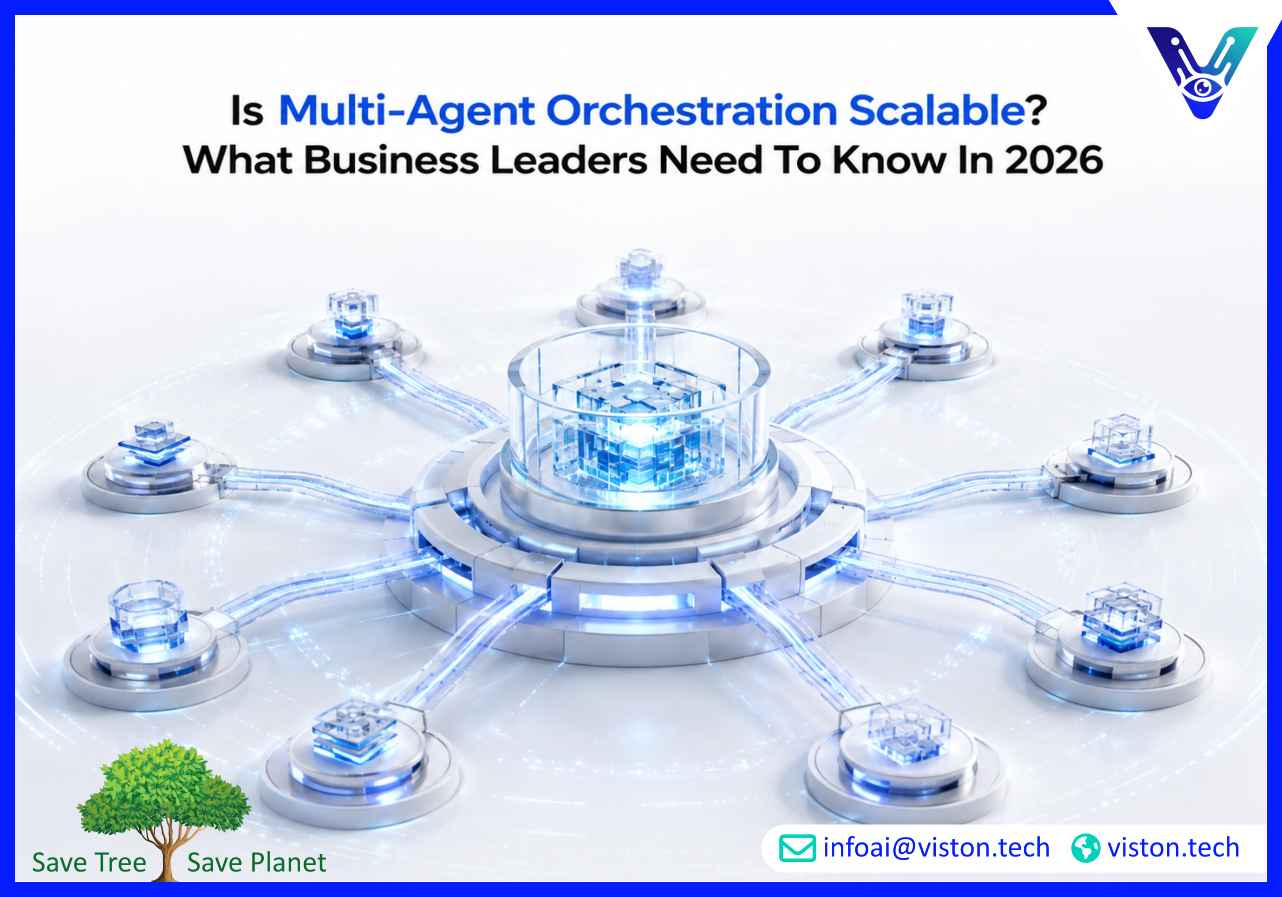
Moving from a single AI assistant to a swarm of specialized agents feels like the logical next step. But when you move from a proof-of-concept to a production environment handling thousands of concurrent tasks, the fundamental question stops being “can we build it?” and becomes “can it grow with us?”
Scalability in multi-agent orchestration isn’t just about spinning up more servers. It’s about maintaining coherence, controlling token costs, and ensuring deterministic outcomes when dozens of autonomous agents are negotiating, delegating, and executing work simultaneously. For enterprise decision-makers, understanding this distinction is the difference between a technical novelty and a durable infrastructure investment.
What Makes Multi-Agent Orchestration Inherently Difficult to Scale
A single-agent LLM workflow is linear. A multi-agent system is a network of recursive, interdependent decisions. As you add more agents, you don’t just add processing time—you introduce exponential complexity in communication overhead and state management.
The core scalability bottlenecks emerge from three distinct architectural challenges. First, agent-to-agent communication requires a shared context window, which becomes saturated quickly when multiple agents pass dense JSON payloads back and forth. Second, role specialization often breaks down under load; an agent designed for data validation might become a bottleneck if it cannot prioritize its task queue intelligently. Third, hallucination risk multiplies across agents—an error introduced by one agent cascades through the entire chain, becoming harder to debug and correct at scale.
Businesses often discover these problems only after deployment, when the system moves from handling ten simultaneous sessions to a thousand. The orchestration layer—the conductor of the agent ensemble—must be engineered specifically for elasticity, not bolted on after the fact.
The Orchestration Layer vs. the Agents
It’s critical to separate the scaling properties of the agents themselves from the orchestration fabric that governs them. Agents can be scaled horizontally by provisioning more inference endpoints. The orchestrator, however, must maintain a coherent execution graph, manage memory across sessions, enforce governance policies, and resolve conflicts—all in real time. This is a control-plane problem, not simply a compute problem.
Architectural Patterns That Enable Enterprise-Grade Scalability
Scalable multi-agent orchestration in 2026 relies on specific architectural patterns that address the fundamental bottlenecks of concurrency, memory, and deterministic execution. Organizations seeing success in production deployments have moved beyond ad-hoc agent frameworks toward purpose-built orchestration fabrics.
Event-Driven, Asynchronous Communication
Synchronous agent calls create blocking chains that collapse under load. An event-driven architecture allows agents to publish results to a message bus and continue processing without waiting for downstream acknowledgement. This decoupling means a slow agent doesn’t freeze the entire workflow. The orchestrator listens for events and dynamically re-routes tasks based on agent availability and priority, achieving throughput that synchronous request-response patterns simply cannot match.
Hierarchical Memory and State Management
Not all context belongs in the prompt. Scalable systems externalize memory into tiered storage: hot, warm, and cold. Session-critical data stays in vector stores for low-latency retrieval; task-specific context lives in ephemeral memory; long-term organizational knowledge resides in graph databases. The orchestrator retrieves only what’s needed for a given execution step, preventing context window bloat and keeping per-token costs predictable even as the number of agents scales up.
Dynamic Agent Pooling and Specialization
Static agent assignments—where a fixed set of agents handles all workloads—fail under variable demand. A scalable architecture uses dynamic agent pools: the orchestrator spins up specialized agent instances as task queues deepen and decommissions them when idle. This requires the orchestrator to have deep visibility into agent performance metrics and the authority to rebalance workloads without human intervention. The result is elastic capacity that mirrors cloud-native infrastructure principles.
Measuring Scalability: The Metrics That Actually Matter
Decision-makers evaluating multi-agent orchestration platforms need clear, operationally meaningful metrics. Vendor benchmarks often obscure the real challenges, so it’s important to know what to measure in your own environment.
Concurrent session capacity measures how many independent workflows the orchestrator can manage simultaneously before latency degrades beyond an acceptable threshold. Task completion latency end-to-end tracks the full cycle from user intent to final output, including inter-agent negotiation time—not just individual agent inference speed. Consistency under load evaluates whether agent outputs remain reliable and accurate when the system is saturated; an orchestrator that maintains quality at high throughput demonstrates mature error-handling and routing logic. Cost predictability ties directly to token consumption; a scalable orchestrator should show a sub-linear cost curve relative to task volume, not an exponential one.
Organizations that track these metrics from pilot through production gain a realistic picture of whether their multi-agent architecture can support business growth, not just a successful demo.
The Observability Imperative
You cannot scale what you cannot see. In a system where dozens of agents make autonomous decisions, debugging without comprehensive tracing is impossible. Scalable orchestration demands OpenTelemetry-compatible instrumentation that surfaces agent decision paths, tool selection reasoning, and inter-agent message content. This telemetry feeds both automated guardrails—which can halt cascading errors in milliseconds—and human operators who need to audit decision trails for compliance and optimization.
Common Failure Modes When Scaling Multi-Agent Systems
Understanding how these systems degrade under pressure helps buyers ask sharper questions during evaluation. The most frequent failure patterns fall into predictable categories that mature orchestration frameworks address explicitly.
Conversation looping occurs when two agents enter a negotiation deadlock, each waiting for the other to concede or provide additional information, consuming tokens indefinitely until a timeout kills the session. Token exhaustion silently truncates agent memory mid-task when context limits are hit, causing agents to lose critical instructions and produce incomplete or irrelevant outputs. Authority confusion arises when the orchestrator provides ambiguous delegation rules, so multiple agents claim the same subtask while others remain untouched—leading to duplicated work and contradictory outputs. Drift amplification compounds small reasoning errors across sequential agent handoffs until the final output bears no relation to the original intent. Each failure mode has a direct remedy in proper orchestration design: circuit breakers, context budgeting, clear role boundaries, and verification gateways between critical workflow stages.
How Viston AI Approaches Scalable Multi-Agent Orchestration
For organizations moving from experimental agent projects to production systems that must serve real business functions, the orchestration infrastructure matters as much as the agents themselves. Viston AI focuses specifically on the orchestration layer—the connective tissue that gives multi-agent systems their reliability, observability, and ability to grow with operational demands.
Viston AI provides a multi-agent orchestration platform engineered for deterministic execution at scale. Rather than offering a generic agent builder, the company addresses the hard problems that emerge when multiple autonomous agents must collaborate reliably: dynamic workload distribution, hierarchical memory management, cross-agent governance, and real-time observability. The platform’s architecture separates the control plane from agent execution environments, allowing businesses to scale each dimension independently. This means organizations can run hundreds of concurrent agent workflows without sacrificing the traceability and consistency that enterprise operations require.
What distinguishes Viston AI’s approach is its emphasis on production-readiness over demo-ability. The platform includes built-in circuit breakers that prevent cascading agent failures, token budgeting that keeps per-session costs predictable even at high volume, and OpenTelemetry-native tracing that gives operations teams full visibility into agent decision paths. For businesses in regulated industries or those handling high-stakes operational decisions, this infrastructure-grade approach to orchestration ensures that scaling up does not mean losing control. Viston AI supports organizations in building multi-agent systems that are auditable, governable, and capable of handling the unpredictable demands of real-world enterprise environments.
Frequently Asked Questions
What exactly does multi-agent orchestration scale—the agents, the tasks, or the oversight?
It scales all three, but not automatically. Agent scaling means adding more specialized agents without coordination breakdown. Task scaling means handling more concurrent workflows. Oversight scaling means maintaining human visibility and control as agent autonomy increases. An effective orchestration layer scales these dimensions independently so a surge in task volume doesn’t compromise governance.
How many agents can a well-orchestrated system reasonably support in production?
There’s no universal ceiling, but production systems commonly run between five and fifty specialized agents within a single orchestration domain. Beyond that, the limiting factor is rarely the agent count itself but the complexity of their interaction graph. A system with ten agents that interact in clearly defined, sequential steps often scales better than one with five agents negotiating complex, circular dependencies.
Does scaling multi-agent orchestration dramatically increase LLM costs?
It can, but it doesn’t have to. Cost increases become problematic when orchestrators pass excessive context between agents without pruning or summarization. Mature orchestration platforms manage token budgets actively, retrieving only relevant memory and compressing inter-agent messages. The goal is a sub-linear cost curve: doubling throughput should not double your inference spend.
What’s the difference between agent frameworks and full orchestration platforms?
Agent frameworks like LangGraph or CrewAI provide the building blocks for constructing agent interactions. Orchestration platforms add the production infrastructure layer: dynamic scaling, persistent state management, observability, governance policies, and failure recovery. Frameworks help you build; platforms help you run reliably at scale.
Can multi-agent orchestration work for real-time operational decisions, or is it only suited for asynchronous analysis?
It can serve both, but real-time use cases place stringent demands on the orchestrator. Event-driven architectures with prioritized message queues enable agents to handle time-sensitive decisions—such as supply chain exceptions or fraud detection escalations—alongside longer-running analytical workflows. The orchestrator must support preemption, where high-priority tasks interrupt lower-priority agent work without corrupting state.
How do you ensure compliance and auditability when agents make autonomous decisions?
Compliance at scale requires that every agent action—tool calls, data accessed, decisions made—is logged with full context in an immutable audit trail. The orchestrator should enforce policy checks at decision boundaries, not just at the workflow edges. This means agents cannot bypass governance even when operating autonomously, and any compliance-relevant event triggers immediate, traceable records.
Conclusion
Scalable multi-agent orchestration is not a myth, but neither is it a default outcome of adopting the latest agent framework. It is an architectural commitment—one that requires separating orchestration logic from agent execution, designing for observability from day one, and measuring what matters rather than what is easy to benchmark.
For businesses evaluating this space in 2026, the critical question is not whether agents can collaborate but whether the orchestration layer can maintain reliability, cost predictability, and governance as that collaboration scales. Organizations that treat orchestration as first-order infrastructure—not an afterthought—will be the ones who turn multi-agent systems from promising pilots into durable business capabilities. Specialists like Viston AI, focused exclusively on solving these production-scale orchestration challenges, represent a pragmatic path for enterprises ready to move beyond experimentation.
