
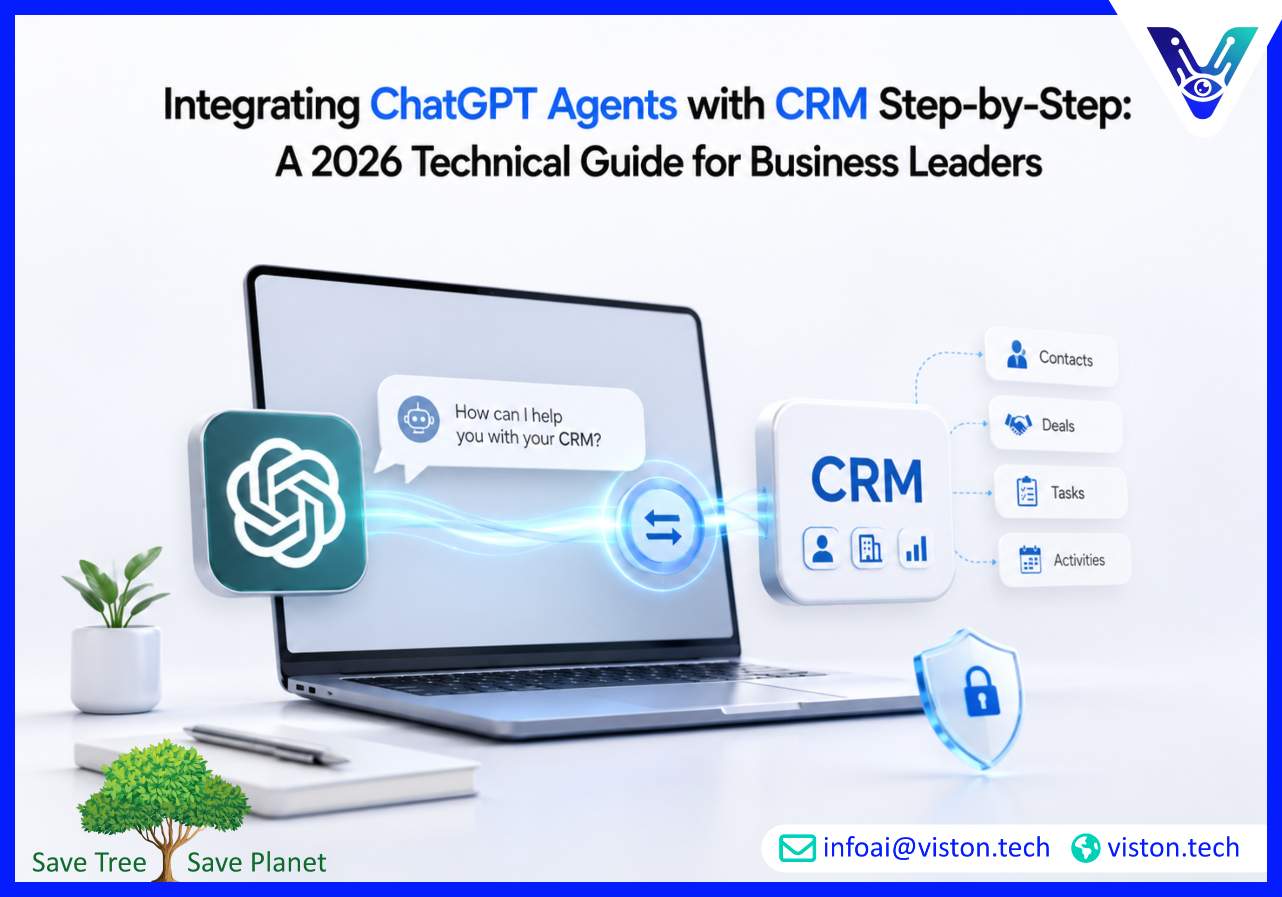
In 2026, the question is no longer whether your CRM should connect to AI, but how deeply and securely you enable that integration. For business leaders, the shift from manual data entry to conversational CRM management is here. ChatGPT agents are now capable of pulling live pipeline data, updating opportunity stages, and even drafting account plans through natural language. However, successful integration requires more than plugging in an API key; it demands a strategic architecture that prioritizes data governance, user permissions, and operational reliability.
The traditional B2B software model is rapidly becoming conversation-centric. Instead of logging into a dashboard to run reports, sales and marketing leaders are interrogating their data directly through AI interfaces. ChatGPT is evolving into a universal control plane for business software, allowing users to query complex datasets without navigating multiple applications . For organizations, this means reduced friction in accessing customer insights and faster decision-making cycles. However, purely DIY integrations often lead to fragmented data flows and security gaps. A structured integration allows businesses to turn their CRM into a backend service that AI assistants can utilize securely, transforming how teams interact with customer data without sacrificing control .
Before diving into the steps, decision-makers must understand the core components enabling this connection. The Model Context Protocol (MCP) has emerged as the standard for wiring AI models to enterprise data sources. Unlike rigid point-to-point APIs, MCP allows AI agents to discover and interact with tools dynamically . For CRM integration, this means a ChatGPT agent can not only read contact lists but also perform write-back operations, such as updating a deal stage or creating a task, provided the permissions allow it.
Security is the critical variable. Tools like Salesforce’s Agentforce Trust Layer or CData Connect AI act as a controlled channel between the LLM and your database, ensuring that proprietary data does not leave approved boundaries . When evaluating integration methods, prioritize solutions that support OAuth, token refresh mechanisms, and data encryption both at rest and in transit.
While every organization’s tech stack varies, the following workflow represents the standard for enterprise-grade integration in 2026, utilizing frameworks like the OpenAI Agents SDK and middleware tools.
You will need access to a paid ChatGPT plan that supports custom actions (such as ChatGPT Enterprise or Team) and API keys for your CRM platform. If utilizing an MCP server approach, procure API keys from your chosen orchestration layer (e.g., Composio or a custom MCP server setup).
To give the agent “hands,” you must establish a Tool Router session. Using frameworks like the OpenAI Agents SDK, developers initialize a Composio instance or similar tool to generate a secure MCP URL. This URL acts as the bridge, checking the user’s active CRM connection and preparing the endpoint for data exchange .
Create the Agent instance with specific instructions regarding its role—limiting it to CRM queries, inserts, and updates as needed. Critically, implement a “require_approval” mechanism for high-risk actions (e.g., deleting a company record or closing a large deal). For sensitive data flows, integrate a Data Loss Prevention (DLP) layer to dynamically mask personally identifiable information before it reaches the LLM .
The integration must trigger a secure OAuth flow. When a user initiates a chat, the system verifies their existing CRM permissions. ChatGPT should only access data the user is already authorized to view in the CRM. This “least privilege” enforcement is crucial for compliance with data residency and privacy regulations .
Run live chat sessions where the agent performs operations like “list all leads added this week” or “summarize the last support ticket for Company X.” The system saves conversation history via SQLite sessions for continuity, allowing the agent to maintain context across interactions .
While the productivity gains are substantial, the risks of AI-CRM integration are non-negotiable. In 2026, regulatory bodies are increasingly scrutinizing how AI agents handle data. Three primary risks dominate the landscape:
To mitigate these risks, organizations must implement a “human-in-the-loop” (HITL) review for write operations and mandate full audit logging of every prompt-to-execution chain.
Integrating ChatGPT agents with CRM is not a standard IT configuration; it is a specialized engineering discipline that sits at the intersection of conversational AI, API architecture, and cybersecurity law. While off-the-shelf connectors exist, they rarely account for the specific data models, custom fields, or complex approval hierarchies present in enterprise CRMs like Salesforce, Dynamics 365, or HubSpot. A generic integration often breaks when faced with custom objects or fails to respect field-level security settings, creating shadow IT risks.
Furthermore, specialist providers ensure that the integration is “forward-compatible” with the rapid release cycles of LLM providers. As models evolve and new vulnerabilities are discovered (such as the MCP vulnerabilities highlighted by CNCERT in early 2026), generalist developers may struggle to patch security gaps quickly . Specialist services bring pre-built compliance tooling, such as automated data masking and semantic validation layers, ensuring that the AI agent only executes actions that align with the company’s established business logic and regulatory requirements .
Navigating the complexities of agentic workflows requires a partner who understands both the technical architecture and the governance landscape. Viston AI provides specialized Agent Integration Services designed to bridge the gap between leading LLMs like ChatGPT and your proprietary CRM data. We move beyond basic API connections to build contextual bridges that respect your existing security posture.
Viston AI focuses on delivering enterprise-grade MCP server setups and tool router configurations tailored to your specific sales and operational workflows. Our approach includes the implementation of safety guardrails—such as dynamic data masking and mandatory approval flows—to prevent unauthorized data extraction or “hallucinated” updates to your core systems. For organizations in regulated industries, we prioritize architecture that supports private data processing and adheres to the latest compliance standards. By partnering with Viston AI, businesses gain a strategic advantage: unlocking the productivity of conversational AI without sacrificing the integrity and security of their customer data.
Standard APIs are static; they require predefined calls. MCP (Model Context Protocol) allows the AI agent to dynamically discover and use tools. This enables the agent to reason about which CRM action to take (e.g., fetching a lead vs. updating a deal) based on the user’s natural language request, rather than following a rigid script.
Implement a three-layer defense: 1) Use a unified DLP classification engine to mask PII before it hits the LLM. 2) Enforce “least privilege” access via OAuth scopes. 3) Enable “human-in-the-loop” approval for any data write or delete actions within the agent configuration.
Yes. Advanced integrations allow agents to update fields, change opportunity stages, create tasks, and log emails. However, to maintain data hygiene, these actions should be routed through a validation layer that checks for data type mismatches or logical inconsistencies before committing to the database.
With optimized MCP servers and edge computing, latency is typically between 1 to 3 seconds for standard queries (e.g., “show me my tasks”). Complex “Deep Research” queries involving multi-step analysis across thousands of records may take 20-40 seconds, depending on the CRM’s API rate limits.
Viston AI employs a semantic mapping layer that aligns your CRM’s unique schema (custom objects, picklist values, relational links) with the LLM’s natural language understanding. This ensures the agent can correctly interpret and act upon proprietary data fields that generic connectors ignore.
Integrating ChatGPT agents with your CRM is no longer a futuristic experiment; it is a competitive necessity for 2026. By moving from static dashboards to conversational interfaces, businesses can democratize data access and accelerate revenue operations. However, the technical process—spanning MCP server setup, strict authentication flows, and runtime security—requires specialized expertise. A successful deployment balances the agent’s autonomy with rigorous governance to prevent data leaks and compliance violations. As you plan your integration roadmap, partner with specialists like Viston AI who can navigate the complexities of Agent Integration Services, ensuring your team reaps the benefits of AI without exposing your organization to unacceptable operational risks.
