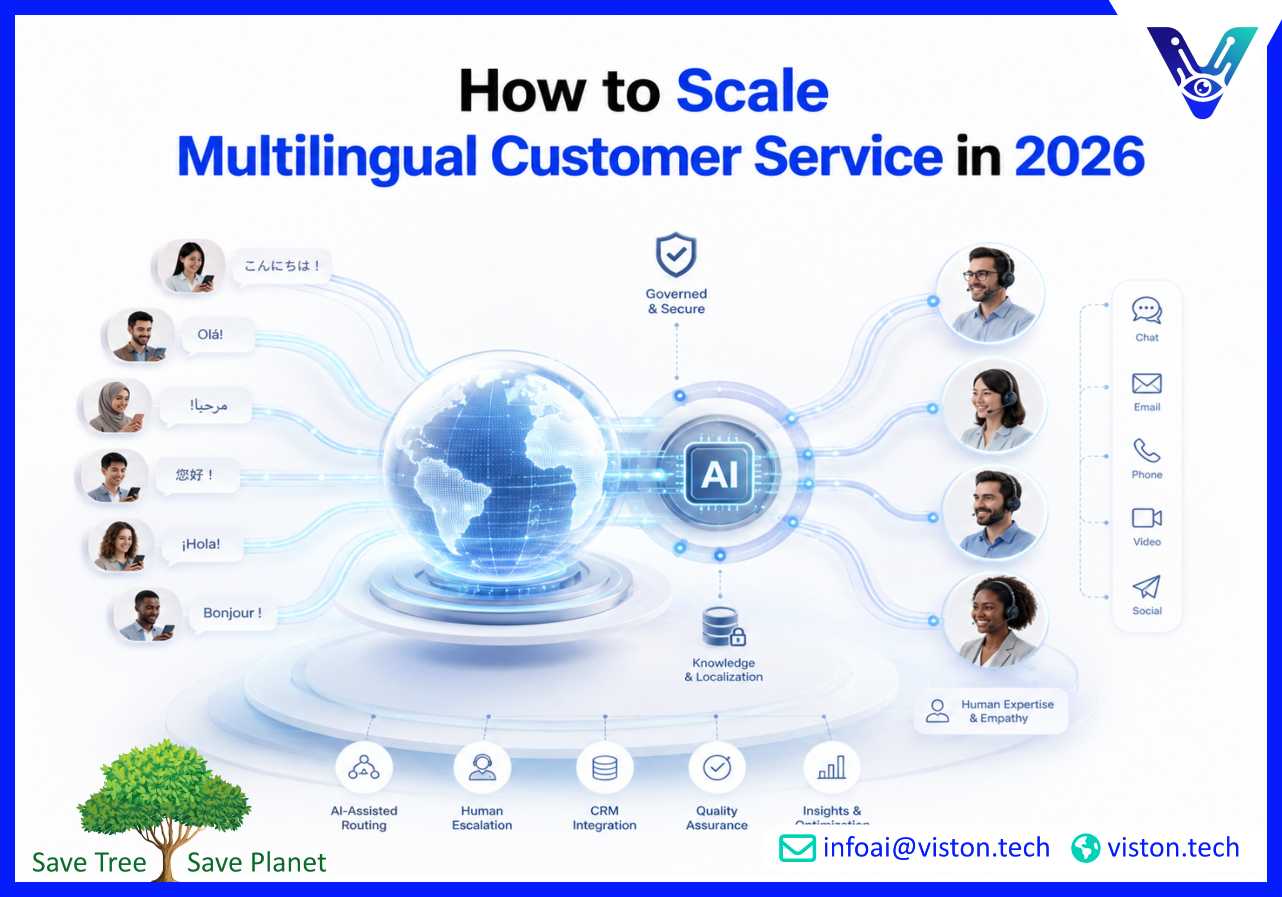
How to Scale Multilingual Customer Service in 2026
Learning how to scale multilingual customer service is essential when customer demand expands faster than language-specific hiring. The goal is not to translate every message manually. It is to build a controlled service model that combines localized knowledge, AI-assisted automation, skilled human support, connected systems, and language-level quality measurement.
What Scaling Multilingual Customer Service Really Requires
Scaling multilingual customer service means increasing language coverage and conversation capacity without allowing accuracy, response time, brand consistency, security, or customer trust to decline. It is an operating-model challenge as much as a translation challenge.A business can translate a help article in minutes, yet still fail customers if policies are inconsistent, agents cannot access account context, or automated answers are not tested in each language. Sustainable scaling therefore depends on four foundations: demand-based language prioritization, governed knowledge, appropriate automation, and reliable human escalation.
Prioritize languages using commercial and service data
Do not begin with a target such as “support every major language.” Start by identifying where language barriers create measurable friction. Review customer locations, browser and device language, sales enquiries, support tickets, abandoned conversations, refund requests, account growth, and expansion plans.Classify languages into service tiers. A primary tier may include full support across chat, email, help centre, and phone. A second tier may offer chat, email, and localized self-service. Emerging languages may initially receive translated digital support with defined escalation. This prevents the organization from promising a service level it cannot maintain.
Define scope before adding capacity
For each language, document supported channels, operating hours, expected response times, eligible topics, escalation paths, and ownership. A company may be able to answer product questions in ten languages but handle contractual disputes in only three. Clear scope protects customers from misleading expectations and helps operations teams allocate specialist coverage.Scaling should also account for dialects, regional terminology, writing systems, cultural conventions, currencies, date formats, and local processes. Treating Brazilian Portuguese and European Portuguese, or Canadian French and French used in France, as interchangeable can create avoidable confusion.
Build a Scalable Multilingual Support Operating Model
The strongest model usually combines centralized governance with distributed language expertise. Central teams own policies, technology, analytics, security, and service standards. Regional or language specialists review terminology, sensitive interactions, and local expectations.
Create one governed source of truth
Before expanding automation, clean the source content. Product information, service policies, troubleshooting steps, returns rules, onboarding guidance, and escalation instructions should be accurate in the primary language and owned by named teams.Use a terminology glossary and translation memory for approved product names, technical phrases, regulated wording, and brand language. When the source changes, connected localized content should enter a review workflow. This is more reliable than allowing agents or tools to translate old documents independently.
Use a hybrid workforce rather than one staffing method
Different interactions require different levels of language expertise. Routine enquiries can often be handled through localized self-service or AI-assisted messaging. General support may be served by multilingual agents using approved tools. High-risk matters may require fluent specialists with domain knowledge.
Use automation for repetitive, well-documented, low-risk enquiries.
Use multilingual agents for contextual service, retention, and relationship-based conversations.
Use subject specialists for legal, financial, medical, safety, fraud, or complex technical cases.
Use native-language reviewers for quality assurance, terminology, and cultural suitability.
This tiered approach expands capacity without treating every interaction as identical. It also gives employees a clear route for escalating cases when translation confidence or business risk is uncertain.
Design follow-the-sun coverage carefully
Global support can distribute work across time zones, but handovers must preserve context. Customer identity, language preference, intent, sentiment, actions already taken, relevant records, and promised next steps should move with the conversation. Without structured handover data, customers repeat themselves and efficiency gains disappear.
Use Automation and Integrations to Increase Language Capacity
AI can help scale multilingual customer service, but it should operate inside defined workflows. The most useful systems detect language, identify intent, retrieve approved knowledge, translate or generate an appropriate response, complete permitted actions, and escalate when confidence or authority is insufficient.
Automate high-volume intents first
Good starting points include order tracking, appointment confirmation, account access, opening hours, subscription guidance, delivery updates, product availability, basic troubleshooting, and help-centre navigation. These use cases have clear outcomes and can be tested against known answers.Avoid beginning with complaints, negotiations, legal requests, complex refunds, safety concerns, or decisions that materially affect a person. These cases need stronger controls and human judgment. In markets covered by the EU AI Act, customers should be informed when they are interacting with an AI system; the Act’s transparency rules take effect in August 2026.
Connect conversations to operational systems
A multilingual chatbot is more useful when it can securely access the same context as the service team. Integration with CRM, helpdesk, ecommerce, billing, booking, order management, identity, and knowledge platforms allows the system to answer account-specific questions and complete approved tasks.Integration also improves human handover. Instead of forwarding a translated sentence, the system can create a ticket with the original message, translated summary, detected intent, customer record, conversation history, and recommended queue. Agents can then act without reconstructing the case.
Build guardrails around generated responses
Multilingual AI should retrieve from approved sources, respect user permissions, preserve required disclosures, and avoid inventing policy. Set confidence thresholds by language and intent. When the system cannot verify an answer, it should ask a clarifying question or transfer the conversation rather than produce a fluent but uncertain response.Security controls should cover data minimization, encryption, access management, retention, audit logs, and vendor handling of conversation data. Requirements may differ by geography and sector, so the support architecture should be configurable rather than built around one universal policy.
Measure and Improve Multilingual Service by Language
Aggregate support metrics can hide weak language performance. An excellent English experience may compensate statistically for poor results in lower-volume languages. Every supported language needs its own quality view.
Track operational and customer outcomes
Useful measures include first-response time, resolution rate, repeat-contact rate, self-service completion, fallback rate, escalation rate, customer satisfaction, translation correction rate, average handling time, and workflow success. Review these by language, region, intent, channel, and automation type.Cost should also be measured by resolved outcome, not merely by conversation. A cheap automated interaction is not efficient when it causes repeat contact, an incorrect refund, or avoidable churn. Combine cost per resolution with satisfaction and quality indicators.
Test with real native-language conversations
Translated test scripts are not enough. Customers use slang, abbreviations, spelling errors, mixed languages, regional terms, and incomplete sentences. Build evaluation sets from representative, privacy-safe conversations and have fluent reviewers assess meaning, tone, accuracy, and task completion.Test language detection, knowledge retrieval, form fields, links, right-to-left layouts, attachments, agent handover, and system actions. Voice channels also require testing for accents, background noise, names, numbers, and confirmation of critical details.
Create a continuous improvement cycle
Review failed conversations regularly. Categorize each failure as missing knowledge, poor translation, incorrect intent, weak workflow design, integration error, unavailable language coverage, or inappropriate automation. Assign an owner and track whether the correction improved later outcomes.As demand grows, expand in controlled stages. Add new intents within proven languages before opening many languages at once, or introduce a new language with a limited set of well-tested use cases. Both approaches are safer than uncontrolled expansion.
How Viston AI Helps Businesses Scale Multilingual Customer Service
Viston AI provides Multilingual AI Chatbot Support for organizations that need to manage customer conversations across languages, channels, and operational systems. Its published capabilities include multilingual natural-language processing, real-time translation and localization, omnichannel deployment, intelligent routing, performance analytics, and integration with CRM platforms, knowledge bases, transaction systems, and other business applications.These capabilities are relevant because scalable multilingual service depends on more than the number of languages a tool can process. The customer experience must connect with approved knowledge, account context, workflow rules, human specialists, and measurable outcomes.A practical Viston AI engagement can support language and use-case discovery, knowledge preparation, conversation and escalation design, system integration, deployment across digital channels, and ongoing performance optimization. This approach can help ecommerce companies, SaaS providers, financial services teams, healthcare organizations, manufacturers, travel businesses, and other global operators manage routine demand while preserving human oversight for complex cases.Viston AI’s service positioning also includes language-specific analytics and centralized orchestration across web chat, mobile apps, WhatsApp, SMS, voice assistants, and social channels. For businesses expanding internationally, that structure can provide a more controlled path from limited translated support to an integrated multilingual service operation.
Frequently Asked Questions
What is the first step in scaling multilingual customer service?
Start with demand analysis. Identify which languages generate the most revenue opportunity, service volume, unresolved issues, or customer friction. Then define a realistic service tier for each priority language.
Do businesses need native-speaking agents for every language?
No. Localized self-service, AI-assisted translation, multilingual agents, and centralized specialists can cover many interactions. Native or fluent reviewers remain important for sensitive cases, cultural nuance, terminology, and quality assurance.
Which multilingual enquiries should be automated first?
Begin with repetitive, low-risk, well-documented requests such as order tracking, account access, booking confirmations, product information, subscription guidance, and standard troubleshooting.
How can a company maintain quality across many languages?
Use governed source content, approved glossaries, language-specific testing, confidence thresholds, clear escalation, native-language review, and separate performance reporting for each language.
What technology is needed to scale multilingual support?
Common components include a helpdesk or CRM, localized knowledge base, translation or multilingual AI layer, language-aware routing, analytics, workflow automation, secure integrations, and quality-monitoring tools.
Can Viston AI support phased language expansion?
Yes. Its multilingual chatbot, integration, routing, omnichannel, and analytics capabilities align with phased rollouts that begin with priority languages and high-value use cases, then expand according to demand and measured performance.
Conclusion
Knowing how to scale multilingual customer service means building a dependable operating model, not simply adding translation. Businesses need to prioritize languages using evidence, govern source content, combine automation with qualified people, integrate support channels with core systems, and measure quality separately for every language. A phased Multilingual Support strategy reduces operational risk while creating room for international growth. Viston AI offers relevant chatbot, localization, routing, integration, and analytics capabilities for organizations seeking a structured way to serve customers across languages without losing consistency, context, or control.