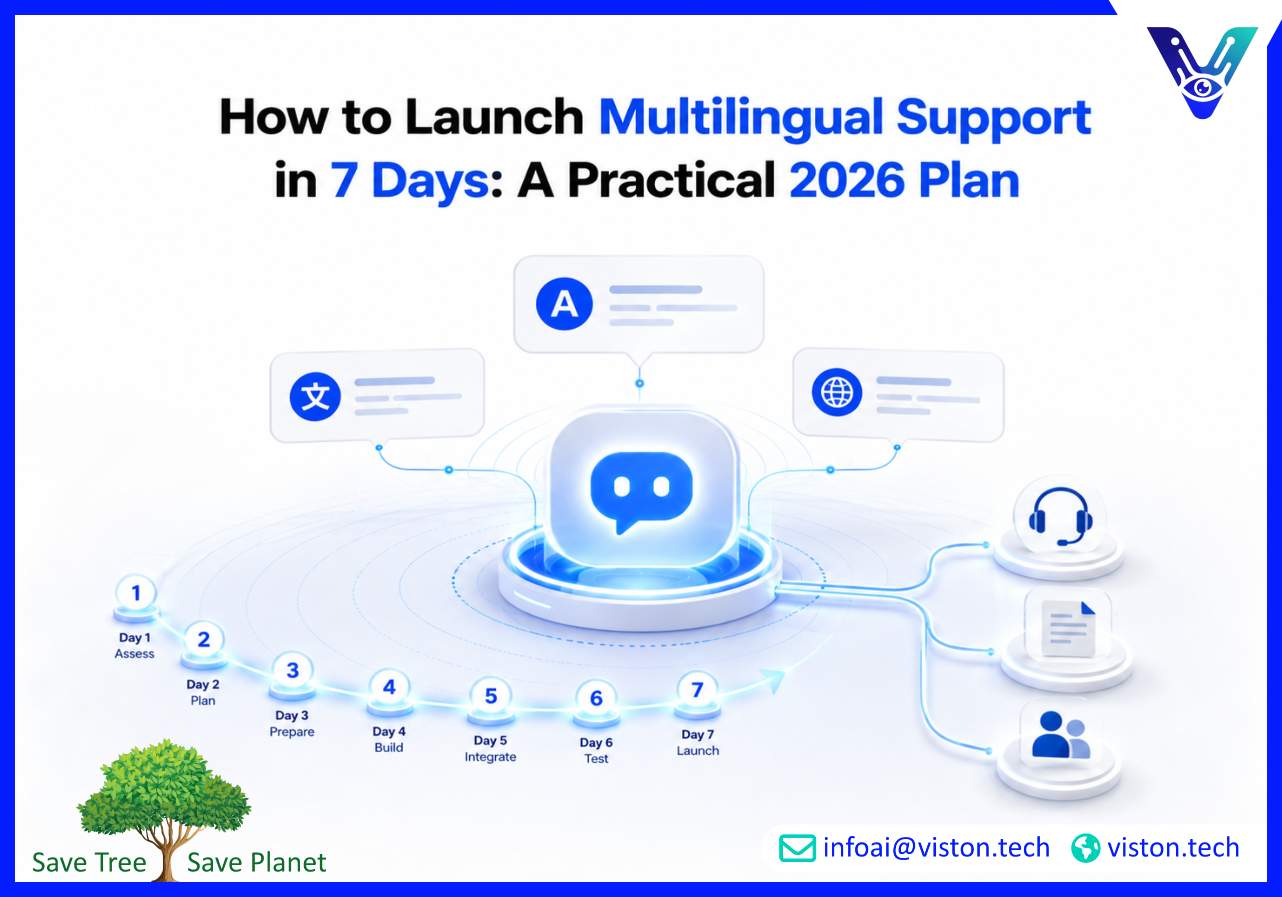
How to Launch Multilingual Support in 7 Days: A Practical 2026 Plan
Learning how to launch multilingual support in 7 days is less about translating everything and more about creating a controlled, useful first release. With focused language selection, approved knowledge, AI-assisted workflows, human escalation, and clear quality checks, global businesses can begin serving priority customers quickly without compromising accuracy or trust.
What a Seven-Day Multilingual Support Launch Should Achieve
A seven-day launch should be treated as a minimum viable multilingual support programme, not a complete global transformation. The objective is to make a small number of high-value support journeys available in selected languages, connect them to existing service operations, and establish a reliable process for learning and expansion.A full programme may include local-language agents, translated help centres, voice support, regional service levels, localized policies, and formal quality assurance. Building everything in one week often creates inconsistent answers, weak escalation paths, and poor reporting.A realistic seven-day launch should deliver:
Two or three priority languages selected from real customer demand
A defined set of high-volume, low-risk support intents
Approved multilingual answers for those intents
Automatic language detection or clear language selection
A human handover route for complex or sensitive conversations
Basic reporting by language, intent, resolution, and escalation
A documented plan for improvement after launch
Choose the right operating model
Most businesses should use a hybrid model in 2026. AI can handle language detection, first-line answers, translation assistance, routing, and repetitive workflows, while trained people manage complaints, exceptions, regulated topics, negotiation, and emotionally sensitive cases. This approach provides speed without pretending automation can safely resolve every issue.The operating model should reflect channel needs. Website chat is suitable for an early pilot because conversations are easy to monitor. Email allows time to review translated replies. Voice is more complex because pronunciation, accents, latency, and real-time escalation require additional testing. Begin with the channels that are easiest to control.
Days 1–2: Define Scope, Languages, Content, and Risk
Day 1: Prioritize languages using evidence
Do not select languages simply because they are widely spoken. Use support tickets, website analytics, customer locations, sales pipeline data, product usage, failed searches, and market expansion plans. The best first languages are those where demand is visible and where better support can improve retention, conversion, onboarding, or operational efficiency.For each language, define the audience, channel, expected volume, service hours, and business objective. Terminology and escalation rules may differ by market and customer type, so language coverage must reflect customer context rather than a generic translation layer.
Day 1: Select launch-ready intents
Choose approximately 10 to 20 common intents that are frequent, predictable, and supported by approved information. Examples include account access, order status, delivery questions, product setup, appointment scheduling, basic troubleshooting, subscription information, and ticket creation.Exclude high-risk scenarios from automatic resolution during the first release. Legal complaints, financial decisions, medical guidance, identity disputes, fraud reports, safety issues, complex cancellations, and contractual interpretation should be routed to qualified people unless the business has already designed and validated a controlled workflow.
Day 2: Prepare a trusted source of truth
Multilingual support is only as reliable as the knowledge behind it. Gather the current policies, product instructions, service processes, troubleshooting guides, pricing rules, and escalation criteria needed for the selected intents. Remove duplicate or outdated material and identify an owner for each source.Create an approved answer set in the organization’s strongest operational language before localizing it. Each answer should explain the issue clearly, state any conditions, provide the next step, and identify when escalation is required. This reduces the risk of translating inconsistent source content.
Day 2: Create a lightweight language and style guide
A practical guide should cover preferred terminology, product names, tone, formality, prohibited wording, date and number formats, regional variations, and words that should remain untranslated. It should also define how the support experience handles code-switching, where customers combine languages in one message.Review privacy and compliance requirements before sending customer data to translation or AI systems. Define permitted data, storage, transcript access, retention, and restricted conversations. Because requirements vary by market, legal and security owners should approve the pilot boundaries.
Days 3–5: Configure, Integrate, Translate, and Test
Day 3: Build the multilingual workflow
Configure the support entry point to detect language automatically or allow customers to choose it. Automatic detection is convenient, but the customer should be able to correct the choice. The workflow should preserve the selected language throughout the conversation and carry it into the ticket, CRM record, or agent queue.Connect only the systems required for the pilot. This may include a helpdesk, CRM, knowledge base, order platform, scheduling tool, or customer identity service. Limit permissions to the minimum needed. A support assistant that only answers FAQs should not receive broad access to customer or financial records.Define confidence thresholds and fallback behaviour. When the system cannot identify the intent, retrieve a trusted answer, or complete an action safely, it should ask a clarifying question or escalate. It should never hide uncertainty behind fluent language.
Day 4: Localize answers, not just words
Machine translation can accelerate the first draft, but customer-facing content still requires review for meaning, terminology, tone, and regional relevance. Literal translation may fail when a phrase contains idioms, product-specific language, culturally sensitive wording, or policy terms with precise meanings.Use a qualified reviewer for each launch language where possible. The reviewer should test whether the response sounds natural, preserves the original policy, and gives an actionable next step. For lower-volume languages where full human review is not immediately available, narrow the scope further and route uncertain conversations to human support.Localize templates for greetings, apologies, waiting messages, consent statements, confirmation messages, handovers, and closure. Customers notice inconsistency when the main answer is localized but system messages remain in another language.
Day 5: Run structured testing
Testing should include more than perfect example questions. Use misspellings, slang, short messages, long messages, mixed languages, indirect requests, regional vocabulary, and repeated questions. Check whether the system understands intent, retrieves the correct source, keeps context, and escalates appropriately.Create a test sheet covering the expected answer, source, permitted action, escalation, and result. Test each language separately because performance in one does not prove equivalent quality in another.Also test unavailable integrations, missing records, duplicate tickets, unsupported languages, and out-of-hours handovers. Customers should receive a clear explanation and safe next step rather than a broken conversation.
Days 6–7: Pilot, Launch, Monitor, and Improve
Day 6: Run a controlled internal or limited-customer pilot
Release the service to employees, one customer segment, one region, or a small percentage of traffic. Review real task transcripts for accuracy, tone, privacy exposure, unnecessary escalation, and failed workflows.Before public launch, confirm ownership. Someone must monitor alerts, approve content changes, handle escalations, review language quality, and pause automation when a serious issue appears. A multilingual support system without operational ownership can deteriorate quickly even when the technology works.
Day 7: Go live with visible boundaries
Tell customers which languages, channels, and hours are supported. Do not imply full native-agent coverage if the experience is AI-assisted or limited to selected topics. Clear expectations build more trust than broad promises that the service cannot consistently meet.Keep the initial launch focused and track performance by language. Useful measures include:
Conversation and ticket volume by language
Intent recognition and answer accuracy
Self-service resolution and completion rate
Fallback, abandonment, and escalation rate
Customer satisfaction by language
Human handover quality and response time
Workflow success and CRM or helpdesk update accuracy
Review failed conversations daily during the first week after launch. Group problems into missing content, poor translation, unclear intent, integration failure, routing error, or unsupported request. Fixing these categories systematically is more effective than rewriting isolated answers without understanding the cause.
Plan the next 30 days before launch day ends
The seven-day launch creates a foundation, not a finished programme. Next, expand knowledge coverage, improve weak intents, add languages based on demand, and formalize quality assurance. Establish recurring reviews for content freshness, security, regional policy changes, and model performance.Scale only when the pilot shows stable accuracy, reliable handovers, and measurable customer value. Adding languages too quickly multiplies content, testing, and governance requirements. A disciplined expansion sequence protects service quality while allowing global coverage to grow.
How Viston AI Supports a Fast Multilingual Support Launch
Viston AI provides multilingual AI chatbot support as part of its broader conversational AI and business integration services. Its published capabilities include multilingual customer interactions, natural language processing, real-time translation and localization, omnichannel deployment, intelligent routing, analytics, and integration with business systems. These capabilities are directly relevant to organizations building a controlled multilingual support pilot.For a seven-day launch, the practical value is not simply access to translation technology. The work involves selecting priority intents, structuring trusted knowledge, configuring language detection, designing safe fallbacks, connecting the support workflow to existing systems, and measuring performance by language. Viston AI’s service positioning around multilingual chatbots, enterprise integrations, workflow automation, and ongoing monitoring aligns with those implementation needs.Global organizations can use this approach to begin with a narrow web chat, messaging, or helpdesk use case and then expand after evidence shows that the experience is accurate and operationally sustainable. Where conversations involve sensitive, regulated, or high-value decisions, the deployment should retain human escalation and market-specific review. This creates a practical balance between rapid implementation, scalable automation, and responsible customer service.
Frequently Asked Questions
Can a business genuinely launch multilingual support in seven days?
Yes, but the first release should be limited. A business can launch selected languages, channels, and low-risk support intents in seven days when source content is ready, integrations are manageable, and reviewers are available. A complete global support operation usually requires a longer phased programme.
How many languages should be included in the first launch?
Most businesses should begin with two or three languages supported by clear customer demand. Starting small makes it easier to review translations, test workflows, monitor quality, and correct issues before expanding.
Should multilingual support use AI, human agents, or both?
A hybrid model is usually the strongest option. AI can handle detection, routine questions, translation assistance, and routing, while human agents manage complex, sensitive, regulated, or low-confidence conversations.
What content should be translated first?
Translate content linked to the highest-volume support needs: core FAQs, account access, onboarding, order or service status, basic troubleshooting, ticket creation, escalation messages, and essential policy explanations. Review the source content before translation.
How should multilingual support quality be measured?
Measure accuracy, resolution, fallback rate, escalation, customer satisfaction, response time, workflow completion, and handover quality by language. Reviewing only total conversation volume can hide poor experiences in individual markets.
Can Viston AI help with a multilingual support pilot?
Viston AI offers multilingual AI chatbot support, NLP, localization, routing, analytics, and business-system integration capabilities that are relevant to designing and expanding a multilingual support pilot. The final scope should be based on the organization’s languages, channels, data requirements, and risk profile.
Conclusion
Knowing how to launch multilingual support in 7 days helps businesses move quickly without confusing speed with completeness. The strongest approach is a focused pilot built around priority languages, approved knowledge, safe automation, human escalation, integration testing, and language-level reporting. In 2026, effective multilingual support must be accurate, transparent, secure, and operationally owned. Viston AI offers relevant multilingual support and conversational AI capabilities for global organizations that want to establish a practical first release and then scale it through measured, evidence-based improvement.