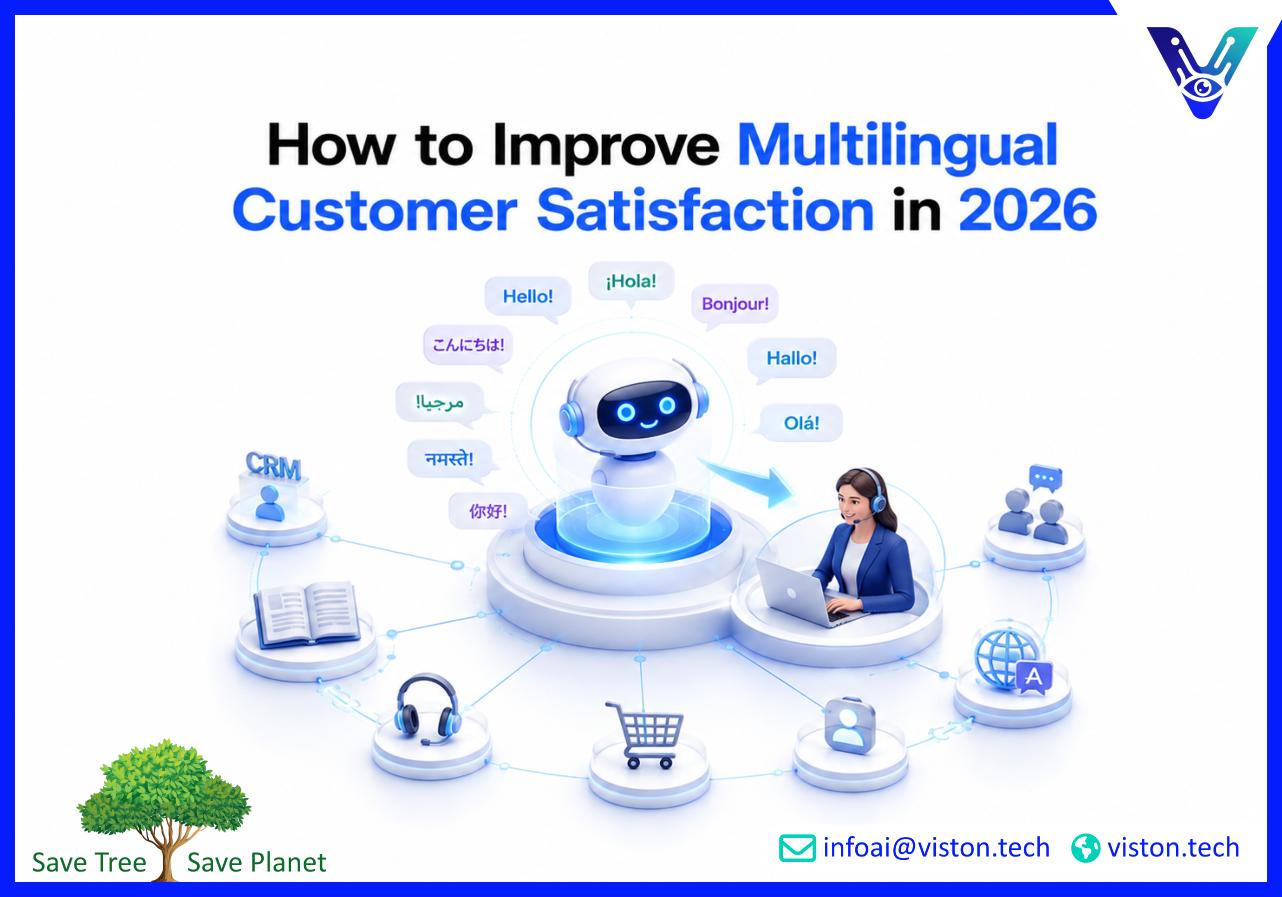
How to Improve Multilingual Customer Satisfaction in 2026
To improve multilingual customer satisfaction, businesses must do more than translate replies. Customers expect accurate answers, natural language, consistent policies, fast resolution, and easy access to a human when automation is not enough. In 2026, strong multilingual support depends on localized knowledge, connected systems, quality controls, and language-specific performance management.
What Multilingual Customer Satisfaction Means in Practice
Multilingual customer satisfaction reflects how well a business serves customers across different languages without creating a lower-quality experience for people who do not use the company’s primary language. The goal is not identical wording in every market. It is an equally reliable outcome: the customer understands the answer, completes the task, trusts the information, and knows what will happen next.A translated message can still fail if it uses the wrong product terminology, ignores regional expectations, or does not match the customer’s account. For example, a fluent response about returns is not useful when it quotes the wrong policy for the customer’s country. A polite chatbot response is not satisfactory if it cannot access order status, subscription details, or previous support history.
Customers judge the complete support journey
Satisfaction is shaped by every stage of the interaction. Customers notice whether they can find help in their preferred language, whether the terminology feels natural, whether answers remain consistent across email and chat, and whether a human agent receives the conversation context after escalation.Operational details also affect trust:
Dates, currencies, measurements, names, and addresses are formatted correctly.
Product names and technical terms are translated consistently.
Local policies, delivery rules, payment methods, and service hours are accurate.
The tone matches the seriousness of the issue and the expectations of the market.
Customers do not have to repeat their problem after changing channels or agents.
Language quality matters, but resolution quality matters more.
Why Multilingual Customer Satisfaction Often Declines
Most multilingual service problems are not caused by one poor translation. They usually come from gaps between content, technology, workflows, and ownership. A company may offer several languages publicly while its knowledge base, escalation process, and back-office systems remain designed for one language.
Inconsistent or outdated source content
Translation cannot repair unclear source material. When policies, product instructions, and internal procedures conflict, every supported language inherits the problem. Teams may translate an old help article while agents use a newer internal rule, leading to different answers for the same question.A reliable program begins with approved source content and named owners. Each policy, workflow, and help article should have a review date. High-impact information such as pricing, refunds, account access, warranties, eligibility, and compliance guidance needs tighter control than general marketing content.
Overreliance on literal machine translation
Machine translation is useful for speed and coverage, but literal output can misread idioms, technical language, abbreviations, sentiment, or culturally sensitive wording. Quality may also vary by language pair and use case. A system that performs well for routine English-to-Spanish questions may be less reliable for specialist terminology or a lower-resource language.Set quality controls according to risk. Routine enquiries may suit automation, while complaints, contract changes, regulated guidance, safety matters, and high-value disputes need stronger review.
Poor intent recognition and missing context
A multilingual chatbot may identify the language correctly but misunderstand the customer’s goal. Words used for cancellation, renewal, delivery failure, or account closure can vary by region and customer segment. If training examples are based only on polished translations, the system may struggle with real messages containing spelling errors, mixed languages, local expressions, or incomplete sentences.The support system should also use permitted customer context such as account, order, product, location, and prior interactions. Without context, customers receive generic information instead of a relevant resolution.
Weak escalation and fragmented channels
Automation damages satisfaction when it delays access to a person. Customers should be able to escalate after repeated failure, negative sentiment, urgent language, or a high-risk request. The receiving agent needs the original message, translated summary, detected intent, customer details, and actions already attempted.Fragmented channels create another common problem. A customer may start in web chat, continue by email, and finish through a phone call. If language preference and conversation history do not move with the customer, the experience feels disconnected and repetitive.
How to Improve Multilingual Customer Satisfaction
The strongest improvements come from combining language quality with operational design. Businesses should begin with the customer journeys that generate the greatest demand, frustration, or commercial value, then expand coverage in controlled stages.
Prioritize languages using customer evidence
Choose languages based on support tickets, customer locations, browser settings, sales enquiries, product usage, conversion data, refunds, and abandoned conversations. Market size alone is not enough. A smaller customer segment with high support demand may require attention before a larger market that already communicates comfortably in the primary language.Define what “supporting a language” means across self-service, chat, email, voice, and live-agent workflows. Clear service levels prevent unrealistic expectations.
Build a localized knowledge foundation
Create an approved knowledge base before scaling automation. Localize complete customer journeys rather than isolated sentences. Onboarding, billing, troubleshooting, returns, cancellations, delivery, account security, and escalation instructions should use consistent terminology and reflect regional rules.Maintain a multilingual glossary for product names, feature labels, industry terms, tone, and words that should remain untranslated. This keeps human and automated responses consistent.
Combine automation with human judgment
AI can provide instant language detection, translation, intent classification, knowledge retrieval, conversation summaries, and routine workflow completion. Human agents remain important when the issue involves ambiguity, emotion, negotiation, exceptions, sensitive information, or material consequences.Design confidence thresholds so the system knows when not to answer. A useful multilingual assistant should ask a clarifying question, cite the approved internal source where appropriate, or escalate rather than generate a confident but uncertain response.For organizations serving customers in the European Union, 2026 also brings greater attention to AI transparency. Customers interacting with an AI system should be clearly informed that they are speaking with a machine. Transparent design supports trust and allows the customer to make an informed choice about seeking human assistance.
Connect support to customer and operational systems
Multilingual support becomes more useful when it can access the systems required to complete the customer’s task. Integration with CRM, helpdesk, ecommerce, billing, booking, inventory, and knowledge platforms enables context-aware answers and reduces repetitive questions.Write-back actions such as creating tickets, updating language preference, recording consent, or triggering follow-up should be logged and monitored for failures.
Design language-aware human handovers
Escalation should preserve the customer’s preferred language and the meaning of the original message. Agents need a concise summary, but they should also be able to view the source text when nuance matters. Routing can consider language, subject expertise, urgency, customer value, and agent availability.Translated agent-assist tools can help when a fluent agent is unavailable, but sensitive or complex cases may still require native or specialist review.
How to Measure and Continuously Improve Satisfaction
Overall customer satisfaction can hide serious language-specific problems. Every supported language should be treated as its own service experience, with separate measurement, testing, and improvement priorities.
Track quality by language, channel, and intent
Useful multilingual support metrics include customer satisfaction score, first-contact resolution, self-service resolution, response time, repeat contact, fallback rate, escalation rate, abandonment, translation corrections, and human handover quality. Segment these measures by language, market, channel, and enquiry type.Do not optimize one metric in isolation. High automation is not valuable when customers reopen cases, and low escalation may simply mean customers cannot reach a person.
Review real conversations with native-language expertise
Automated dashboards reveal patterns, but qualitative review explains why they occur. Sample successful, failed, escalated, and low-satisfaction conversations in each language. Native or fluent reviewers should assess accuracy, tone, cultural fit, terminology, compliance, and whether the resolution was practical.Feedback should feed into knowledge updates, intent examples, routing rules, prompt design, agent training, and workflow changes. Review new product launches, policy changes, seasonal campaigns, and market expansions before they create large volumes of multilingual enquiries.
Create a clear governance cycle
Assign owners for source content, translations, language models, integrations, analytics, privacy, and escalation policy. Establish regular reviews for content accuracy, access permissions, data retention, failed automations, and customer feedback.Validate releases with natural phrasing, mixed-language input, spelling variations, regional vocabulary, and edge cases to detect uneven performance across languages.
How Viston AI Supports Better Multilingual Customer Experiences
Viston AI provides Multilingual AI Chatbot Support for organizations that need to manage customer conversations across languages, channels, and business systems. Its published capabilities include language-aware natural language processing, real-time translation and localization, omnichannel deployment, intelligent routing, performance analytics, and integration with CRM platforms, knowledge bases, transaction systems, and other business applications.These capabilities are relevant to customer satisfaction because multilingual service quality depends on more than translating the final response. A practical solution must understand intent, retrieve approved knowledge, use permitted customer context, complete workflows, and transfer complex cases to the right human team without losing conversation history.Viston AI’s delivery approach covers discovery, data preparation, model selection, testing, integration, deployment, monitoring, and continuous optimization. This supports phased rollouts in which a business begins with priority languages, high-volume enquiries, and selected channels before expanding based on measured demand and performance.For ecommerce, SaaS, financial services, healthcare, travel, retail, and other customer-facing organizations, the value lies in creating a controlled multilingual support operation. Language-specific analytics, contextual automation, routing, and ongoing model improvement can help teams reduce friction while maintaining oversight of accuracy, security, compliance, and escalation quality.
Frequently Asked Questions
What is the fastest way to improve multilingual customer satisfaction?
Start with the highest-demand languages and the most common customer problems. Localize approved help content, improve routing, and automate low-risk enquiries while keeping clear human escalation for complex or sensitive cases.
Is translation software enough for multilingual customer support?
No. Translation software can help with speed, but effective multilingual support also requires accurate source content, customer context, workflow integration, cultural localization, quality assurance, security controls, and trained human escalation.
How can AI improve multilingual customer satisfaction?
AI can detect language, classify intent, retrieve localized knowledge, translate conversations, personalize responses, summarize cases, and automate routine workflows. It performs best when connected to trusted data and governed by confidence thresholds and human oversight.
Which multilingual support metrics matter most?
Track customer satisfaction, first-contact resolution, repeat contact, fallback rate, escalation rate, response time, abandonment, translation corrections, and workflow success. Review each metric separately by language and channel.
Should every language receive the same support model?
Not necessarily. Service design should reflect demand, risk, channel preference, agent availability, and commercial value. One language may receive full live-agent coverage while another begins with localized self-service and translated escalation.
Can Viston AI integrate multilingual support with existing systems?
Viston AI publishes multilingual chatbot integration capabilities for CRM, knowledge, transaction, analytics, and other business platforms. Integration can provide customer context, support workflow completion, and preserve data across languages and channels.
Conclusion
Businesses improve multilingual customer satisfaction by combining accurate localization with dependable service operations. The priorities are clear: select languages using real demand, maintain trusted knowledge, connect support to customer systems, automate suitable tasks, and make human help easy to reach. Performance must be measured separately for every language because a strong result in one market does not guarantee quality in another. In 2026, effective Multilingual Support also requires transparent AI use, secure data handling, and continuous quality review. Viston AI offers relevant multilingual chatbot, integration, routing, and analytics capabilities for organizations building a scalable, customer-focused support model.