
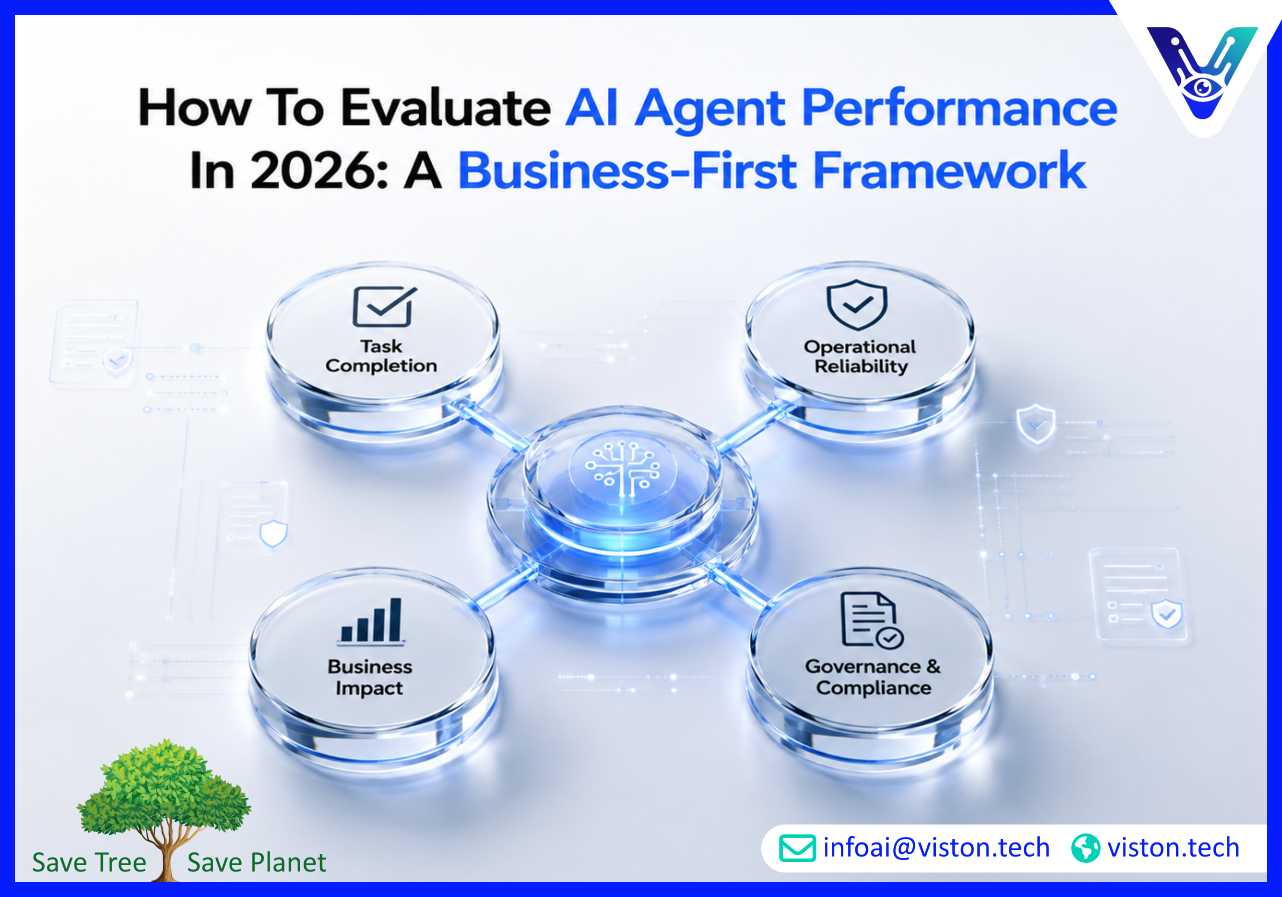
Evaluating AI agent performance has become one of the most critical capability gaps in enterprise technology. As autonomous agents move from experimental pilots into production workflows handling customer interactions, supply chain decisions, and financial processes, the traditional metrics borrowed from chatbot evaluation no longer work. Business leaders need a structured, outcome-aligned framework that measures what actually matters: task completion accuracy, business impact, operational reliability, and governance compliance.
Most organizations evaluating AI agent performance fall into a common trap. They reach for familiar benchmarks—response latency, token efficiency, user satisfaction scores—and assume these translate into agent quality. They do not. An AI agent is not a chatbot. It is a goal-oriented autonomous system that plans, decides, uses tools, and executes multi-step tasks with minimal human intervention.
The fundamental shift in 2026 is that agents operate within business processes, not isolated chat interfaces. Evaluating an agent that processes insurance claims requires a completely different measurement framework than evaluating one that generates marketing copy. Accuracy alone is insufficient. The agent must demonstrate reliability across hundreds of similar tasks, maintain compliance with regulatory requirements, handle edge cases gracefully, and produce auditable decision trails.
Companies that continue using surface-level metrics will find themselves with agents that score well on dashboards but fail in production. The evaluation framework must match the operational reality.
A rigorous evaluation methodology for deployed AI agents rests on four interconnected measurement dimensions. Each pillar addresses a different stakeholder concern and together they form a complete picture of whether an agent is genuinely ready for business-critical work.
The most fundamental metric is whether the agent actually completes its assigned tasks correctly. This sounds obvious, yet many evaluation frameworks skip straight to efficiency metrics before verifying baseline accuracy.
Task completion evaluation should measure three levels. First, binary completion rate tracks whether the agent reaches the intended end state. An accounts payable agent either successfully processes the invoice or it does not. Second, partial completion quality assesses how well the agent handles tasks that require multi-step reasoning, tool calls, and conditional logic. Did it follow the correct sequence? Did it recover from intermediate failures? Third, goal alignment accuracy checks whether the completed task actually satisfies the original business objective, not just the literal instruction.
In production environments, task completion must be measured against a representative distribution of real workloads. Testing agents against curated benchmark datasets creates a dangerous illusion of capability. The evaluation set needs to include edge cases, ambiguous inputs, conflicting instructions, and scenarios the agent was not explicitly trained on.
Task completion is necessary but insufficient. An agent that succeeds 95% of the time but fails unpredictably on the remaining 5% creates unacceptable business risk. Operational reliability measures how consistently the agent performs across varied conditions over time.
Key reliability indicators include performance variance across workload types, degradation patterns under increased task complexity, and recovery behavior when tool calls fail or external APIs return errors. A well-built agent should degrade gracefully—pausing, requesting clarification, or escalating to a human operator—rather than continuing with corrupted context or hallucinated information.
Businesses deploying agents in regulated industries in India must pay particular attention to reliability under compliance constraints. An agent processing GST-related financial data cannot have intermittent failures that create audit gaps. Continuous monitoring with automated alerting on reliability degradation has become standard practice for production agent deployments in 2026.
Technical metrics must translate into business outcomes. The evaluation framework needs to connect agent performance directly to operational KPIs that executives and budget holders care about.
Business impact assessment maps agent tasks to measurable process improvements: reduction in processing time for customer onboarding, decrease in manual review hours for document verification, increase in first-contact resolution for support workflows, and direct cost savings from automated decision-making. The most sophisticated evaluation approaches measure net business throughput improvement—accounting for both the automation gains and the human oversight costs that agent deployments introduce.
A common oversight is failing to measure the cost of agent errors. Every incorrect task completion has a remediation cost, whether it requires human rework, customer compensation, or compliance reporting. The evaluation framework must capture these downstream costs to produce a true ROI picture. An agent with 92% accuracy that generates expensive remediation cases may deliver less net value than an 85% accuracy agent with cheaper failure modes.
The fourth pillar has gained prominence as regulatory frameworks around AI deployment have matured. Evaluating AI agent performance now includes mandatory assessment of governance controls, safety guardrails, and regulatory compliance.
Governance evaluation covers decision auditability—can every agent action be traced back to its reasoning chain and approved tool calls? Policy adherence verifies that the agent respects organizational rules about data handling, access permissions, and escalation thresholds. Safety boundary enforcement tests whether the agent refuses or escalates tasks that fall outside its defined operational scope.
For enterprises operating across multiple jurisdictions, compliance evaluation must address region-specific requirements. Organizations deploying agents in India need to verify alignment with the Digital Personal Data Protection Act requirements around automated decision-making and data processing transparency. The evaluation framework should include regular compliance auditing as a continuous process, not a one-time pre-deployment check.
Translating evaluation principles into operational practice requires deliberate infrastructure and process design. The most effective approaches combine automated testing with human-in-the-loop assessment calibrated to the agent’s risk profile.
An evaluation pipeline should include synthetic scenario testing using generated edge cases that probe specific capability boundaries, production sampling where a statistically significant portion of real agent interactions undergoes human review, and regression testing triggered by any model update, prompt change, or tool configuration modification. The pipeline must run continuously—agent performance is not static and drifts as underlying models, data distributions, and business requirements change.
Evaluation cadence should align with business criticality. Agents handling high-value financial transactions require near-real-time performance monitoring with automated circuit breakers that pause operations if metrics cross defined thresholds. Lower-risk internal productivity agents can operate with daily or weekly evaluation cycles. What matters is that the evaluation infrastructure exists and produces actionable insights, not just historical reports.
Several recurring patterns cause organizations to overestimate their agents’ production readiness. Recognizing these pitfalls helps teams build more honest and useful evaluation processes.
Over-optimizing for demo scenarios remains widespread. Teams tune agent behavior on a small set of showcase tasks that executives see in review meetings, creating impressive demonstrations that mask poor generalization to real workload diversity. The evaluation set must be systematically constructed from production data distributions, not hand-picked success cases.
Ignoring human-agent interaction quality is another frequent gap. Many agent deployments include handoff points where human operators review, approve, or override agent decisions. If the agent provides unclear reasoning, incomplete context summaries, or poorly structured recommendations, the human review process becomes slow and error-prone. Agent evaluation must measure the quality of these collaboration touchpoints.
Treating evaluation as a pre-deployment gate rather than a continuous process leads to production surprises. Agent performance evolves with model provider updates, changing business data, and accumulated context drift. The evaluation framework must be a living system that runs alongside production operations indefinitely.
Viston AI builds agent evaluation directly into the development and deployment lifecycle for every AI agent solution delivered to enterprise clients. The company’s approach reflects years of hard-won experience moving agents from promising prototypes into reliable production systems that businesses depend on daily.
Viston AI’s evaluation methodology begins during solution design, where the team works with clients to define measurable success criteria mapped to specific business outcomes. Rather than applying generic benchmarks, the evaluation framework is custom-configured for each deployment’s operational context—whether that involves supply chain optimization agents, customer service automation, or internal workflow orchestration. The company maintains dedicated evaluation infrastructure that runs continuous testing against production-representative workloads, generating performance dashboards that give operations teams real-time visibility into agent health.
For enterprises concerned with governance and compliance, Viston AI incorporates audit trail verification, policy adherence testing, and safety boundary validation into standard evaluation workflows. The team’s experience with regulated industry deployments informs evaluation practices that satisfy both operational and compliance stakeholders. Viston AI supports businesses in India and global markets with evaluation frameworks that account for regional regulatory requirements while maintaining consistency across international operations. The company’s focus remains on delivering agents that organizations can trust in production—not just agents that perform well in controlled demonstrations.
Traditional model evaluation focuses on output quality against static test sets—accuracy scores, perplexity, BLEU scores. AI agent evaluation must assess multi-step task execution, tool use proficiency, recovery from failures, and alignment with business objectives. Agents operate in dynamic environments with real-world consequences, requiring evaluation frameworks that measure end-to-end process completion and operational reliability, not just isolated output quality.
Evaluation cadence depends on the agent’s risk profile and business criticality. High-stakes agents handling financial transactions, healthcare decisions, or regulatory processes require continuous monitoring with automated alerts. Moderate-risk agents supporting internal operations can run on daily evaluation cycles. Low-risk experimental agents may operate on weekly reviews. The key principle is that evaluation must be continuous, not a one-time pre-deployment activity.
The most meaningful ROI metrics connect agent performance to business outcomes: reduction in process cycle time, decrease in manual review hours, improvement in task throughput, cost per completed task compared to manual processing, and error remediation costs. Successful evaluation frameworks measure both the automation gains and the oversight costs, producing a net business impact figure that accurately reflects the agent’s economic contribution.
Pre-production reliability testing should use production-representative workload samples that include edge cases, ambiguous inputs, and failure scenarios. Synthetic scenario generation can systematically probe capability boundaries. Staged rollout approaches—starting with shadow mode operation, then limited production with human review, then scaled deployment—allow teams to validate reliability under real conditions while managing risk exposure.
Human evaluators remain essential for assessing output quality on tasks where correctness is nuanced, context-dependent, or requires domain expertise. The most effective evaluation approaches combine automated metrics for scale and consistency with human review for quality assessment and edge case identification. Human evaluation is particularly important for measuring collaboration quality at agent-human handoff points.
Yes. Viston AI develops custom evaluation frameworks as an integrated part of its AI agent development and deployment services. The team works with client stakeholders to define evaluation criteria aligned with specific business processes, operational requirements, and compliance obligations, then builds the monitoring infrastructure to support continuous performance assessment in production.
Evaluating AI agent performance demands a structured business-first approach that goes far beyond technical accuracy metrics. Organizations that invest in comprehensive evaluation frameworks—covering task completion, operational reliability, business impact, and governance compliance—will be the ones that successfully scale agent deployments from pilots to enterprise-wide production systems. The methodology must be continuous, grounded in real workload data, and directly connected to measurable business outcomes. For companies navigating AI agent development and deployment in 2026, building rigorous evaluation capabilities is not optional. It is the foundation of trustworthy, scalable, and defensible agent operations that deliver genuine business value.
