
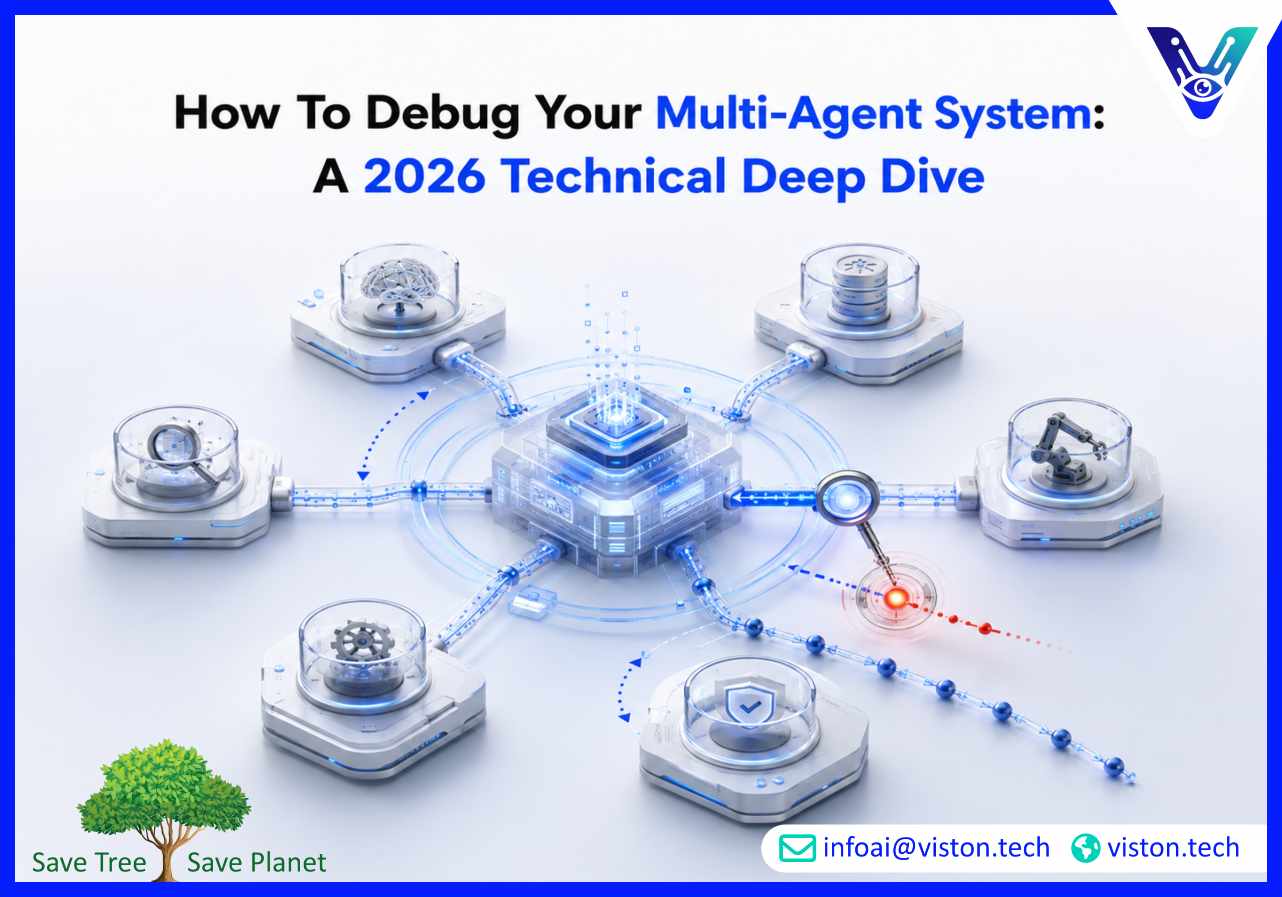
Multi-agent orchestration promises scalability and specialized intelligence, but when dozens of autonomous agents interact, pinpointing the root cause of a failure becomes exponentially harder than debugging monolithic code. In 2026, as enterprise deployments scale from pilot to production, understanding how to systematically debug a multi-agent system is no longer optional—it is a core competency for maintaining reliability and controlling operational costs.
Traditional software debugging relies on deterministic execution paths and breakpoints. Multi-agent systems (MAS) defy this logic. Failures here are often emergent, arising from complex interactions rather than a single line of faulty code. Issues can remain latent for dozens of steps before manifesting as an error, making it difficult to trace the causal chain through long interaction histories .
Furthermore, agents are non-deterministic. The same input can yield different outputs due to the probabilistic nature of Large Language Models (LLMs). This variability turns simple regression testing into a complex statistical challenge. Consequently, logs that simply record “Agent A said X” are insufficient; developers require tools that understand why the agent chose that path and whether the orchestration logic handled it correctly .
Debugging an orchestrated system requires shifting from a code-centric view to a data-flow and conversation-centric view. Here is how experienced teams are tackling this in 2026.
Passive log analysis generates hypotheses but cannot confirm them. The most effective debugging strategy today is intervention-driven. Instead of guessing which agent failed, introduce targeted interventions at specific orchestration points—such as editing an agent’s message or altering its plan mid-execution. If the system recovers, you have isolated the fault . This “active verification” turns debugging from a forensic inquiry into a scientific experiment, reducing the time spent chasing false leads by up to 60% .
In a well-orchestrated system, agents communicate via defined protocols like the Agent-to-Agent (A2A) protocol or the Model Context Protocol (MCP) . When debugging, examine the orchestration layer’s telemetry. Verify that the planner correctly decomposed the user’s goal, that the executor assigned tasks to the correct specialized agents (workers, services, or support agents), and that the state management unit accurately logged context . If an agent receives garbled input, the issue likely resides not in the receiving agent, but in the upstream orchestration logic that failed to translate the state correctly.
2026 has seen the rise of agentic debuggers that control the execution environment actively. Tools like InspectCoder allow developers to set strategic breakpoints within the agent workflow, inspect runtime states, and even perturb variables to see how agents react . This dynamic analysis transforms debugging from blind trial-and-error into a systematic root cause diagnosis, mimicking how a human developer would step through code but scaled for agent interactions .
Observability is the bedrock of debugging. However, you cannot observe what you cannot measure. Standard logs (metrics, events, logs, traces) are insufficient for agentic systems. You require “agentic observability”—a view that captures the reasoning traces and knowledge retrieval steps alongside the raw outputs .
When your system fails, the orchestration layer should provide a knowledge graph visualization of how data flowed between agents. If a fraud detection agent rejects a transaction, the orchestrator must expose which data points (supplied by the retrieval agent) and which policy rules (enforced by the governance agent) triggered the rejection. Without this semantic transparency, you are effectively debugging in the dark .
Not all failures are technical; many are policy violations. In regulated industries (finance, healthcare), an agent might technically succeed in its task but violate a SOX or HIPAA constraint. Debugging these requires analyzing the constraint projection engine within your orchestrator.
Modern orchestration frameworks, such as the Constraint-Aware Multi-Agent Cognitive Orchestration (CAMCO) model, treat policy compliance as a constraint optimization problem . If the system enters a “safe fallback” state or rejects an action, debugging involves checking the Lagrangian utility shaping—did the risk-weighted utility of an action exceed the threshold? This helps distinguish between an agent that cannot perform a task versus an agent being correctly blocked by a guardrail .
At Viston AI, we specialize exclusively in multi-agent orchestration. We do not build generic agents; we build the control planes that make them work together reliably. Our orchestration framework addresses the specific debugging challenges of 2026 by embedding traceability directly into the workflow definition. We utilize a hybrid architecture that separates deterministic execution (80% of tasks) from autonomous reasoning (20%) . This allows our clients to debug with precision: when a non-deterministic error occurs, it is isolated to a specific “reasoning node” rather than cascading through the entire system. We provide comprehensive observability tooling that visualizes inter-agent handoffs, tracks token consumption to identify runaway costs, and enforces policy guardrails automatically. For businesses scaling agentic AI in 2026, Viston AI provides the orchestration expertise to move from “agents that work” to “systems that are debuggable, auditable, and compliant.”
What is the most common cause of failure in multi-agent systems?
The most common failure is “cascading hallucination,” where an early agent’s minor error is amplified by subsequent agents due to a lack of context validation. This is often traced to poor orchestration rather than a single agent’s capability.
How do you debug latency issues in agent workflows?
Latency usually stems from inefficient orchestration logic or blocked communication protocols. Use distributed tracing across your orchestrator to identify if agents are waiting on I/O, stuck in negotiation loops, or suffering from context window overload.
Can I debug a live production multi-agent system without stopping it?
Yes, through “shadow mode” debugging. Viston AI supports sandboxed orchestration where live data is mirrored to a debug environment, allowing you to test interventions on running workflows without impacting production outcomes.
What is the difference between agent errors and orchestration errors?
An agent error is when the LLM fails to perform its specific task (e.g., calculating a sum incorrectly). An orchestration error is when the system fails to route the data correctly, enforce policy, or manage state, even if every individual agent works perfectly.
How important is state management for debugging?
Critical. Most debugging failures in multi-agent systems are actually state management failures. If the orchestrator loses track of an agent’s prior output, downstream agents will operate on stale or missing data.
Debugging a multi-agent system requires a fundamental shift in perspective. You must move beyond viewing agents as isolated code units and start treating the orchestration layer as the system’s operating system. By leveraging intervention-driven validation, dynamic analysis, and policy-aware observability, businesses can transform unreliable agent swarms into predictable, enterprise-grade automations. As you scale your agentic AI initiatives, prioritize the robustness of your multi-agent orchestration—because a chain of agents is only as reliable as the conductor leading them.
