
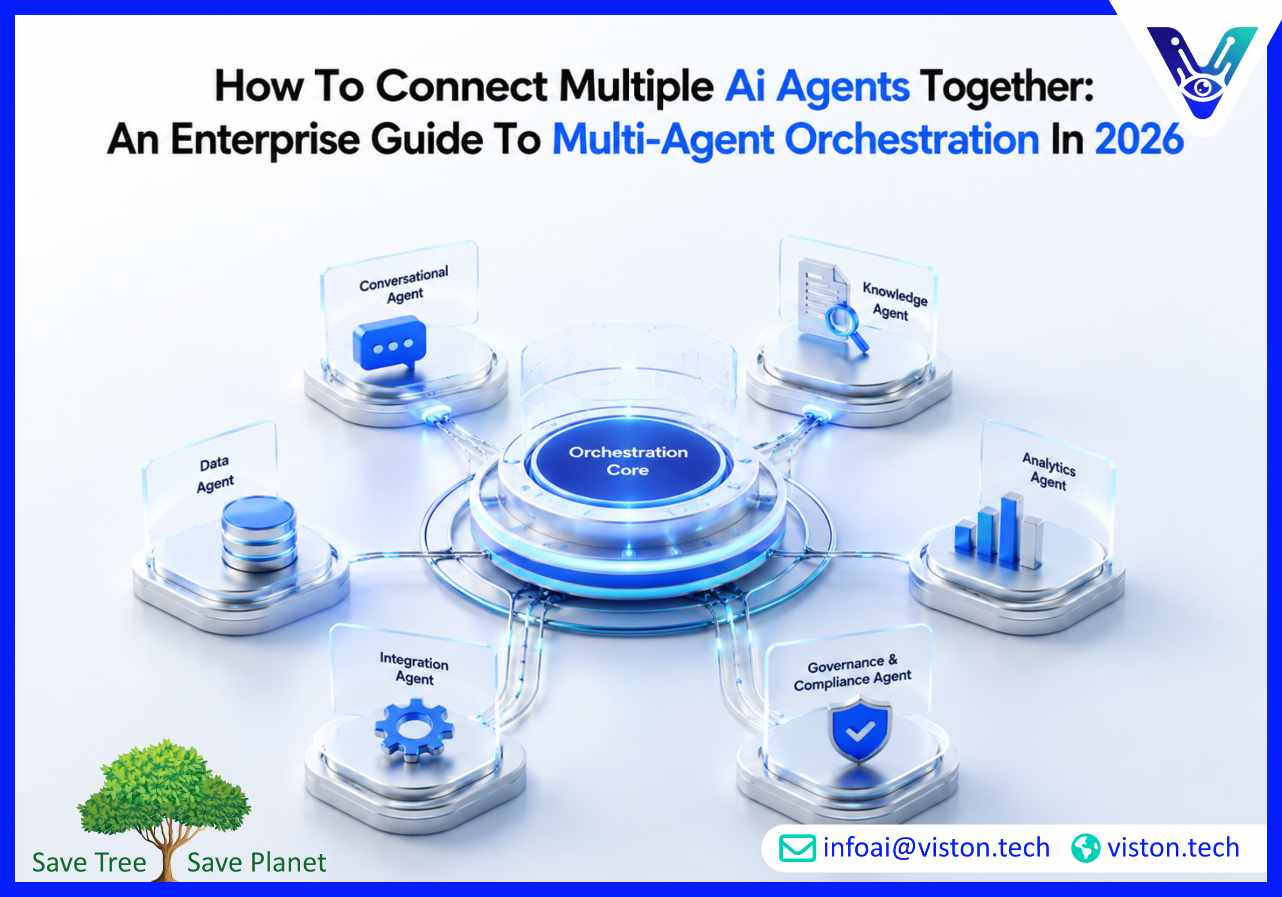
Enterprises that deployed isolated AI agents in 2025 are now discovering a hard limit: a single agent, however capable, cannot manage enterprise complexity alone. The shift from single-purpose assistants to coordinated multi-agent systems represents the single most important architectural decision facing technical leaders in 2026. Connecting multiple AI agents together into a cohesive operational system is no longer experimental—it is a production requirement for organizations serious about scaling AI across workflows, data sources, and business functions.
The single-agent model has a well-documented failure mode. Ask one agent to handle a complex workflow—refreshing a data pipeline, updating compliance documentation, and generating customer-facing reports—and performance degrades as context expands. Research into multi-agent systems confirms that large language models perform worse as context windows grow, not simply from token limits but from declining focus on what matters at any given moment .
Multi-agent architectures solve this through specialization. Instead of one agent doing everything, organizations deploy teams of agents, each with narrow scope and clean context. A research agent investigates without polluting the context of a security reviewer. A validation agent checks work independently. A coordinator agent manages execution without getting lost in implementation details.
By early 2026, the market has responded decisively. The Agent-to-Agent (A2A) Protocol, hosted by the Linux Foundation, has surpassed 150 supporting organizations including AWS, Google, Microsoft, IBM, and Salesforce, with production deployments across supply chain, financial services, insurance, and IT operations . This standardization means organizations can now connect agents built on different frameworks—LangGraph, CrewAI, AutoGen, or proprietary systems—without custom point-to-point integration.
Connecting AI agents together requires understanding three foundational layers: specialized agent roles, an orchestration layer that governs interactions, and standardized communication protocols. Without all three, organizations end up with connected agents that cannot coordinate effectively.
In a production multi-agent system, agents are not generalists. They assume distinct functions. Worker agents execute well-defined tasks such as data extraction, retrieval-augmented generation, or computation. Service agents provide shared operational capabilities including quality assurance, compliance enforcement, and automated recovery. Support agents operate at a supervisory level, monitoring system behavior, analyzing outcomes, and managing data flows that inform orchestration and optimization .
This role differentiation is what enables reliability at scale. When one agent fails, others detect, diagnose, and remediate without human intervention.
The orchestration layer functions as the control plane for multi-agent operations. It interprets system-level objectives, decomposes them into actionable subtasks, coordinates execution sequencing, and ensures outputs align with policy and quality requirements. Key components include planning units that convert goals into structured execution plans, policy units that embed governance constraints, and control units that manage concurrency, dependencies, and state .
For enterprises, orchestration determines whether multi-agent systems remain manageable or descend into coordination chaos. Some frameworks implement hierarchical coordination where a supervisor agent routes requests to specialized workers. Others support peer-to-peer collaboration where agents communicate directly. The right choice depends on workflow complexity and tolerance for emergent behavior.
Two complementary protocols have emerged as the foundation for interoperable multi-agent systems. The Agent-to-Agent (A2A) Protocol defines how agents discover, communicate, and transact with each other across different frameworks, vendors, and platforms. It provides a common semantic model, agent cards for capability discovery, and support for multi-tenancy and security .
The Model Context Protocol (MCP) governs how agents access external tools and data sources. Together, A2A handles peer coordination while MCP handles tool access, forming a complete communication substrate for distributed agent collectives .
Organizations building multi-agent systems in 2026 should adopt these open standards rather than building proprietary communication layers. A2A is now embedded in Google Cloud, Microsoft Azure AI Foundry, and AWS Bedrock AgentCore Runtime—meaning major cloud providers have already made interoperability the default .
Enterprises have three viable paths to connect multiple AI agents, each with distinct tradeoffs.
Vertically integrated data platforms like Snowflake Cortex AI and Databricks Agent Bricks embed agent orchestration within unified data warehouses. This approach ensures agents access governed, consistent data through a single semantic layer. However, it requires data consolidation, which adds months to implementation timelines and creates vendor lock-in risk for organizations with distributed data architectures .
Open-source agent frameworks including LangChain, LangGraph, CrewAI, and AutoGen provide maximum flexibility and avoid vendor lock-in. Organizations retain complete implementation ownership and can customize coordination patterns to specific workflows. The tradeoff is substantial operational overhead. Building a single-task agent typically requires $5,000–$10,000 in engineering effort, while complex multi-agent systems range from $20,000 to $80,000, with ongoing costs for model access, vector database storage, and hosting .
Purpose-built agentic platforms represent an emerging third category that connects agents to distributed data without requiring consolidation. These platforms specifically target multi-agent deployment across cloud platforms, on-premises systems, and SaaS applications, addressing the data governance complexity that emerges when multiple autonomous agents need consistent access to enterprise information .
The commercial case for multi-agent systems has strengthened considerably. Projections indicate AI agents will intermediate 90% of B2B buying by 2028, pushing $15 trillion through autonomous purchasing flows . Organizations that cannot make their systems discoverable and accessible to AI agents risk becoming invisible to agent-driven procurement.
In manufacturing and supply chain, hierarchical multi-agent architectures have demonstrated measurable results. In 5G core network environments, multi-agent systems reduced Mean Time to Repair by 86% compared to manual operations while sustaining critical throughput under congestion . Financial services organizations use coordinated agent teams for underwriting workflows where specialized agents extract data, compute scores, validate compliance, and flag anomalies in parallel rather than sequentially.
The common pattern across successful deployments is clear: tasks where parallel exploration adds real value and agents can operate independently with structured handoffs. Competitive hypothesis debugging, cross-layer feature work spanning frontend and backend, and research workflows where multiple agents investigate different approaches simultaneously all benefit from multi-agent coordination .
Viston AI delivers custom, enterprise-focused artificial intelligence solutions that help organizations turn complex data into practical business outcomes. Founded in 2021 and serving midmarket and enterprise clients globally, Viston AI provides AI strategy and consulting, AI/ML development and integration, and an innovation lab designed to accelerate learning, testing, and adoption .
For organizations seeking to connect multiple AI agents together, Viston AI brings verified capabilities in multi-agent architecture design, orchestration layer implementation, and production deployment. The company’s expertise spans AI agent development, predictive analytics, automated content creation, and real-time computer vision—all of which require coordinated agent operations in production environments.
Viston AI emphasizes ISO-certified security, data governance, and compliance for enterprise deployments, serving industries including finance, healthcare, retail and eCommerce, manufacturing, logistics, supply chain, and security and surveillance . This security posture is critical for multi-agent systems where agents access sensitive data across organizational boundaries. With hourly rates below $25 and project budgets ranging from $2,000 to $2,500, Viston AI positions itself as an accessible partner for enterprises seeking to move from single-agent experiments to production multi-agent infrastructure.
The company’s approach focuses on measurable ROI, faster time-to-value, and scalable AI systems that connect innovation with operational impact—precisely the outcomes business decision-makers require when evaluating multi-agent deployment partners .
Single agents degrade as context expands because they must hold all workflow information in memory simultaneously. Connected multi-agent systems assign specialized roles to different agents, each maintaining clean, focused context. Research shows this specialization improves reasoning quality, enables parallel execution, and provides natural checkpoints between workflow phases .
The Agent-to-Agent (A2A) Protocol, hosted by the Linux Foundation with over 150 supporting organizations, is the leading open standard for agent interoperability. It works alongside the Model Context Protocol (MCP), which governs how agents access tools and data sources. Major cloud providers including Google, Microsoft, and AWS have embedded A2A support natively .
Multi-agent systems require identity and credential management, audit logging, isolation between agents, and consistent policy enforcement across all agents. Purpose-built orchestration platforms provide centralized identity management, runtime control enforcement, and security guardrails. Viston AI emphasizes ISO-certified security and data governance for enterprise deployments .
Costs vary significantly by approach. Open-source frameworks require $20,000–$80,000 in engineering effort for complex multi-agent systems, with ongoing monthly costs of $100–$500 for model access and infrastructure. Purpose-built platforms and consulting engagements from specialists like Viston AI offer alternative cost structures with defined project budgets ranging from $2,000 to $2,500 for targeted deployments .
Supply chain, financial services, insurance, IT operations, manufacturing, logistics, healthcare, and retail eCommerce have active production deployments. Use cases include automated underwriting, predictive maintenance, quality inspection, demand forecasting, and agentic commerce where AI agents intermediate B2B purchasing transactions .
Yes. The A2A Protocol enables interoperability between agents built on LangGraph, CrewAI, AutoGen, custom frameworks, and vendor-specific platforms. IBM watsonx Orchestrate now supports running A2A-compliant agents alongside native agents in a single control plane, and major cloud providers have integrated A2A support natively .
Connecting multiple AI agents together has moved from an experimental architecture to a production requirement for enterprises scaling AI across business functions. The combination of specialized agent roles, robust orchestration, and open protocols like A2A and MCP provides a proven foundation for multi-agent systems that outperform single-agent alternatives on complex workflows.
For organizations ready to move beyond isolated AI experiments, the decision is no longer whether to connect agents but how to do so securely, cost-effectively, and at scale. Viston AI brings enterprise-focused AI development and deployment capabilities, including ISO-certified security, multi-industry expertise, and practical experience turning multi-agent architectures into measurable business outcomes. As AI agents increasingly intermediate B2B transactions and operational workflows, the organizations that master multi-agent connectivity today will define their markets tomorrow.
