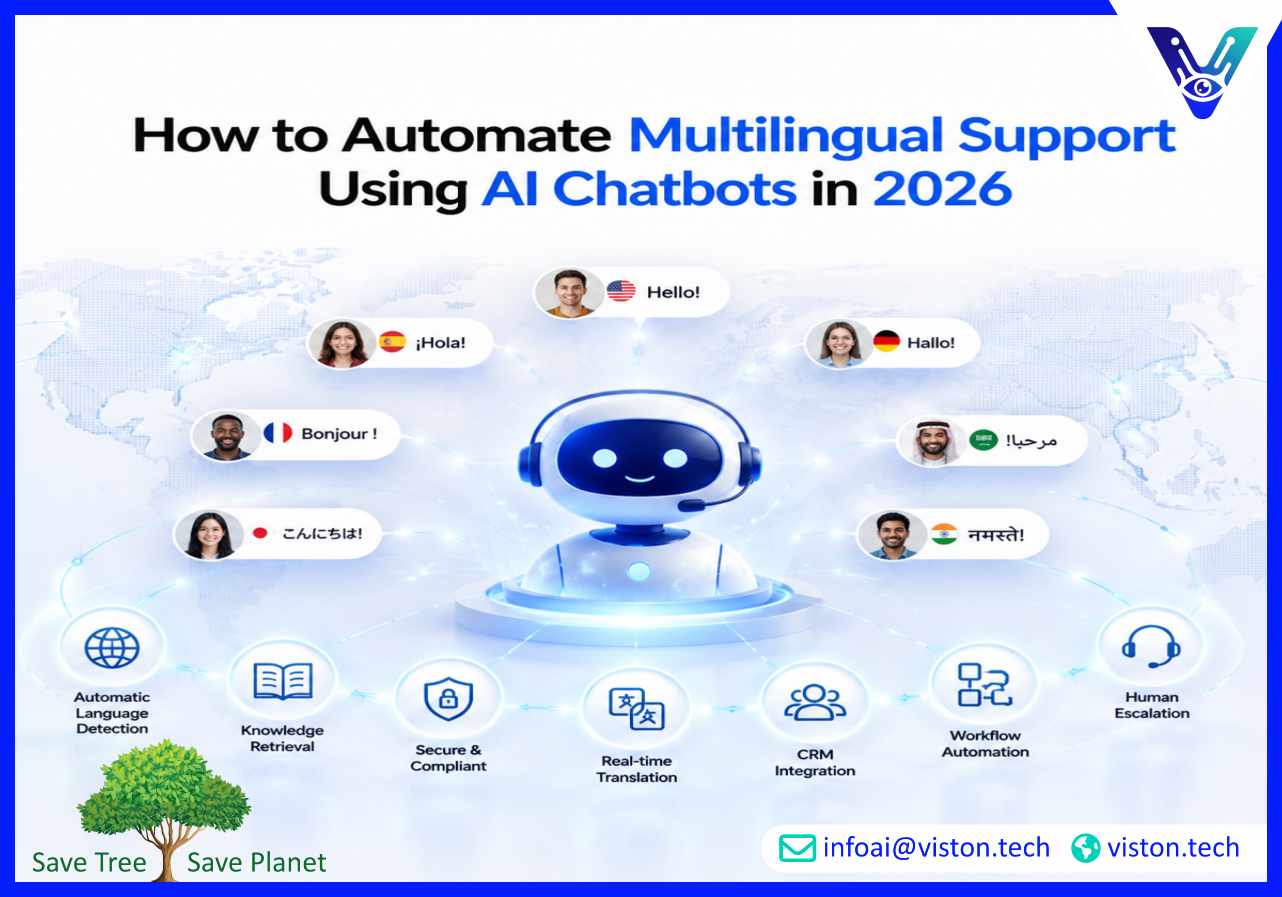
How to Automate Multilingual Support Using AI Chatbots in 2026
Businesses can automate multilingual support using AI chatbots by combining language detection, approved knowledge, real-time translation, workflow integrations, and human escalation. Done well, this model gives customers faster help in their preferred language while helping support teams control workload, maintain consistency, and expand service coverage without building a separate operation for every market.
What It Means to Automate Multilingual Support Using AI Chatbots
Multilingual support automation is more than translating an English chatbot response into another language. A reliable system must understand what the customer wants, retrieve the correct business information, respond naturally in the selected language, complete permitted actions, and transfer the conversation when human judgment is needed.Modern AI chatbots can handle common service requests such as order tracking, account access, booking changes, product guidance, billing questions, onboarding, troubleshooting, and frequently asked questions. They can also collect structured information before creating a ticket or routing the user to an agent. This reduces repetitive work while keeping employees available for complaints, exceptions, negotiations, sensitive issues, and complex technical cases.The most practical operating model combines five elements:
Automatic language identification or a clear language selector
A trusted, localized knowledge base
Natural language understanding for customer intent and context
Connections to CRM, helpdesk, ecommerce, booking, or account systems
Language-aware escalation to trained human agents
The chatbot should not simply produce fluent text. It should use approved sources, respect user permissions, preserve important terminology, and know when confidence is too low to continue. AI customer service chatbots are especially useful for immediate answers, repetitive FAQs, scalable self-service, and multilingual engagement, but their value depends on accurate knowledge and operational integration.
Choose automation use cases before choosing languages
Businesses often begin by asking how many languages a chatbot can support. A better first question is which customer journeys should be automated. Defining the use case prevents the project from becoming a broad translation exercise with unclear outcomes.Start with high-volume, well-documented, low-risk enquiries. These are easier to test and usually provide the clearest operational benefit. More sensitive workflows can be added after knowledge quality, escalation, identity checks, and monitoring are proven.
How to Build an Automated Multilingual Support Workflow
A successful deployment begins with support operations, not the chatbot interface. The business must decide what information is authoritative, which actions the bot can take, where customer data is stored, and when a person must intervene.
1. Prioritize languages using real customer demand
Review support tickets, customer locations, website language settings, sales enquiries, abandoned chats, refund requests, and expansion plans. Select languages according to actual demand and commercial importance. Supporting three languages well is usually more valuable than offering ten languages with weak knowledge coverage and inconsistent escalation.For each priority language, document expected volume, preferred channels, peak hours, and available human support.
2. Prepare and localize the knowledge base
The chatbot needs a controlled source of truth. Gather current FAQs, product documentation, policies, troubleshooting guides, onboarding content, shipping rules, service terms, and approved response templates. Remove duplicates, expired pages, contradictions, and content without a clear owner.Localize the highest-value content instead of relying only on instant machine translation. Product names, financial language, technical terms, legal wording, dates, units, currencies, address formats, and tone may require regional adaptation. Create a terminology glossary so the same concept is translated consistently across the chatbot, website, emails, app, and human support team.
3. Design intent recognition and conversation flows
Group common customer requests into intents such as “track my order,” “change my booking,” “cancel my subscription,” or “reset my password.” Add examples written by native or fluent speakers, including informal phrases, spelling variations, code-switching, abbreviations, and regional vocabulary.Conversation flows should ask only for information needed to complete the task. They should confirm important details before taking an action and clearly explain the next step. Where the chatbot is uncertain, it should ask a clarifying question or offer escalation rather than guessing.
4. Connect the chatbot to business systems
Automation becomes useful when the chatbot can access relevant context. Integrations may include CRM platforms, helpdesk software, ecommerce systems, order management, booking tools, identity services, payment platforms, knowledge bases, and analytics systems.These connections allow the bot to retrieve an order, check account status, create a ticket, schedule an appointment, or pass diagnostic information to a support queue. Access should be permission-based, logged, and limited to the data required.
5. Build human handover into the workflow
Human escalation is part of good automation, not evidence of failure. Define handover triggers for repeated misunderstanding, low confidence, negative sentiment, complaints, refunds, legal requests, fraud concerns, accessibility needs, and high-value customer issues.The agent should receive the original conversation, translated summary, detected language, customer details, identified intent, and actions already attempted. This prevents the customer from starting again and allows a specialist who does not speak the language fluently to understand the case with appropriate translation support.
How to Maintain Accuracy, Security, and Customer Trust
The main risk in multilingual chatbot support is not awkward wording. It is a fluent but incorrect answer. Businesses need controls that protect meaning, customer data, and service consistency across every supported language.
Test each language independently
Do not assume that strong English performance will transfer automatically to other languages. Test intent recognition, answer accuracy, tone, fallback behaviour, workflow completion, and escalation separately for every language. Include real customer phrasing rather than only professionally translated test scripts.Native-language review is particularly important for policy explanations, regulated terminology, technical support, complaints, and emotionally sensitive conversations.
Use confidence thresholds and approved sources
The chatbot should retrieve answers from approved content and follow clear rules when information is missing or conflicting. For high-risk topics, use stricter confidence thresholds and require human approval before the chatbot gives guidance or completes an action.Every policy, product guide, workflow, and localized article should have an owner and review date. When source content changes, all language versions should be updated together.
Protect customer information
Multilingual support may involve names, account details, addresses, payment information, health information, or private conversation histories. Apply data minimization, encryption, role-based access, retention controls, audit logs, and secure integration practices. Avoid exposing internal notes or restricted content through translated responses.Businesses serving customers in the European Union should also prepare for applicable AI transparency requirements. From 2 August 2026, the EU’s AI Act transparency rules require people to be informed when they are interacting with an AI system in relevant circumstances. A clear chatbot disclosure, accessible privacy information, and visible route to human assistance should therefore be part of the experience design.
Preserve human control for sensitive cases
Automation should have defined boundaries. A trained employee may still need to approve refunds, handle contractual disputes, provide regulated advice, or respond to vulnerable customers. These limits should be explicit and auditable.
How to Measure and Scale Multilingual Chatbot Automation
Businesses should evaluate multilingual automation by service outcomes, not only conversation volume. A busy chatbot can still create poor customer experiences if it misunderstands users or blocks access to human help.Track performance separately by language, channel, intent, and market. Useful metrics include:
Self-service resolution rate
First-contact resolution
Fallback and misunderstanding rate
Escalation rate and handover quality
Customer satisfaction by language
Average response and resolution time
Workflow completion and integration error rate
Repeat contact after an automated answer
Translation corrections identified by reviewers
Cost per successfully resolved conversation
Run a controlled pilot
Launch with selected languages, channels, and intents. Compare chatbot answers with approved answers, review failed conversations daily during the early stage, and test escalation outside normal business hours. A pilot should prove that the chatbot can resolve useful tasks reliably before wider expansion.
Create a continuous improvement cycle
Review fallback messages, negative feedback, abandoned conversations, repeat contacts, and agent corrections. These signals reveal missing content, poor translation, unclear prompts, broken integrations, and new customer intents. Assign owners to update knowledge, conversation design, workflows, and language quality.Scale only when performance is stable. Add languages according to demand, then extend into new channels or more complex tasks while maintaining human review capacity.
How Viston AI Supports Automated Multilingual Customer Service
Viston AI provides Multilingual AI Chatbot Support for organizations that need to manage customer conversations across languages, channels, and connected business workflows. Its published capabilities include multilingual natural language processing, real-time translation and localization, omnichannel deployment, intelligent routing, performance analytics, and integrations with CRM, knowledge, transaction, and support systems.These capabilities are relevant because effective multilingual automation depends on more than language generation. The chatbot must recognize intent, access approved information, use customer context responsibly, complete permitted workflows, and escalate complex cases with a usable conversation history.Viston AI’s approach can support businesses that want to begin with priority languages and repeatable service requests, then expand coverage as demand and performance become clearer. This may include ecommerce order support, SaaS onboarding, booking assistance, technical troubleshooting, customer account enquiries, and multilingual lead qualification.For decision-makers, the practical value lies in combining chatbot delivery with integration, routing, analytics, and continuous optimization. This gives support leaders a clearer view of performance by language and helps operations teams improve knowledge quality, automate suitable tasks, and preserve human oversight where it matters.
Frequently Asked Questions
Can AI chatbots automatically detect a customer’s language?
Yes. Many multilingual chatbots can identify the language from the customer’s message or use profile, browser, and channel settings. Businesses should still provide an easy language selector because short or mixed-language messages can be misclassified.
Do I need a separate chatbot for every language?
Not necessarily. A single multilingual architecture can serve several languages through shared workflows and localized knowledge. However, each language should have its own testing, glossary, performance reporting, and quality review process.
Which multilingual support tasks should be automated first?
Begin with repetitive, low-risk tasks such as FAQs, order status, booking confirmations, account access, onboarding guidance, opening hours, product information, and basic troubleshooting. Add complex workflows only after reliable testing and escalation are in place.
Can an AI chatbot replace multilingual support agents?
It can reduce repetitive workload, but it should not remove human support. Agents remain important for sensitive complaints, exceptions, negotiations, regulated topics, unusual technical problems, and situations requiring empathy or judgment.
How do I prevent inaccurate translated answers?
Use approved source content, terminology glossaries, confidence thresholds, native-language testing, restricted workflows, and human review. Monitor failed conversations and corrections separately for each language instead of relying on overall chatbot accuracy.
Can Viston AI integrate multilingual chatbots with existing systems?
Viston AI presents multilingual chatbot integration as part of its service capabilities, including connections to CRM, knowledge bases, support platforms, transaction systems, and workflow tools. Integration scope should be defined around the business systems and actions required for each use case.
Conclusion
To automate multilingual support using AI chatbots successfully, businesses need more than instant translation. They need trusted knowledge, language-aware intent recognition, secure system integrations, clear workflow limits, reliable human handover, and performance monitoring for every supported language. A phased rollout helps teams automate suitable enquiries without losing control of accuracy or customer experience. Viston AI offers relevant Multilingual Support capabilities for organizations seeking a connected, measurable, and scalable approach to multilingual customer service.