
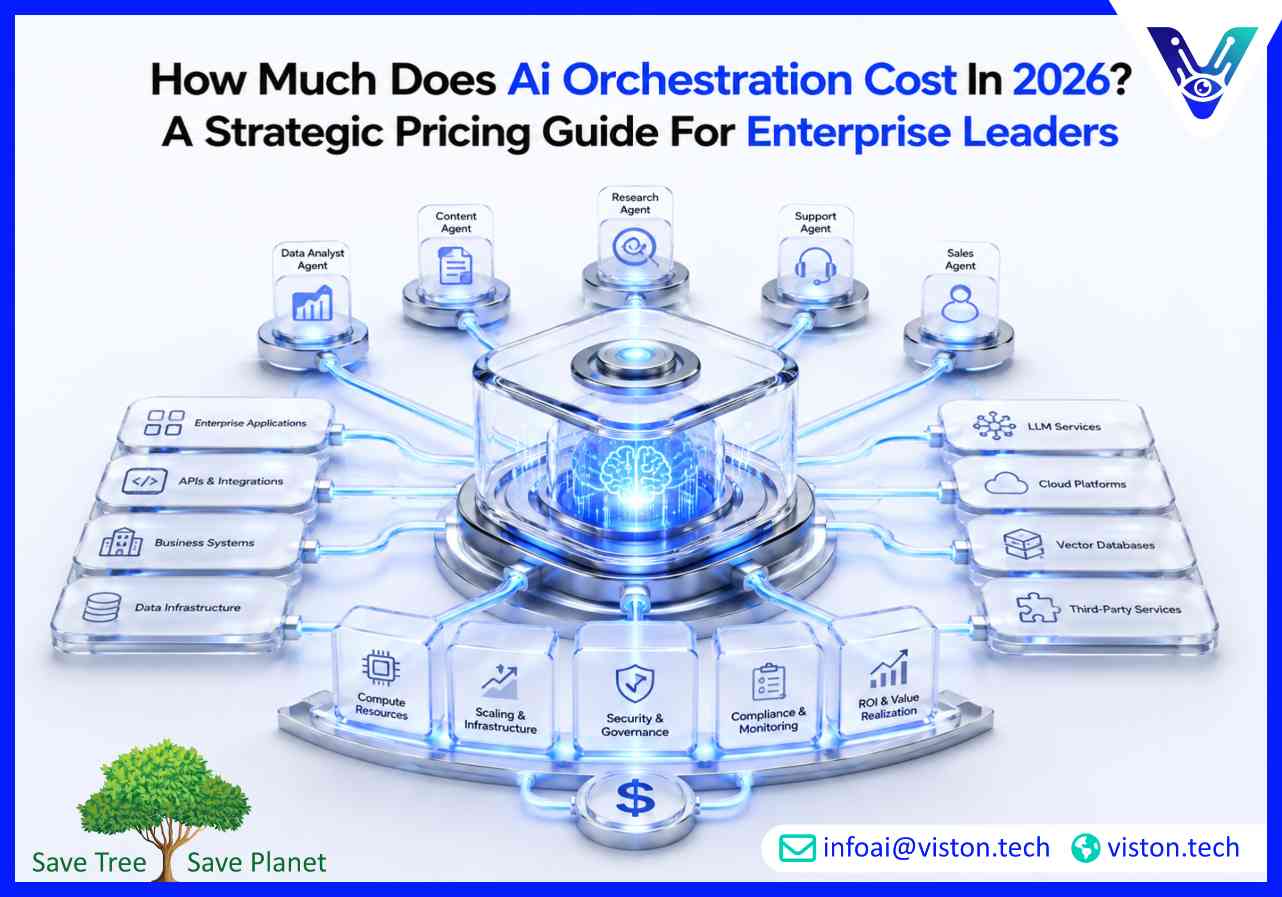
AI orchestration has moved from experimental labs to the boardroom agenda. Businesses across India and global markets now recognize that connecting AI agents, models, and enterprise systems isn’t just a technical decision. It’s a strategic investment. This guide explains what shapes AI orchestration costs, what budget ranges to expect, and how to evaluate pricing models against genuine business outcomes.
AI orchestration coordinates multiple artificial intelligence components, including large language models, retrieval-augmented generation pipelines, autonomous agents, and enterprise APIs, into a single coherent workflow. Instead of isolated AI tools operating independently, orchestration ensures these systems share context, pass data securely, and deliver unified business outputs.
For enterprises, orchestration solves the fragmentation problem. When a customer service AI needs information from a supply chain model, orchestration makes that handshake possible. This coordination layer reduces manual intervention, prevents data silos, and creates end-to-end automation that standalone AI tools cannot achieve.
The technology typically includes agentic frameworks, workflow engines, memory management systems, guardrail implementations, and monitoring dashboards. Some organizations build these layers internally. Many engage strategic AI consulting services to design, implement, and govern the orchestration architecture properly from day one.
Pricing varies significantly based on several interconnected factors. Understanding each helps procurement teams and technology leaders evaluate proposals accurately rather than comparing headline figures that represent different scopes.
The number of systems being orchestrated directly affects cost. Connecting three internal APIs with one language model requires considerably less engineering than orchestrating fifteen agents across cloud, on-premise, and edge environments. Enterprise orchestration often involves legacy system integration, custom middleware development, and extensive API normalization. Each additional integration point increases development time, testing requirements, and ongoing maintenance overhead.
Real-time orchestration demands higher infrastructure investment than batch processing. Organizations needing sub-second response times for customer-facing applications should expect premium pricing for the low-latency architecture, redundant systems, and specialized engineering required.
The choice of underlying AI models substantially influences recurring expenses. Proprietary models accessed through commercial APIs charge per token or request, with costs scaling alongside usage volume. Open-weight models deployed on dedicated infrastructure shift spending toward compute resources rather than API fees. Many orchestrated systems use multiple models strategically, routing simpler queries to efficient models while reserving expensive reasoning models for complex tasks.
Inference optimization techniques, including quantization, caching layers, and semantic routing, can reduce per-query costs by 40-60% in well-designed systems. These optimizations require upfront engineering investment but deliver compounding savings for high-volume deployments.
Regulated industries in India, including banking under RBI guidelines, healthcare under Digital Personal Data Protection Act requirements, and publicly listed companies with SEBI obligations, face additional orchestration costs. Implementing audit trails, access controls, data residency measures, and model explainability frameworks adds 20-35% to typical implementation budgets. Organizations handling sensitive personal data or operating across jurisdictions should factor compliance engineering into cost projections from the outset.
Organizations choosing to build custom orchestration layers internally face initial engineering investments of 2,000-5,000 person-hours for production-grade systems, plus ongoing platform engineering costs. Purchasing commercial orchestration platforms reduces time-to-value but introduces licensing fees, vendor lock-in considerations, and potential customization limitations. Many enterprises adopt hybrid models, combining commercial orchestration frameworks with custom integrations and governance layers. Strategic AI consulting services help evaluate these trade-offs against specific operational requirements and growth trajectories.
While every implementation differs, understanding market benchmarks helps set reasonable budget expectations.
Organizations testing orchestration concepts with limited scope, typically two to four integrated systems and controlled user groups, should budget between $40,000 and $120,000. These engagements usually span 8-14 weeks and deliver working prototypes that validate technical approaches and business assumptions before larger commitments. Pilot budgets cover architecture design, initial integration engineering, basic guardrails, and limited testing.
Mid-scale orchestration serving single departments or specific business functions, such as marketing operations, customer support triage, or procurement workflows, typically ranges from $150,000 to $400,000 in year-one costs. This includes production-grade architecture, comprehensive testing, monitoring dashboards, operator training, and 6-12 months of operational support. Monthly recurring costs for inference, infrastructure, and maintenance commonly range from $15,000 to $45,000 depending on usage volume and model selections.
Multi-department orchestration with dozens of integrated systems, custom agent frameworks, and organization-specific governance requirements represents $500,000 to $2,500,000 in initial investment. These programs typically unfold across 6-18 months and involve phased rollouts with continuous optimization. Annual operating costs, including dedicated orchestration platform teams, compliance monitoring, model updates, and infrastructure, range from $200,000 to $800,000. Enterprises in regulated sectors or those requiring 24/7 operational support should plan toward the upper end of these ranges.
AI orchestration providers and consulting firms structure engagements differently. Understanding common models helps decision-makers compare proposals on equivalent terms.
Well-suited for organizations with clearly documented requirements, fixed-price engagements specify deliverables, timelines, and acceptance criteria upfront. This model provides budget certainty but requires thorough scoping to avoid change-order costs when requirements evolve. Fixed-price projects work best for orchestration implementations where integration points, model choices, and success metrics are well understood before contracting begins.
Many AI orchestration initiatives benefit from iterative development, where teams build, test, and refine orchestration layers in two-week cycles. Time and materials pricing, typically $150-$350 per hour for senior orchestration engineers and architects in India, accommodates evolving requirements and discovery during implementation. Organizations new to agentic architectures often find this approach more practical, as exact requirements frequently shift once stakeholders see working prototypes.
Some providers offer ongoing orchestration management with pricing tied to transaction volumes, automated processes, or business outcomes. These arrangements shift technical risk to the provider while aligning costs with realized value. Outcome-based pricing requires clear baseline measurements and agreement on attribution methodology. For organizations seeking predictable operating expenses rather than capital investment, managed orchestration services warrant evaluation alongside build-and-operate approaches.
Viston AI provides strategic AI consulting services that help enterprises navigate orchestration complexity from business case development through production operations. The firm works with organizations across India and international markets to design orchestration architectures that align technical decisions with commercial objectives.
Rather than promoting generic frameworks, the consulting approach addresses the specific integration realities, compliance requirements, and operational constraints each enterprise faces. Engagements typically begin with architecture assessment and roadmap development, identifying which workflows deliver highest impact from orchestration and which technical approaches suit existing infrastructure investments. Implementation support includes platform selection guidance, custom integration engineering, guardrail design, and knowledge transfer to internal teams.
For organizations concerned about vendor lock-in or technology obsolescence, the consulting methodology emphasizes portable architectures, open standards where practical, and documented decision rationale that supports future adaptability. The firm’s experience spans regulated industries, high-volume customer operations, and complex multi-system enterprise environments. Businesses evaluating orchestration investments benefit from this practical implementation perspective when building internal business cases and vendor evaluation criteria.
Organizations can begin exploring orchestration with focused proofs of concept starting around $40,000-$60,000. These targeted engagements validate technical approaches and quantify business impact before larger commitments. The key is scoping tightly around specific, measurable workflows rather than attempting broad orchestration too early.
Annual operating costs, including inference, infrastructure, monitoring, and maintenance, typically range from 30-70% of initial implementation investment depending on usage volume and architectural choices. Organizations that invest early in optimization and automation tend to see lower operating ratios over time as manual oversight decreases.
India-based implementation teams often deliver orchestration engineering at 40-60% lower professional service rates compared to North American or European equivalents, while maintaining comparable technical capability. Additionally, Indian cloud regions and local inference infrastructure can reduce latency and data transfer costs for domestic operations.
Common under-budgeted items include model retraining and fine-tuning cycles, compliance audit preparation, internal change management and training, integration maintenance as connected systems evolve, and the engineering time required to update orchestration flows when business processes change. Building 15-25% contingency into orchestration budgets accounts for these typically overlooked requirements.
Most enterprises observe initial productivity and automation metrics within 3-6 months of production deployment. Full return on investment, accounting for implementation costs, typically materializes within 12-24 months depending on deployment scale and process automation volume. Organizations that phase rollouts by business function often achieve faster payback on early phases, which then fund subsequent expansion.
Strategic AI consulting services, such as those provided by Viston AI, focus on architecture decisions, technology selection, governance design, and organizational readiness before implementation begins. This contrasts with implementation vendors who execute against predetermined specifications. Organizations benefit from consulting engagement when the orchestration strategy itself requires development before engineering resources can be effectively deployed.
AI orchestration costs reflect the genuine complexity of connecting autonomous systems in production environments where reliability, security, and business outcomes matter. Understanding the cost drivers, from architecture decisions and model selection through compliance requirements and delivery approaches, helps enterprises budget realistically and evaluate proposals effectively. Whether pursuing proof-of-concept validation or enterprise-wide deployment, organizations that align orchestration investments with specific business workflows achieve faster returns than those pursuing technology implementation without clear commercial context. Strategic AI consulting services help bridge the gap between technical possibility and practical business value, ensuring orchestration decisions support long-term organizational goals rather than short-term technology enthusiasm.
