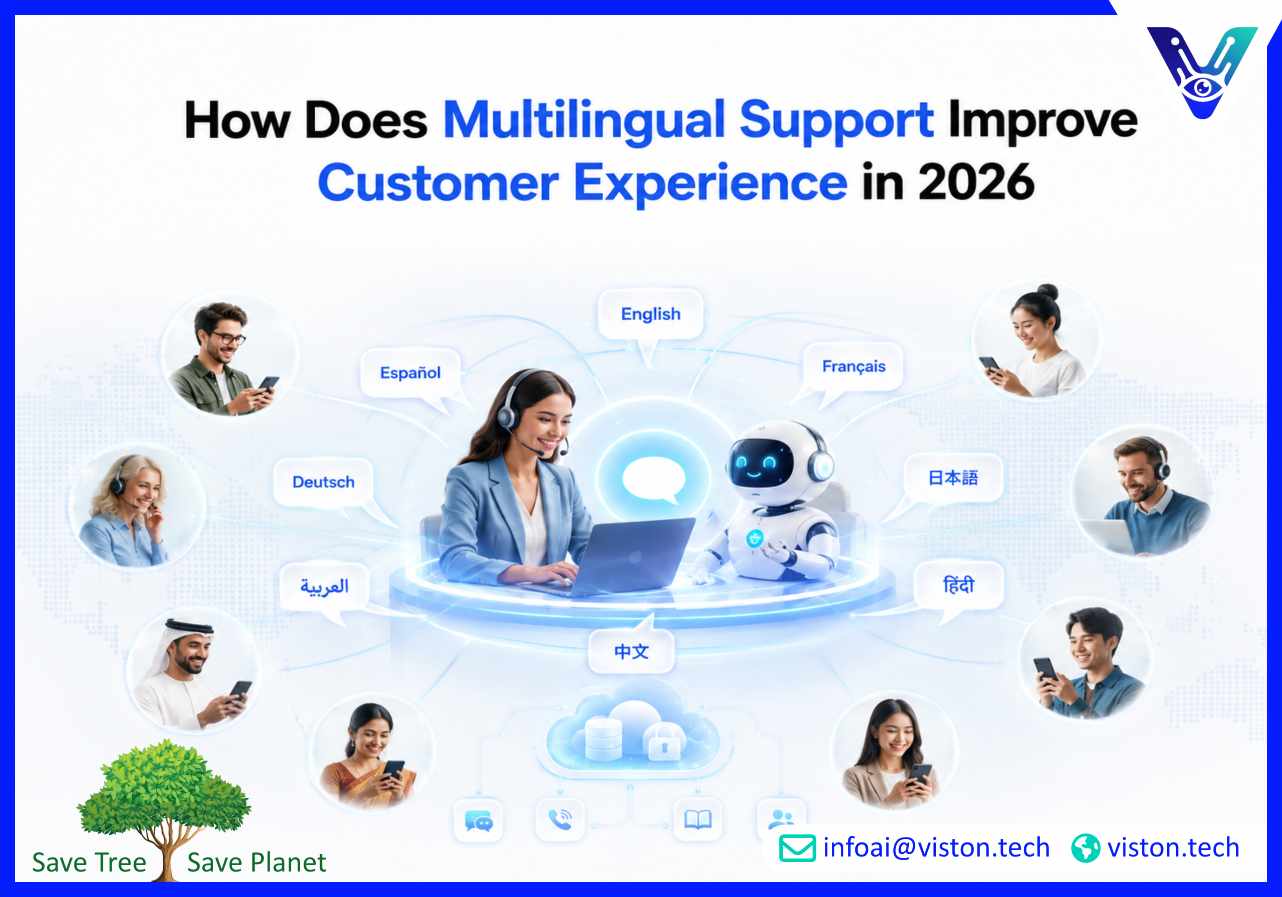
How Does Multilingual Support Improve Customer Experience in 2026?
Multilingual support improves customer experience by allowing people to ask questions, understand instructions, resolve problems, and complete transactions in the language they use most comfortably. When delivered consistently across customer touchpoints, it reduces effort, builds trust, improves service accessibility, and helps businesses support customers across markets without creating fragmented experiences.
What Multilingual Support Means for Customer Experience
Multilingual support is the ability to provide dependable customer service in more than one language. It can include multilingual agents, localized self-service content, AI chatbots, real-time translation, language-aware routing, translated agent workspaces, and automated workflows.It is broader than translating individual messages. Translation changes words from one language into another, while multilingual customer support ensures that the complete service experience remains understandable and useful. This includes navigation, chatbot prompts, help articles, product terminology, billing instructions, forms, escalation messages, emails, and human conversations.A customer should not receive a localized marketing page and then be forced to use another language when asking for help. The language experience needs to continue across the entire customer journey, including discovery, purchasing, onboarding, account management, technical support, complaints, renewals, and cancellations.
Language is part of service usability
Customers may understand a second language well enough to browse a website but still struggle with technical instructions, financial terminology, medical information, return conditions, or troubleshooting steps. During stressful situations, even fluent users may prefer their primary language because it reduces the risk of misunderstanding important details.Multilingual support therefore improves usability. It helps customers explain their needs more precisely and makes it easier for them to understand what the business expects them to do next.
Consistency matters as much as language availability
Simply offering many languages does not guarantee a strong experience. Customers need accurate, current, and consistent information in every supported language.If a return policy says one thing in English and something different in Spanish, the problem is not translation quality alone. It is a knowledge-management failure. Businesses need approved source content, terminology standards, language-specific quality checks, and clear ownership of updates.In 2026, multilingual workflows can automatically adapt support messages and workflow steps according to a customer’s detected or selected language. However, businesses still need to test whether buttons, forms, knowledge content, system messages, and escalation paths remain understandable throughout the workflow.
How Multilingual Support Improves Customer Experience
The primary benefit of multilingual support is reduced customer effort. Customers can describe a problem naturally instead of translating their thoughts, searching for unfamiliar terminology, or asking another person to communicate on their behalf.
It improves understanding and response accuracy
Customers provide better information when they can communicate in a familiar language. They can explain symptoms, product issues, account problems, delivery concerns, or billing questions with greater precision.This gives support teams and automated systems better context. Fewer details are lost, fewer assumptions are required, and the likelihood of sending an irrelevant answer is reduced.Accurate understanding is especially important for technical support, financial services, healthcare, travel, logistics, ecommerce, SaaS, and other environments where a small misunderstanding can lead to an incorrect action or repeated contact.
It builds trust and emotional confidence
Language affects how customers interpret tone, empathy, urgency, and competence. A response that is technically correct but unnatural or culturally inappropriate may still feel dismissive.Providing support in the customer’s preferred language shows that the business has considered the customer’s needs. It can make the interaction feel more personal and less transactional, particularly when customers are frustrated, confused, or making an important purchase decision.Trust also depends on honesty. When a chatbot is uncertain, it should ask a clarifying question or transfer the conversation rather than provide a fluent but unreliable answer.
It improves speed and availability
Without multilingual systems, messages may need to wait for a specific bilingual employee or regional team. This can increase response times outside normal working hours and create backlogs for less commonly supported languages.AI chatbots, translated self-service content, and automated language detection can provide immediate help for routine enquiries. Customers can check an order, find a policy, reset an account, review booking information, or begin troubleshooting without waiting for a particular agent.Conversational automation can also gather relevant information before escalation. The human agent receives the customer’s language, account details, detected intent, conversation history, and attempted steps, creating a smoother handover. Multilingual automation is most valuable when it resolves suitable requests quickly while preserving access to human support for complex situations.
It creates more inclusive customer journeys
English-only support can unintentionally exclude customers who can purchase a product but cannot confidently resolve a problem in English. Multilingual service reduces that barrier and makes digital experiences accessible to a wider audience.This matters for global companies, but it is equally relevant to businesses serving linguistically diverse customers within one country. A company does not need international offices to receive enquiries in multiple languages.
It strengthens self-service
Customers frequently prefer to find an answer without opening a ticket. Localized help centres, product guides, onboarding instructions, troubleshooting articles, and chatbot answers allow customers to solve straightforward problems independently.Effective multilingual self-service should localize more than the main article text. Search terms, article categories, navigation labels, screenshots, interface terminology, forms, and related links must also make sense in the selected language.
Where Multilingual Support Creates Measurable Customer Value
Multilingual support can improve experience throughout the customer lifecycle. The strongest results appear when language support is connected to the customer’s context and the systems needed to complete the task.
Sales and pre-purchase support
Potential customers may need clarification about product specifications, compatibility, delivery, pricing, payment methods, contracts, or availability. Answering these questions in the customer’s preferred language reduces uncertainty and makes it easier to move forward.For ecommerce businesses, this may involve product discovery, sizing, shipping, returns, and checkout support. For B2B companies, it may include qualification questions, demo scheduling, technical requirements, or procurement information.
Onboarding and product adoption
A customer relationship can weaken quickly when the purchasing experience is localized but onboarding is not. Multilingual onboarding helps users understand setup steps, account permissions, feature names, integrations, and expected outcomes.SaaS businesses can use localized guides and multilingual assistants to help users complete activation tasks. Service providers can explain documentation requirements, timelines, and next steps. Better comprehension can reduce avoidable setup errors and support demand.
Support and problem resolution
During support interactions, language-aware routing can send conversations to suitable agents, teams, or automated workflows. An AI assistant may resolve repetitive questions, while complaints, payment disputes, safety concerns, legal requests, and unusual technical cases are transferred to people.The quality of the transfer matters. Customers should not need to repeat the entire issue after switching channels or moving from automation to a human agent.
Retention and relationship management
Multilingual support continues to matter after a problem is resolved. Renewal notices, service updates, feedback requests, account changes, loyalty communications, and cancellation processes should remain clear and consistent.A customer who repeatedly struggles to obtain help may leave even when the product itself is satisfactory. A reliable language experience can reduce this friction and make the relationship easier to maintain.
Customer-experience metrics to monitor
Businesses should measure multilingual support performance separately for each language rather than relying on one global average. Useful metrics include:
First-response time by language and channel
First-contact resolution rate
Customer satisfaction by supported language
Self-service resolution rate
Chatbot fallback and misunderstanding rates
Human escalation rate and handover quality
Repeat-contact and conversation-abandonment rates
Translation corrections and terminology errors
Workflow completion and system-update accuracy
Testing should include natural messages written by real speakers, including spelling variations, informal language, mixed-language conversations, dialects, and industry terminology. Research published in 2026 found that machine-translated test data can overstate multilingual intent-classification performance compared with noisy native customer requests.
How to Deliver High-Quality Multilingual Support in 2026
Businesses do not need to launch every language at once. A focused rollout is usually easier to govern and improve.
Prioritize languages using customer demand
Review support tickets, customer locations, browser settings, sales enquiries, website traffic, abandoned conversations, and market plans. Select languages that represent meaningful customer demand or commercial opportunity.Language prioritization should also consider case complexity. A language generating a smaller number of high-value technical or contractual enquiries may require more attention than a language generating many simple questions.
Create a trusted source of knowledge
Before translating content, confirm that the original information is accurate. Remove duplicate articles, resolve conflicting policies, standardize terminology, and assign content owners.Create glossaries for product names, technical terms, legal language, brand expressions, and words that should not be translated. This helps automated systems and human agents communicate consistently.
Combine automation with human judgment
AI can support language detection, routine answers, translation, ticket classification, routing, knowledge retrieval, and conversation summaries. Human agents remain essential for sensitive complaints, negotiation, emotional situations, unusual requests, and decisions that require accountability.The operating model should define confidence thresholds and escalation triggers. Customers should always have an appropriate route to human assistance when automation cannot resolve the issue safely.
Connect language support to business systems
A grammatically correct answer is not enough when the customer needs an action. Multilingual support should connect with CRM, helpdesk, ecommerce, booking, billing, order-management, inventory, and knowledge systems where appropriate.These integrations allow the support experience to use relevant customer context, retrieve current information, create tickets, update records, schedule appointments, or initiate approved workflows.
Apply privacy, security, and quality controls
Translated conversations may contain personal, financial, health, employee, or contractual information. Businesses should apply access controls, data minimization, encryption, retention policies, audit logging, and regional compliance requirements according to the use case.Quality assurance should include native or fluent review, scenario testing, terminology checks, escalation testing, and ongoing analysis of failed conversations. Every language should be treated as its own customer-experience environment.
How Viston AI Supports Better Multilingual Customer Experiences
Viston AI provides Multilingual AI Chatbot Support for businesses seeking to deliver language-aware customer interactions across digital channels. Its published capabilities include multilingual intent recognition, real-time translation and localization, centralized knowledge management, intelligent routing, escalation workflows, and performance reporting by language and geography.The service is relevant to customer experience because multilingual conversations often need to do more than answer questions. Viston AI describes integrations with CRM platforms, knowledge bases, transaction systems, appointment calendars, inventory tools, and support applications. These connections can give an automated assistant the context required to provide relevant information, create support records, update customer data, or trigger approved workflows.Viston AI also presents an omnichannel approach covering web chat, mobile applications, WhatsApp, SMS, voice assistants, and social platforms. Centralized conversation and knowledge controls can help businesses avoid creating separate, inconsistent support experiences for each language or channel.For organizations introducing multilingual support, the practical value lies in combining language capability with implementation discipline. Language selection, knowledge preparation, system integration, escalation design, testing, monitoring, security, and continuous optimization must work together. This approach can help businesses deliver more accessible support while maintaining control over response quality and operational workflows.
Frequently Asked Questions
How does multilingual support improve customer satisfaction?
It reduces the effort required to explain problems and understand solutions. Customers receive clearer answers, feel more confident during interactions, and are less likely to repeat information because of language misunderstandings.
Is multilingual support the same as translation?
No. Translation converts content between languages. Multilingual support manages the wider service experience, including localized knowledge, appropriate tone, routing, workflows, integrations, human escalation, and consistent policies.
Does a business need native-speaking agents for every language?
Not always. AI chatbots, localized self-service, translation tools, and translated agent workspaces can handle many routine enquiries. Fluent human review remains important for sensitive, complex, regulated, or culturally nuanced conversations.
Which support content should be localized first?
Start with high-volume and high-impact content such as account access, onboarding, order tracking, product guidance, billing explanations, booking details, return policies, troubleshooting steps, and escalation messages.
How can businesses measure multilingual customer experience?
Track response time, resolution rate, customer satisfaction, self-service success, fallback rate, repeat contact, escalation quality, workflow completion, and translation corrections separately for each language and channel.
Can Viston AI integrate multilingual support with existing systems?
Viston AI describes integration capabilities for CRM, helpdesk, knowledge, transaction, inventory, appointment, and other business systems. The suitability of any integration depends on the organization’s platform, workflow, security, and deployment requirements.
Conclusion
Multilingual support improves customer experience by making service clearer, faster, more inclusive, and easier to use. It helps customers understand information, communicate accurately, complete tasks, and receive appropriate assistance across languages and channels. In 2026, effective Multilingual Support requires more than automatic translation. Businesses need trusted knowledge, contextual automation, reliable integrations, human escalation, security controls, and language-specific performance measurement. Viston AI offers relevant multilingual chatbot, routing, integration, omnichannel, and analytics capabilities for organizations building a more consistent global customer experience.