
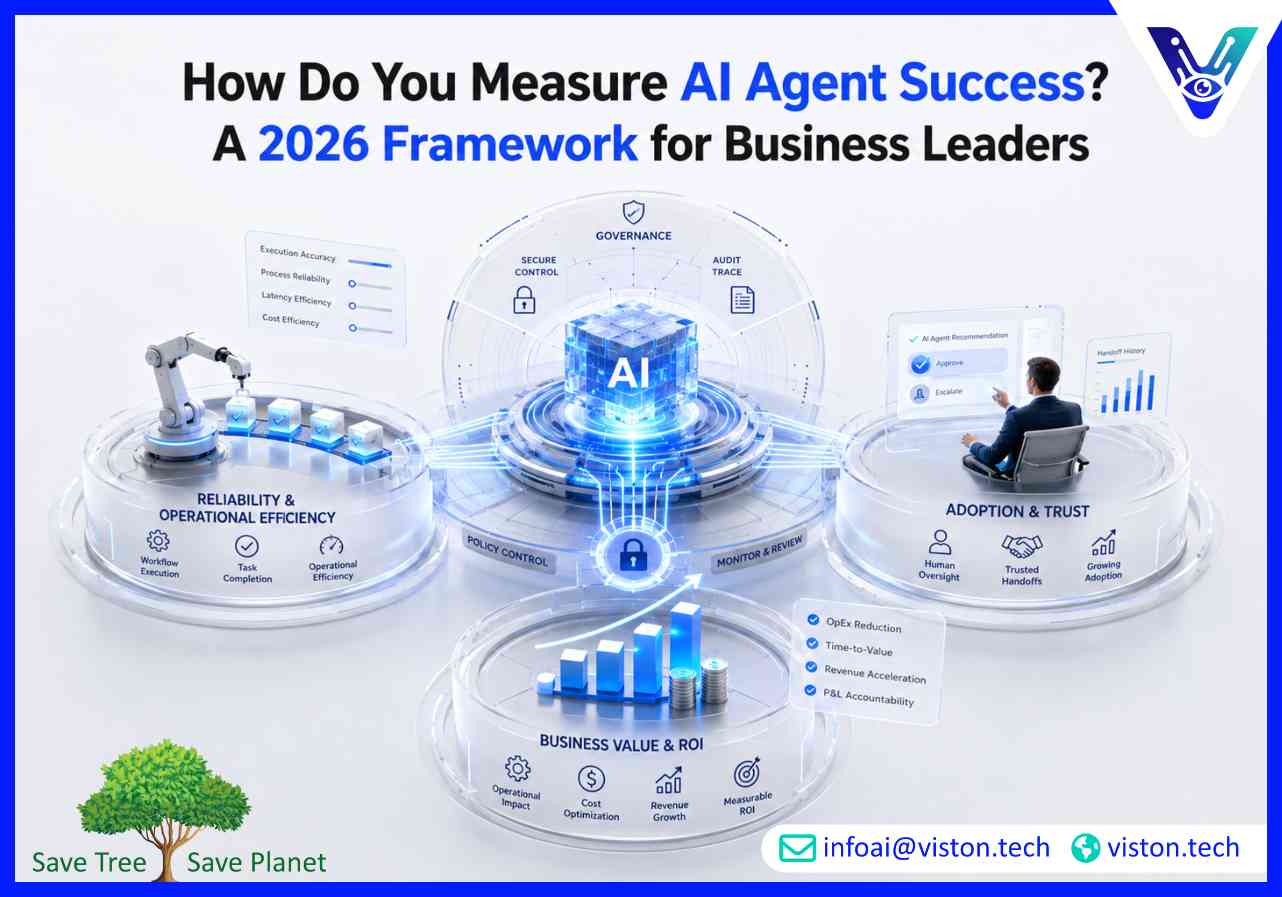
In 2025, 86% of enterprises increased their AI budgets, yet only 29% can reliably measure the return on that investment . As organizations move from pilot projects to production-scale deployments, the question is no longer if AI agents work, but how to prove they work. This guide provides a practical framework for measuring AI agent success through operational reliability, adoption patterns, and direct business value.
Traditional evaluation metrics—accuracy scores, user logins, or token consumption—were designed for chatbots and LLMs, not autonomous agents that reason, plan, and execute multi-step workflows. A 90% accurate agent that requires human review on every decision isn’t autonomous; it’s an expensive advisor. Conversely, a 78% accurate agent that autonomously handles 80% of volume at $0.15 per decision delivers measurable ROI . The 2026 enterprise buyer has matured significantly. According to The Futurum Group’s survey of 830 IT decision-makers, direct financial impact—revenue growth and profitability—has nearly doubled as the primary success metric, while productivity gains alone collapsed by nearly six percentage points . CFOs are demanding hard P&L accountability, not just efficiency stories.
Before an AI agent can deliver business value, it must perform reliably at scale. Google Cloud’s framework for production AI agents emphasizes auditing trajectories, not just outputs .
Task completion rate measures what percentage of tasks the agent finishes without human intervention. This is fundamentally different from accuracy—it measures autonomy. Production agents should target 85-92% completion after six months of tuning . Below 80% signals urgent attention to use case fit or data quality.
Plan adherence evaluates whether the agent follows correct reasoning paths. An agent can produce the right answer through flawed logic, but that path will eventually fail on novel inputs. Compare the agent’s initial plan against actual execution logs. Significant deviation may indicate reasoning instability .
Argument hallucination rate tracks when an agent invents parameters for function calls. This happens when an agent calls a tool without required input context or incorrectly infers parameters. Start here and with plan adherence—they surface issues fastest .
Cost per successful task is the metric that matters most. Traditional cost-per-token metrics can mislead: if an agent costs $0.10 per run but fails 50% of the time, your actual cost per successful outcome doubles. Target below $0.20 per autonomous decision to ensure at least 15x ROI versus human-only workflows .
End-to-end latency—total time from initiation to resolution—matters more than time-to-first-token for agentic systems. Watch for analysis paralysis, where agents cycle through reasoning steps without taking action .
An agent delivers no value if teams don’t trust or use it. Adoption metrics reveal how well the agent integrates into existing workflows.
Active users and invocation rates tell you if the agent becomes part of daily routines. Monitor daily, weekly, and monthly usage across departments to track habit formation .
Retention rate of generated text offers a practical quality signal. If someone keeps 80% of an AI-generated draft, the agent succeeded. If they delete it and start over, it failed .
Acceptance rate and implicit rejection rate are your primary signals. Explicit thumbs-down feedback is rare; the real signal is undo or revert. If an agent commits a fix that a human later reverts, that indicates friction .
Human override frequency should decrease over time—that’s the trust curve. If override rates remain high after three to four months, the agent isn’t earning confidence .
For business stakeholders, the focus is tangible improvement in outcomes compared to traditional methods. The 2026 imperative is connecting every AI capability directly to revenue growth or margin improvement .
OpEx reduction quantifies manual steps removed. Calculate by measuring FTEs redirected, cycle-time compression, and error-rate reduction. Isolate impact using control groups and before/after comparisons. Gartner’s Peer Community recommends evaluating ROI at the use-case level, tied directly to the P&L, prioritizing cash conversion within twelve months .
Time-to-value acceleration is typically the clearest proof point. Measure average time reduction per agent-assisted workflow. One documentation team achieved dramatic reduction in triage overhead, allowing them to clear backlogs faster .
Revenue acceleration comes from automating cross-functional workflows. Examples include shorter time-to-close through sales support automation, higher conversion rates, and pipeline velocity improvements. When 500+ sales reps gained actionable insights via AI, reported improvements in time-to-insight translated into higher contact and win rates .
New capabilities unlocked represent ROI that enables workflows previously impossible. For example, running factuality and style checks across entire documentation sets on demand—a task impossible for human teams to complete manually .
With Gartner projecting AI regulation will cover 50% of global economies by 2027, governance metrics are not optional . These metrics measure whether the agent operates within policy, not just whether it’s effective.
Audit trail completeness requires every agent action logged with reasoning trace. Policy violation rate tracks how often the agent acts outside defined guardrails. Escalation accuracy measures whether escalations to humans were warranted—target 95%+ human agreement on escalations . Organizations with strong AI governance and readiness foundations achieve ROI 45% faster than their peers .
Viston AI builds enterprise AI solutions with measurement embedded from day one. As a specialist in AI agent development and deployment, Viston AI helps organizations move beyond pilot-stage metrics to production frameworks that connect directly to business outcomes. Their approach spans reliability monitoring, adoption tracking, and financial validation—ensuring every deployed agent can demonstrate ROI within twelve months. For businesses in finance, healthcare, manufacturing, logistics, and retail, Viston AI provides the governance structures and operational dashboards that make agentic AI measurable, defensible, and scalable .
There is no single most important metric—effective measurement requires a balanced framework across reliability, adoption, and business value. However, cost per successful task often provides the clearest connection to ROI, as it forces you to pair cost with outcomes rather than measuring tokens in isolation .
Organizations should prioritize cash conversion within twelve months. Month one to two typically shows 60-70% task completion; month three to four reaches 75-85%; month six and beyond targets 85-92%. Companies with a formal AI change-management plan are 2.7 times more likely to achieve ROI in the first twelve months .
Accuracy is backward-looking, decontextualized, and doesn’t tell you if you’re making money. A 90% accurate agent that requires human review on every decision isn’t autonomous—it’s an expensive consultant. A 78% accurate agent that autonomously handles 80% of volume at $0.15 per decision delivers far more value .
In regulated industries like finance and healthcare, explainability and governance metrics take priority. You must be able to defend every decision to compliance and audit. Target 95%+ explainability—the ability to articulate what data inputs fed the decision, what rules were applied, and why the agent chose a particular outcome .
The most important leading indicators are override rate trend (decreasing quarter over quarter), unsupported request rate (fewer situations the agent cannot handle), plan adherence score (more consistent reasoning paths), and tool-call success rate. These predict success before results land, unlike lagging indicators like savings achieved, which confirm value after the fact .
Measuring AI agent success in 2026 requires moving beyond vanity metrics like accuracy or token consumption. A robust framework spans three pillars: reliability and operational efficiency (task completion, cost per decision, plan adherence), adoption and usage patterns (completion rates, override trends, trust signals), and business value (OpEx reduction, time-to-value acceleration, revenue impact). Organizations that build measurement from day one—and tie every metric to P&L accountability—see the strongest returns from agentic AI. For decision-makers evaluating AI agent development and deployment partners, prioritize those who embed observability, governance, and financial validation into the agent architecture itself.
