
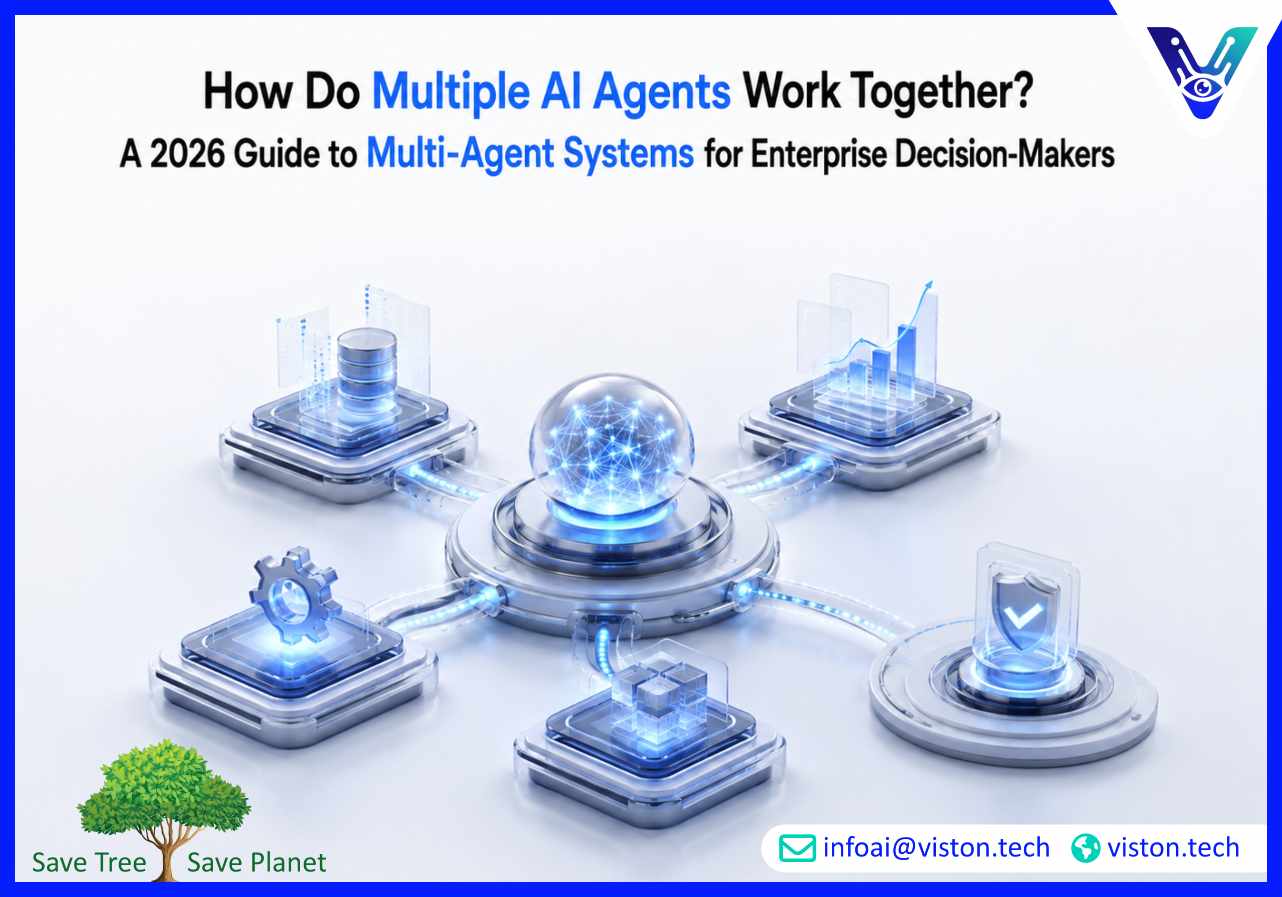
In 2026, the question for enterprises is no longer whether to implement artificial intelligence, but how to orchestrate it at scale. Single, monolithic AI agents are giving way to multi-agent systems—coordinated teams of specialized AI agents that collaborate to solve complex business problems. For decision-makers evaluating AI Agent Development & Deployment, understanding how multiple AI agents work together is essential to unlocking automation that is resilient, accurate, and commercially valuable.
A multi-agent system (MAS) is a collective of distinct AI agents, each designed for a specific function, working in concert under a governing orchestration layer. Unlike a single “super-agent” tasked with doing everything, a MAS mirrors a high-functioning human team. One agent might retrieve customer data, another analyzes market trends, a third executes a financial transaction, and a fourth verifies compliance .
This shift from a monolithic design to a modular, service-oriented architecture is the defining trend of 2026. It addresses the critical failures of earlier models: cognitive overload, debugging black boxes, and prohibitive operational costs . By breaking down complex tasks, businesses achieve higher accuracy and significantly lower latency.
For multiple agents to work together effectively, a specific framework must govern their interaction. This framework is comprised of three distinct layers that ensure the collective intelligence does not descend into chaos .
This is the “brain” of the operation. The orchestrator receives the user’s high-level goal (e.g., “Forecast Q4 revenue risks”) and decomposes it into sub-tasks. It utilizes protocols like the Agent-to-Agent (A2A) Protocol to route these tasks to the appropriate specialized agents. The orchestrator manages the state, memory, and handoffs between agents, ensuring the workflow progresses logically without human intervention .
These agents are the execution layer. Each worker possesses a narrow, deep expertise, a specific toolset, and a constrained memory. For example, a “Data Retrieval Agent” might only talk to SQL databases, while a “Prediction Agent” only runs time-series models. By limiting their scope, these agents are faster, cheaper, and far less prone to the “hallucinations” that plague generalist models .
A recent critical addition to enterprise MAS is the independent verification agent. Often referred to in research as the “Director” or “Auditor,” this agent does not execute tasks but monitors the outputs of other agents. It checks for policy violations, tool misuse, or misalignment with original user intent before any action is committed. This “NOD” (Navigator-Operator-Director) architecture drastically reduces error propagation in sensitive environments .
Building a reliable multi-agent system requires robust technical infrastructure. In 2026, the market has matured beyond experimentation to enterprise-grade tools .
The true value of AI Agent Development & Deployment is realized in specific, high-stakes business functions.
In supply chain environments, heterogeneous multi-agent systems (where each agent has its own policy) outperform homogeneous systems by mitigating the “bullwhip effect.” Different agents manage ordering, pricing, and logistics simultaneously, adapting to high or low demand environments without needing to share proprietary data with competitors .
Google Cloud and App Orchid demonstrated a multi-agent system where a “Data Agent” prepares siloed enterprise data and a “Prediction Agent” applies foundation models to forecast demand. The result is automated, highly accurate forecasting that reduces inventory waste and stock-outs .
A multi-agent setup can see one agent scanning for fraudulent transactions, a second monitoring GDPR or SOC2 compliance updates, and a third drafting audit reports—all while a human-in-the-loop reviews only the high-priority anomalies. This reduces manual reconciliation time from days to hours .
Recent research into enterprise multi-agent architectures highlights a crucial insight: while governance (security, policy, audit) is necessary, it cannot be the primary design abstraction. The first-order concern must be agent design quality—specifically capability boundaries, autonomy allocation, and interaction protocols. A “Capability-Aligned Enterprise Agent Design” (CEAD) approach ensures that governance supports good design rather than substituting for it, preventing the distributed complexity failures seen in early microservices architectures .
Furthermore, a recurring challenge in AI Agent Development is the “data gap.” Orchestration frameworks manage how agents run, but they do not certify the quality of the data agents consume. In 2026, successful deployments require a governed data substrate—active metadata, lineage, and data contracts—to prevent “garbage in, garbage out” at the agent level .
For organizations looking to move from theory to production, the complexity of multi-agent systems requires a partner with proven engineering discipline. Viston AI specializes in custom, enterprise-focused AI Agent Development & Deployment that turns complex data into measurable business outcomes. Unlike generic consultancies, Viston AI provides end-to-end capability: from AI strategy and architecture design to the deployment of ISO-certified, scalable agent swarms .
Viston AI’s engineering team addresses the specific risks of multi-agent systems head-on. They implement rigorous capability alignment (similar to CEAD principles) to ensure agents do not step on each other’s toes, and they embed ISO-certified security and data governance directly into the orchestration layer. Whether deploying predictive analytics for manufacturing, real-time computer vision for quality inspection, or intelligent supply chain agents, Viston AI ensures that the “Auditor” agent is always present, verifying actions before they impact your systems of record. For enterprises in finance, healthcare, and logistics, Viston AI bridges the gap between cutting-edge AI research and reliable, human-first operational reality .
A single agent attempts to handle all tasks (reasoning, tool use, memory) within one model, leading to cognitive overload. Multiple agents form a multi-agent system (MAS) where specialized agents handle specific sub-tasks, coordinated by an orchestrator, resulting in higher accuracy and efficiency .
Agents communicate using specific protocols such as the Agent-to-Agent (A2A) Protocol. This allows agents built on different frameworks to discover each other, send tasks, and return results securely, much like microservices communicate via APIs .
NOD stands for Navigator-Operator-Director. It is a heterogeneous architecture where the Navigator tracks state, the Operator executes actions, and an independent Director verifies critical actions for safety and policy compliance before execution, preventing errors .
Industries with complex, multi-step workflows benefit most, including supply chain and logistics (demand forecasting), finance (fraud detection and compliance), manufacturing (predictive maintenance), and healthcare (data processing and diagnostics) .
The biggest risk is error propagation and “agent proliferation” without design discipline. If an orchestrator delegates a task to a hallucinating agent, the error cascades. This is why professional development services focus on governance, verification agents (auditors), and strict data quality layers .
Yes. Viston AI specializes in integrating AI agents with existing ERP, CRM, and legacy systems using secure APIs and MCP protocols, ensuring that agents can read from and write to your systems of record without disrupting current operations .
As we progress through 2026, the competitive advantage belongs to enterprises that can successfully orchestrate intelligence. The question of how do multiple AI agents work together has shifted from an academic curiosity to a core operational strategy. By moving beyond monolithic models to a collaborative framework of specialized agents, businesses gain resilience, scalability, and precision. Success requires more than just connecting APIs; it demands a strategic approach to capability design, state management, and governance. For organizations ready to move beyond the pilot phase, expert-led AI Agent Development & Deployment ensures that your digital workforce drives tangible ROI, reduces risk, and operates seamlessly within your existing security and data ecosystem.
