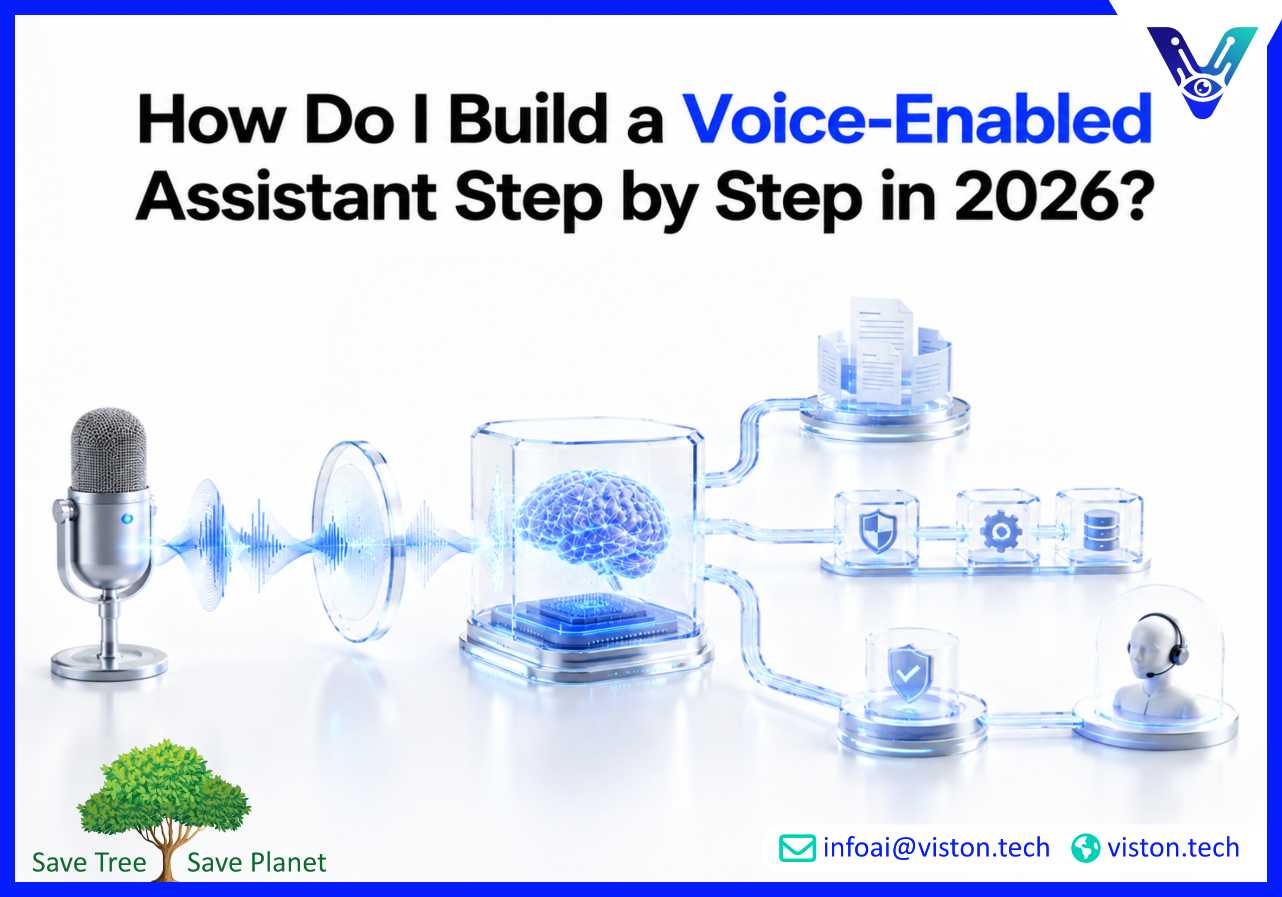
How Do I Build a Voice-Enabled Assistant Step by Step in 2026?
Building a voice-enabled assistant requires more than connecting speech recognition to an AI model. A reliable business solution must understand real users, retrieve trusted information, complete approved tasks, protect sensitive data, and transfer conversations safely when automation is not appropriate. The following process turns that goal into a practical development plan.
Step 1: Define the Use Case, Users, and Voice Assistant Architecture
The first step is to decide exactly what the assistant should accomplish. Avoid beginning with a broad objective such as “answer every customer question.” Start with a narrow, valuable workflow that can be measured and controlled, such as appointment booking, order-status enquiries, lead qualification, internal IT support, account information, inventory checks, or maintenance reporting.
Identify the user outcome and business outcome
For each use case, document what the user wants, what systems the assistant needs, what action it may perform, and what result the business expects. A customer-support assistant might aim to resolve common enquiries and reduce queue pressure. A warehouse assistant might let employees update stock hands-free. A sales assistant might qualify callers and schedule meetings.Choose success measures before development starts. Useful metrics include task-completion rate, first-contact resolution, speech-recognition accuracy, fallback rate, average response latency, escalation rate, customer satisfaction, successful system updates, and cost per completed interaction. Clear metrics prevent the project from becoming a technology demonstration with no operational value.
Map conversations and escalation paths
Create a conversation map for each priority intent. Include the opening, user authentication where necessary, questions the assistant must ask, information it needs to retrieve, confirmation before sensitive actions, error handling, and the conditions for human transfer.Voice conversations must be simpler than screen-based journeys. Users cannot scan several options at once, so prompts should be brief, choices should be limited, and important information should be repeated or confirmed. The design should also handle interruptions, silence, background noise, corrections, ambiguous requests, and users who change topics midway through a conversation.
Select the interaction channel and architecture
Decide whether the assistant will operate through telephone calls, a mobile application, a website microphone, smart devices, headsets, kiosks, or embedded equipment. The channel affects audio quality, authentication, latency, telephony integration, and user expectations.A common production architecture uses streaming speech-to-text, a language or dialogue layer, business tools and APIs, and streaming text-to-speech. This component-based approach offers control over transcripts, prompts, retrieval, tool calls, and monitoring. Native speech-to-speech models can provide more fluid interaction, but teams should still evaluate observability, safety controls, cost, and integration requirements. Recent enterprise voice-agent research emphasizes that streaming and pipelining across components are central to responsive performance.
Step 2: Build the Speech, Intelligence, Knowledge, and Integration Layers
Choose speech recognition and voice output
Speech-to-text converts spoken audio into text the assistant can process. Evaluate providers or models using real recordings from the intended environment rather than clean demo audio. Test accents, dialects, code-switching, specialist terminology, names, numbers, background noise, telephone compression, and varied speaking speeds.Text-to-speech converts the response into audio. Select a voice that is clear, appropriate for the brand, and easy to understand over the chosen channel. Review pronunciation controls, language support, streaming capability, voice consistency, accessibility, and commercial usage terms. Do not optimize only for naturalness; predictable pronunciation and low delay often matter more in operational workflows.
Build the conversation intelligence layer
The intelligence layer determines intent, manages context, selects information, and decides whether to answer, ask a clarifying question, call a tool, or escalate. It may use intent classification, a large language model, deterministic business rules, or a combination of these.Define strict boundaries. The assistant should know which subjects it may address, which actions it may perform, what information requires verification, and when it must avoid guessing. Use structured prompts and response policies to keep answers concise and suitable for spoken delivery. High-risk actions such as payments, cancellations, account changes, or regulated guidance should require stronger authentication, explicit confirmation, and appropriate human oversight.
Create a trusted knowledge layer
Connect the assistant to approved information such as product documentation, service policies, FAQs, internal procedures, pricing rules, troubleshooting guides, and customer-specific records. Retrieval-augmented generation can help the system find relevant content at runtime, but the underlying knowledge must still be current, clearly owned, access-controlled, and free from conflicting versions.Separate public knowledge from private or role-restricted data. Apply metadata so the assistant can filter information by user type, region, product, language, policy version, or permission level. When no reliable answer is available, the assistant should say so and offer the next practical step rather than inventing a response.
Connect the assistant to business systems
A useful voice-enabled assistant often needs to do more than speak. Integrate it with CRM, helpdesk, scheduling, order management, ERP, identity, payment, knowledge, or workflow platforms through secure APIs. Use narrowly scoped tool functions such as “check order status,” “create support ticket,” or “book available slot” instead of giving the model unrestricted access to backend systems.Validate inputs and outputs at the integration layer. Add timeouts, retries, duplicate-action protection, audit records, and clear error messages. Before any irreversible action, repeat the critical details and ask the user to confirm them.
Step 3: Prepare Data, Apply Security Controls, and Test Real Conversations
Prepare language and conversation data
Collect representative phrases for each intent, including informal wording, incomplete questions, abbreviations, product names, and common mispronunciations. Review historic calls or transcripts only when their use is lawful and appropriate, and remove unnecessary personal information before using them for training or evaluation.Create test sets that remain separate from development data. Include successful requests, unclear requests, out-of-scope questions, adversarial prompts, emotional users, repeated interruptions, mixed languages, and failure conditions. Subject-matter experts should review the accuracy of responses and the safety of proposed actions.
Design privacy, security, and governance from the start
Voice data can contain personal, financial, health, biometric, or confidential business information. Define what audio and transcripts will be collected, why they are needed, how consent is obtained, where data is processed, who can access it, how long it is retained, and how deletion requests are handled.Apply encryption, role-based access, secrets management, environment separation, logging controls, personal-data redaction, and vendor risk review. Protect tool calls from prompt injection and prevent the assistant from exposing system instructions, credentials, internal records, or data belonging to another user. NIST’s AI Risk Management Framework provides a voluntary structure for governing, mapping, measuring, and managing AI risks across the system lifecycle.
Test the complete experience
Test each component individually, then test the full conversation path under realistic conditions. Measure transcription errors, intent accuracy, answer quality, tool-call success, time to first audio, total response delay, interruption handling, transfer quality, and recovery from failed APIs.Run user acceptance testing with people who resemble the intended audience. Include different devices, microphones, call networks, accents, and noise levels. Red-team the assistant for unauthorized requests, data leakage, social engineering, harmful instructions, and attempts to bypass workflow rules. A launch decision should be based on defined acceptance thresholds, not a handful of successful demonstrations.
Step 4: Launch Gradually, Monitor Performance, and Improve Continuously
Start with a controlled deployment
Launch with a limited audience, a small set of intents, or restricted operating hours. Keep human support available and make escalation easy. A phased rollout allows the team to identify misunderstood requests, missing knowledge, weak prompts, slow integrations, and unexpected user behaviour before traffic increases.Use feature flags and version control so models, prompts, voices, knowledge sources, and workflows can be changed or rolled back safely. Maintain separate development, testing, and production environments. For critical workflows, define incident procedures and a fallback mode that routes users to a person or a conventional self-service channel.
Monitor both technical and business performance
Technical monitoring should cover service availability, latency, speech errors, model failures, API errors, token or audio usage, and cost. Conversation monitoring should cover completion, containment, fallback, repeat contact, escalation, sentiment, and human-handover quality. Business monitoring should show whether the assistant is reducing workload, improving access, increasing qualified opportunities, or completing operational tasks correctly.Review failed conversations regularly. Group them into speech-recognition problems, missing intents, knowledge gaps, poor conversation design, authentication failure, integration error, or cases that should always be handled by a person. This turns real usage into a prioritized improvement backlog.
Establish ongoing ownership
A production assistant needs named owners for product decisions, conversation design, knowledge content, integrations, security, compliance, analytics, and support. Set a review schedule for policies, prompts, models, permissions, and vendors. Re-test important journeys whenever a connected system, business rule, or model changes.Continuous improvement should be controlled rather than fully automatic. New responses, intents, or actions should be evaluated before release, particularly when they affect money, safety, privacy, employment, healthcare, or contractual commitments.
How Viston AI Supports Voice-Enabled Assistant Development
Viston AI offers Voice-Enabled AI Assistant services that combine speech recognition, speech synthesis, natural language processing, multi-turn context management, business-system integration, analytics, and model lifecycle operations. Its published service scope includes multilingual capabilities, connections to CRM, ERP, service-management, and custom API environments, as well as monitoring and governance controls for enterprise deployments.This delivery model is relevant when an organization needs more than a basic voice interface. Building a production assistant usually requires use-case discovery, conversation design, model and provider selection, knowledge preparation, secure tool integration, testing, deployment controls, and continuous optimization. Viston AI positions these capabilities as an end-to-end service rather than a standalone speech component.For customer support, employee service, sales, field operations, manufacturing, logistics, retail, finance, healthcare, and other workflow-led environments, that integration focus can help connect spoken requests to useful business actions. Its service materials also describe analytics for intent distribution, completion, escalation, sentiment, and model performance, alongside versioning, testing, deployment automation, and rollback processes. These capabilities are important for organizations seeking a voice-enabled assistant that remains measurable, maintainable, and aligned with operational controls as usage grows.
Frequently Asked Questions
How long does it take to build a voice-enabled assistant?
A focused prototype can be built relatively quickly, but production timing depends on the number of intents, languages, integrations, security requirements, data readiness, and testing depth. Complex or regulated workflows generally need more discovery, validation, and governance.
What technology is needed for a voice-enabled assistant?
Most solutions need audio capture or telephony, speech-to-text, conversation intelligence, a trusted knowledge source, secure business APIs, text-to-speech, monitoring, and human-handover capability. Identity, analytics, and compliance controls may also be required.
Should I use speech-to-speech or a cascaded voice architecture?
Choose based on the use case. Cascaded architectures provide clearer control over transcription, retrieval, prompts, and tools. Speech-to-speech models may feel more natural and responsive, but teams should verify observability, security, integration support, and cost before production use.
How can I improve voice assistant accuracy?
Test with real audio, tune specialist vocabulary, improve intent examples, keep knowledge current, ask clarifying questions, and review failed conversations. Accuracy should be measured at task level, not only by transcription quality.
How do I keep a voice assistant secure?
Minimize stored data, obtain appropriate consent, encrypt audio and transcripts, apply role-based access, redact sensitive information, authenticate users before private actions, restrict API permissions, log important events, and maintain a reliable human escalation path.
Can Viston AI build and integrate a custom voice assistant?
Viston AI presents Voice-Enabled AI Assistants as a service covering speech technology, NLP, multilingual interaction, enterprise integrations, analytics, governance, and ongoing model operations, making it relevant for organizations planning a custom production deployment.
Conclusion
To build a voice-enabled assistant step by step, begin with one measurable use case, design the conversation carefully, choose an architecture that fits the channel, and connect the system only to trusted knowledge and tightly controlled business tools. Security, realistic testing, human handover, monitoring, and clear ownership are as important as speech quality. Organizations that treat Voice-Enabled Assistants as operational products rather than one-off demos are better positioned to achieve reliable adoption and measurable value. Viston AI offers relevant development and integration capabilities for businesses that need a structured path from initial design to production operation.