
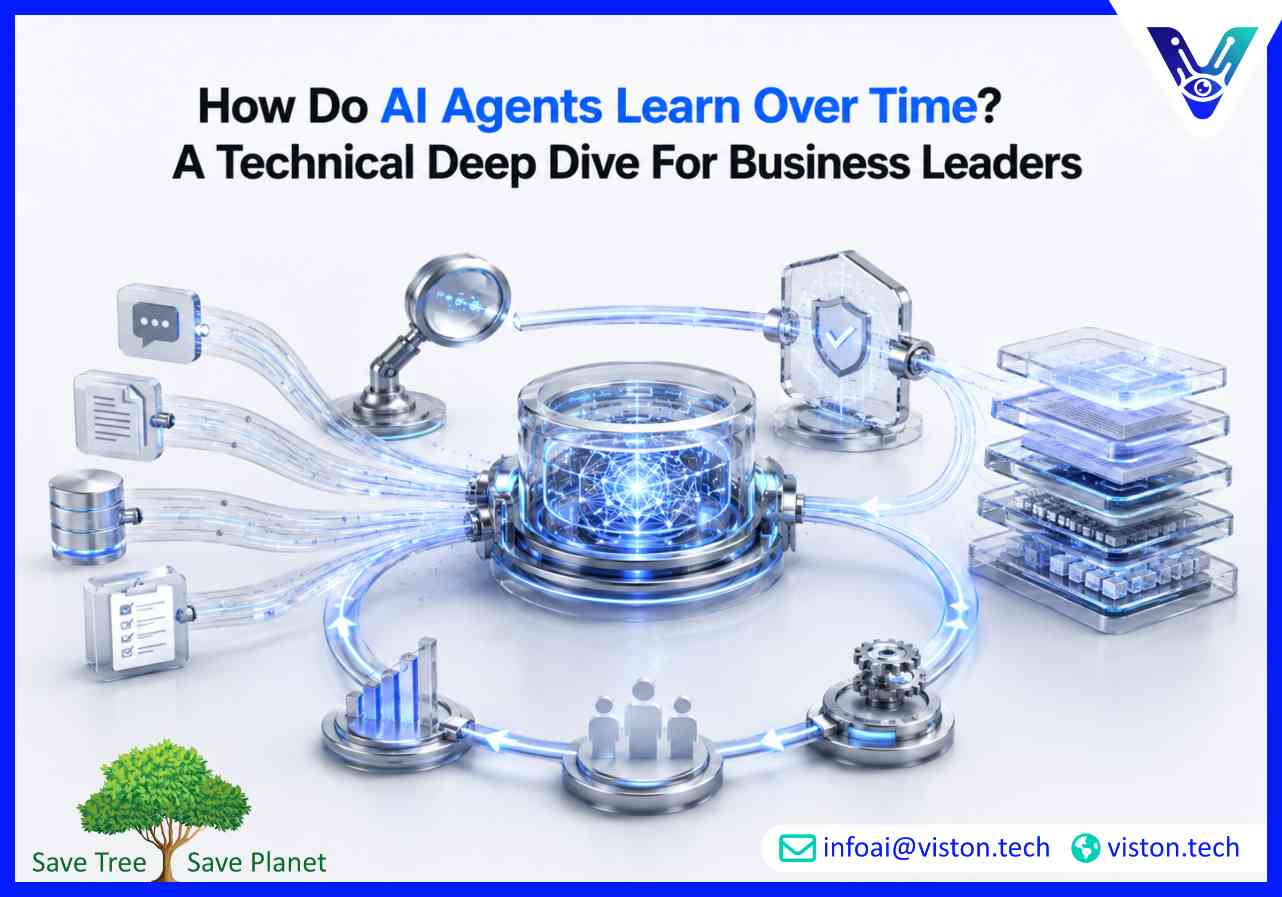
In 2026, the difference between a brittle automation script and a valuable enterprise asset is the ability to learn. For business leaders evaluating AI Agent Development & Deployment, understanding the mechanisms behind continuous improvement is no longer theoretical—it is a commercial imperative. With projections suggesting AI agents will intermediate 90% of B2B buying by 2028, the adaptability of your autonomous systems directly impacts competitive advantage . This guide explains exactly how modern AI agents evolve, the architectures that enable it, and what decision-makers should look for in production-ready systems.
Traditional machine learning models are frozen in time. Once trained, they do not adapt to new market conditions, policy changes, or user preferences without costly retraining. AI agents, however, operate in a different paradigm. They learn over time through feedback loops that do not necessarily modify the underlying large language model (LLM) weights. Instead, agents learn by updating their context, memory stores, and reusable skills.
This is known as continual learning without parameter updates. As one 2026 research paper describes, agents can carry knowledge forward across interactions by externalizing learning into structured “skills” stored as plain-text files . When an agent encounters a new task, it retrieves relevant skills from its library, applies them, and then updates those skills based on the outcome. This closed-loop design enables improvement without the downtime or expense of retraining foundation models.
Through analyzing current deployments and academic literature, we can identify three primary ways enterprise-grade agents learn over time.
Anthropic recently introduced a feature called “dreaming” for its Claude Managed Agents platform, which exemplifies this mechanism. Dreaming is a scheduled process that reviews an agent’s past sessions, extracts patterns across them, and curates memories so agents improve over time . Critically, the agent writes learnings as structured “playbooks” that future sessions can reference. In a live demonstration, an autonomous drone-landing agent improved meaningfully overnight simply by reviewing its previous simulation runs and creating a descent playbook. No human wrote the new rules; the agent synthesized them from its own history.
For enterprises, this means agents can identify recurring mistakes and optimal workflows without manual reprogramming. Legal AI company Harvey saw task completion rates increase roughly sixfold after implementing similar reflective learning .
Perhaps the most practical learning mechanism for B2B environments is skill acquisition. Agents can construct, adapt, and improve task-specific skills through experience . In this architecture, agents start with elementary abilities, such as executing API calls or searching internal documentation. As the agent works, it distills successful patterns into new skills, expanding its library.
Academic frameworks like XSkill demonstrate a dual-stream approach: agents learn “experiences” (action-level guidance for specific tools) and “skills” (structured task-level guidance for planning) . When an agent retrieves and adapts this knowledge to a new visual or data context, it feeds usage history back into the accumulation loop, creating a self-improving cycle. For operations managers, this translates to agents that get faster at processing invoices or more accurate at triaging support tickets without explicit retraining.
The most sophisticated learning layer involves reinforcement learning (RL) optimized on live production data. Microsoft refers to this as the “signals loop”—capturing user interactions and product usage data in real time, then systematically integrating this feedback to refine model behavior . Products like GitHub Copilot achieved over a 30% improvement in code completion retention by fine-tuning models on hundreds of thousands of real-world samples and applying reinforcement learning.
CoreWeave has advanced this concept by closing the “training-to-inference gap,” enabling agents to improve using real-world data without lengthy offline evaluations . Their unified platform allows enterprises to ship agents that learn autonomously from production interactions, a capability they call the “superintelligence loop.” For CTOs, this represents the end of the build-test-freeze cycle and the beginning of systems that compound in capability over time.
Understanding how agents learn is only valuable if it connects to measurable results. Early enterprise deployments reveal specific improvements.
In supply chain management, agentic exception handling systems reduce response time from three to four hours to under twelve minutes by learning common disruption patterns . In healthcare administration, autonomous prior authorization agents compress a five-day cycle to under eighteen hours while improving first-submission completeness. In software development, multi-agent systems now process hundreds of builds simultaneously, with Netflix using them to analyze logs and automatically refine deployment scripts .
The common thread is that these systems do not require constant human instruction. They learn the nuances of your specific environment—your suppliers’ behavior, your customers’ preferences, your team’s communication patterns—and optimize accordingly.
Not all agent platforms learn equally. When assessing AI Agent Development & Deployment partners, business leaders should ask specific questions.
Does the agent learn without model retraining? The most production-ready systems use external memory and skill libraries, which are observable and auditable. Avoid black-box solutions where learning happens invisibly.
How are learning loops governed? In regulated industries, you need the ability to inspect what an agent has learned and roll back changes. Platforms should provide immutable audit trails of skill updates .
What triggers learning? Is it scheduled batch processing (overnight dreaming sessions) or real-time adaptation? The right answer depends on your use case. Financial trading requires near-instant adaptation; inventory optimization can benefit from daily reviews.
How are failures used for improvement? Advanced systems use a separate “grader” agent to evaluate outputs against rubrics, identifying gaps without bias . This separation of concerns produces more reliable learning than asking a single agent to critique its own work.
At Viston AI, we build AI Agent Development & Deployment specifically for adaptive, production-critical environments. We do not treat agents as static scripts. Our deployments incorporate external skill libraries that evolve with your operations, reflective learning loops that capture institutional knowledge, and observable feedback mechanisms that satisfy compliance requirements. Whether we are deploying autonomous agents for supply chain coordination, financial reconciliation, or customer operations, our architecture ensures systems improve with every interaction. For organizations in regulated or fast-moving industries, we provide the governance layer necessary to trust agent learning—auditable, reversible, and aligned with business objectives. We help clients move from pilot to production with systems that get more valuable over time, not less.
Not automatically. Most production systems use scheduled learning or trigger-based reflection to avoid instability. Continuous learning must be designed intentionally with evaluation rubrics and rollback capabilities .
Yes. Agents learn from internal data—past sessions, proprietary documents, and interaction logs. In secure enterprise environments, learning happens entirely within your infrastructure using techniques like reflective learning and skill distillation .
In our deployments, clients often see meaningful gains within one to two weeks of production use. Simple pattern recognition (like preferred workflows) emerges in days; complex strategic improvements may take several learning cycles .
Effective systems use separate “grader” agents or human-in-the-loop checkpoints to validate learning before deployment. Additionally, skill updates are typically versioned and reversible, allowing operators to roll back problematic changes .
Not necessarily. Modern agent platforms abstract the learning loop through orchestration layers and managed services. However, defining rubrics and governance rules does require operational expertise. Your development partner should handle the infrastructure .
The ability of AI agents to learn over time transforms them from automated helpers into strategic assets. By leveraging reflective learning, skill acquisition, and reinforcement from real-world signals, modern agents adapt to your business without constant reprogramming. For organizations evaluating AI Agent Development & Deployment, the key is to prioritize systems with observable, governable learning loops—not just raw intelligence. Viston AI specializes in building exactly these adaptive, production-ready agent systems, helping clients turn autonomous workflows into compounding competitive advantages. As 2026 progresses, the question is no longer whether your agents can learn, but how well you are preparing them to.
