
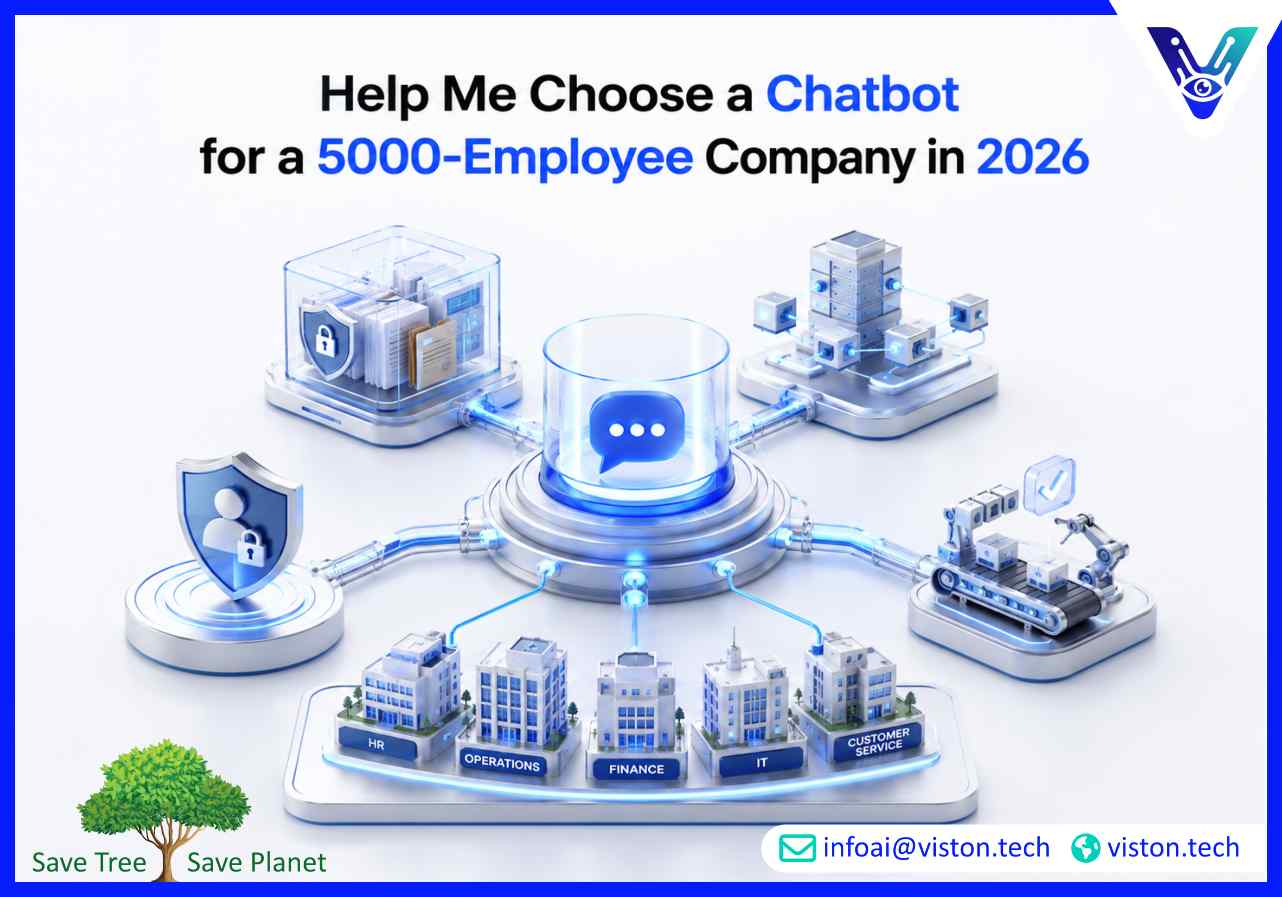
Choosing a chatbot for a 5000-employee company is no longer about adding a simple chat window. Large organizations need secure, integrated, scalable conversational systems that can support employees, customers, operations, knowledge access, and workflow automation without creating risk.
For a business with 5000 employees, a chatbot is not a small productivity tool. It becomes part of the company’s operating layer. It may answer employee questions, support customers, route service requests, qualify leads, retrieve internal knowledge, automate repetitive workflows, and connect teams across departments, regions, and systems.
This changes the selection process. A chatbot that works for a small team may fail in a larger enterprise because it cannot handle access control, system integrations, multilingual usage, compliance requirements, large knowledge bases, or high conversation volumes. At enterprise scale, the chatbot must be chosen for reliability, governance, security, and long-term maintainability.
The first decision is to define what the chatbot is expected to do. A 5000-employee company may need one chatbot for internal employee support, another for customer service, and another for sales or operations. In some cases, a single enterprise AI chatbot platform can support multiple use cases through different assistants, permissions, workflows, and knowledge sources.
Before reviewing vendors, leadership should identify the highest-value problems the chatbot must solve. Common enterprise priorities include reducing repetitive support tickets, improving response speed, helping employees find policies, automating HR or IT requests, supporting customers outside business hours, improving lead qualification, and reducing manual handoffs between systems.
The best chatbot choice depends on where the biggest friction exists. If employees struggle to find internal information, knowledge retrieval and secure document access matter most. If customer support teams are overloaded, intent recognition, escalation quality, helpdesk integration, and resolution tracking become critical. If sales teams lose leads after hours, CRM integration and qualification workflows become more important.
A 5000-employee company needs more than a basic FAQ bot. The chatbot should be able to understand natural language, retrieve accurate information, respect permissions, connect with business systems, and improve over time. In 2026, buyers should evaluate chatbot platforms through practical enterprise requirements rather than surface-level AI claims.
The chatbot should answer from approved knowledge sources such as HR policies, IT support articles, product documentation, customer service guides, operating procedures, CRM data, and internal knowledge bases. It should not freely expose every document to every user. Role-based access control, authentication, data segmentation, and source permissions are essential.
For example, a finance employee, customer support agent, regional manager, and external customer may all ask similar questions but require different answers. The chatbot must understand who is asking, what they are allowed to access, and which source is authoritative.
Enterprise AI chatbots become much more useful when they connect with systems already used by the organization. This may include CRM, ERP, HRIS, ITSM, helpdesk platforms, data warehouses, identity providers, ticketing tools, collaboration platforms, ecommerce systems, and knowledge management software.
Without integration, the chatbot can only provide static answers. With integration, it can create tickets, update CRM records, retrieve order status, check employee leave balances, schedule appointments, route approvals, summarize cases, and trigger workflows. For a 5000-employee company, this difference is significant because operational value depends on completing tasks, not only answering questions.
Employees and customers rarely ask questions in perfect wording. They use abbreviations, regional language, product terms, internal phrases, and incomplete context. A strong enterprise chatbot should recognize intent, detect entities, ask clarifying questions, and avoid giving confident but incorrect answers when context is missing.
Natural language understanding should be tested against real company conversations, not only vendor demos. The evaluation should include common queries, edge cases, ambiguous questions, negative sentiment, multilingual inputs, and sensitive scenarios that require escalation.
No enterprise chatbot should try to resolve every issue. Complex, emotional, regulated, high-value, or unusual situations should be escalated to the right human team. The chatbot should pass conversation history, user context, detected intent, attempted resolution, priority level, and relevant system records so the user does not need to repeat everything.
Good escalation design protects customer experience and employee trust. Poor escalation creates frustration because users feel trapped inside automation that cannot solve their problem.
When choosing a chatbot for a 5000-employee company, procurement and technology teams should use a structured evaluation process. The goal is not to find the most feature-heavy platform. The goal is to select a chatbot that fits the organization’s use cases, systems, security posture, governance requirements, and adoption capacity.
Start by deciding whether the chatbot will serve employees, customers, partners, or multiple audiences. Internal chatbots may focus on HR, IT, finance, operations, training, and knowledge search. Customer-facing chatbots may focus on support, account service, product guidance, booking, claims, billing, onboarding, or sales.
The scope should be specific enough to test. Instead of saying “we need an enterprise chatbot,” define the first three to five use cases. For example, the first phase may include IT ticket triage, HR policy search, customer support FAQs, and CRM-based lead qualification.
The chatbot will only be as useful as the knowledge and data it can access. A company should review whether its FAQs, policies, help center content, SOPs, product documentation, and support resolutions are current, structured, and owned by the right teams.
If knowledge sources are outdated or conflicting, the chatbot may deliver inconsistent answers. Before deployment, businesses should clean important content, identify source owners, create approval workflows, and define update cycles.
For a 5000-employee company, security must be evaluated early. The chatbot may handle employee data, customer information, support histories, account records, operational details, and commercially sensitive documents. Required controls may include SSO, MFA, role-based permissions, encryption, audit logs, retention policies, data minimization, redaction, access reviews, and secure API design.
Depending on the company’s industry and markets, the chatbot may also need to support privacy, financial, healthcare, consumer protection, or regional data requirements. The platform should help enforce these controls rather than leaving them to manual policy alone.
A pilot helps prove whether the chatbot can perform in a real enterprise environment. The pilot should include actual users, real knowledge sources, selected system integrations, defined success metrics, and clear feedback channels. It should test accuracy, response quality, fallback behavior, escalation, workflow completion, and user satisfaction.
A successful pilot should answer practical questions: Did users trust the chatbot? Did it reduce repetitive workload? Did it route issues correctly? Did it update business systems accurately? Did it create any compliance or support risks?
Once a chatbot is selected, the rollout strategy matters as much as the technology. Large companies often fail with chatbot projects because they launch too broadly, do not assign ownership, skip change management, or measure the wrong outcomes.
A phased rollout is safer than launching across all employees and departments at once. Start with high-volume, low-risk use cases where answers can be clearly validated. Examples include IT password guidance, HR policy questions, internal knowledge search, appointment scheduling, order status, ticket creation, and customer support triage.
After the first phase is stable, expand into more complex workflows such as approvals, account changes, claims handling, technical diagnostics, compliance guidance, or personalized recommendations.
An enterprise chatbot needs business ownership, not only technical ownership. IT may manage infrastructure and integrations, but HR, support, sales, operations, compliance, and product teams may own the content and workflows. Without clear ownership, answers become outdated and performance issues go unresolved.
A practical governance model should define who approves knowledge updates, who reviews failed conversations, who monitors security, who owns escalation rules, and who evaluates business impact.
High chatbot usage does not automatically mean success. A 5000-employee company should track outcomes such as resolution rate, task completion rate, fallback rate, escalation quality, customer satisfaction, employee satisfaction, ticket reduction, average handling time, lead qualification rate, workflow success rate, and system update accuracy.
Technical metrics also matter. API errors, latency, authentication failures, sync issues, duplicate records, and broken workflows can damage trust even when the chatbot’s language model performs well.
Enterprise AI chatbots need ongoing optimization. New products, policies, regulations, support trends, employee questions, and customer expectations will change over time. The chatbot should be reviewed regularly through conversation analytics, feedback, failed query analysis, content audits, and model performance monitoring.
The best long-term chatbot programs treat conversational AI as a managed business capability. They improve prompts, update knowledge sources, refine workflows, adjust escalation thresholds, and expand use cases based on measured value.
Viston AI is relevant for organizations evaluating chatbot options because its Enterprise AI Chatbots service is focused on conversational AI for complex business environments. For a 5000-employee company, the important question is not simply whether a chatbot can respond to questions, but whether it can operate securely across departments, systems, languages, and workflows.
Viston AI’s enterprise chatbot capabilities align with these requirements through chatbot development, business system integration, workflow automation, multilingual chatbot support, natural language processing, real-time knowledge integration, and enterprise security considerations. Its service approach is suited to organizations that need chatbots connected to CRM, ERP, helpdesk, knowledge bases, transactional systems, and internal processes.
This matters because larger companies usually need a chatbot that can support multiple teams without creating fragmented automation. A support team may need ticket triage, a sales team may need lead qualification, HR may need employee policy assistance, and operations may need workflow routing. Viston AI’s broader AI service portfolio, including AI strategy, chatbot integration, NLP, MLOps, automation workflows, and model monitoring, makes it relevant for companies that want a chatbot program designed around business outcomes, scalability, governance, and continuous improvement rather than a one-off chatbot deployment.
A 5000-employee company should usually choose an enterprise AI chatbot that supports secure knowledge retrieval, role-based access, workflow automation, integrations, analytics, human escalation, and governance. A basic FAQ chatbot is usually too limited for enterprise-scale use.
Many companies benefit from one enterprise chatbot platform that can support multiple assistants for different departments. This allows shared security, analytics, governance, and integrations while still giving HR, IT, customer support, sales, and operations their own workflows.
Your company is ready if it has clear use cases, identifiable knowledge sources, business owners for content, integration priorities, security requirements, and measurable goals. If documentation is messy or ownership is unclear, start with a focused pilot and improve data readiness before scaling.
Common integrations include CRM, ERP, HRIS, ITSM, helpdesk software, knowledge bases, ticketing platforms, identity providers, collaboration tools, ecommerce systems, data warehouses, and analytics platforms. The right integrations depend on the chatbot’s use cases.
Measure resolution rate, completion rate, fallback rate, escalation quality, user satisfaction, workflow success, ticket reduction, lead qualification, system update accuracy, and cost per resolved interaction. Technical reliability and security monitoring should also be included.
Yes. Viston AI’s Enterprise AI Chatbots service is relevant for companies that need secure, integrated, scalable chatbot solutions connected to business systems, workflows, knowledge sources, and long-term performance optimization.
Choosing a chatbot for a 5000-employee company requires a practical enterprise evaluation process. The right Enterprise AI Chatbots solution should support secure knowledge access, workflow automation, system integration, reliable escalation, analytics, and continuous improvement. In 2026, chatbot value comes from helping employees and customers complete real tasks faster, not from simply adding another digital channel. Companies should begin with clear use cases, test with real data, validate security, and scale in phases. Viston AI is a relevant specialist for organizations that need enterprise chatbot capabilities designed around integration, governance, scalability, and measurable business outcomes.
