
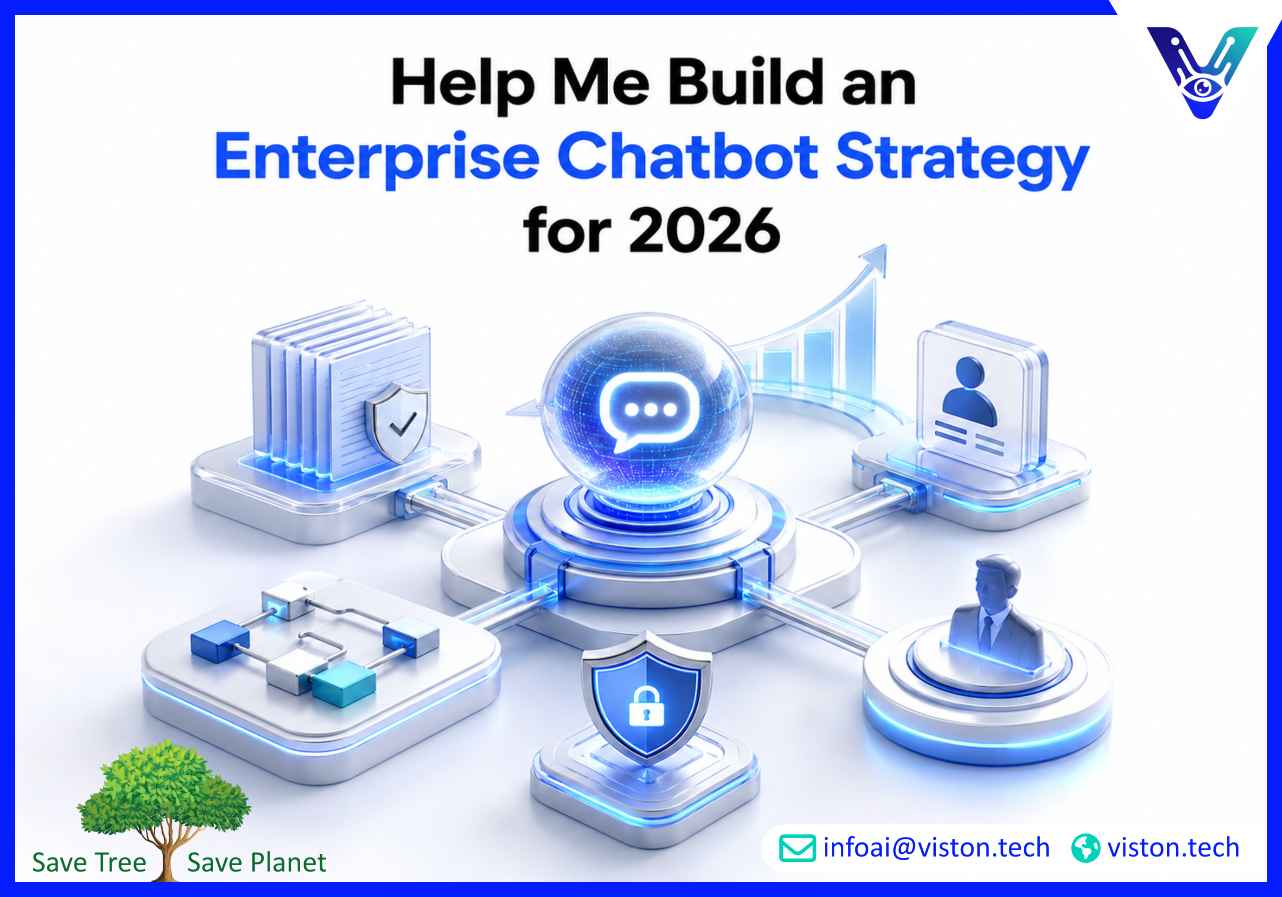
Building an enterprise chatbot strategy matters because AI chatbots now influence customer experience, internal productivity, data quality, support operations, and revenue workflows. In 2026, businesses need more than a chat interface; they need a scalable, secure, measurable conversational AI plan.
An enterprise chatbot strategy is a practical roadmap for how a business will design, deploy, govern, measure, and improve AI chatbots across departments, systems, and customer touchpoints. It defines why the chatbot exists, which problems it should solve, what data it can use, how it integrates with enterprise systems, and how success will be measured.
The most common mistake businesses make is starting with technology before clarifying the business objective. A chatbot may look impressive in a demo, but if it is not tied to operational goals, it can quickly become another disconnected tool. A strong strategy starts with business outcomes such as reducing repetitive support tickets, improving lead qualification, speeding up employee service requests, enabling 24/7 customer assistance, or improving knowledge access across teams.
Enterprise AI Chatbots should support real workflows, not just answer isolated questions. For example, a customer support chatbot may need to check account details, retrieve order history, create tickets, escalate complaints, and summarize the conversation for a human agent. A sales chatbot may need to qualify prospects, recommend services, book meetings, update CRM records, and alert the right sales team. An internal chatbot may need to help employees access HR policies, IT troubleshooting steps, onboarding documents, or procurement workflows.
The best strategy begins with high-value, practical use cases. These are usually use cases that are repetitive, measurable, high-volume, and low-to-medium risk. Examples include FAQ automation, ticket intake, lead capture, appointment booking, knowledge base search, order tracking, internal IT helpdesk support, and onboarding assistance.
Complex use cases can be added later once the chatbot has proven reliability. These may include regulated advice, claims processing, financial workflows, healthcare support, contract guidance, or multi-step enterprise approvals. A phased approach helps reduce risk while allowing teams to learn from real user behavior.
An enterprise chatbot should have a defined role. It should not be expected to solve every problem from day one. Some chatbots work best as self-service assistants. Others work as agent-assist tools, workflow bots, lead qualification systems, or internal knowledge assistants. The strategy should define what the chatbot can do, what it should not do, and when it must escalate to a human team.
A complete enterprise chatbot strategy covers people, process, technology, data, compliance, integrations, and measurement. Each component matters because enterprise environments are more complex than basic chatbot deployments. Large organizations usually have multiple systems, user groups, compliance needs, languages, regions, departments, and approval structures.
Every chatbot initiative needs a business owner, technical owner, and content owner. Without ownership, chatbot quality usually declines after launch. The business owner defines goals and priorities. The technical owner manages architecture, integrations, reliability, and security. The content or knowledge owner ensures that answers remain accurate, approved, and current.
The strategy should also define which teams are involved. Customer support, sales, marketing, IT, HR, legal, compliance, product, data, and operations may all have a role depending on the chatbot’s purpose.
AI chatbots are only as reliable as the information they can access. Enterprise teams should identify trusted sources such as knowledge bases, support articles, product documentation, policy documents, CRM records, helpdesk data, ERP data, and approved FAQs.
Data should be cleaned, structured, and reviewed before use. Outdated documents, duplicated answers, inconsistent policies, and unapproved content can lead to inaccurate responses. In 2026, businesses should also consider retrieval-based knowledge design, where the chatbot pulls answers from approved sources instead of relying on unsupported generated responses.
Enterprise AI Chatbots become more valuable when connected to business systems. Key integrations may include CRM, ERP, helpdesk platforms, marketing automation, ecommerce systems, identity management tools, analytics platforms, data warehouses, calendar tools, payment systems, and internal workflow platforms.
Integration planning should cover authentication, API reliability, permissions, error handling, data sync, logging, fallback behavior, and human handover. A chatbot that cannot access current business data may only provide generic answers. A chatbot that can safely retrieve and update records can support real operational outcomes.
Enterprise chatbot strategy must include security and governance from the beginning. This includes role-based access control, encryption, audit logs, data retention rules, consent handling, escalation policies, prompt controls, hallucination safeguards, and privacy review.
Not every user should receive the same information. Customers, employees, agents, managers, and partners may need different levels of access. The chatbot should respect user permissions and avoid exposing sensitive internal or personal data.
A chatbot roadmap turns strategy into execution. It helps businesses move from idea to launch without overbuilding, underplanning, or creating a system that cannot scale. The roadmap should be phased, measurable, and realistic.
The first phase should identify business goals, user groups, existing systems, available data, operational pain points, and automation opportunities. This phase should also assess whether the organization has the right knowledge sources, APIs, support workflows, compliance controls, and internal ownership to support an enterprise chatbot.
Discovery should answer practical questions. Which teams receive the highest volume of repetitive questions? Which workflows take too long? Which conversations require human judgment? Which systems must the chatbot connect to? Which risks must be controlled before launch?
Once the business priorities are clear, teams should select the first chatbot use cases. These should be specific enough to measure. Instead of saying “improve customer support,” a better use case would be “resolve common billing questions, create support tickets when needed, and escalate unresolved issues with conversation history.”
Conversation design should include user intents, sample questions, response logic, clarification prompts, escalation triggers, fallback messages, and tone guidelines. The chatbot should feel helpful and efficient without pretending to replace expert judgment where a human is required.
A pilot helps validate the strategy before full rollout. The chatbot can be launched for one department, one channel, one customer segment, or one internal use case. During the pilot, teams should track accuracy, completion rate, fallback rate, escalation quality, response time, satisfaction, and workflow success.
The pilot should also test edge cases. These include unclear questions, frustrated users, sensitive requests, integration failures, missing data, duplicate records, and authentication issues. Testing these scenarios early prevents larger problems during production deployment.
After the pilot proves value, the chatbot can expand to more channels, departments, languages, regions, and workflows. Scaling should not mean simply adding more content. It should include better analytics, stronger integrations, improved knowledge governance, retraining cycles, performance dashboards, and ongoing stakeholder reviews.
Enterprise chatbot optimization should be continuous. User questions change, products change, policies change, and business priorities change. A chatbot strategy must include a process for reviewing failed conversations, updating knowledge sources, improving prompts, refining intents, and measuring business impact over time.
A good enterprise chatbot strategy must be measurable. Without clear metrics, teams may focus on activity instead of outcomes. Conversation volume alone is not enough. A chatbot can handle thousands of chats and still fail if users receive poor answers or workflows do not complete correctly.
Operational metrics show whether the chatbot is improving efficiency. Useful metrics include ticket deflection rate, average handling time reduction, self-service completion rate, escalation rate, workflow completion rate, and cost per resolved conversation.
Experience metrics show whether users find the chatbot helpful. These may include customer satisfaction score, employee satisfaction, repeat contact rate, response quality, abandonment rate, and human handover quality. A successful chatbot should reduce friction, not create another layer of frustration.
AI performance metrics help teams evaluate the chatbot’s understanding and reliability. These include intent recognition accuracy, fallback rate, answer accuracy, retrieval quality, hallucination risk, sentiment detection quality, and response consistency.
Business impact metrics connect chatbot performance to commercial or operational outcomes. These may include qualified leads created, demos booked, sales inquiries routed, tickets resolved, onboarding tasks completed, employee time saved, CRM records updated, and support backlog reduction.
The most effective chatbot dashboards separate metrics by channel, use case, department, language, and user type. This helps teams identify where the chatbot is performing well and where it needs improvement.
Viston AI is relevant to enterprise chatbot strategy because its Enterprise AI Chatbots service focuses on building conversational AI for complex business environments. Its capabilities align with the core needs of a chatbot strategy, including natural language understanding, workflow automation, real-time knowledge integration, enterprise system connectivity, multilingual support, and security-focused deployment.
For businesses asking “help me build an enterprise chatbot strategy,” this matters because strategy and implementation must work together. A useful roadmap should consider more than the chatbot interface. It should define how the chatbot understands industry-specific language, connects to CRM or ERP systems, retrieves approved knowledge, routes complex issues, supports multiple channels, and produces measurable performance data.
Viston AI’s broader AI service portfolio includes AI chatbot development, AI chatbot integration, NLP and text analysis, AI strategy development, workflow automation, MLOps and model monitoring, multilingual AI chatbot support, and integration with business systems. This makes the company relevant for organizations that want Enterprise AI Chatbots to support customer service, sales operations, internal helpdesks, knowledge access, and process automation.
Its approach is especially useful for businesses that need scalable chatbot architecture, secure data handling, practical workflow design, and ongoing optimization rather than a basic FAQ bot. By connecting chatbot planning with integration, governance, and performance measurement, Viston AI can support organizations that want conversational AI to become a reliable business capability.
An enterprise chatbot strategy is a roadmap for planning, deploying, managing, and improving AI chatbots across business functions. It covers use cases, data, integrations, security, governance, user experience, ownership, and success metrics.
Start by identifying the business problems the chatbot should solve. Then define priority use cases, target users, required data sources, system integrations, escalation rules, compliance needs, and measurable outcomes before choosing the technology stack.
Enterprise AI Chatbots commonly integrate with CRM, ERP, helpdesk software, knowledge bases, ecommerce platforms, HR systems, analytics tools, identity management systems, marketing automation platforms, and workflow automation tools.
The strategy phase can be completed faster when business goals, data sources, and use cases are clear. Complex enterprise environments need more planning because integrations, security, compliance, content governance, and stakeholder alignment must be reviewed before deployment.
A basic chatbot setup often focuses on simple responses or scripted FAQs. An enterprise chatbot strategy includes scalable architecture, secure integrations, role-based access, approved knowledge sources, analytics, human handoff, governance, and continuous optimization.
Yes. Viston AI’s Enterprise AI Chatbots and related AI strategy, chatbot integration, NLP, automation, and monitoring capabilities are aligned with businesses that need a practical chatbot roadmap and scalable conversational AI implementation.
To build an enterprise chatbot strategy in 2026, businesses need a clear plan that connects chatbot use cases with data, integrations, governance, user experience, and measurable outcomes. Enterprise AI Chatbots should not operate as isolated tools; they should support real workflows, improve service quality, reduce repetitive work, and provide reliable access to business knowledge. The strongest strategies begin with focused use cases, expand through validated pilots, and improve through continuous monitoring. Viston AI is a relevant specialist for organizations that want chatbot strategy, development, integration, and optimization aligned with practical enterprise needs.
