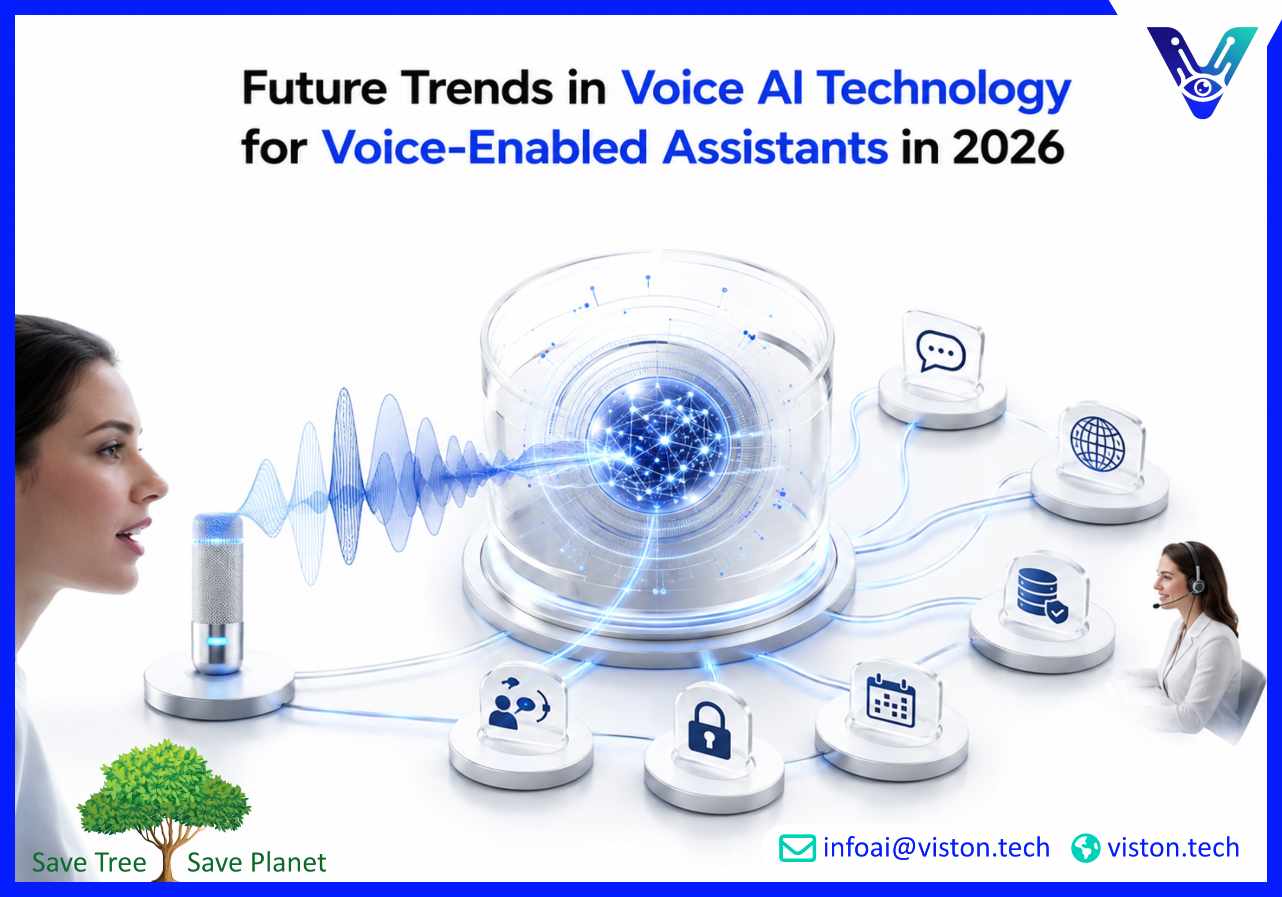
Future Trends in Voice AI Technology for Voice-Enabled Assistants in 2026
Future trends in voice AI technology are changing how businesses design customer support, sales conversations, internal automation, and hands-free digital workflows. In 2026, Voice-Enabled Assistants are moving from simple speech commands to intelligent, integrated, multilingual, and outcome-focused business systems.
Future Trends in Voice AI Technology and What They Mean for Businesses
Voice AI is no longer limited to basic call routing, scripted phone menus, or simple “ask and answer” experiences. Businesses are now looking at voice as a practical interface for customer service, employee support, sales qualification, appointment handling, knowledge search, workflow automation, and operational assistance.The most important shift is that voice technology is becoming more conversational and more connected to business systems. A modern voice-enabled assistant must understand natural language, handle interruptions, recognize intent, retrieve accurate information, complete tasks, and escalate smoothly when human support is needed.This matters because customers and employees do not want to learn system commands. They want to speak naturally and receive useful support without waiting in queues, repeating information, or navigating rigid IVR menus. For business leaders, this creates an opportunity to improve accessibility, response speed, service consistency, and operational efficiency.
Voice AI is becoming a business workflow layer
The future of voice AI is not only about better speech recognition. It is about connecting speech to action. A voice assistant that can answer a question is useful. A voice assistant that can check an order, update a CRM record, book an appointment, create a support ticket, verify a policy, or summarize a call is far more valuable.This is why businesses are evaluating voice AI through a practical lens. They want to know whether the technology can reduce repetitive work, improve customer experience, support multilingual users, protect sensitive data, and operate reliably across channels.
Voice interfaces are becoming more natural
In earlier voice automation, users had to adapt to the system. They were asked to speak in short commands, choose from numbered options, or repeat phrases until the system understood them. In 2026, the expectation is different. Voice-enabled assistants must adapt to the user’s speech patterns, intent, context, tone, language, and urgency.This creates new technical requirements. Businesses need stronger natural language understanding, real-time speech processing, context management, interruption handling, sentiment detection, and knowledge grounding. Voice AI must also understand when not to answer and when to involve a human agent.
Trend 1: Real-Time, Low-Latency Voice Experiences
One of the strongest future trends in voice AI technology is the demand for faster, more natural conversation. Delays of several seconds can make a voice assistant feel robotic, unreliable, or frustrating. In customer-facing environments, latency directly affects trust.Low-latency voice AI depends on multiple components working together: automatic speech recognition, language understanding, response generation, retrieval from business knowledge, text-to-speech, telephony infrastructure, and system integrations. If one layer is slow, the full experience suffers.
Why latency matters for customer experience
Voice conversations are different from text chat. In a chat window, a short delay may feel acceptable. In a phone conversation, silence feels awkward almost immediately. Customers may interrupt, repeat themselves, or abandon the call if the assistant pauses too long.Businesses implementing Voice-Enabled Assistants should therefore measure response speed alongside accuracy. A fast but inaccurate assistant creates risk. An accurate but slow assistant creates friction. The goal is a balanced experience where the assistant responds quickly, confirms important details, and handles complex queries without sounding rushed.
Streaming speech recognition and response generation
Modern voice AI systems are moving toward streaming architectures, where the system begins processing speech while the user is still speaking. This allows faster intent detection and smoother turn-taking. Instead of waiting for a full sentence to finish, the assistant can prepare context, retrieve data, and respond more naturally.This trend is especially important for contact centers, healthcare administration, financial services, logistics, field support, and appointment-driven businesses where every second affects service quality and operating cost.
Trend 2: Agentic Voice Assistants That Can Complete Tasks
The next stage of voice AI is agentic capability. This means a voice-enabled assistant can do more than respond with information. It can follow a process, make decisions within defined rules, use tools, call APIs, update systems, and complete business workflows with appropriate guardrails.For example, a customer could call to reschedule an appointment. A basic voice bot might explain the policy. An agentic voice assistant can identify the customer, check availability, confirm the new time, update the booking system, send a confirmation, and record the interaction in the CRM.
From conversation handling to workflow execution
Task-capable voice assistants are valuable because many business conversations are not just informational. They involve actions. Customers want refunds, bookings, account updates, order tracking, troubleshooting, renewals, cancellations, quotes, or service requests. Employees want policy answers, IT support, HR guidance, reporting help, or workflow approvals.To support these needs, voice AI must connect with business systems such as CRM platforms, helpdesk tools, ERP systems, calendars, payment systems, ecommerce platforms, knowledge bases, and internal workflow tools.
Guardrails become essential
As voice assistants take action, governance becomes more important. Businesses need clear rules for what the assistant can do independently, what requires confirmation, and what must be escalated. Sensitive actions such as payment changes, account closure, medical advice, legal requests, financial decisions, or compliance-related processes should include strong controls.Effective guardrails may include identity verification, role-based permissions, confidence thresholds, audit logs, human approval steps, fallback paths, and real-time monitoring. In 2026, these controls are not optional extras. They are part of responsible voice AI implementation.
Trend 3: Multilingual, Multimodal, and Emotion-Aware Voice AI
Another major trend is the expansion of voice AI across languages, accents, channels, and interaction types. Businesses serving global or diverse audiences cannot rely on one-language voice automation. They need assistants that can support multilingual users without losing accuracy, tone, or context.Voice AI is also becoming more multimodal. A user may begin with a phone call, receive a link by SMS, continue on WhatsApp, upload an image, and complete the process through a web portal. The assistant must maintain context across these touchpoints instead of treating each interaction as separate.
Multilingual voice support is becoming a buyer expectation
Multilingual support is especially important for customer service, travel, healthcare, financial services, ecommerce, education, public services, and international B2B operations. Buyers want voice assistants that recognize accents, handle code-switching, understand regional terminology, and provide culturally appropriate responses.This requires more than translation. It requires localized training data, pronunciation tuning, multilingual knowledge bases, language-specific escalation routing, and compliance awareness across regions.
Emotion and sentiment signals will guide better escalation
Voice carries signals that text often misses. Tone, pace, hesitation, frustration, stress, and repeated correction can indicate whether a user needs human support. Future voice-enabled assistants will increasingly use sentiment and emotion signals to improve routing and service quality.This does not mean every emotional signal should trigger automation. Businesses should use sentiment carefully and ethically. The practical goal is to detect when a conversation is becoming sensitive, urgent, or unsuccessful, then escalate with full context so the human agent can respond appropriately.
Multimodal journeys will reduce repeated effort
Many voice interactions are easier when supported by visual or text-based steps. A customer may speak to a voice assistant but need a payment link, form, document upload, map, product image, or appointment confirmation. The strongest voice AI experiences will blend speech with digital follow-up instead of forcing everything into the call.This trend helps businesses improve completion rates. Instead of asking users to spell long email addresses, policy numbers, or product codes repeatedly over the phone, the assistant can move specific steps to a secure digital channel while keeping the conversation connected.
Trend 4: Voice AI Governance, Security, and Performance Measurement
As voice AI becomes more capable, businesses must treat it as an operational system, not a novelty interface. A voice-enabled assistant can affect customer trust, data privacy, brand reputation, sales quality, compliance, and service outcomes. This makes governance and measurement central to future adoption.Business leaders should evaluate voice AI based on accuracy, latency, completion rate, escalation quality, containment rate, customer satisfaction, workflow success, security controls, and integration reliability. A voice assistant that sounds impressive but fails to complete tasks or protect data is not ready for serious business use.
Security and privacy expectations are rising
Voice AI systems may process personal data, account details, call recordings, authentication information, payment-related queries, health details, employee records, or confidential business information. This means businesses need careful data handling from the start.Important controls include call recording policies, consent flows, data minimization, encryption, access control, retention rules, PII redaction, secure integrations, audit trails, and region-specific compliance review. These safeguards are especially important in regulated industries and global markets.
Knowledge grounding will reduce inaccurate answers
One of the biggest risks in AI-assisted conversations is generating answers that sound confident but are not grounded in approved business information. Future-ready voice assistants should retrieve responses from trusted sources such as product documentation, policy libraries, CRM records, order systems, help center content, and approved workflows.Grounded voice AI helps businesses maintain consistency. It also makes updates easier. When pricing, policies, availability, procedures, or compliance requirements change, the assistant should rely on updated source systems rather than outdated training examples.
Performance monitoring will drive continuous improvement
Voice AI performance should be reviewed continuously. Teams should analyze failed intents, fallback queries, customer interruptions, escalation reasons, sentiment changes, call completion, average handling time, and workflow errors. These insights help improve prompts, training data, knowledge coverage, conversation design, and system integrations.The most successful businesses will not launch a voice assistant and leave it unchanged. They will manage it like a live service channel with regular optimization, governance reviews, and measurable business outcomes.
How Viston AI Supports Future-Ready Voice-Enabled Assistants
Viston AI is relevant to future trends in voice AI technology because its Voice-Enabled AI Assistants service is aligned with the direction business buyers are moving toward: conversational AI that combines speech recognition, natural language processing, LLMOps infrastructure, multilingual support, analytics, and enterprise system integration.For organizations planning voice AI in 2026, this matters because the value of a voice assistant depends on more than speech quality. It must understand intent, manage multi-turn dialogue, retrieve trusted knowledge, connect with business systems, monitor performance, and support secure automation at scale. Viston AI positions its voice-enabled assistant capabilities around intelligent voice interactions, natural language understanding, speech recognition, real-time analytics, LLMOps orchestration, and integration with platforms such as CRM, ERP, helpdesk, and business applications.Its broader AI service portfolio also includes enterprise AI chatbots, multilingual support, AI chatbot integration, NLP and text analysis, agentic workflows, automation bots, model monitoring, and AI strategy services. This makes the company relevant for businesses that want voice AI to support customer service, sales operations, employee assistance, workflow automation, and multilingual engagement rather than operate as a disconnected voice tool.For global B2B teams, Viston AI’s practical relevance is strongest where companies need voice-enabled assistants that are reliable, integrated, measurable, and designed around real business processes.
Frequently Asked Questions
What are the biggest future trends in voice AI technology?
The biggest trends include low-latency conversations, agentic voice assistants, multilingual support, multimodal journeys, emotion-aware escalation, secure system integration, knowledge-grounded answers, and continuous performance monitoring.
How will voice AI change customer service in 2026?
Voice AI will help customer service teams automate routine calls, reduce wait times, improve self-service, collect caller context before escalation, support multiple languages, and connect conversations with CRM and helpdesk workflows.
What makes modern Voice-Enabled Assistants different from IVR systems?
Traditional IVR systems usually rely on fixed menus and predefined options. Modern Voice-Enabled Assistants use speech recognition, natural language understanding, generative AI, workflow automation, and business system integrations to handle more flexible conversations.
Why is low latency important in voice AI?
Low latency makes conversations feel natural. Long pauses can frustrate users, increase interruptions, and reduce trust. Businesses should optimize voice AI for both fast response times and accurate, context-aware answers.
Do businesses need multilingual voice AI?
Multilingual voice AI is important for businesses serving diverse regions, international customers, or multilingual workforces. It helps improve accessibility, customer satisfaction, and service consistency across languages and accents.
Can Viston AI help businesses build future-ready voice assistants?
Yes. Viston AI’s Voice-Enabled Assistants service is relevant for businesses that need conversational voice AI connected to NLP, speech recognition, multilingual support, analytics, LLMOps, and business system integration.
Conclusion
Future trends in voice AI technology show that Voice-Enabled Assistants are becoming more natural, intelligent, secure, multilingual, and operationally useful. The strongest business use cases will come from voice AI that can understand real conversations, connect with enterprise systems, complete workflows, escalate responsibly, and improve through performance data. In 2026, companies should evaluate voice AI not only by how human it sounds, but by how reliably it supports customer experience, productivity, compliance, and measurable business outcomes. Viston AI is a relevant specialist for organizations exploring voice-enabled assistants that need practical integration, scalable delivery, and business-focused implementation.