
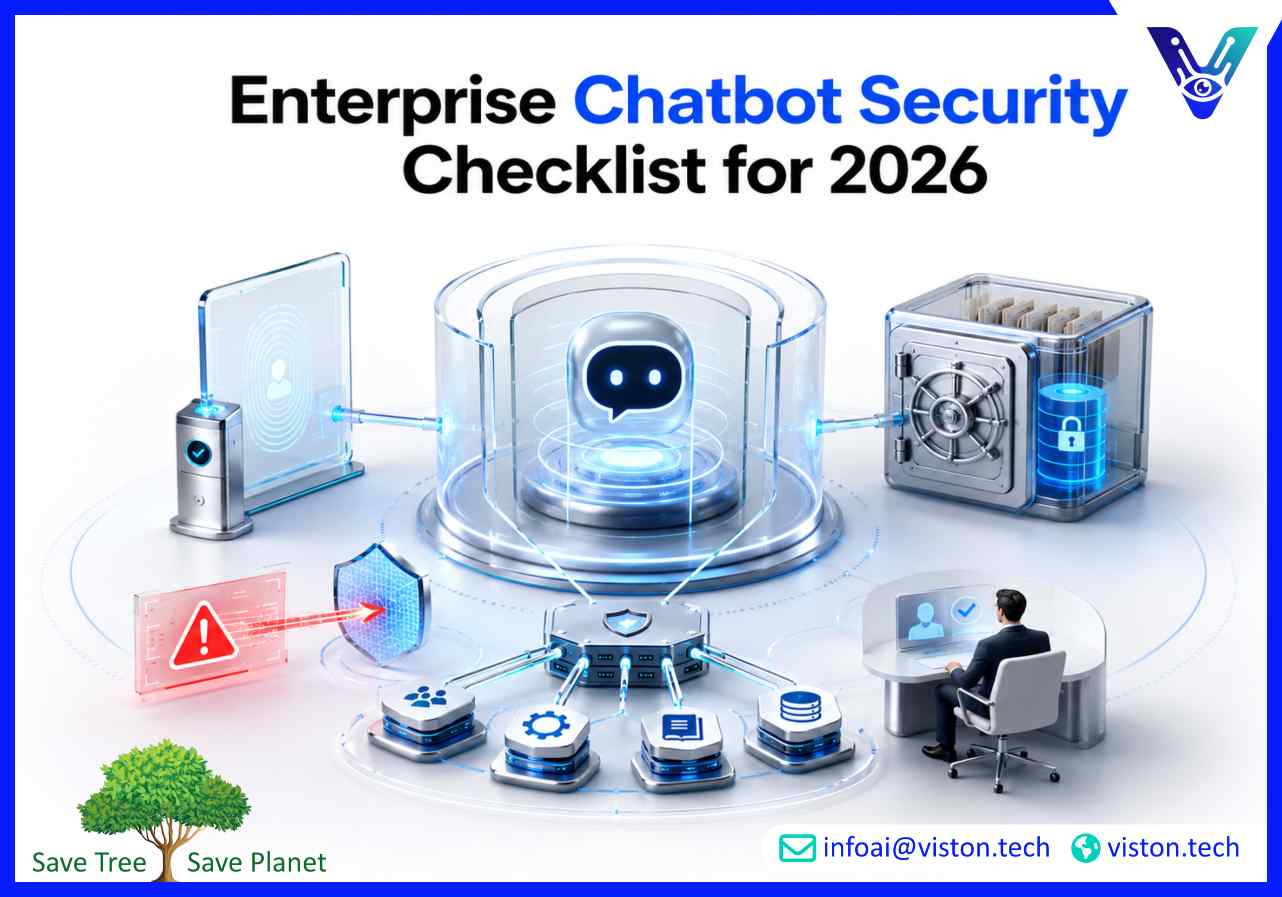
An enterprise chatbot security checklist helps businesses deploy conversational AI without exposing customer data, internal systems, workflows, or brand trust. As chatbots become connected to CRMs, ERPs, knowledge bases, helpdesks, and transaction systems, security must be designed before launch, not repaired after failure.
Enterprise chatbots are no longer simple FAQ tools. In 2026, many organizations use AI chatbots to answer customer questions, qualify leads, assist employees, retrieve internal knowledge, create tickets, update records, trigger workflows, and support service operations across multiple channels. That makes chatbot security a business risk, not only a technical concern.
The risk increases when a chatbot has access to sensitive information, customer profiles, financial records, healthcare data, contracts, internal policies, pricing logic, or operational systems. If access controls are weak, a chatbot can expose data to the wrong user. If prompt handling is poor, attackers may try to manipulate the system into ignoring instructions. If integrations are over-permissioned, a chatbot may be able to perform actions beyond its intended role.
Security expectations have also matured. The OWASP Top 10 for LLM Applications 2025 highlights AI-specific risks including prompt injection, sensitive information disclosure, supply chain weaknesses, data and model poisoning, improper output handling, excessive agency, system prompt leakage, vector and embedding weaknesses, misinformation, and unbounded consumption.
For enterprise leaders, the takeaway is clear: chatbot security needs layered controls. Traditional application security is still required, but it is not enough on its own. A secure enterprise chatbot also needs AI-specific governance, privacy controls, access boundaries, monitoring, human escalation, model evaluation, data lifecycle management, and integration security.
A practical checklist should protect five areas: user data, company knowledge, connected systems, AI behavior, and operational accountability. Each area requires controls that can be tested, monitored, and improved over time.
The goal is not to eliminate every possible risk. The goal is to reduce avoidable exposure, define safe operating boundaries, detect misuse quickly, and ensure the chatbot supports business workflows without becoming an uncontrolled access point.
The most important security decisions happen before the chatbot goes live. Businesses should complete a structured pre-deployment review that covers data, access, architecture, AI behavior, integrations, and user experience.
Start by documenting exactly what the chatbot is allowed to do. A support chatbot may answer product questions and create tickets, while a sales chatbot may qualify leads and schedule meetings. An internal chatbot may retrieve policy documents but should not expose restricted HR, finance, or legal information unless strong authorization is in place.
The scope should define permitted intents, restricted topics, available systems, escalation rules, and forbidden actions. This reduces the risk of excessive agency, where an AI system is given more authority than the business can safely govern.
Before connecting a chatbot to any database, document the types of data it can see, process, store, or generate. Separate public information, internal information, confidential information, personal data, regulated data, and high-risk business data.
The chatbot should only access the minimum data required for its task. For example, an order-status chatbot may need order ID, delivery status, and customer authentication confirmation. It does not need full payment details, internal fraud notes, or unrelated customer history.
Enterprise chatbots should not treat every user the same. Customers, employees, agents, administrators, and partners need different permissions. Role-based access control, single sign-on, multi-factor authentication, and session management should be used where appropriate.
Authorization must also apply inside conversations. A user should not be able to retrieve another customer’s data by changing an account number, email address, or order reference in chat. Every sensitive response should be checked against the user’s verified identity and permitted access level.
Many enterprise chatbot failures come from weak integration design. The chatbot should connect to backend systems through secure APIs, not direct uncontrolled database access. API gateways, token-based authentication, scoped permissions, rate limiting, request validation, and audit logging should be part of the architecture.
Each integration should be reviewed for read and write permissions. If the chatbot only needs to check ticket status, it should not have permission to delete tickets. If it creates CRM leads, it should not have unrestricted access to export the entire contact database.
System prompts, business rules, routing logic, hidden instructions, and policy layers should be treated as sensitive configuration. A secure chatbot should not reveal internal prompts, credentials, API rules, moderation instructions, or backend workflow logic to users.
Prompt injection defenses should include input filtering, instruction hierarchy, context separation, tool-use restrictions, output validation, and testing against adversarial prompts. These controls reduce the chance that a user can override business instructions through carefully crafted text.
Security does not end at deployment. Once users start interacting with the chatbot, the business needs runtime monitoring, abuse detection, quality controls, and operational response processes.
Chatbot monitoring should identify repeated failed authentication attempts, unusual data requests, excessive conversation volume, prompt injection attempts, suspicious file uploads, unauthorized workflow triggers, and repeated attempts to access restricted topics.
Security teams should be able to review logs without exposing unnecessary personal data. Logs should include enough detail to investigate incidents, but they should follow privacy and retention rules. Sensitive fields such as passwords, payment data, tokens, and identity documents should be masked or excluded.
AI-generated responses should not automatically become system actions without validation. If a chatbot creates a ticket, updates a record, generates a refund request, changes an appointment, or triggers a workflow, the output should pass rule-based checks before execution.
For high-risk actions, the chatbot should ask for confirmation or involve a human reviewer. This is especially important when the action affects money, legal status, customer identity, access permissions, healthcare guidance, or contractual commitments.
Secure escalation is part of chatbot security. The chatbot should transfer users to a human agent when confidence is low, identity verification fails, the user shows frustration, the request is sensitive, or the conversation falls outside approved scope.
The handoff should include conversation context, verified user details, attempted resolution steps, detected intent, and relevant system records. At the same time, the chatbot should not expose internal notes, hidden prompts, or restricted system data during escalation.
Enterprise AI chatbots often rely on retrieval-augmented generation, where the system pulls information from knowledge bases, documents, intranets, or vector databases. This improves accuracy, but it also creates new risks.
Documents must be permission-aware. A public chatbot should not retrieve confidential internal files. An employee chatbot should only retrieve documents the employee is authorized to see. Vector databases and embeddings should be reviewed for access control, data freshness, source attribution, and poisoning risks.
Red-team testing should simulate real misuse, including prompt injection, role manipulation, data extraction attempts, hallucinated policy responses, unauthorized workflow execution, and attempts to bypass content restrictions. Testing should cover both the model and the surrounding application layer.
Results should feed into improvement cycles. A chatbot security checklist is not a one-time document. It should be updated when new integrations are added, new data sources are connected, user roles change, regulations evolve, or model behavior changes.
Enterprise chatbot security depends on clear ownership. Without governance, teams may disagree about who approves data access, who reviews incidents, who owns model behavior, who updates knowledge content, and who signs off on compliance requirements.
A chatbot may be used by customer support, sales, HR, operations, or IT, but security ownership must be cross-functional. Business teams define use cases and acceptable outcomes. IT manages architecture and integrations. Security reviews controls and monitoring. Legal and compliance teams assess privacy, consent, record retention, and regulatory obligations.
NIST’s AI Risk Management Framework includes a Generative AI Profile designed to help organizations identify risks unique to generative AI and align risk management actions with their goals and priorities.
Users should understand when they are interacting with an AI chatbot, what information may be collected, and how their data may be used. Consent language should be clear, especially when the chatbot collects personal data, records conversations, uses transcripts for training, or integrates with marketing and sales systems.
Privacy controls should include data minimization, retention schedules, deletion workflows, regional data handling where relevant, and clear restrictions on using sensitive conversation data for model improvement.
Businesses deploying enterprise chatbots should also consider AI governance maturity. ISO/IEC 42001 provides a management-system approach for organizations developing or using AI-based products and services, including risk assessment and treatment across AI projects.
This matters because chatbot security is not only about technical safeguards. It also involves documented policies, accountability, testing evidence, vendor assessment, change management, user training, and ongoing improvement.
Enterprise chatbots often depend on external model providers, hosting platforms, analytics tools, messaging channels, cloud services, plugins, connectors, and data processors. Every third-party component should be reviewed for security, privacy, reliability, data processing terms, incident response obligations, and support standards.
Vendor review should include where data is processed, whether prompts are retained, how logs are handled, what encryption is used, how access is controlled, how vulnerabilities are disclosed, and what happens if the service becomes unavailable.
A chatbot incident response plan should cover data leakage, unauthorized access, prompt injection exploitation, incorrect high-risk advice, unsafe workflow execution, malicious user abuse, integration failure, and model behavior drift.
The plan should define severity levels, escalation contacts, containment actions, user communication steps, forensic logging, rollback procedures, and post-incident improvement actions. Security teams should rehearse these scenarios before the chatbot handles sensitive or high-volume interactions.
Viston AI is relevant to an enterprise chatbot security checklist because its Enterprise AI Chatbots service is positioned around secure, integrated conversational AI for complex business environments. Viston AI describes its chatbot offering as supporting customer interactions across channels, languages, and business units, with integration into CRM, knowledge bases, and transactional systems.
For security-focused buyers, this integration capability matters because chatbot risk often comes from the systems the chatbot can access. Viston AI’s Enterprise AI Chatbots page references enterprise security and compliance capabilities such as end-to-end encryption, role-based access controls, audit logging, data residency options, and compliance frameworks for regulated environments.
Its AI Chatbot Integration service is also aligned with secure deployment needs because it focuses on connecting conversational interfaces with CRM, ERP, and core business platforms while enabling real-time data synchronization and automated workflows. Viston AI’s integration content references API gateway architecture, authentication, rate limiting, protocol translation, OAuth 2.0, SAML, TLS 1.3, access controls, and audit logging as part of enterprise chatbot connectivity.
This makes Viston AI a relevant specialist for organizations that want enterprise AI chatbots designed with operational usefulness, system connectivity, and security controls in mind. Its role is especially practical when businesses need chatbot experiences that do more than answer questions, while still protecting data, workflows, and compliance obligations.
An enterprise chatbot security checklist should include data classification, user authentication, role-based access control, encryption, secure APIs, prompt injection defenses, knowledge base permissions, audit logging, monitoring, vendor review, human escalation, privacy controls, and incident response planning.
AI chatbots are more complex because they interpret natural language, retrieve context, generate responses, and may trigger actions in business systems. This creates risks such as prompt injection, sensitive data exposure, excessive permissions, inaccurate outputs, and misuse of connected tools.
Businesses can reduce prompt injection risk by separating system instructions from user input, limiting tool permissions, validating outputs, filtering malicious inputs, testing adversarial prompts, monitoring unusual behavior, and avoiding direct execution of AI-generated actions without safeguards.
Conversation logs are useful for troubleshooting, security investigation, quality improvement, and compliance evidence. However, logs should follow data minimization rules, mask sensitive information, limit access, define retention periods, and avoid storing unnecessary personal or confidential data.
Chatbot security should be reviewed before launch, after major updates, when new integrations are added, when data sources change, after incidents, and on a scheduled basis. High-risk or regulated deployments may need more frequent testing and governance reviews.
Viston AI’s Enterprise AI Chatbots and AI Chatbot Integration services are relevant for businesses that need secure chatbot design, system integration, workflow automation, access controls, audit logging, and enterprise-ready deployment planning.
An enterprise chatbot security checklist is essential for any business using conversational AI to handle customer, employee, or operational workflows. In 2026, chatbot security must cover data protection, access control, prompt safety, system integration, monitoring, compliance, and incident readiness. The strongest deployments are built with clear boundaries, tested controls, permission-aware knowledge access, and accountable governance. Enterprise AI Chatbots can create real business value, but only when security is designed into the architecture from the beginning. Viston AI is a relevant partner for organizations seeking secure, integrated chatbot solutions that connect practical automation with enterprise-grade safeguards.
