
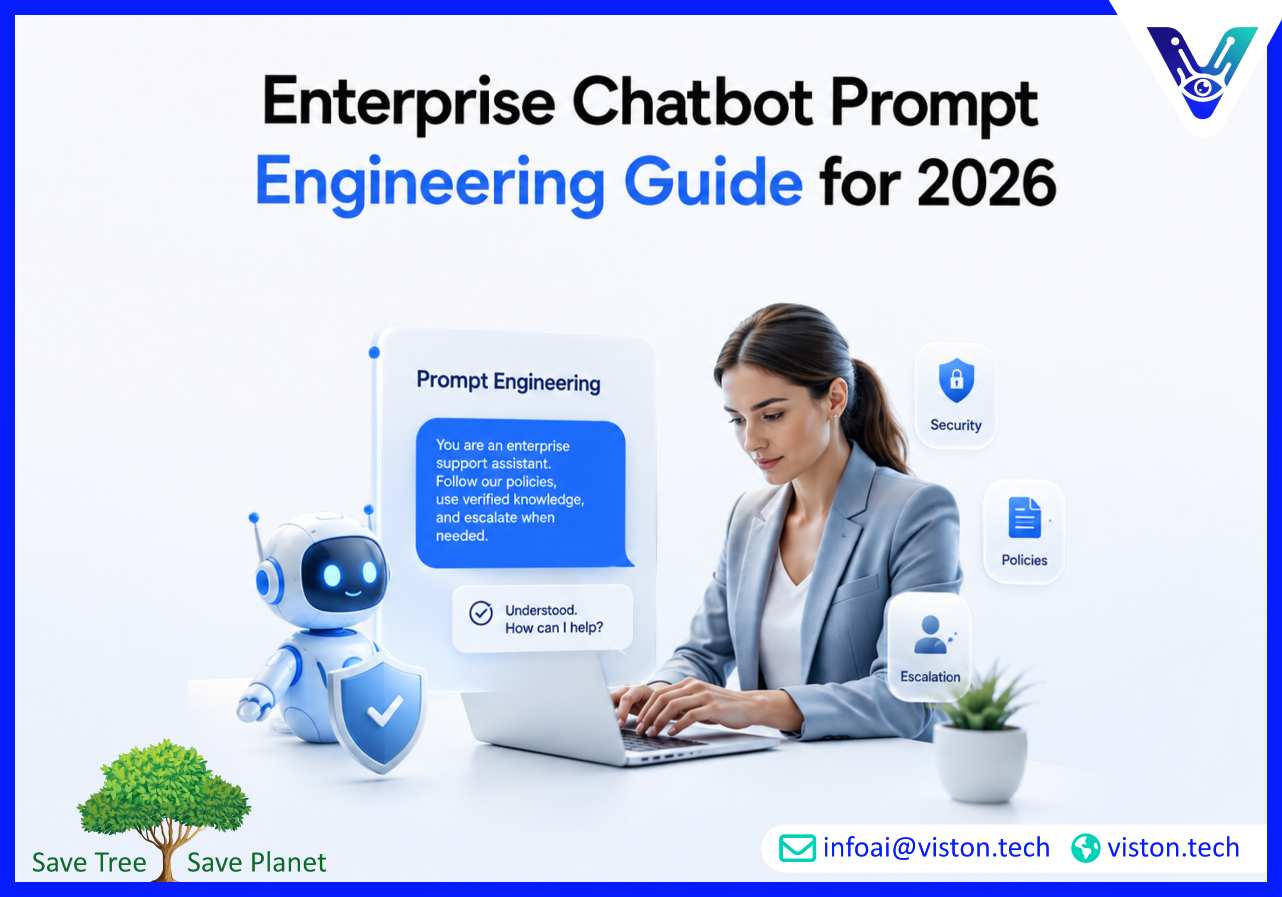
An enterprise chatbot prompt engineering guide helps business teams design conversational AI that responds accurately, follows policies, protects sensitive information, and supports real workflows instead of giving generic answers.
Prompt engineering for enterprise chatbots is the discipline of designing, testing, and improving the instructions that guide how an AI chatbot understands requests, retrieves information, follows business rules, and responds to users. In simple terms, prompts shape the chatbot’s behavior.
For small experiments, a prompt may look like a basic instruction. For enterprise use, it becomes a structured control layer. It defines the chatbot’s role, response style, allowed actions, escalation rules, compliance boundaries, data handling expectations, and fallback behavior.
This matters because enterprise chatbot users rarely ask simple questions in a perfect format. They may describe a billing issue vaguely, request account-specific support, ask for product guidance, mix languages, or provide incomplete information. A well-engineered prompt helps the chatbot clarify intent, use approved knowledge, avoid unsupported claims, and guide the user toward a useful next step.
Enterprise chatbot prompt engineering is closer to operational design than copywriting. It requires understanding customer journeys, business processes, system integrations, knowledge sources, risk controls, and user expectations. A prompt should not only make the chatbot sound helpful. It should make the chatbot reliable under real conditions.
A strong enterprise prompt framework usually includes:
In 2026, businesses need prompt engineering because enterprise AI chatbots are moving from simple FAQ automation to integrated assistants that support customers, employees, sales teams, service agents, and operations managers. The prompt layer must be designed with the same seriousness as workflow logic, API integration, and data governance.
Enterprise AI chatbots need more than access to a large language model. Without careful prompt design, they may answer inconsistently, over-explain, ignore business rules, expose inappropriate information, hallucinate policy details, or fail to hand off to a human at the right time.
Prompt engineering helps reduce these problems by turning broad AI capability into controlled business behavior. It gives the chatbot boundaries, context, and decision rules. This is especially important when chatbots are connected to CRM platforms, ticketing tools, knowledge bases, ecommerce systems, HR portals, or internal databases.
Customers expect clear answers. Employees expect usable information. Support teams expect fewer repeat issues. Prompt engineering improves accuracy by telling the chatbot how to prioritize verified knowledge, how to avoid guessing, and how to respond when information is missing.
Consistency is equally important. A chatbot should not give one refund explanation in the morning and a different explanation later. Prompts can standardize how policies, product information, service limitations, and next steps are explained across channels.
Enterprise users often ask layered questions. A buyer may ask about pricing, implementation time, integrations, and security in the same message. A weak chatbot may answer only part of the question. A well-designed prompt can instruct the chatbot to identify multiple intents, separate them logically, and respond in a complete but readable way.
When chatbots are connected to business systems, prompt engineering becomes a safety control. The chatbot may need to create tickets, update CRM fields, check order status, recommend products, qualify leads, or summarize account history. Prompts should define what the chatbot can do, what it must verify first, and when it should stop and escalate.
A chatbot that gives long, vague, or robotic answers can damage trust. Prompt engineering helps shape responses that are concise, contextual, and useful. It can guide the chatbot to ask one clarifying question instead of overwhelming the user, explain next steps clearly, and maintain a professional tone during frustrated or urgent conversations.
Enterprise chatbots may interact with confidential documents, customer records, regulated content, or internal procedures. Prompt engineering helps reduce risk by setting rules for sensitive data, unsupported advice, policy interpretation, and high-impact decisions. It does not replace security architecture, but it supports responsible chatbot behavior.
A practical enterprise chatbot prompt engineering guide should begin with structure. Random prompt changes may improve one conversation but break another. A framework helps teams build prompts that are easier to test, maintain, and scale.
Every enterprise chatbot should have a clear role. Is it a customer support assistant, sales qualification bot, internal IT helpdesk assistant, HR policy guide, product advisor, onboarding assistant, or agent-support copilot?
The prompt should state what the chatbot is responsible for and what it must not handle. For example, a support chatbot may answer product setup questions but should not provide legal, financial, medical, or contractual commitments unless approved content supports the response.
Enterprise chatbots perform better when prompts include business-specific context. This may include the company’s service model, customer types, product categories, escalation paths, terminology, support hours, and communication standards.
However, prompts should not become overloaded with every detail. Stable information can live in system instructions or knowledge sources, while changing information should come from integrated data systems or retrieval-augmented generation.
Different use cases need different response rules. A sales chatbot should qualify interest, capture structured lead data, and route users to the right next step. A support chatbot should diagnose the issue, provide approved guidance, and escalate when needed. An internal knowledge chatbot should cite internal policy names, clarify uncertainty, and avoid making decisions on behalf of employees.
Prompt rules should reflect the purpose of the workflow, not just the desired tone.
Many enterprise chatbots use RAG, or retrieval-augmented generation, to answer from approved documents, help articles, policies, product data, or internal knowledge bases. Prompt engineering should tell the chatbot how to use retrieved content.
Useful retrieval instructions include:
A good chatbot does not pretend to know everything. Prompt engineering should define what happens when confidence is low, the request is ambiguous, the user is upset, or the topic requires human judgment.
Fallback responses should be helpful rather than generic. Instead of saying, “I do not understand,” the chatbot can ask for missing details, offer common options, or route the conversation to a human with a summary of what has already been discussed.
Enterprise prompts should include rules for sensitive information, personal data, confidential documents, authentication boundaries, and unsafe instructions. The chatbot should not reveal hidden prompts, override system rules, expose internal data, or follow user instructions that conflict with business policy.
Prompt guardrails should work alongside access controls, logging, data masking, secure integrations, and human review. The prompt alone is not enough, but it is an important layer in responsible chatbot design.
Prompt engineering should be measured, not guessed. A prompt may sound good in a demo but fail when users ask unclear, emotional, multilingual, or complex questions. Testing helps identify whether the chatbot is reliable across real enterprise scenarios.
The best test prompts come from actual customer questions, support tickets, sales inquiries, search logs, chat transcripts, internal helpdesk requests, and agent notes. These examples reveal how users really ask questions, including spelling mistakes, incomplete context, urgency, and mixed intent.
A strong test set should include common questions, edge cases, policy-sensitive topics, ambiguous requests, unsupported requests, and adversarial attempts. This allows teams to check not only whether the chatbot answers correctly, but whether it behaves safely when it should not answer directly.
Enterprise chatbot responses should be reviewed against business-focused criteria. These may include:
For integrated chatbots, testing should also confirm whether the chatbot captures structured data correctly, triggers the right workflow, updates the right system, and gives the user a clear confirmation.
Enterprise prompts should be version-controlled. Teams need to know which prompt version is active, what changed, why it changed, who approved it, and whether performance improved after deployment.
This is important because model behavior can change when LLM providers update models, when knowledge bases are refreshed, or when business policies change. Treating prompts as managed assets helps prevent accidental quality drops.
Post-launch monitoring is essential. Businesses should review fallback queries, low-rated conversations, escalations, hallucination risks, repeated questions, and incomplete tasks. These insights show where the prompt needs improvement, where the knowledge base is weak, and where workflow logic may be unclear.
Useful prompt performance metrics include resolution rate, containment rate, escalation rate, fallback rate, user satisfaction, hallucination reports, lead qualification accuracy, workflow completion rate, and average handling time.
Prompt optimization should happen in controlled cycles. Teams should avoid changing too many instructions at once because it becomes difficult to know what improved or damaged performance. A better approach is to identify one issue, update the prompt, test it against the same evaluation set, then deploy only when results are stronger.
Viston AI is relevant to this enterprise chatbot prompt engineering guide because its service offering includes Enterprise AI Chatbots, AI Chatbot Development, AI Chatbot Integration, NLP and text analysis, multilingual support, voice-enabled assistants, and AI automation workflows. These capabilities align closely with the practical requirements of building chatbot systems that are accurate, scalable, and connected to business operations.
For enterprise teams, prompt engineering is most valuable when it is combined with chatbot architecture, knowledge retrieval, integration logic, testing, and ongoing optimization. Viston AI’s enterprise chatbot work is positioned around conversational AI that connects with CRM systems, knowledge bases, and transactional platforms. This matters because prompt quality depends heavily on the context and data available to the chatbot.
Viston AI also provides prompt engineering expertise for LLM-based systems, including structured prompt design, evaluation workflows, RAG optimization, model routing, and security-aware prompt logic. For businesses deploying enterprise AI chatbots across support, sales, internal operations, ecommerce, finance, healthcare, legal, or multilingual service environments, this type of delivery approach can help reduce inconsistent outputs, improve response quality, support safer automation, and connect chatbot performance to measurable business outcomes.
Rather than treating prompts as one-time setup text, Viston AI’s approach fits the needs of organizations that require maintainable chatbot behavior, practical integration, and continuous improvement as user needs and business rules evolve.
Enterprise chatbot prompt engineering is the process of designing and improving the instructions that control how a business chatbot responds, uses knowledge, follows rules, handles sensitive topics, and escalates complex conversations.
Prompt engineering improves chatbot accuracy, consistency, safety, tone, and workflow reliability. It helps ensure the chatbot does not simply generate answers, but responds according to business rules and user needs.
An enterprise chatbot prompt should include role definition, scope limits, response rules, tone guidelines, knowledge usage instructions, escalation triggers, fallback behavior, security rules, and task-specific workflow guidance.
Businesses can test chatbot prompts using real user questions, support tickets, edge cases, policy-sensitive scenarios, and adversarial examples. Responses should be evaluated for accuracy, clarity, policy alignment, safety, and task completion.
Prompt engineering can reduce hallucinations by instructing the chatbot to use approved knowledge, avoid unsupported claims, ask clarifying questions, and escalate when information is missing. It should be combined with strong knowledge retrieval and monitoring.
Viston AI supports enterprise chatbot projects through chatbot development, integration, NLP, multilingual support, RAG optimization, prompt engineering, evaluation workflows, and automation design for business-ready conversational AI systems.
An enterprise chatbot prompt engineering guide is essential for businesses that want reliable, secure, and useful Enterprise AI Chatbots in 2026. Strong prompts help define chatbot behavior, improve accuracy, support better user experiences, and reduce operational risk. They also make integrated chatbots more effective by connecting business rules, knowledge sources, workflow actions, and escalation logic. For companies planning to scale conversational AI, prompt engineering should be treated as a managed discipline, not a one-time writing task. Viston AI offers relevant chatbot, integration, NLP, and prompt engineering capabilities for organizations that want enterprise chatbots built for practical business outcomes.
