
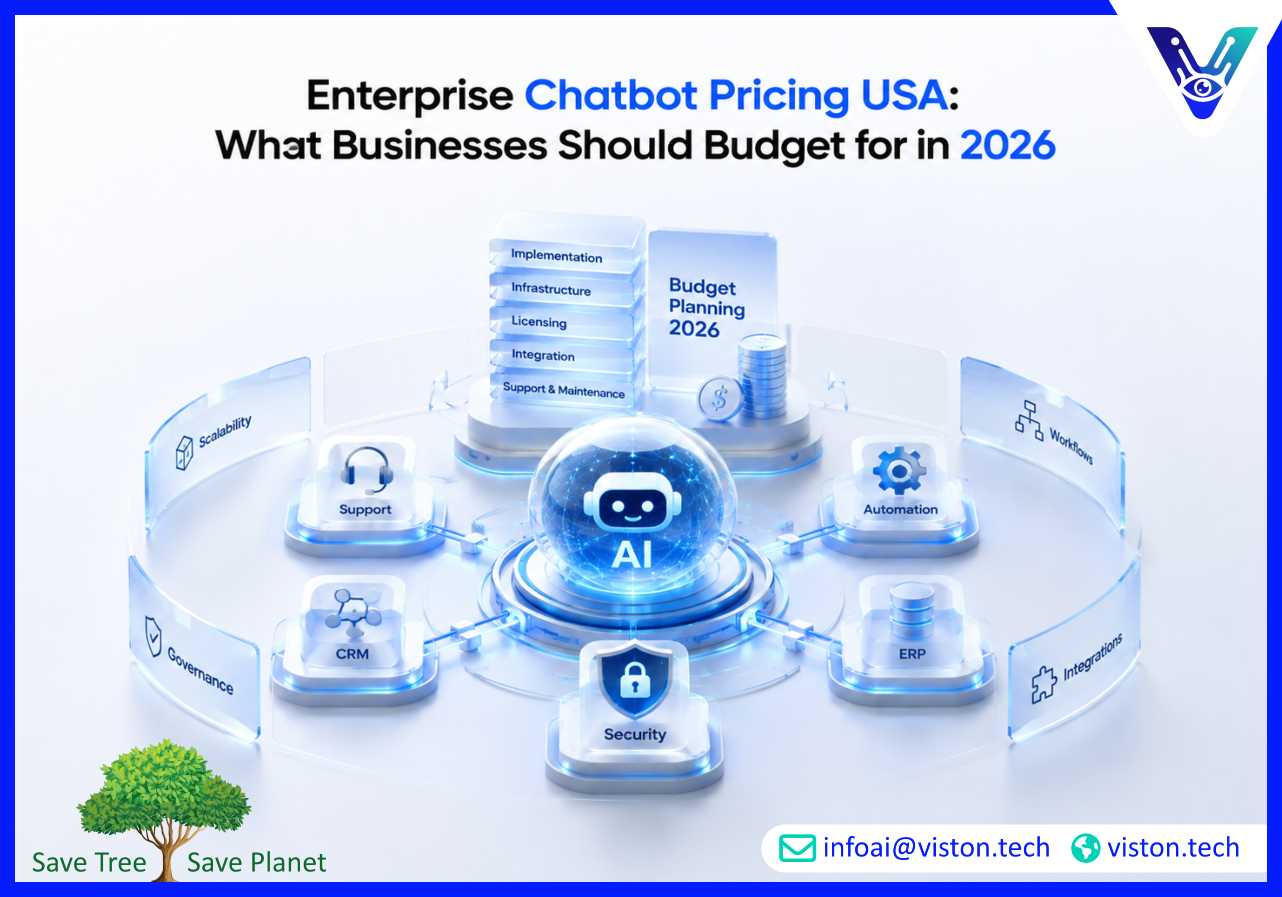
Enterprise chatbot pricing USA is no longer just about buying a chat widget. In 2026, businesses are budgeting for AI capability, secure integrations, workflow automation, governance, support, and measurable outcomes across customer service, sales, operations, and internal teams.
Enterprise chatbot pricing USA depends on far more than the visible chat interface. A basic chatbot may answer simple questions, but an enterprise AI chatbot is expected to understand user intent, retrieve accurate business information, connect with internal systems, support multiple channels, protect sensitive data, and scale reliably as usage grows.
For US businesses, pricing is shaped by the complexity of the use case, the level of customization, the number of integrations, the required security controls, and the expected conversation volume. A chatbot used only for website FAQs will cost much less than an AI assistant connected to CRM, ERP, ticketing, billing, inventory, scheduling, authentication, and analytics platforms.
In practical terms, enterprise chatbot pricing usually includes several cost layers. These may include strategy and discovery, conversation design, AI model configuration, knowledge base preparation, backend integration, custom workflow development, testing, deployment, hosting, API usage, analytics, training, maintenance, and continuous optimization.
This is why buyers should avoid evaluating chatbot pricing only by monthly subscription cost. A low monthly tool fee may look attractive, but it may not include the work needed to make the chatbot reliable in a real enterprise environment. For larger organizations, the real value comes from whether the chatbot can reduce manual work, improve response quality, qualify leads, support customers faster, and create cleaner operational workflows.
Actual pricing varies by provider, platform, and scope, but US businesses can generally think about enterprise chatbot budgets in broad categories:
For many enterprise buyers, the right question is not “What is the cheapest chatbot?” The better question is “What level of chatbot investment will safely support our business workflows, users, systems, and growth expectations?”
Enterprise AI Chatbots are priced according to the work required to make them useful, secure, and dependable. The same chatbot interface can hide very different levels of engineering and service quality underneath. Understanding the main cost drivers helps buyers compare proposals more accurately.
A chatbot that answers general product questions is relatively simple. A chatbot that qualifies enterprise leads, checks account status, opens support tickets, recommends services, updates CRM records, and routes users to the right team is more complex. Each additional business process increases planning, development, testing, and governance requirements.
Complex use cases require clearer intent mapping, better conversation logic, fallback handling, exception management, and human handover design. The more business-critical the chatbot becomes, the more investment is needed to make it reliable.
Modern enterprise chatbots often use large language models, retrieval-augmented generation, structured knowledge bases, semantic search, prompt orchestration, and guardrails. Pricing can increase when the chatbot must retrieve answers from company documents, product databases, policy manuals, technical documentation, or internal knowledge systems.
Knowledge preparation is often underestimated. Documents may need to be cleaned, organized, tagged, updated, permission-controlled, and connected to the chatbot in a way that reduces inaccurate or unsupported answers. For enterprise environments, this work is essential because employees and customers expect accurate responses, not generic AI output.
Integrations are one of the biggest drivers of enterprise chatbot pricing. A chatbot becomes more valuable when it can interact with business systems, but every integration adds technical and operational complexity.
Common integrations include CRM platforms, helpdesk systems, ecommerce platforms, ERP software, marketing automation tools, scheduling platforms, payment systems, identity providers, data warehouses, and internal APIs. Each integration may require authentication, data mapping, error handling, testing, logging, and security review.
US businesses often need chatbot solutions that support data privacy, access control, audit trails, secure hosting, encryption, user consent, and responsible AI usage. Requirements become more demanding in regulated sectors such as healthcare, finance, insurance, legal services, education, and government-related services.
Security-sensitive deployments may require additional architecture planning, role-based permissions, data retention controls, private environments, compliance documentation, vulnerability testing, and internal approval processes. These factors can increase upfront and ongoing costs, but they reduce operational and reputational risk.
Enterprise chatbot pricing may also depend on usage. Higher conversation volumes can increase hosting, infrastructure, API, model inference, monitoring, and support costs. A chatbot serving a few hundred users per month has different cost requirements than one handling thousands of daily customer or employee interactions.
Businesses should ask providers how usage is priced. Some models charge by seat, conversation, resolution, message, API call, token usage, workflow, or monthly platform tier. The best pricing model depends on expected usage patterns and business objectives.
Enterprise chatbot pricing USA usually follows one of several commercial models. Each model has advantages and trade-offs. Buyers should understand what is included, what is excluded, and how costs may change as usage grows.
In a custom development model, the business pays for strategy, design, development, integration, testing, and deployment. This model is useful when the chatbot requires unique workflows, custom business logic, specific system integrations, or a tailored user experience.
The main advantage is flexibility. The chatbot can be built around the company’s operations instead of forcing the company to adapt to a fixed tool. The main consideration is that custom development usually requires a higher upfront budget and a clear implementation plan.
Some chatbot platforms charge a monthly subscription based on users, seats, conversation volume, features, or support level. This model can work well for businesses that want a predictable operating cost and do not need heavy customization.
However, subscription pricing should be reviewed carefully. A monthly fee may not include advanced integrations, custom workflows, AI model usage, implementation support, analytics, compliance support, or optimization. Enterprise buyers should ask for a full cost breakdown before comparing subscription options.
A hybrid model is common for enterprise AI chatbot projects. The business pays an upfront implementation fee for setup, customization, integration, and launch, then pays an ongoing monthly or annual fee for hosting, monitoring, maintenance, support, and improvements.
This model often fits enterprise needs because chatbot success does not end at launch. AI chatbots require ongoing refinement as customer questions change, knowledge bases expand, products evolve, and workflow requirements become more mature.
Usage-based pricing charges according to activity, such as conversations, messages, resolutions, API calls, or AI model consumption. This can be fair for businesses with variable demand, but it can also create budget uncertainty if usage grows quickly.
US companies planning high-volume deployments should model expected usage before choosing this pricing structure. They should also ask about usage limits, overage fees, model costs, rate limits, and reporting transparency.
Managed chatbot services include ongoing monitoring, optimization, training, reporting, support, and improvement. This model is useful for companies that do not have internal AI, data, or automation teams to maintain the chatbot after launch.
Managed services can increase monthly cost, but they often improve long-term performance. A chatbot that is not maintained can become outdated, inaccurate, or misaligned with business processes. For enterprise teams, ongoing management is often the difference between a chatbot that performs well and one that slowly loses value.
The best way to approach enterprise chatbot pricing is to build a budget around business outcomes, not just software features. A chatbot should support a clear operational goal, such as reducing repetitive support requests, improving lead qualification, accelerating employee access to information, automating internal workflows, or improving customer response times.
Before requesting pricing, define what the chatbot must solve. For example, a sales team may need faster lead routing and better qualification. A support team may need ticket deflection and improved self-service. An operations team may need an internal assistant that helps employees find policies, submit requests, or check workflow status.
A clear use case helps providers estimate scope accurately. It also prevents overspending on unnecessary features or underinvesting in critical capabilities.
Enterprise chatbot projects are more manageable when requirements are phased. The first phase may focus on one channel, one audience, and a limited number of high-value workflows. Later phases can add more integrations, languages, departments, automation rules, analytics, and advanced AI capabilities.
This phased approach helps control risk and budget. It also gives the business real usage data before expanding the chatbot across more systems or teams.
Many chatbot budgets focus only on the initial build. A more realistic budget includes both implementation and ongoing operating costs. These may include hosting, AI model usage, third-party platform fees, support, monitoring, retraining, content updates, integration maintenance, analytics, and compliance review.
Buyers should ask providers to separate upfront costs from recurring costs. This makes it easier to compare proposals and forecast total cost of ownership over 12, 24, or 36 months.
The cheapest chatbot proposal may not be the best option if it lacks integration experience, AI governance, secure development practices, analytics, or long-term support. Enterprise AI Chatbots affect customer experience, data quality, support productivity, and operational trust. Poor implementation can create hidden costs through failed handovers, inaccurate answers, duplicate records, broken workflows, or low user adoption.
A strong provider should be able to explain the technical architecture, integration approach, data handling process, testing plan, performance metrics, and post-launch optimization model. This level of clarity is especially important for US enterprises that need reliable delivery and accountable outcomes.
Viston AI is relevant to enterprise chatbot pricing because the cost of a chatbot depends heavily on how well it is planned, integrated, and aligned with business systems. Viston AI provides AI-focused services that include AI chatbots, generative AI, automation, and enterprise system integration, which are directly connected to the needs of businesses evaluating Enterprise AI Chatbots.
For companies in the USA, this matters because enterprise chatbot projects often require more than a standard chatbot tool. Businesses need conversation flows that match real customer and employee needs, AI models configured for useful responses, knowledge systems that support accurate answers, and integrations that connect chatbot activity with CRM, support, sales, or operational platforms.
Viston AI’s service positioning is useful for organizations that want chatbot investment to support practical outcomes such as faster response handling, structured lead capture, workflow automation, better self-service, and improved operational visibility. Its broader AI service capability also supports businesses that may want to expand from chatbot deployment into AI assistants, automation workflows, multilingual support, or more advanced enterprise AI use cases.
Rather than treating chatbot pricing as a simple software purchase, Viston AI can help businesses think through scope, implementation complexity, integration needs, and long-term scalability. This kind of planning is important for enterprise buyers that want a chatbot solution built around business value, not just a conversational interface.
Enterprise chatbot pricing in the USA varies widely based on complexity, integrations, AI model usage, security needs, support requirements, and conversation volume. A simple chatbot may require a modest setup budget, while a custom enterprise AI chatbot with multiple integrations and workflow automation can require a significantly larger investment.
The biggest pricing factors are use case complexity, AI model requirements, knowledge base preparation, system integrations, security controls, compliance needs, conversation volume, analytics, and ongoing support. Integrations with CRM, helpdesk, ERP, ecommerce, or internal systems often have a major impact on total cost.
A subscription platform may be enough for simple use cases, but custom enterprise chatbot development is often better when the business needs unique workflows, secure integrations, specialized knowledge, role-based access, or advanced automation. The right choice depends on business goals, internal systems, and scalability needs.
Ongoing costs may include hosting, AI model usage, platform fees, technical support, content updates, chatbot training, integration maintenance, monitoring, reporting, and optimization. Enterprise AI Chatbots should be reviewed regularly to maintain accuracy, performance, and business relevance.
Companies can control costs by starting with a focused use case, prioritizing high-value workflows, phasing integrations, using clear success metrics, preparing clean knowledge sources, and choosing a provider that can explain both upfront and recurring costs. A phased rollout reduces risk and improves budget control.
Viston AI can support businesses evaluating Enterprise AI Chatbots by helping define scope, plan implementation, connect chatbot workflows with business systems, and align the solution with practical outcomes such as automation, lead handling, support efficiency, and scalable AI adoption.
Enterprise chatbot pricing USA should be evaluated as a business technology investment, not as a simple chatbot purchase. In 2026, the real cost depends on AI capability, workflow complexity, integrations, security, usage, support, and long-term optimization. Businesses that plan carefully can avoid underbuilt solutions and invest in Enterprise AI Chatbots that improve customer experience, reduce manual workload, and support measurable operational outcomes. For organizations that need a practical and scalable approach, Viston AI offers relevant expertise in AI chatbot development, enterprise integration, and business-focused automation planning.
