
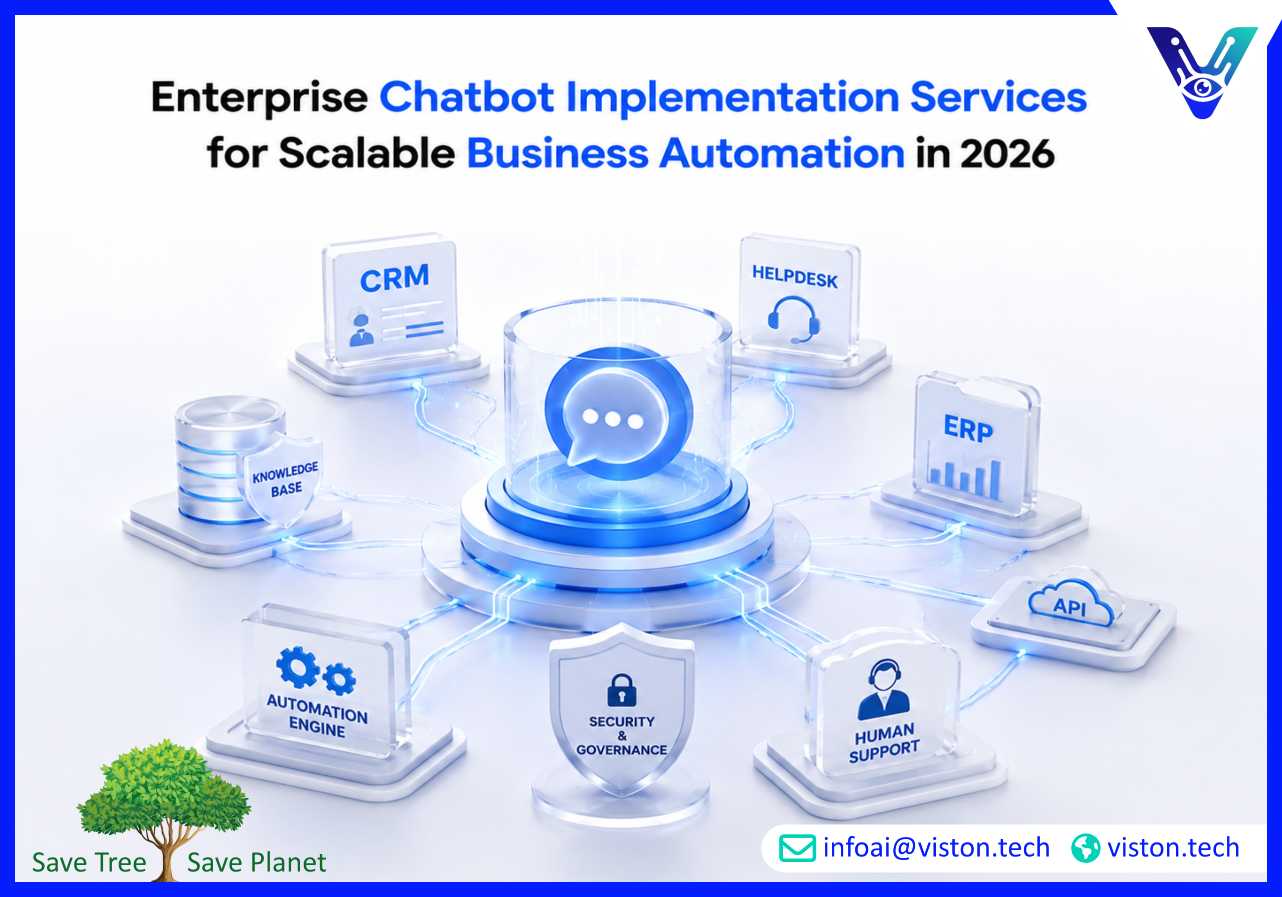
Enterprise chatbot implementation services help businesses move from basic chat automation to reliable conversational AI that supports customers, employees, sales teams, and operations at scale. In 2026, implementation quality matters because enterprise chatbots must be accurate, secure, integrated, measurable, and aligned with real business workflows.
Enterprise chatbot implementation services cover the planning, design, development, integration, deployment, governance, and optimization of AI-powered chatbots for business environments. Unlike simple website chat widgets, enterprise AI chatbots are built to support complex interactions, multiple departments, large user volumes, internal systems, sensitive data, and long-term operational requirements.
A successful enterprise chatbot is not only a conversational interface. It is a connected business tool that can understand user intent, retrieve relevant information, guide users through workflows, escalate to human teams when needed, and record outcomes inside business systems. This may include CRM platforms, helpdesk tools, ERP systems, HR platforms, knowledge bases, ecommerce systems, payment tools, scheduling systems, or internal databases.
For business leaders, the real value of enterprise chatbot implementation is not the chatbot itself. The value comes from faster service delivery, reduced repetitive workload, better lead handling, improved employee access to information, consistent support quality, and stronger operational visibility.
Basic chatbot setup often focuses on predefined answers, simple flows, and limited website interactions. Enterprise implementation requires a deeper approach. The chatbot must understand business-specific terminology, handle multi-step conversations, respect data access rules, integrate with existing systems, and perform reliably across teams, channels, and markets.
Enterprise AI chatbots may support customer service, sales enablement, onboarding, HR support, IT service desks, field operations, account management, procurement, or internal knowledge search. Each use case requires different conversation logic, security rules, escalation paths, reporting needs, and success metrics.
This is why implementation should begin with business discovery, not technology selection. Teams need to define what the chatbot should solve, which users it will support, what systems it must connect with, what information it can access, and how success will be measured after launch.
In 2026, businesses expect AI chatbots to do more than answer frequently asked questions. Buyers now look for conversational AI that can support service delivery, automate operational tasks, personalize responses, assist employees, qualify leads, and provide measurable business outcomes. At the same time, organizations are more cautious about security, compliance, hallucinated answers, poor handoffs, and weak integration.
The gap between a useful enterprise chatbot and a frustrating one is usually implementation quality. A chatbot can have access to a powerful language model and still fail if the knowledge base is disorganized, integrations are incomplete, escalation logic is weak, or business rules are not properly mapped.
Enterprise chatbot implementation services matter because they help businesses create a structured, governed, and scalable conversational AI environment. The most common business reasons include:
Businesses also need enterprise chatbots to be controlled and accountable. A chatbot that gives unsupported answers, exposes sensitive data, or triggers the wrong workflow can create business risk. Strong implementation includes guardrails, permissions, review processes, audit trails, fallback rules, testing, and continuous improvement.
Modern enterprise AI chatbots should be designed with governance from the start. This includes clear rules around data handling, user authentication, access control, prompt safety, output validation, logging, human escalation, and compliance with relevant industry requirements.
Security is especially important when chatbots are connected to customer records, payment systems, employee data, healthcare information, financial data, or legal documents. Enterprise implementation should define what the chatbot can retrieve, what it can update, what it must never disclose, and when it must transfer the conversation to a human team.
In practical terms, governance protects both the business and the user. It helps the chatbot remain useful without becoming uncontrolled automation.
A strong implementation process turns business needs into a working chatbot system. The process should be practical, phased, and measurable. Enterprises should avoid launching a chatbot across too many use cases at once. A focused implementation usually performs better because the team can test, refine, and scale with confidence.
The first step is to identify the highest-value chatbot use cases. These may include customer support automation, sales lead qualification, appointment booking, order tracking, internal IT helpdesk support, HR policy assistance, onboarding guidance, or knowledge base search.
Each use case should be assessed based on volume, complexity, risk, data availability, integration needs, user expectations, and potential business impact. A high-volume, low-risk process is often a good starting point because it allows the chatbot to deliver value quickly while giving the team useful training data.
Enterprise chatbot conversations should be designed around real user needs. This includes mapping intents, entities, user journeys, fallback paths, escalation points, confirmation steps, and required data fields. Good conversation design avoids unnecessary questions and helps users complete tasks with minimal friction.
For AI-powered chatbots, prompt design and retrieval logic also matter. The chatbot should know when to answer directly, when to retrieve information from approved sources, when to ask clarifying questions, and when to avoid giving an answer because the request is outside its approved scope.
Many chatbot failures begin with poor knowledge quality. Enterprise AI chatbots need accurate, current, and well-structured content. This may include help center articles, product documents, SOPs, policy documents, technical manuals, sales enablement content, onboarding guides, and internal FAQs.
Before implementation, content should be reviewed for duplication, outdated guidance, unclear wording, missing ownership, and conflicting answers. The chatbot can only perform well when the knowledge sources behind it are reliable.
Integration is where enterprise chatbot implementation becomes commercially valuable. A chatbot connected to business systems can do more than answer questions. It can create tickets, update CRM records, check order status, schedule appointments, route leads, retrieve account information, trigger workflows, and notify internal teams.
Integration should be built with secure APIs, permission controls, error handling, and clear logging. Businesses should also define what happens when an external system is unavailable. A reliable chatbot must handle system failures gracefully instead of leaving users confused.
Before launch, enterprise chatbots should be tested across expected and unexpected scenarios. Testing should include intent accuracy, response quality, escalation logic, data permissions, integration workflows, multilingual behavior, mobile experience, and edge cases.
After launch, optimization should continue. Teams should review failed conversations, unanswered questions, drop-off points, escalation patterns, user feedback, and workflow completion rates. Enterprise chatbot implementation is not a one-time project. It is an ongoing improvement cycle.
Choosing the right implementation partner is critical because enterprise chatbot success depends on business understanding, technical depth, integration capability, and long-term support. A provider should not only build a chatbot interface. They should understand how conversational AI fits into customer experience, operations, sales workflows, data architecture, governance, and measurable business outcomes.
A qualified partner should understand natural language processing, large language models, retrieval-augmented generation, prompt engineering, conversation design, API integrations, analytics, deployment architecture, testing, and model monitoring. They should also know how to adapt chatbot behavior to different business functions, industries, and risk levels.
Enterprise chatbot implementation services must include the ability to connect with existing systems. This may involve CRM platforms, helpdesk systems, ERP tools, communication platforms, internal databases, identity management systems, and analytics platforms. Without integration, the chatbot may become an isolated channel rather than a useful operational asset.
The provider should be able to design secure data flows, role-based access, human escalation, audit logs, monitoring dashboards, and maintenance processes. They should also support ongoing improvements after deployment because chatbot performance changes as users ask new questions, products evolve, policies change, and business workflows expand.
Businesses should define measurable outcomes before implementation begins. Useful metrics include containment rate, resolution rate, customer satisfaction, response time, escalation rate, lead qualification rate, workflow completion rate, ticket deflection, cost per resolved conversation, and knowledge gap reduction.
A serious implementation partner should help define these KPIs and build reporting that connects chatbot activity to business value.
Viston AI is relevant to enterprise chatbot implementation services because its service portfolio includes Enterprise AI Chatbots, AI Chatbot Development, AI Chatbot Integration, multilingual chatbot support, voice-enabled assistants, natural language processing, automation workflows, and business system integration. This aligns closely with what organizations need when moving from basic chatbot experiments to production-ready enterprise AI chatbots.
For businesses evaluating enterprise chatbot implementation, Viston AI’s positioning is strongest where conversational AI must connect with real business operations. Its approach focuses on building chatbots that support customer interactions, workflow automation, knowledge access, lead handling, and system-connected service experiences. This is important because enterprise chatbots only become valuable when they understand context, retrieve trusted information, integrate with business platforms, and support measurable outcomes.
Viston AI can be relevant for companies that need AI chatbots across customer service, sales support, internal operations, multilingual communication, and digital self-service. Its broader AI capabilities also support implementation needs such as NLP, model selection, AI strategy, automation, integration architecture, and ongoing optimization. For organizations seeking scalable Enterprise AI Chatbots, this makes Viston AI a practical specialist to consider when chatbot implementation must be secure, integrated, business-focused, and built for long-term improvement.
Enterprise chatbot implementation services include planning, designing, developing, integrating, deploying, testing, and optimizing AI chatbots for business use. They help companies build chatbots that support customers, employees, workflows, and connected systems at scale.
The timeline depends on use case complexity, integration requirements, knowledge base readiness, approval processes, and security needs. A focused chatbot pilot can often be implemented faster, while multi-channel enterprise deployments with several integrations require a phased rollout.
Enterprise AI chatbots can integrate with CRM systems, helpdesk platforms, ERP tools, ecommerce platforms, HR systems, knowledge bases, scheduling tools, payment systems, messaging platforms, and internal databases. Integration should be designed with secure APIs and clear access controls.
Success depends on clear use cases, accurate knowledge sources, strong conversation design, secure integrations, proper escalation rules, governance controls, user testing, and ongoing optimization based on real conversation data.
Yes. Enterprise AI chatbots can support internal operations by helping employees find policies, create IT tickets, access HR information, retrieve documents, complete routine workflows, and reduce repetitive requests to internal teams.
Viston AI’s Enterprise AI Chatbots and related chatbot development and integration services are aligned with enterprise chatbot implementation needs, especially where businesses require conversational AI connected to workflows, knowledge systems, automation, and customer or employee support channels.
Enterprise chatbot implementation services are essential for businesses that want AI chatbots to deliver more than basic automation. A successful implementation connects conversational AI with business workflows, trusted knowledge, secure systems, measurable KPIs, and continuous improvement. In 2026, enterprise AI chatbots must be accurate, governed, integrated, scalable, and useful across customer and employee journeys. Companies that invest in structured implementation can improve service speed, reduce manual workload, strengthen lead handling, and create more consistent digital experiences. For organizations seeking reliable Enterprise AI Chatbots, Viston AI offers relevant capabilities that support practical, business-focused chatbot implementation.
