
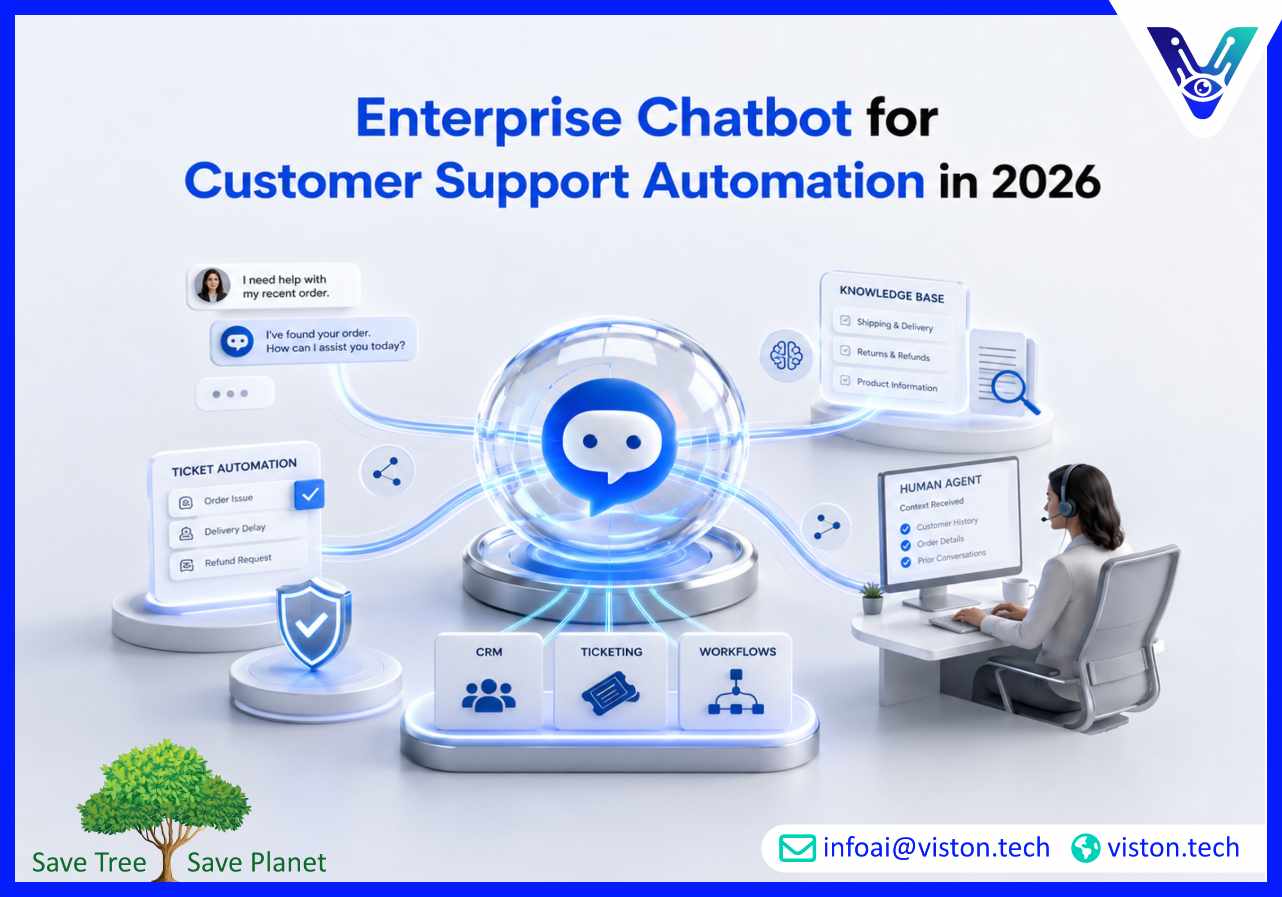
An enterprise chatbot for customer support automation helps businesses manage support requests faster, reduce repetitive manual work, and deliver consistent customer service across digital channels. In 2026, companies need more than a basic FAQ bot. They need secure, integrated, AI-powered chatbot systems that can understand customer needs, connect with business tools, and support real service outcomes.
An enterprise chatbot is an AI-powered conversational system built for large-scale business use. It helps customers get answers, complete support tasks, submit requests, and reach the right human agent when needed. Unlike a basic chatbot, an enterprise chatbot can connect with CRM systems, ticketing platforms, knowledge bases, order systems, customer portals, and internal workflows.
For customer support automation, the chatbot can handle common questions, check order or service status, create support tickets, collect issue details, route cases, recommend solutions, and escalate complex problems with conversation history. This makes support faster, more organized, and easier to scale.
Customer expectations are higher than ever. People want quick, accurate, and helpful responses at any time. At the same time, support teams are dealing with high ticket volumes, repeated questions, limited resources, and pressure to improve service quality.
An enterprise chatbot for customer support automation helps solve these challenges by handling repetitive requests automatically. This allows human agents to focus on complex, sensitive, or high-value conversations. It also improves response speed, reduces waiting time, and creates a more consistent support experience.
In 2026, businesses also need better support visibility. A chatbot can help track common customer issues, failed conversations, escalation reasons, and service gaps. These insights help companies improve knowledge base content, support workflows, product information, and customer experience.
A good enterprise chatbot should understand customer intent, even when users phrase questions differently. It should handle simple spelling mistakes, follow conversation context, and identify what the customer is trying to achieve.
The chatbot should answer from approved and updated business content, such as FAQs, product documentation, support guides, service policies, and internal knowledge bases. This helps reduce inaccurate answers and keeps support communication consistent.
Integration is one of the biggest differences between a basic chatbot and an enterprise chatbot. A connected chatbot can create tickets, update customer records, check order details, assign cases, trigger workflows, and send confirmation messages.
Automation should not block customers from getting human help. A strong chatbot should know when to escalate a conversation and pass the full context to the support agent, including the issue, customer details, previous messages, and attempted solutions.
Enterprise chatbot systems must protect customer data. Businesses should consider access control, secure integrations, data privacy, audit logs, permission-based responses, and clear rules around what the chatbot can and cannot do.
The best way to implement an enterprise chatbot is to start with clear support goals. Businesses should identify high-volume, repetitive, and low-risk support requests that can be automated first. Examples include order tracking, password reset guidance, appointment booking, refund questions, account updates, product setup, and basic troubleshooting.
Before building chatbot flows, companies should review real support tickets, live chat transcripts, call notes, and customer feedback. This helps the chatbot reflect actual customer language instead of internal assumptions.
Businesses should also define clear KPIs before launch. Useful chatbot performance metrics include self-service resolution rate, escalation rate, fallback rate, customer satisfaction score, ticket deflection, response time, completion rate, and workflow success rate.
After deployment, the chatbot should be monitored and improved regularly. Failed conversations, repeated escalations, and unanswered questions should be reviewed to improve chatbot accuracy, knowledge coverage, and workflow performance.
Viston AI is relevant to enterprise chatbot for customer support automation through its Enterprise AI Chatbots service. The company focuses on building AI-powered chatbot solutions that support customer communication, automation workflows, multilingual interactions, and business system integration.
For customer support teams, this matters because chatbot value depends on more than conversation handling. A useful enterprise chatbot should connect with CRM, ticketing tools, knowledge bases, and business workflows so it can support real service operations.
Viston AI can help businesses design chatbot systems that improve response handling, reduce repetitive support work, route customer issues more effectively, and create smoother support experiences. Its service approach is suitable for organizations that want practical, scalable chatbot automation rather than a simple scripted chat widget.
It is an AI-powered chatbot designed to automate customer support tasks such as answering questions, creating tickets, checking information, routing requests, and escalating complex issues to human agents.
A basic chatbot usually handles simple scripted replies. An enterprise chatbot supports integrations, workflows, analytics, security controls, knowledge base access, and large-scale customer service operations.
It can automate FAQs, ticket creation, order tracking, appointment scheduling, refund questions, account support, product guidance, troubleshooting, and customer routing.
No. Chatbots are best used to handle repetitive support tasks and assist human agents. Complex, emotional, sensitive, or high-risk issues should still be handled by trained support teams.
Integration allows the chatbot to work with CRM, ticketing, order, and support systems. This helps automate real workflows instead of only giving general answers.
An enterprise chatbot for customer support automation helps businesses improve response speed, reduce manual support workload, and deliver more consistent customer experiences. In 2026, successful chatbot automation depends on natural language understanding, reliable knowledge sources, secure integrations, human handoff, and continuous improvement. With the right strategy, Enterprise AI Chatbots can become a practical support automation tool that improves service quality and operational efficiency. Viston AI supports this need by helping businesses build chatbot solutions designed for real customer support workflows.
