
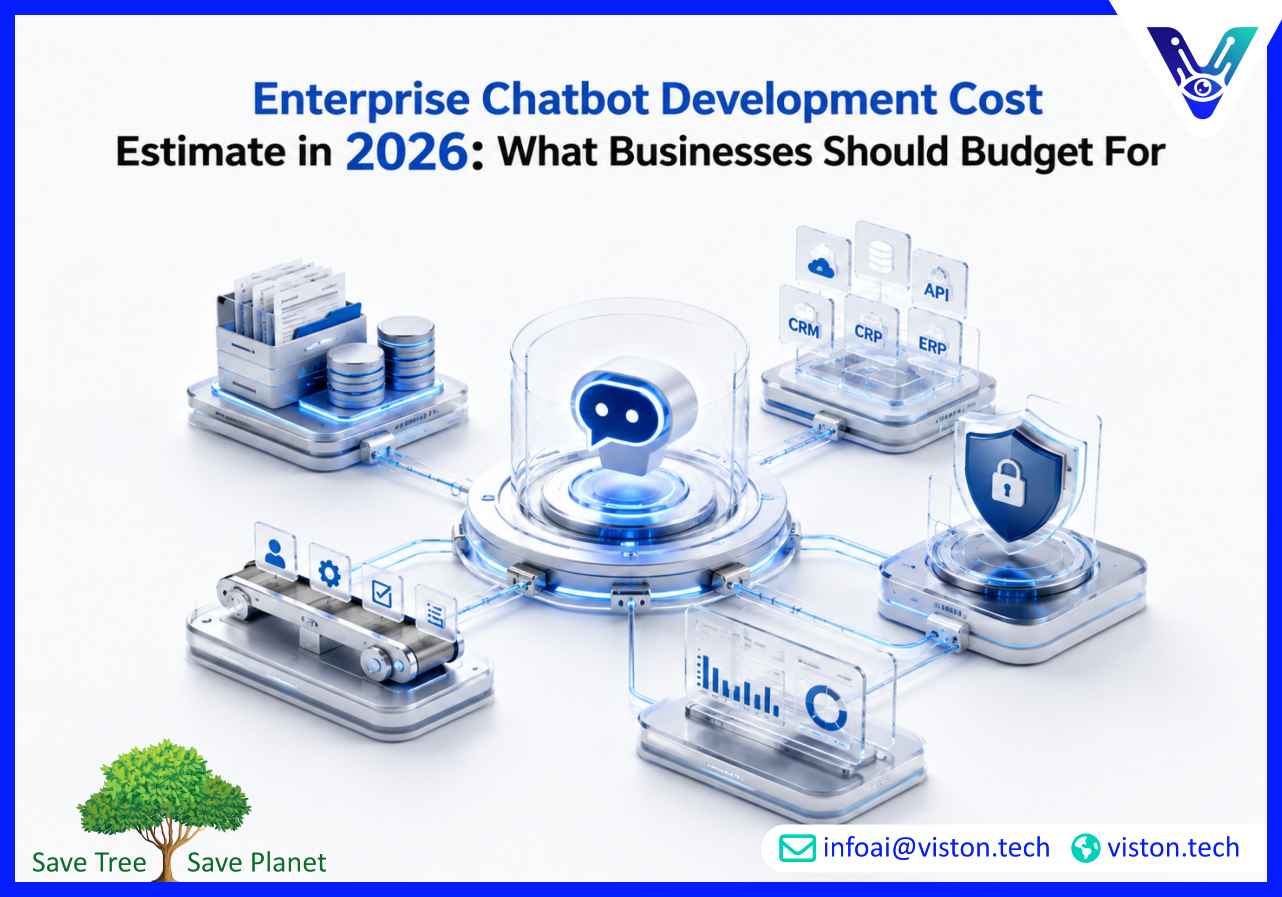
An enterprise chatbot development cost estimate helps business leaders understand the real investment behind secure, scalable, AI-powered customer and workflow automation. In 2026, chatbot costs depend less on the interface itself and more on intelligence level, integrations, data readiness, compliance, reliability, and long-term optimization.
Enterprise chatbot development is not the same as adding a basic chat widget to a website. A true enterprise AI chatbot may support customer service, sales qualification, employee helpdesk requests, appointment scheduling, technical support, order tracking, claims intake, onboarding, or internal operations. Each use case carries different requirements, risks, and cost implications.
A reliable cost estimate should include the full delivery lifecycle. That usually means discovery, solution architecture, conversation design, AI model selection, knowledge base preparation, integration planning, security configuration, testing, deployment, analytics setup, user training, and post-launch optimization.
Businesses often underestimate chatbot budgets because they focus only on visible development work. The real cost is shaped by what the chatbot must understand, what systems it must connect with, what actions it must perform, and how safely it must operate with business or customer data.
A basic chatbot may answer fixed FAQs, collect contact details, and route users to a human team. This type of system is relatively predictable because the conversation paths are predefined.
An enterprise AI chatbot is more advanced. It may use natural language processing, retrieval-augmented generation, custom knowledge sources, CRM synchronization, ticket creation, authentication, multilingual support, human escalation, analytics dashboards, and ongoing model monitoring. These capabilities increase the budget because they require deeper engineering, better testing, and stronger governance.
For business buyers, the right question is not only “How much does a chatbot cost?” A better question is “What level of automation, reliability, security, and business impact do we need?” That answer determines whether the project is a simple support bot, a mid-level AI assistant, or an enterprise-grade conversational system.
Every serious chatbot estimate should be based on scope and complexity. Two businesses may both ask for an “enterprise chatbot,” but their requirements can be completely different. A chatbot that answers product questions on one website costs far less than a multilingual assistant connected to CRM, ERP, payment systems, helpdesk tools, and private customer records.
The intelligence level of the chatbot is one of the biggest cost drivers. Rule-based bots are cheaper because they follow fixed decision trees. AI-powered chatbots cost more because they require intent recognition, prompt engineering, response control, fallback handling, knowledge retrieval, and accuracy testing.
Generative AI chatbots also need careful configuration to reduce inaccurate answers, protect sensitive data, and keep responses aligned with company policies. When a chatbot uses large language models, vector databases, retrieval pipelines, custom prompts, or domain-specific knowledge, the estimate must include architecture, testing, and optimization time.
A chatbot that handles ten FAQs has a much smaller scope than a chatbot that manages sales inquiries, books appointments, creates support tickets, checks order status, qualifies leads, and updates internal systems. Each workflow requires conversation mapping, validation rules, error handling, and user experience testing.
Costs increase when the chatbot must complete tasks rather than simply answer questions. Task-based automation may involve API calls, secure permissions, backend workflows, transaction confirmation, user authentication, and audit trails.
AI chatbot quality depends heavily on the source content it uses. If company documentation is outdated, duplicated, incomplete, or scattered across PDFs, spreadsheets, helpdesk articles, websites, and internal documents, the project will require content cleanup before development can succeed.
Knowledge base preparation may include content auditing, document structuring, metadata planning, chunking strategy, retrieval testing, answer review, and governance rules. This work is easy to overlook, but it is essential for chatbot accuracy and reliability.
Integrations are often the largest difference between a low-cost chatbot and an enterprise chatbot. Connecting the chatbot to systems such as Salesforce, HubSpot, Microsoft Dynamics, SAP, Oracle, Shopify, Zendesk, Freshdesk, ServiceNow, Slack, Microsoft Teams, WhatsApp, payment gateways, calendars, or internal databases adds technical complexity.
Each integration may require API mapping, authentication, data permissions, workflow logic, error handling, logging, monitoring, and testing. If the chatbot reads or writes business data, the estimate should reflect the operational responsibility involved.
Enterprise chatbots often handle sensitive customer, employee, financial, healthcare, or operational data. That means the project may need encryption, role-based access, user authentication, audit logs, data retention policies, consent handling, secure hosting, and compliance review.
Security is not an optional upgrade for serious chatbot development. It is a core requirement when the chatbot is connected to private systems or supports regulated workflows. Stronger security requirements naturally increase planning, development, and validation costs.
A single website chatbot is simpler to build than a chatbot that works across web, mobile app, WhatsApp, Messenger, Microsoft Teams, Slack, voice channels, and internal portals. Each channel has different interface rules, message formats, authentication needs, and testing requirements.
Multilingual chatbot development also affects the estimate. It requires translated knowledge sources, language-specific testing, tone control, localization, and sometimes different flows for different regions or customer groups.
Enterprise chatbot development cost estimates should usually be presented as ranges until requirements are fully documented. Exact pricing before discovery can be misleading because small details, such as one extra integration or compliance requirement, can significantly change the budget.
A starter chatbot is suitable for businesses that need basic automation without complex AI or deep system integration. It may include FAQs, contact capture, simple lead forms, basic routing, one deployment channel, and limited reporting.
This type of chatbot is useful when the business wants to reduce repetitive questions but does not need advanced personalization, system access, or automated backend actions.
A mid-level AI chatbot is suitable for companies that need more flexible conversations, better answer quality, analytics, and some integration with sales or support systems. It may include AI-powered responses, a custom knowledge base, CRM integration, ticket creation, fallback logic, conversation analytics, and improved escalation.
This is often the most practical starting point for businesses that want measurable value from AI chatbot automation without immediately building a highly complex enterprise platform.
An enterprise AI chatbot is built for scale, security, business-critical workflows, multiple teams, and complex system environments. It may include advanced natural language understanding, retrieval-augmented generation, multiple integrations, multilingual support, omnichannel deployment, role-based access, human handover, compliance features, custom analytics, and ongoing optimization.
Enterprise-grade chatbot projects can reach significant budgets because they require strategy, architecture, development, testing, compliance, integration, and continuous improvement. For many organizations, the value comes from reducing repetitive workload, improving response speed, increasing lead quality, improving service consistency, and enabling 24/7 support at scale.
A realistic chatbot budget begins with discovery. Businesses should avoid choosing a vendor based only on the lowest initial quote because chatbot quality depends on planning, data, integration, and ongoing support. A low-cost build can become expensive later if it fails to resolve issues, creates poor customer experiences, or requires major rebuilding.
The estimate should start with the business problem. Is the chatbot expected to reduce support tickets, qualify enterprise leads, improve conversion rates, support employees, automate onboarding, or assist with technical troubleshooting? Clear outcomes help determine the right features and prevent unnecessary spending.
AI chatbot development has both implementation and recurring costs. Build cost includes planning, design, development, integrations, testing, deployment, and documentation. Operating cost may include hosting, AI model usage, API fees, monitoring, analytics, support, security updates, and optimization.
This distinction is important because chatbot usage can grow over time. Higher conversation volume, longer AI responses, more retrieval steps, and advanced model usage can increase monthly operating costs. Businesses should ask for both upfront and ongoing cost estimates.
Integrations should be identified before pricing is finalized. A chatbot that only sends a contact form is very different from one that creates CRM records, checks inventory, verifies accounts, updates tickets, schedules appointments, or triggers payment workflows.
Each system connection should be scoped with clear rules around data access, permissions, fallback behavior, error messages, and ownership of maintenance.
Testing is one of the most important parts of chatbot development. Enterprise chatbots should be tested for intent accuracy, answer quality, edge cases, escalation behavior, system failures, security controls, integration reliability, and user experience.
Post-launch optimization should also be planned. Real users will ask unexpected questions, use different wording, and expose content gaps. Ongoing improvement helps maintain performance and keeps the chatbot aligned with changing business processes.
The lowest-cost chatbot is not always the most cost-effective option. A well-built enterprise AI chatbot can support customer experience, sales operations, employee productivity, service efficiency, and data quality. The business case should consider time saved, faster response times, improved lead handling, reduced repetitive work, better reporting, and more consistent service delivery.
Viston AI is relevant to enterprise chatbot development cost planning because its service offering is closely aligned with the capabilities that usually shape chatbot budgets. The company provides Enterprise AI Chatbots, AI Chatbot Development, AI Chatbot Integration, NLP and text analysis, AI automation and workflow bots, generative AI solutions, custom AI solution development, and MLOps and model monitoring.
For businesses estimating chatbot costs, this matters because enterprise chatbot projects are rarely limited to conversation design alone. They often require AI architecture, knowledge base preparation, CRM or ERP integration, secure API workflows, multilingual support, analytics, escalation logic, and long-term performance improvement.
Viston AI’s enterprise chatbot capabilities are suited to organizations that need conversational AI to operate as part of a broader business system. Its focus on integration with CRM, knowledge bases, transactional systems, workflow automation, security, compliance, and omnichannel deployment connects directly to the real cost drivers behind enterprise chatbot development.
This makes Viston AI a practical specialist for companies that want a cost estimate based on actual scope rather than a generic chatbot package. A business can use this approach to clarify what should be built first, what can be phased later, which integrations are essential, and how ongoing support should be planned for measurable outcomes.
Enterprise chatbot development cost depends on AI complexity, integrations, channels, data readiness, security, compliance, and support requirements. A basic chatbot may require a lower budget, while a secure enterprise AI chatbot with multiple integrations, multilingual support, and workflow automation requires a higher investment.
A complete estimate should include discovery, conversation design, AI configuration, knowledge base setup, integrations, security planning, testing, deployment, analytics, documentation, training, and post-launch optimization. Recurring costs such as hosting, model usage, API fees, support, and monitoring should be shown separately.
Enterprise AI chatbots cost more because they need advanced natural language understanding, secure system integrations, business workflow automation, compliance controls, analytics, human escalation, and ongoing optimization. They are built as operational systems, not just simple website chat tools.
Yes. Businesses can reduce risk and control cost by starting with a focused first phase, limiting initial integrations, preparing clean knowledge base content, choosing priority use cases, and expanding after performance is validated. Phased delivery is often better than trying to build every feature at once.
Yes. Operating costs should be estimated before launch. These may include hosting, AI model usage, API calls, analytics, monitoring, support, and content updates. Separating build cost from monthly operating cost gives decision-makers a clearer view of total ownership cost.
Viston AI’s Enterprise AI Chatbots and AI Chatbot Development services are aligned with cost estimation because they cover key scope areas such as AI architecture, integrations, automation workflows, multilingual support, security, analytics, and ongoing model monitoring.
An enterprise chatbot development cost estimate in 2026 should reflect the full business responsibility of the solution, not only the chatbot interface. The final budget depends on AI intelligence, workflow depth, knowledge quality, integrations, security, deployment channels, and ongoing optimization. Businesses should plan for both implementation and operating costs, define measurable outcomes, and use discovery to avoid inaccurate quotes. For organizations that need secure, scalable, and integrated Enterprise AI Chatbots, Viston AI is positioned as a relevant specialist that can support practical planning, development, integration, and long-term chatbot performance.
