
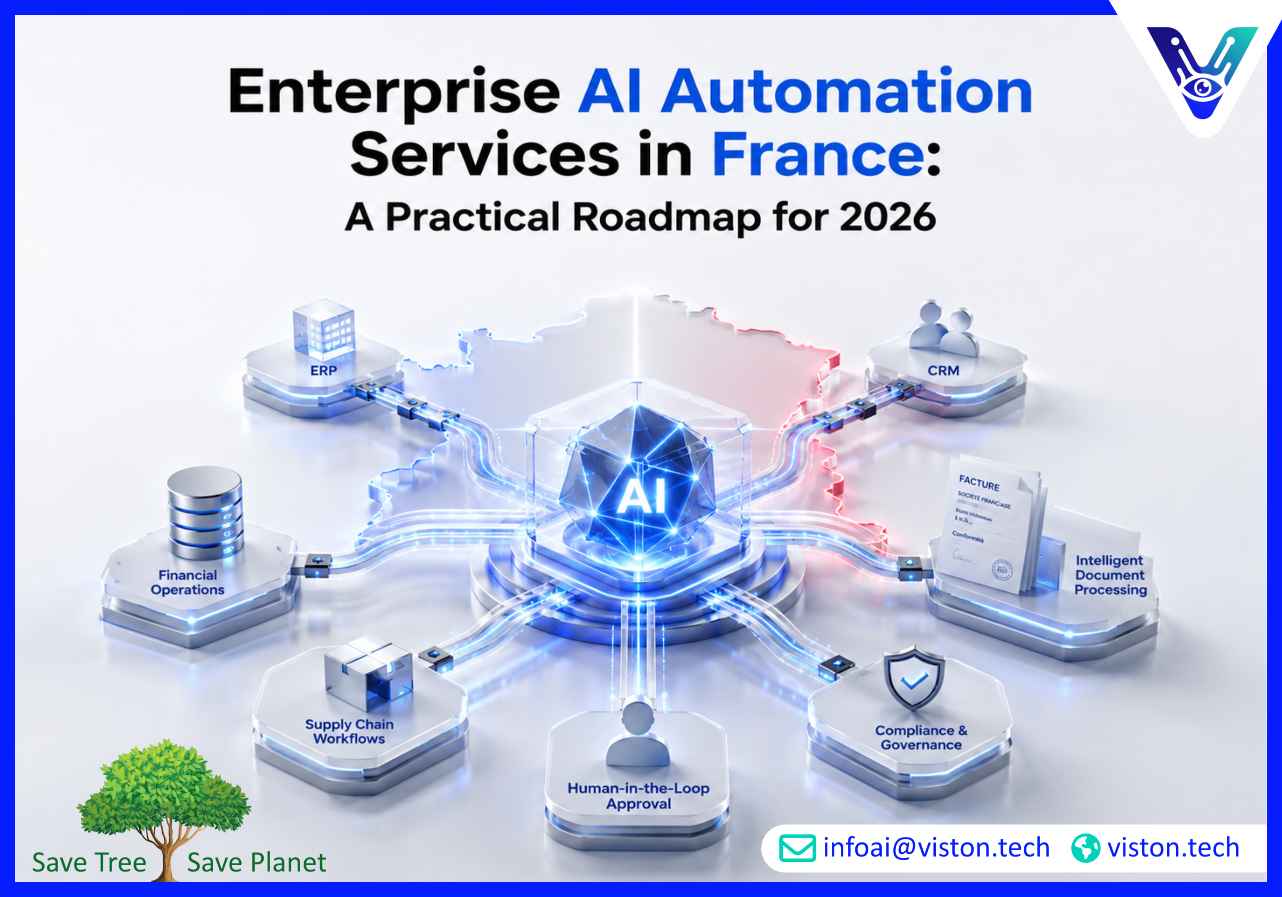
French enterprises are moving past the experimental phase of artificial intelligence. The conversation has shifted from “what can AI do?” to “how do we embed it into operations without creating fragility?” For business and technology leaders, 2026 marks the year where AI automation services must deliver measurable operational change rather than isolated productivity gains.
Enterprise AI automation services have matured considerably. They are no longer a collection of standalone tools bolted onto existing processes. Today, they represent a disciplined approach to connecting workflows, data streams, and decision logic across departments using AI agents and intelligent bots.
The core of modern AI automation sits at the intersection of three capabilities: large language models that understand unstructured information, deterministic workflow engines that enforce business rules, and integration layers that connect to ERP systems, CRMs, document repositories, and communication platforms. When designed properly, these components form what engineers call agentic workflows—sequences where AI agents perform multi-step tasks, handle exceptions, and escalate to human operators only when ambiguity exceeds defined thresholds.
For French enterprises, this matters in specific ways. Organisations managing complex supply chains, regulated financial operations, or high-volume administrative processes are finding that point solutions create more problems than they solve. A bot that drafts emails but cannot read incoming attachments, access the CRM, or respect GDPR data boundaries adds friction rather than removing it. The real value comes from services that map entire business processes, identify where AI can safely take ownership of decisions, and build the governance layer around those handoffs.
France presents a distinct environment for enterprise automation. The regulatory framework, workforce expectations, and industrial mix create requirements that off-the-shelf international solutions rarely satisfy completely.
The regulatory dimension is the most immediate. Any automation touching personal data, employee monitoring, credit decisions, or customer communications falls under CNIL guidelines and EU AI Act provisions. These require explainable decision trails, human oversight mechanisms, and documented risk assessments for high-risk use cases. Organisations that deploy automation without this architectural foundation face compliance exposure that can materialise months or years after implementation.
Workforce dynamics create a second pressure. French employment law and social dialogue traditions mean automation projects succeed or fail based on how they involve internal stakeholders. Service providers unfamiliar with comité social et économique consultation processes or the practical realities of French workplace culture often stumble during deployment, regardless of technical competence.
The economic argument has sharpened in 2026. Labour costs in professional services, logistics, and administrative functions continue to rise. Businesses that automate routine cognitive work—document processing, data reconciliation, compliance checking, multi-step approvals—redirect experienced staff toward analysis, client relationships, and exception handling. The goal is rarely headcount reduction. It is capacity creation without linear cost growth.
The technology itself has matured to a point where reliability is measurable. Modern workflow bots achieve task completion rates above 95% for well-defined processes when the underlying systems and data structures are sound. The remaining 5%—the exceptions—are where human judgment adds the most value. This is the operational sweet spot that structured automation services aim to capture.
Buyers evaluating enterprise AI automation services should look past interface demonstrations and focus on architectural fundamentals. Five capability areas separate production-grade implementations from pilot projects that never scale.
Not every business process benefits from AI automation. High-frequency, rule-based workflows with structured data inputs deliver the strongest returns. Processes involving frequent exceptions, ambiguous inputs, or decisions requiring deep contextual knowledge may be better served by decision-support tools rather than full automation. A credible automation partner conducts rigorous process qualification before writing a single line of integration code. This means documenting process variants, failure modes, data quality levels, and the actual cost of errors versus the cost of manual processing.
Workflow bots are only as capable as their connections to operational systems. Production automation requires robust APIs, secure credential management, and the ability to handle system timeouts, schema changes, and partial data availability without cascading failures. French enterprises commonly run SAP, Microsoft Dynamics, Salesforce, Sage, or sector-specific platforms. The automation layer must interact with these systems through their native interfaces while maintaining audit trails for every transaction.
Many French business workflows still pivot on documents—invoices, purchase orders, regulatory filings, contracts, delivery notes. Modern AI automation pairs OCR with language models that understand document context, extract structured data, validate against business rules, and flag discrepancies. The processing must work across French-language documents with their specific formats, legal terminology, and numerical conventions. Accuracy on financial documents, in particular, must be extremely high because downstream reconciliation errors compound quickly.
The most operationally resilient automations are designed with explicit human handoff points. These are not failures of automation. They are deliberate design choices that recognise where judgment, relationship management, or regulatory requirements demand human involvement. The automation service should make these handoffs seamless—routing the right information to the right person with full context, tracking resolution time, and learning from human decisions to improve future handling.
Once workflows are running autonomously, the business needs comprehensive visibility. This includes real-time dashboards showing throughput and exception rates, detailed logs for every automated decision, impact assessments when underlying systems or rules change, and audit-ready reports demonstrating compliance with internal controls and external regulations. For AI Act compliance, high-risk automation categories require specific documentation that the automation platform should generate as a natural byproduct of its operation.
The most successful enterprise automation deployments in France cluster around a few operational domains where the process patterns are well understood and the data environment is sufficiently structured.
Finance operations lead adoption. Invoice processing, expense management, account reconciliation, and inter-company billing involve high volumes of structured and semi-structured data moving between defined systems. Automated workflows reduce processing time from days to minutes while improving accuracy. The compliance benefit is significant, as every action generates a timestamped, attributable record.
Customer service operations benefit when automation handles classification, routing, and first-response drafting while keeping complex or sensitive cases with experienced agents. French consumer expectations around service quality and data protection make this a careful balance. Properly implemented, it reduces response times without compromising the human touch that French customers value.
Supply chain and logistics workflows involve order processing, shipment tracking, customs documentation, and exception management. Organisations moving goods across EU borders or managing multi-tier supplier networks find that automated workflows dramatically reduce the manual coordination overhead that otherwise consumes procurement and logistics teams.
HR and administrative processes—onboarding, contract management, leave administration, compliance training tracking—are repetitive and document-heavy. Automation standardises these processes while ensuring consistent application of company policies and French labour law requirements.
Compliance monitoring has emerged as a distinct use case. Rather than periodic manual reviews, automated workflows continuously scan transactions, communications, and system access patterns against regulatory requirements, generating alerts only when anomalies appear. For financial services firms and regulated industries, this shifts compliance from a backward-looking exercise to an operational control.
Selecting an automation partner involves technical assessment and organisational fit. The following evaluation dimensions help procurement and technology leaders make structured decisions.
Look for demonstrated process analysis capability. Before proposing solutions, a credible partner should ask detailed questions about existing workflows, pain points, system architecture, data quality, and compliance obligations. Partners who propose specific solutions during initial conversations without understanding operational context are unlikely to deliver sustainable results.
Assess integration experience with your specific technology stack. Integration depth matters more than the number of advertised connectors. Ask how they handle API rate limiting, authentication management, error recovery, and data synchronisation in production environments similar to yours.
Evaluate their approach to security and data residency. For French enterprises, data sovereignty is non-negotiable in many sectors. The automation infrastructure should support processing within French or EU data centres, with clear documentation of where data flows, how it is encrypted in transit and at rest, and what access controls govern the automation environment.
Understand their methodology for measuring outcomes. The business case for automation rests on specific metrics—processing time reduction, error rate improvement, capacity freed for higher-value work, compliance audit performance. The service provider should define these metrics upfront and build reporting that tracks them through pilot, rollout, and steady-state operations.
Consider their support model for production operations. AI workflow bots operate in live business environments. When processes break or systems change, response time matters directly to business continuity. Clarify support hours, escalation paths, mean time to resolution commitments, and how they handle changes in underlying systems or business rules.
Viston AI focuses specifically on AI automation and workflow bot deployment for mid-market and enterprise organisations operating in France. Its approach centres on building production-grade automation that integrates with existing business systems while respecting the regulatory and operational realities French companies navigate daily.
The company’s methodology begins with rigorous process discovery. Rather than automating everything technically possible, Viston AI works with operations, finance, and technology teams to identify processes where structured automation delivers the strongest combination of efficiency gain, accuracy improvement, and compliance benefit. This qualification work prevents investment in workflows where exception rates, data quality, or regulatory constraints would undermine automation viability.
On the technical side, Viston AI builds workflow bots that connect to major enterprise platforms—SAP, Microsoft Dynamics, Salesforce, and sector-specific systems common in French industry—with integration architectures that handle the real-world complexity of production environments. The automation layer includes intelligent document processing calibrated for French-language business documents, structured human-in-the-loop handoff points, and governance dashboards that provide the audit trails French regulators require.
For French enterprises, local operational presence matters. Data residency requirements, CNIL compliance expectations, and the practical need for French-speaking support during critical business hours make near-shore delivery a practical advantage. Viston AI’s understanding of French employment law, workplace consultation norms, and industry-specific regulatory requirements reduces the deployment friction that generic international providers often encounter.
The company’s client engagements typically start with a defined-scope pilot targeting a single high-impact process, such as accounts payable automation, customer inquiry classification and routing, or compliance documentation processing. Measured outcomes from the pilot inform the business case for broader deployment, giving procurement teams and internal stakeholders concrete data rather than projections.
Processes with high transaction volumes, structured or semi-structured data inputs, clear business rules, and manageable exception rates deliver the strongest returns. Finance operations, document processing, compliance checks, and multi-step administrative workflows are common starting points. Processes requiring deep contextual judgment or frequent human negotiation are typically better suited for decision-support tools rather than full automation.
CNIL guidelines and the EU AI Act require documented data processing purposes, data minimisation, transparency about automated decisions, and human oversight for high-risk applications. Automation services must provide comprehensive audit trails, support data residency within France or the EU, and include mechanisms for human review of decisions affecting individuals. These requirements influence system architecture from the outset, not as retrofitted controls.
A focused pilot targeting a single well-defined process typically moves from process discovery to production deployment within 8 to 12 weeks. This includes process mapping, integration build, testing with real data, user acceptance, and parallel running before full cutover. Broader rollouts across multiple processes or departments are phased based on pilot outcomes and organisational readiness.
Meaningful metrics include processing time reduction, error rate improvement, staff hours redirected to higher-value work, faster month-end close cycles, reduced compliance findings, and improved service level performance. The specific metrics should be defined during process qualification, baselined before automation, and tracked through dashboards that provide ongoing operational visibility.
Modern AI automation handles French-language documents effectively, including specific legal and financial terminology, numerical conventions, and common document layouts. The processing quality depends on proper configuration for the document types in scope. For multinational French enterprises, the same automation infrastructure can typically handle additional European languages with appropriate model configuration and validation procedures.
Production automation requires monitoring, exception handling, periodic updates when underlying systems or business rules change, and performance optimisation based on operational data. Most organisations benefit from a defined support arrangement covering response times for critical process failures, change management procedures, and regular operational reviews to identify improvement opportunities.
Enterprise AI automation services in France have reached a level of maturity where the technology is no longer the primary constraint. The success of automation initiatives now depends on process selection rigour, integration depth, governance design, and the operational experience of the service provider. For French enterprises, the regulatory environment and workforce dynamics add layers of complexity that reward careful partner selection. Organisations that invest in structured automation with qualified partners are achieving sustainable operational improvements—faster processing, fewer errors, stronger compliance, and teams focused on work that requires human judgment. Whether you are exploring a first pilot or scaling existing automation, the practical path forward starts with a disciplined assessment of where AI workflow bots can create genuine business value in your specific operational context.
