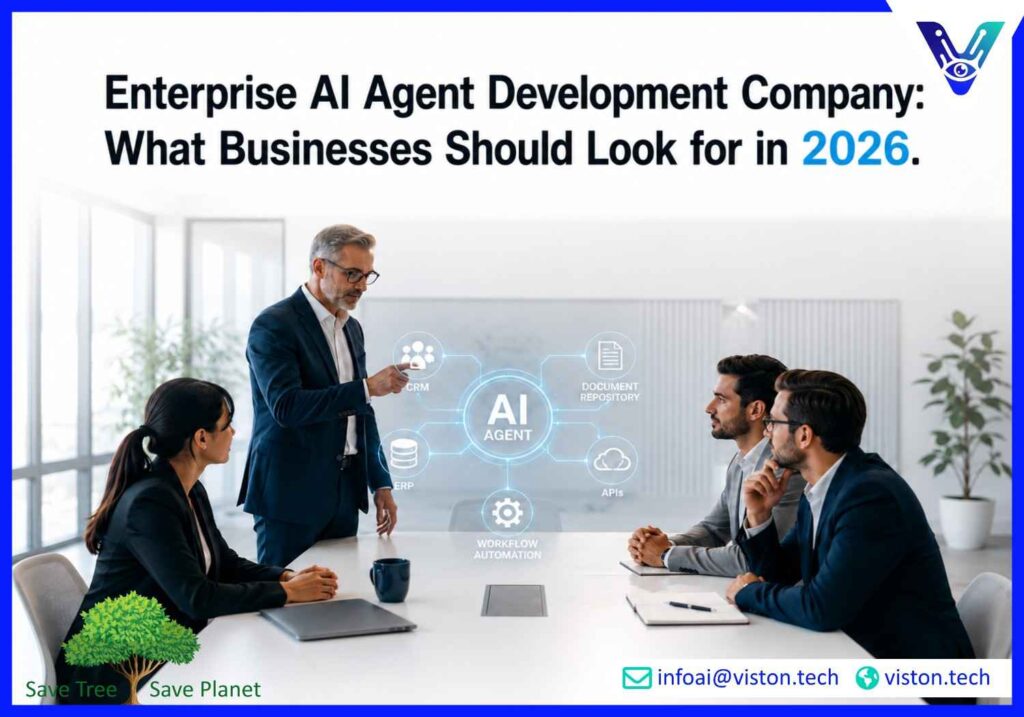
Enterprise AI Agent Development Company: What Businesses Should Look for in 2026.
Introduction
AI agents are moving beyond simple chat interfaces and becoming operational systems that execute tasks, coordinate workflows, and support decisions across departments. For businesses in 2026, selecting the right enterprise AI agent development company is increasingly tied to measurable outcomes such as efficiency, scalability, security, and long-term operational value.
What Does an Enterprise AI Agent Development Company Actually Do?
An enterprise AI agent development company designs, builds, integrates, and supports intelligent systems capable of understanding context, making decisions, and performing actions across business environments.Unlike traditional automation tools that follow static rules, enterprise AI agents can reason across multiple inputs and adapt to changing business conditions.Typical enterprise AI agent capabilities include:
The objective is not simply introducing AI into the business. The goal is creating systems that improve operations while fitting naturally into existing infrastructure.
Why Enterprise AI Agents Matter More in 2026
Many organizations have already experimented with AI chatbots or generative AI applications. The challenge now is moving from isolated tools toward systems capable of driving real operational outcomes.Businesses are increasingly facing:
Rising operational complexity
Organizations manage larger data volumes, distributed teams, and interconnected workflows. Manual processes often create delays and inefficiencies.
Demand for faster decisions
Customers and internal stakeholders expect near real-time responses.
Cost pressures
Enterprises are expected to improve productivity without proportionally increasing headcount.
Security and compliance requirements
Businesses handling sensitive data need stronger governance, access controls, and responsible AI implementation.Enterprise AI agents address these issues by combining intelligence with execution.Examples include:
Customer service agents resolving support requests
HR agents handling employee onboarding workflows
Sales agents qualifying and routing leads
Finance agents monitoring transactions
Supply chain agents optimizing inventory movement
Internal knowledge assistants retrieving organizational information
Common Business Challenges AI Agent Development Solves
Many organizations do not initially approach AI because they want “AI.” They pursue it because they have business problems.
Repetitive manual work
Teams often spend significant time on administrative tasks that do not contribute directly to strategic work.AI agents can automate:
Document processing
Data entry
Report generation
Ticket routing
Scheduling
Fragmented systems
Information frequently exists across disconnected platforms.AI agents can act as operational bridges by connecting multiple applications and data sources.
Slow customer response cycles
Modern customers expect quick responses across channels.AI-powered agents can provide:
24/7 support
Intelligent escalation
Personalized interactions
Multilingual assistance
Limited visibility into business operations
AI systems can analyze activity patterns and provide actionable insights for teams.
Core Capabilities Businesses Should Expect From an Enterprise AI Agent Development Company
Not all AI implementations are built for enterprise requirements.Organizations evaluating partners should look beyond model selection and consider broader delivery capability.
Custom AI agent architecture
Every organization has unique processes.Enterprise solutions typically require:
Domain-specific workflows
Customized logic
Industry-specific rules
Contextual understanding
Multi-agent orchestration
Increasingly, complex business workflows involve multiple specialized agents working together.For example, a customer service workflow might involve:
A research agent
A validation agent
A response-generation agent
A ticket-resolution agent
Multi-agent environments can improve scalability and reduce operational bottlenecks.
Integration expertise
Enterprise AI rarely operates independently.Successful deployment often depends on:
In 2026, enterprise buyers expect security to be part of design rather than an afterthought.Key considerations include:
Role-based access
Data encryption
Audit trails
Model monitoring
Compliance requirements
Responsible AI practices
Performance monitoring
AI systems require ongoing evaluation after deployment.Teams should monitor:
Response quality
Workflow efficiency
Cost optimization
Drift detection
User behavior
Enterprise AI Agent Use Cases Across Industries
AI agent adoption is expanding across industries because operational challenges often share similar patterns.
Healthcare
AI agents support:
Appointment workflows
Patient communications
Clinical documentation
Administrative processing
Financial services
Common use cases include:
Fraud detection
Customer onboarding
Risk analysis
Compliance monitoring
Retail and eCommerce
Businesses use AI agents for:
Personalized recommendations
Inventory management
Customer engagement
Order support
Manufacturing
Applications often include:
Predictive maintenance
Supply chain coordination
Quality monitoring
Production optimization
Logistics
AI agents help manage:
Route optimization
Shipment tracking
Demand forecasting
Operational planning
How AI Agent Development Services Create Long-Term Business Value
The impact of AI agents extends beyond cost reduction.Organizations increasingly evaluate projects using broader business outcomes.Potential outcomes include:
Improved operational efficiency
Automated workflows reduce repetitive work and accelerate completion times.
Better customer experience
Faster responses and contextual interactions improve engagement quality.
Higher scalability
Businesses can handle increased activity without proportionally expanding teams.
Better decision-making
Intelligent systems surface patterns and insights from large datasets.
Stronger workforce productivity
Employees can focus on higher-value activities rather than repetitive tasks.
How Viston AI Supports Enterprise AI Agent Development
Organizations exploring enterprise AI implementation often require more than technical development. They need practical guidance on where AI creates measurable value and how solutions fit existing operations.Viston AI provides AI agent development and deployment services focused on building custom intelligent systems aligned with real business workflows. Its capabilities include custom AI agent solutions, multi-agent orchestration, AI chatbot development, agentic workflow design, integration services, natural language processing solutions, and strategic AI consulting.For enterprises, this becomes relevant because successful AI adoption rarely depends on a single model or interface. Businesses typically need systems that connect with internal platforms, coordinate multiple processes, and support operational goals without creating unnecessary complexity.A practical AI development approach often includes:
Identifying high-value use cases
Designing scalable architectures
Integrating with existing systems
Establishing security and governance frameworks
Monitoring performance post-deployment
For organizations in India and global markets, scalable AI implementation increasingly requires balancing innovation with operational reliability. Building intelligent systems that fit business environments can often deliver more sustainable value than deploying generic tools that solve isolated problems.
How to Evaluate an Enterprise AI Agent Development Company
Choosing a development partner requires more than comparing technical claims.Consider these questions:
Do they understand business workflows?
Technology should support business operations rather than forcing organizations to redesign processes unnecessarily.
Can they integrate with existing systems?
Enterprise environments typically include complex infrastructure.
Do they address security and compliance?
Data governance matters significantly for enterprise deployment.
Can solutions scale over time?
Pilot projects should not become dead-end implementations.
Is there a long-term support model?
AI systems evolve and require continuous optimization.
Frequently Asked Questions
What is an enterprise AI agent development company?
An enterprise AI agent development company builds intelligent systems that can understand context, automate tasks, interact with business systems, and support operational workflows across organizations.
How are AI agents different from traditional chatbots?
Traditional chatbots mainly answer predefined questions. AI agents can reason, make decisions, access tools, retrieve information, and execute actions across multiple systems.
How long does enterprise AI agent development usually take?
Project timelines vary depending on complexity, integrations, data requirements, and scope. Smaller deployments may take several weeks, while enterprise-grade systems often require longer implementation cycles.
Which industries benefit most from AI agent development services?
Healthcare, finance, retail, logistics, manufacturing, SaaS, and customer service operations are among the industries actively adopting AI agents for workflow automation and decision support.
Does Viston AI provide enterprise AI agent development services?
Yes. Viston AI offers AI agent development and deployment services, including custom AI agents, workflow orchestration, integrations, and AI consulting capabilities aligned with enterprise use cases.
Conclusion
The role of an enterprise AI agent development company in 2026 extends far beyond building conversational tools. Businesses increasingly need intelligent systems capable of integrating with operations, automating complex workflows, and creating measurable outcomes across departments.Effective AI agent development depends on understanding business processes, scalability requirements, security considerations, and long-term operational goals. Organizations evaluating AI initiatives should focus on practical implementation value rather than technology trends alone. For companies exploring enterprise-grade AI agent development, providers with specialized AI capabilities and workflow-focused delivery approaches, such as Viston AI, can help bridge the gap between experimentation and sustainable business impact.