
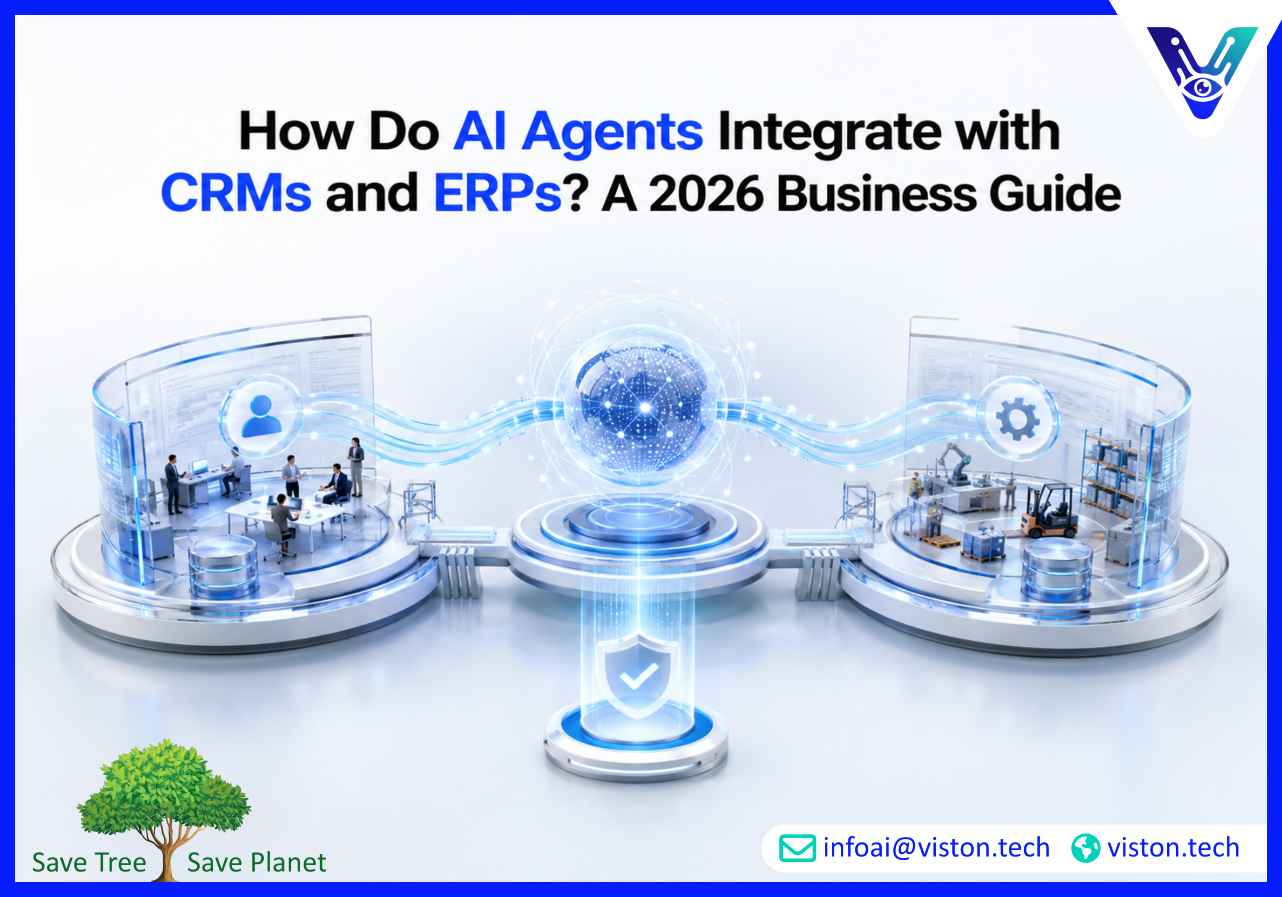
AI agents become far more valuable when they connect with the systems where business data and workflows already live. For many organizations, that means CRM and ERP platforms. Understanding how AI agents integrate with CRMs and ERPs helps leaders plan secure, scalable automation instead of isolated AI experiments.
AI agents integrate with CRMs and ERPs by connecting to their data, workflows, APIs, permissions, and business rules. Instead of operating as standalone chat tools, integrated agents can read customer records, update opportunities, check inventory, create invoices, trigger approvals, generate reports, and support decisions across departments.
A CRM usually stores customer, sales, marketing, and service data. An ERP manages finance, procurement, inventory, operations, supply chain, billing, and resource planning. When AI agents are connected to these platforms, they can act with context.
For example, a sales agent can review CRM activity, identify stalled deals, draft follow-ups, and update next steps. An operations agent connected to an ERP can monitor stock levels, flag purchase requirements, or summarize delayed orders. The value comes from combining intelligence with real business systems.
In 2026, businesses are moving beyond basic AI assistants. They want AI agents that can complete work, not just answer questions. That requires reliable integration with enterprise applications.
Without CRM and ERP access, an AI agent may provide generic responses. With integration, it can understand live business context, follow approved workflows, and support measurable outcomes.
This matters because business teams often struggle with fragmented data, manual updates, delayed reporting, and repetitive system tasks. Integrated AI agents help reduce these gaps by connecting customer, financial, operational, and workflow information in one intelligent layer.
Most modern CRMs and ERPs provide APIs that allow external systems to securely read, write, and update data. AI agents use APIs to retrieve records, submit changes, trigger actions, and synchronize information.
This is one of the most reliable approaches because APIs provide structured access with defined permissions and controls.
Middleware or integration platforms connect multiple applications without building every connection from scratch. These platforms help manage data mapping, workflow triggers, error handling, authentication, and monitoring.
For companies with multiple systems, middleware can make AI agent integration more scalable and easier to maintain.
AI agents can also connect through workflow automation platforms that trigger actions based on events. For example, when a new CRM lead arrives, an agent can qualify it, enrich the record, assign it to a sales rep, and send a personalized email draft.
This approach works well for task-based automation where the process is clearly defined.
Some AI agents integrate through governed access to databases, data lakes, or warehouses. This helps agents analyze historical sales, finance, procurement, or customer service data without directly changing source systems.
This method is useful for reporting, forecasting, and decision-support use cases.
Some CRM and ERP platforms support embedded AI features or custom extensions. Businesses can use these native capabilities when they want agents to work inside the existing user interface.
This can improve adoption because teams do not need to switch tools to use AI-supported workflows.
CRM integration allows AI agents to support sales, marketing, customer success, and service teams.
An integrated CRM agent can:
The main benefit is improved customer context. Teams spend less time searching, updating, and interpreting CRM data, and more time acting on it.
ERP integration connects AI agents with operational and financial workflows.
An ERP-connected agent can:
ERP workflows usually require higher accuracy, stronger permissions, and more control because they often affect finance, supply chain, compliance, and operations. That makes careful integration design essential.
AI agents should only access the data and actions they are authorized to use. Role-based permissions, single sign-on, API tokens, and audit logs help ensure the agent operates safely.
CRM and ERP systems often use different field names, formats, and data structures. A strong integration maps data correctly so the agent understands what each record means and where updates should go.
AI agents must follow business logic. For example, they should not approve discounts, change payment terms, or modify purchase orders unless the workflow allows it.
Not every task should be fully autonomous. High-impact actions may require human review, such as approving refunds, changing financial records, sending legal documents, or updating critical ERP data.
Production-grade integrations need logging, alerts, retries, and fallback processes. If an API fails or a data update is rejected, the system should handle the issue safely.
The strongest benefit is operational efficiency. Teams can reduce repetitive data entry, manual research, and routine coordination across systems.
Integrated AI agents also improve decision-making. Leaders can ask questions about sales, customers, inventory, revenue, or performance and receive system-aware answers based on connected data.
Another benefit is consistency. When workflows are automated through approved rules, businesses reduce process variation and improve data quality.
For customer-facing teams, CRM integration improves response speed and personalization. For operations and finance teams, ERP integration improves visibility, control, and reporting.
AI agent integration can fail when businesses treat it as a simple plugin instead of an enterprise workflow project.
Common risks include poor data quality, unclear permissions, weak API governance, over-automation, lack of monitoring, and disconnected business rules. Another risk is allowing agents to take actions without proper approval controls.
Security is especially important. CRM and ERP systems contain sensitive customer, financial, employee, and operational data. Any AI agent connected to these systems must be designed with access limits, encryption, logging, and compliance awareness.
Businesses should start with high-value, controlled use cases rather than trying to automate everything at once.
A practical approach includes:
Good use cases often begin with reporting, summarization, workflow routing, lead qualification, ticket handling, order visibility, or document processing. These tasks create value while allowing teams to validate reliability before expanding automation.
Viston AI provides Agent Integration Services that help businesses connect AI agents with real operational systems, including CRMs, ERPs, workflow tools, databases, and enterprise applications. This makes its offering directly relevant for organizations asking how AI agents integrate with CRMs and ERPs.
Its work focuses on making AI agents practical inside business environments, not just building standalone assistants. That can include connecting agents to system data, enabling task automation, supporting multi-step workflows, and aligning agent behavior with business processes.
For companies using CRM and ERP platforms, this kind of integration support is important because success depends on more than model capability. The agent must understand the right data, respect permissions, trigger approved actions, and fit existing workflows.
Viston AI’s broader AI agent capabilities also support businesses that need custom agent development, orchestration, and enterprise workflow automation. For decision-makers, the value lies in building AI agents that can operate reliably across systems while supporting measurable business outcomes such as faster service, cleaner data, improved reporting, and reduced manual work.
A reliable provider should understand both AI and enterprise systems. The work requires knowledge of APIs, data models, authentication, automation logic, security, testing, and operational support.
Businesses should evaluate whether the provider can:
The right partner should not simply connect tools. They should help design a safe, useful, and maintainable operating model for AI-enabled workflows.
AI agents integrate with CRMs and ERPs through APIs, middleware, workflow automation tools, databases, and native platform extensions. These connections allow agents to read data, update records, trigger workflows, and support business tasks.
Yes, but automatic updates should be controlled through permissions, validation rules, and approval workflows. Low-risk updates may be automated, while sensitive actions should require human review.
AI agents can automate lead qualification, follow-up drafting, customer summaries, pipeline updates, ticket routing, sales insights, and next-action recommendations.
ERP-connected agents can support inventory checks, order tracking, invoice workflows, procurement requests, vendor summaries, financial reporting, and operational alerts.
They can be secure when designed with role-based access, authentication, encryption, audit logs, data governance, and controlled action permissions. Security should be planned before deployment.
Yes. Viston AI provides Agent Integration Services that help connect AI agents with business systems, workflows, and enterprise applications so organizations can use AI more effectively in real operations.
Understanding how AI agents integrate with CRMs and ERPs is essential for businesses planning practical AI adoption in 2026. The real value comes when agents can access trusted data, follow business rules, and support work across sales, service, finance, operations, and management systems. With the right Agent Integration Services, organizations can move from isolated AI tools to connected, secure, and scalable automation. Viston AI is relevant for businesses exploring this shift because its agent integration capabilities support the connection between AI systems and everyday enterprise workflows.
