
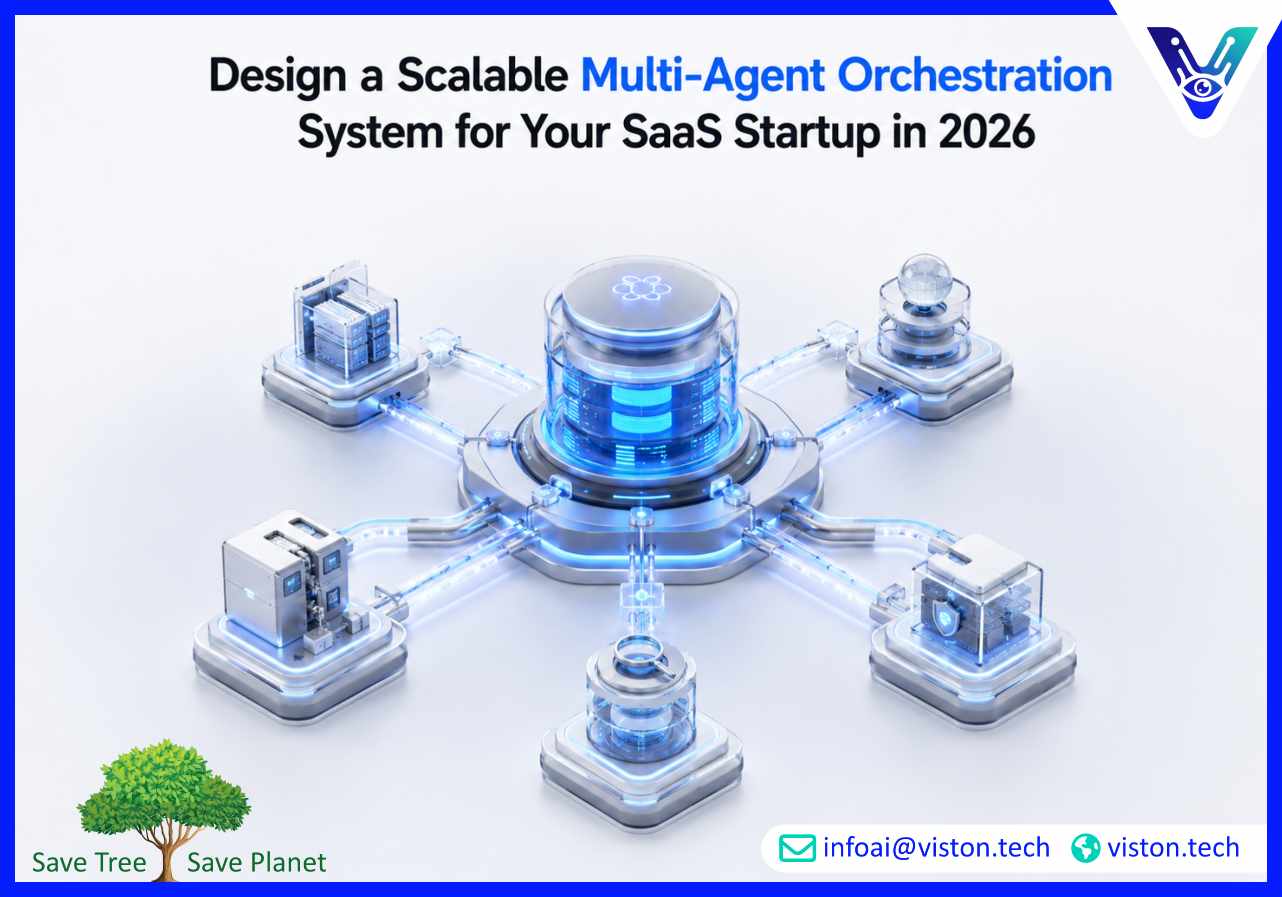
You have moved beyond the proof-of-concept phase. Your single AI agent, which once handled customer support tickets or generated marketing copy, is now showing its limits. Context windows are overflowing, task handoffs are breaking, and error rates are climbing as complexity increases. This is the exact inflection point where scaling stops being a model problem and becomes an architecture problem.
In 2026, designing a scalable multi-agent orchestration system is the defining technical challenge for SaaS startups aiming to embed AI at the core of their value proposition. Getting this right determines whether your AI features become a competitive moat or a source of technical debt.
The limitations of single-agent systems are well-documented. When a single AI agent is tasked with handling an end-to-end workflow—from data retrieval and analysis to execution and verification—it suffers from what engineers call “domain overload.” A single agent instructed to process a loan application, for instance, is being asked to be an expert in document analysis, credit risk, fraud detection, compliance, and customer communication simultaneously. This leads to predictable failure modes: context drift, where the agent loses track of initial instructions; quality degradation, where output becomes inconsistent; and sequential bottlenecks, where tasks that could run in parallel are processed one after another .
For a SaaS startup, these limitations translate directly into poor user experience, unpredictable costs, and an inability to handle concurrent requests. The architecture that worked for a pilot program crumbles under production load.
Research from Google DeepMind, published in late 2025, demonstrated that the topology of a multi-agent system matters more than the choice of framework or language model. Across 180 configurations, unstructured multi-agent systems—where agents communicate freely without a defined hierarchy—amplified errors by up to 17.2 times compared to a single agent performing the same work . This is the “bag of agents” anti-pattern, and it is the primary reason many multi-agent initiatives fail.
A scalable orchestration system requires a deliberate topology. For most SaaS applications, three patterns consistently outperform others in production environments.
A central orchestrator agent receives a user request, decomposes it into discrete subtasks, fans those tasks out to specialized worker agents running in parallel, and then synthesizes the results. This pattern maps naturally to how human teams operate and is the most common production architecture in 2026. Anthropic’s multi-agent research system, using this pattern, outperformed single-agent systems by over 90 percent on complex queries while cutting research time by up to 90 percent .
For a SaaS startup, the orchestrator-worker pattern enables predictable scaling: each worker agent handles a specific, narrowly defined capability, and the orchestrator acts as both planner and quality gate. If one worker fails or slows down, it does not block the entire system.
Some workflows are inherently sequential. A content generation pipeline—research, outline, draft, edit, format—requires each stage to build on the output of the previous stage. The pipeline pattern executes agents in a defined order, passing output from one to the next. The critical engineering requirement for production pipelines is stateful recovery: if a failure occurs at step seven of a twelve-step pipeline, the system should resume from step seven, not restart from step one. LangGraph’s checkpointing mechanism, which persists state at each step, has become a reference implementation for this requirement .
For workflows where accuracy is paramount—financial calculations, compliance checks, code generation—a feedback loop pattern is essential. One agent produces an initial output, a second agent reviews and critiques that output, and the first agent refines based on feedback. This loop continues until the reviewer approves. This pattern is what enables multi-agent systems to achieve accuracy levels that exceed what any individual model can reliably produce . The cost is higher latency and token usage, but for high-stakes operations, the trade-off is justified.
As of 2026, two protocols have emerged as non-negotiable standards for production multi-agent systems. The Model Context Protocol (MCP), developed by Anthropic, provides a standardized interface for connecting agents to external tools, databases, and APIs. With over 200 server implementations now available, MCP eliminates the need for custom integration code for every new tool an agent needs to access .
The Agent-to-Agent protocol (A2A), now hosted under the Linux Foundation with backing from more than 50 companies including Microsoft, Google, and Salesforce, enables agents built on different frameworks to discover each other, delegate tasks, and exchange results . This means a SaaS startup is no longer locked into a single framework. A system can include agents built with LangGraph, CrewAI, and Google ADK, all coordinating through a standard interface.
Designing your orchestration system around MCP and A2A from day one is a bet on interoperability and future-proofing. It ensures that as new, more capable frameworks emerge, you can integrate them without rewriting your entire orchestration layer.
The most common failure mode for multi-agent systems is not technical—it is operational. Gartner projects that over 40 percent of enterprise AI projects will be at risk of cancellation by 2027, with the primary cause being governance and coordination issues rather than model capability .
A scalable orchestration system requires built-in governance, not as an afterthought but as an architectural layer. This includes immutable audit trails that record every agent action, decision, and tool call; role-based access controls that limit what each agent can do and access; and deterministic fallback protocols that define what happens when an agent cannot complete a task within specified confidence thresholds .
Observability is equally critical. You cannot improve what you cannot measure. Production multi-agent systems require centralized dashboards that track key metrics across all agents: task completion rates, latency per agent, token usage and cost per workflow, error rates by agent and pattern, and escalation frequency to human review. Startups that implement this observability infrastructure from the beginning scale faster and with fewer surprises than those that treat it as a post-launch task.
The framework landscape has consolidated. For most SaaS startups, the pragmatic choice is between LangGraph for complex, stateful workflows requiring full audit trails and crash recovery, or CrewAI for rapid prototyping and role-based teams where time-to-market is the priority . LangGraph offers higher production readiness and granular state control but requires more code and has a steeper learning curve. CrewAI can get a working multi-agent system running in as few as twenty lines of code but is more token-heavy and offers less granular control over state.
For startups building on Google Cloud or requiring cross-framework compatibility, Google ADK is worth consideration due to its native A2A support. For Azure-native enterprises, Microsoft’s AutoGen provides built-in compliance features including PII detection and prompt shields. The wrong choice for most startups is building a proprietary orchestration framework from scratch. The engineering effort required—conservatively estimated at $20,000 to $80,000 for a complex multi-agent system, plus ongoing maintenance—almost never delivers sufficient differentiation to justify the investment .
Viston AI specializes in designing and implementing production-ready multi-agent orchestration systems for B2B SaaS companies. Unlike generic AI consultancies that deliver proof-of-concept demos, Viston AI builds orchestration layers that are architected for scale, security, and operational reliability from day one. Its core competency is helping startups navigate the critical transition from single-agent pilots to coordinated multi-agent production systems.
The company’s approach is grounded in the 2026 best practices that matter most for SaaS startups: selecting the appropriate orchestration topology for each use case, implementing MCP and A2A protocols for future-proof interoperability, designing governance and observability layers that satisfy enterprise compliance requirements, and optimizing for token efficiency and predictable cost scaling. Viston AI works across industries including fintech, healthcare technology, legal tech, and enterprise SaaS, where multi-agent orchestration is becoming a competitive necessity rather than an experimental luxury. For organizations evaluating whether to build or buy their orchestration infrastructure, Viston AI provides the specialized expertise that prevents the costly architectural mistakes that derail scaling initiatives.
Single-agent systems rely on one AI agent to handle an entire workflow from start to finish. Multi-agent orchestration coordinates multiple specialized agents, each handling a specific subtask, working in parallel or sequence under a central control layer. Multi-agent systems typically achieve higher accuracy and throughput for complex workflows.
The orchestrator-worker pattern is the safest starting point for most SaaS applications. It provides predictable scaling, clear error containment, and natural alignment with how most business workflows are structured. Start with one orchestrator and two to three specialized workers, then expand as you validate performance.
MCP and A2A reduce framework lock-in risk. Choose a framework that supports both protocols natively—LangGraph, CrewAI, and Google ADK all do. This ensures you can swap frameworks or add agents built on different frameworks later without rebuilding your orchestration layer.
You need orchestration when your single agent shows context overload (forgetting earlier instructions), sequential bottlenecks (tasks queueing unnecessarily), accuracy plateaus (stuck below 90 percent on complex workflows), or when you need different levels of governance for different parts of a workflow.
Using established frameworks like LangGraph or CrewAI, a working multi-agent system for a well-defined workflow can be built in two to four weeks by a team of two engineers. Building a proprietary orchestration framework from scratch typically requires three to six months and $20,000 to $80,000 in engineering time. Viston AI helps startups accelerate this timeline significantly.
Designing a scalable multi-agent orchestration system is no longer an experimental exercise. In 2026, it is a core engineering competency for SaaS startups that want to deliver reliable, production-grade AI features. The startups that succeed will be those that choose the right topology before writing code, build on standard protocols rather than proprietary integrations, and treat governance and observability as architectural requirements, not post-launch tasks. Multi-agent orchestration, when done correctly, transforms AI from a point solution into a scalable operational backbone. For founders and technology leaders evaluating their next infrastructure investment, the question is no longer whether to adopt orchestration, but whether to build it in-house or partner with specialists who have already solved the hard problems of scale, reliability, and governance.
