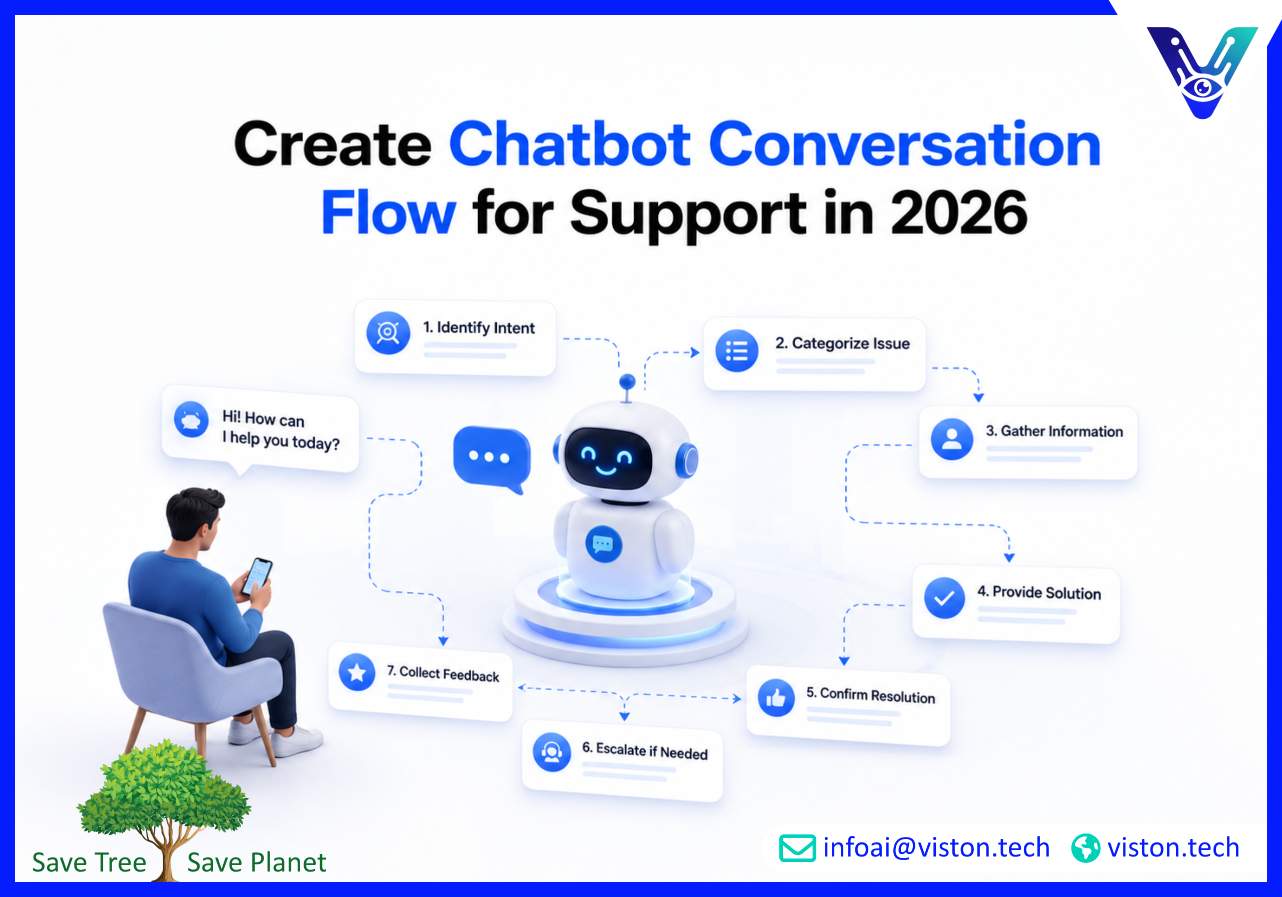
Create Chatbot Conversation Flow for Support in 2026
In 2026, businesses are increasingly relying on AI-powered customer support systems to handle rising service demands, reduce response time, and improve user satisfaction. A well-designed chatbot conversation flow for support ensures customers get fast, accurate, and consistent help while reducing dependency on human agents. For companies in the AI-driven service landscape, structured conversational design is no longer optional—it is a core operational requirement.
What a Chatbot Support Conversation Flow Means for Businesses
A chatbot support conversation flow is a structured sequence of automated interactions designed to help users resolve issues, access information, or escalate queries efficiently through a conversational interface.Unlike static FAQ systems, modern AI chatbot support flows dynamically adapt to user intent, context, and historical data to deliver personalized resolutions.In 2026, businesses use chatbot support flows to:
Automate Tier-1 customer support
Reduce ticket volumes for human agents
Improve first-response resolution rates
Deliver 24/7 customer assistance
Enhance user satisfaction and retention
Support omnichannel communication strategies
A strong support flow acts as the backbone of customer experience automation.
Core Principles of Designing Chatbot Support Conversation Flows
1. Intent Recognition First
The foundation of any support chatbot is accurate intent detection. The system must quickly identify what the user needs—whether it is billing support, technical assistance, account issues, or general inquiries.Modern AI systems use natural language understanding models to classify intent before initiating a structured flow.
2. Minimal User Effort
A well-designed support flow reduces friction by limiting the number of questions asked. Users should not feel like they are filling out a form inside a chat window.
3. Fast Resolution Pathways
The primary goal of support chatbots is resolution. Every step in the flow should move the user closer to either a solution or escalation.
4. Smart Escalation Handling
When the chatbot cannot confidently resolve an issue, it should seamlessly transfer the conversation to a human agent along with context history.
5. Context Awareness
Advanced chatbot systems maintain conversation memory, allowing them to reference previous interactions, user data, and system logs to improve accuracy.
Step-by-Step Chatbot Support Conversation Flow Design
Step 1: Welcome and Intent Identification
The first message sets the tone and helps guide users into the correct support category.Example:“Hi! I’m here to help you with any issues. What do you need assistance with today?”
Order or purchase issue
Technical problem
Billing or payment
Account settings
Speak to support agent
This step ensures early classification of user intent.
Step 2: Issue Categorization
Once intent is identified, the chatbot narrows down the problem type.For example, if the user selects “technical problem,” the chatbot may ask:“Can you tell me what kind of technical issue you are facing?”
Login issues
App not working
Error messages
Performance issues
This structured approach prevents confusion and reduces resolution time.
Step 3: Data Collection and Context Gathering
The chatbot collects essential information required to solve the issue. This may include order IDs, account details, device type, or error codes.Best practice: Only request necessary information to avoid user drop-off.
Step 4: Solution Delivery or Recommendation
Once sufficient context is gathered, the chatbot provides a solution using predefined knowledge bases or AI-generated responses.For example:“It looks like your login issue is due to incorrect password attempts. You can reset your password using this link.”If the issue is known and documented, resolution should be immediate.
Step 5: Verification and Confirmation
The chatbot checks whether the issue has been resolved:“Did this solve your problem?”
Yes, it’s resolved
No, I still need help
This step helps improve resolution tracking and user satisfaction metrics.
Step 6: Escalation to Human Support
If the chatbot cannot resolve the issue, it escalates to a human agent.Modern systems transfer full conversation context so users do not need to repeat themselves.Example:“I’m connecting you with a support specialist who can assist you further.”
Step 7: Feedback Collection
After resolution, users are asked for feedback:
Rate your experience
Was your issue resolved quickly?
Additional comments
This data is critical for improving chatbot performance over time.
Advanced Chatbot Support Flow Strategies for 2026
AI-Powered Dynamic Routing
Instead of static flows, modern chatbot systems dynamically adjust paths based on user behavior, sentiment, and urgency.
Multichannel Support Integration
Support chatbots now operate across platforms including websites, mobile apps, WhatsApp, and social messaging platforms, ensuring consistent experiences.
Sentiment Detection
AI models analyze user tone to detect frustration or urgency and prioritize escalation when needed.
Knowledge Base Integration
Chatbots connect directly with internal documentation systems to provide real-time answers.
Predictive Support
Advanced systems anticipate issues based on user activity and proactively offer assistance before users even ask.
Common Mistakes in Chatbot Support Conversation Flows
Even advanced chatbot systems fail when conversation design is poor. Common mistakes include:
Asking too many questions upfront
Lack of clear navigation options
Overcomplicated response flows
Slow escalation to human agents
Ignoring user intent variations
No fallback responses for unknown queries
These issues lead to user frustration and reduced chatbot adoption rates.
How Viston AI Builds High-Performance Chatbot Support Flows
Viston AI specializes in designing AI-driven chatbot support systems that focus on real business outcomes rather than simple automation. The approach combines conversational design, AI intent recognition, workflow engineering, and system integration to build scalable support solutions.In modern AI chatbot development, support flows must connect seamlessly with CRM systems, ticketing platforms, knowledge bases, and analytics dashboards. Viston AI builds these integrations to ensure that support conversations are not isolated interactions but part of a unified customer service ecosystem.By focusing on structured conversation design and real-time system connectivity, businesses can reduce operational costs, improve response efficiency, and deliver consistent support experiences across multiple channels.As customer expectations continue to rise in 2026, organizations adopting intelligent chatbot support flows gain a significant advantage in scalability, efficiency, and customer satisfaction.
Frequently Asked Questions
What is a chatbot support conversation flow?
It is a structured sequence of automated chatbot interactions designed to help users resolve issues, get answers, or connect with human support efficiently.
Why are chatbot support flows important for businesses?
They reduce support workload, improve response times, enhance customer satisfaction, and provide 24/7 assistance without increasing operational costs.
How do chatbot support flows handle complex issues?
When a chatbot cannot resolve an issue, it escalates the conversation to a human agent while preserving full context for seamless support.
Can chatbot support flows integrate with CRM systems?
Yes, modern chatbot systems integrate with CRM, ticketing, and knowledge base platforms to provide real-time data access and personalized support.
What makes a good chatbot support flow design?
A good flow is simple, intent-driven, fast, context-aware, and capable of smooth escalation to human agents when necessary.
Does Viston AI build chatbot support systems?
Yes, Viston AI develops AI chatbot support systems that integrate conversational flows with business tools to improve customer service efficiency and scalability.
Conclusion
A well-designed chatbot conversation flow for support is essential for delivering efficient, scalable, and customer-centric service experiences in 2026. Businesses that invest in structured flow design can significantly reduce support costs while improving resolution speed and customer satisfaction. As AI capabilities continue to evolve, support chatbots are becoming more intelligent, context-aware, and deeply integrated into business systems. Organizations that prioritize thoughtful conversation design and system integration will be best positioned to deliver seamless and effective customer support experiences.