
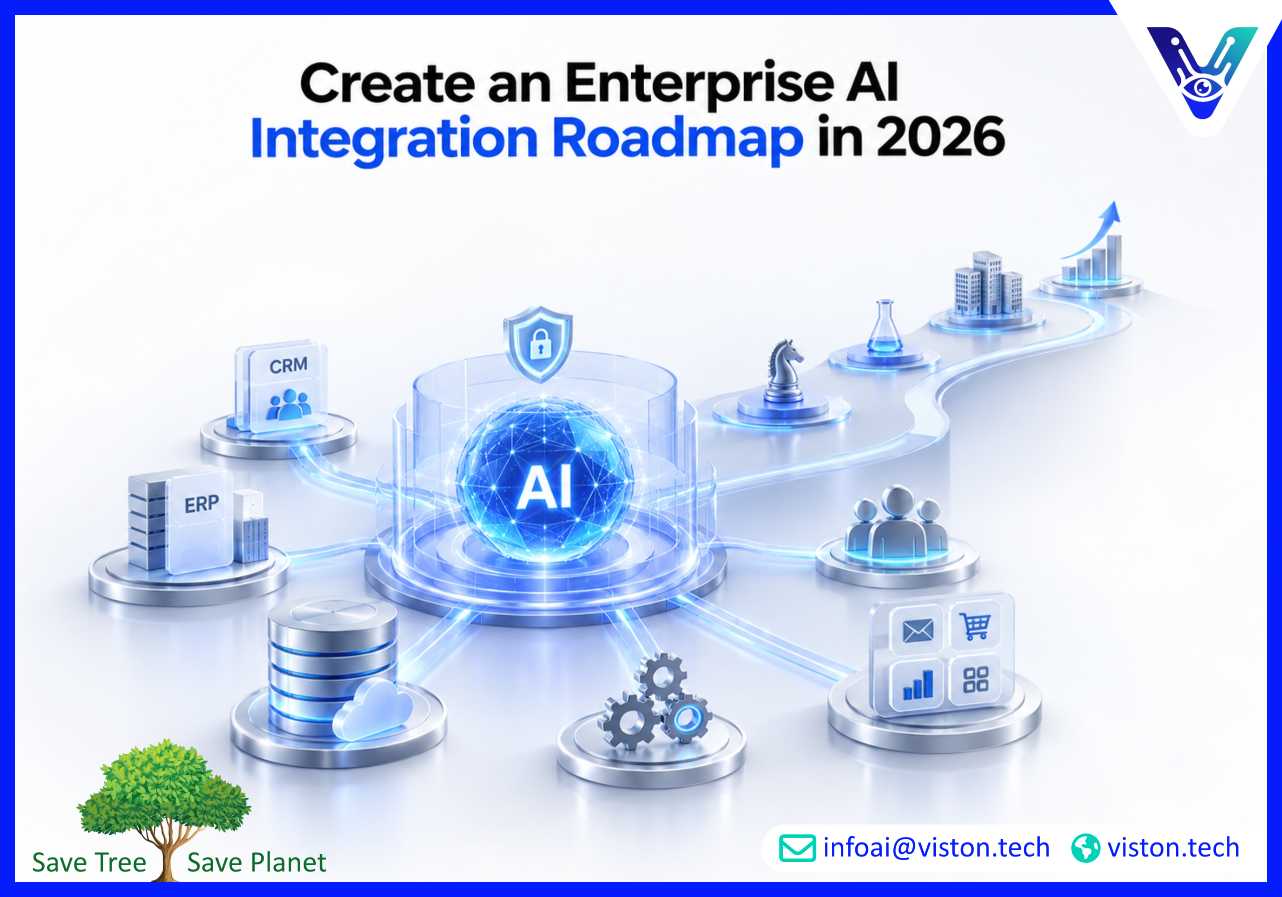
As AI adoption accelerates across industries, many organizations face the same challenge: knowing where to start and how to scale successfully. Creating an enterprise AI integration roadmap helps businesses move beyond isolated AI experiments and establish a structured plan for integrating AI into systems, workflows, and operations. In 2026, a well-defined roadmap is essential for reducing implementation risks, maximizing ROI, and ensuring long-term business value.
Many AI initiatives fail not because of the technology itself, but because organizations lack a clear integration strategy. AI tools often operate independently from core business systems, creating disconnected workflows and limited business impact.
An enterprise AI integration roadmap provides a structured framework for evaluating opportunities, prioritizing initiatives, aligning stakeholders, and deploying AI capabilities in a way that supports business objectives.
Key benefits of a roadmap include:
Rather than deploying AI randomly across teams, organizations can build a coordinated strategy that supports sustainable growth and measurable outcomes.
A successful roadmap requires more than selecting AI tools. It involves understanding business processes, technology infrastructure, data readiness, governance requirements, and organizational priorities.
The first step is identifying why the organization wants to adopt AI. Common objectives include improving operational efficiency, reducing costs, enhancing customer experiences, increasing productivity, accelerating decision-making, and automating repetitive tasks.
Organizations should define measurable outcomes before evaluating specific AI solutions.
AI solutions must integrate with existing enterprise systems. This requires a thorough review of:
Understanding current architecture helps identify integration opportunities and technical constraints.
Data quality directly affects AI performance. Organizations should assess data availability, accessibility, consistency, governance standards, and security requirements before implementation.
AI systems perform best when supported by reliable and well-managed data environments.
Enterprise AI initiatives require governance frameworks that address security, privacy, compliance, transparency, accountability, and operational oversight.
A roadmap should clearly define policies for:
Governance becomes increasingly important as AI expands into critical business operations.
A practical roadmap typically follows a phased approach that balances innovation with operational stability.
Begin by identifying high-value business processes where AI can deliver measurable improvements. Focus on workflows that are repetitive, data-driven, resource-intensive, or prone to delays.
Common opportunities include:
This phase helps prioritize initiatives with the highest potential return.
Not every AI opportunity should be implemented immediately. Organizations should evaluate initiatives based on:
Prioritization prevents resource fragmentation and supports focused execution.
Once priorities are established, businesses should design an integration architecture that defines how AI systems will interact with existing applications and workflows.
This includes:
Strong architecture ensures scalability and long-term maintainability.
Organizations should begin with controlled pilot projects rather than large-scale enterprise rollouts.
Pilot deployments allow teams to:
Lessons learned during pilots often influence broader deployment strategies.
Successful pilots can be expanded into larger programs across departments and business units.
At this stage, organizations often integrate AI into:
Expansion should be governed by established standards and performance metrics.
AI integration is not a one-time project. Businesses should continuously evaluate performance, user adoption, workflow effectiveness, and emerging AI capabilities.
Key metrics may include:
Continuous optimization helps maintain long-term value as business needs evolve.
Organizations frequently encounter obstacles during AI integration initiatives. Understanding these challenges early can improve planning and execution.
Many projects begin with technology-focused goals rather than business-focused outcomes. Successful roadmaps start with measurable business priorities.
Disconnected systems and fragmented data sources can limit AI effectiveness and complicate integration efforts.
Employees may be hesitant to adopt AI-driven workflows. Communication, training, and stakeholder engagement are critical components of successful adoption.
Organizations must ensure AI deployments align with internal governance requirements and external regulatory obligations.
Solutions designed for small pilot projects may struggle when expanded across enterprise environments. Scalability should be considered from the beginning.
Creating an enterprise AI integration roadmap requires a combination of strategic planning, technical expertise, workflow analysis, and implementation experience. Through its Agent Integration Services, Viston AI helps organizations design and execute AI integration strategies that align with business objectives and operational requirements.
Its approach focuses on connecting AI capabilities with existing business systems, workflows, and processes rather than treating AI as a standalone technology initiative. This includes evaluating integration opportunities, designing scalable architectures, supporting workflow automation, enabling agent-based systems, and establishing governance frameworks that support long-term adoption.
Organizations pursuing enterprise AI transformation often need guidance on prioritization, system interoperability, security considerations, and implementation planning. Viston AI’s expertise in AI agent integration, workflow orchestration, automation strategy, and enterprise connectivity helps businesses build practical roadmaps that balance innovation with operational reliability.
By aligning AI initiatives with measurable business outcomes, organizations can reduce implementation risks and create a foundation for scalable AI adoption across multiple departments and functions.
An enterprise AI integration roadmap is a strategic plan that outlines how an organization will evaluate, prioritize, implement, govern, and scale AI initiatives across business systems and operations.
It helps organizations align AI investments with business goals, reduce implementation risks, improve governance, and achieve measurable business outcomes.
The timeline varies depending on organizational complexity, technology infrastructure, and business objectives. Initial roadmap development may take several weeks, while implementation can occur over multiple phases.
A roadmap should include business objectives, opportunity assessment, data readiness evaluation, architecture planning, governance frameworks, implementation phases, and performance measurement strategies.
Common challenges include data silos, legacy systems, unclear objectives, compliance requirements, stakeholder resistance, and scalability concerns.
Yes. Viston AI’s Agent Integration Services support organizations with AI strategy development, integration planning, workflow automation, agent orchestration, and scalable implementation roadmaps.
Creating an enterprise AI integration roadmap is one of the most important steps organizations can take to ensure successful AI adoption in 2026. A structured roadmap helps businesses align AI initiatives with strategic goals, manage risks, prioritize investments, and scale adoption effectively. By focusing on integration, governance, architecture, and measurable outcomes, organizations can transform AI from an experimental technology into a meaningful business capability. For businesses seeking expert support, Viston AI’s Agent Integration Services provide the strategic and technical expertise needed to build practical, scalable, and business-focused AI integration roadmaps.
