
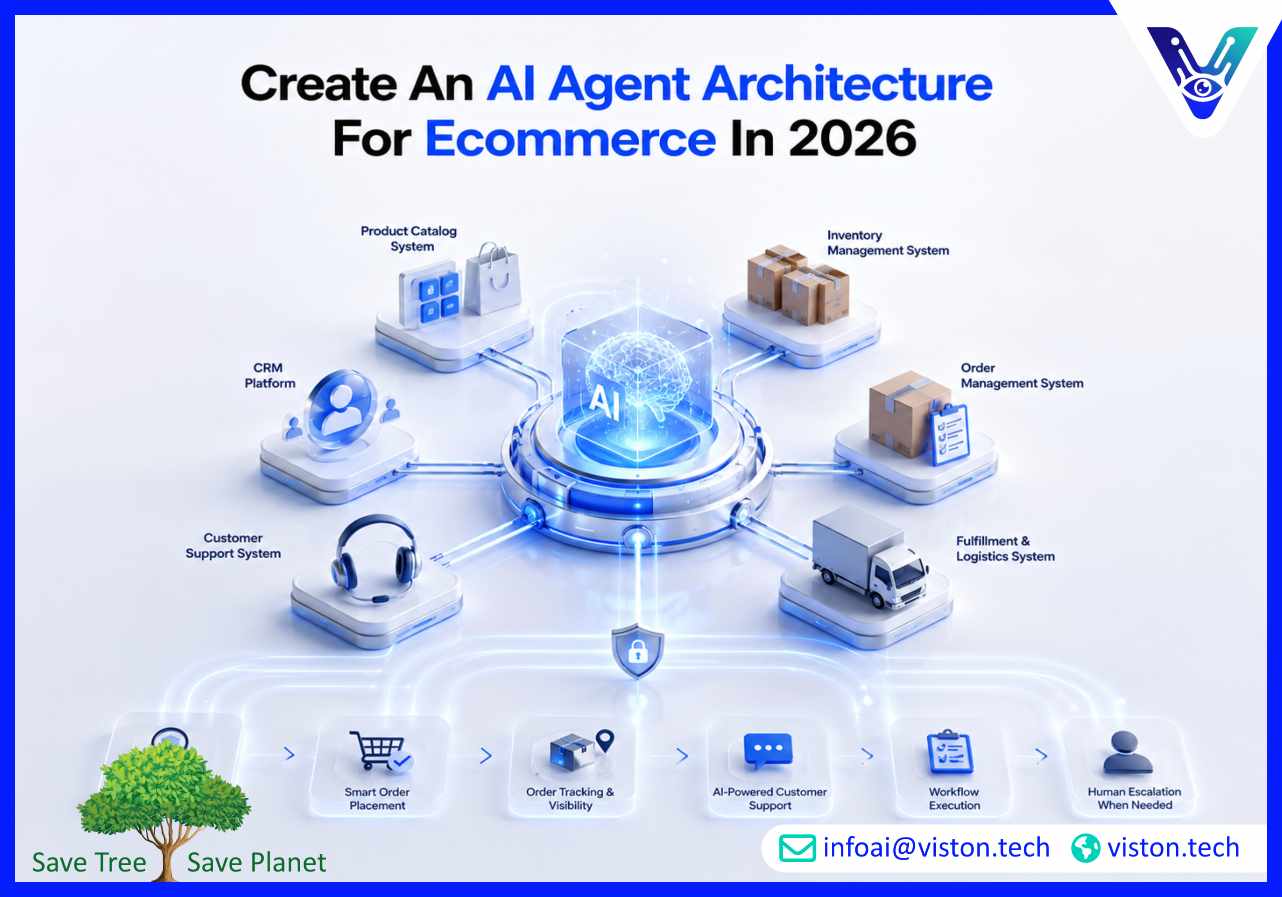
Creating an AI agent architecture for eCommerce matters because online retail now depends on faster decisions, personalized journeys, connected systems, and reliable automation. A well-designed architecture helps eCommerce businesses move beyond basic chatbots and build intelligent agents that can support customers, operations, merchandising, inventory, and growth workflows.
An AI agent architecture for eCommerce is the technical and operational structure that allows intelligent agents to understand goals, access business data, use tools, make decisions, complete tasks, and escalate issues when needed. It defines how the agent thinks, what systems it can access, what actions it can take, and how its performance is monitored.
For eCommerce businesses, this architecture must connect customer-facing experiences with back-office workflows. A customer may ask about product availability, delivery timelines, returns, discounts, or order changes. Behind that simple interaction, the agent may need to retrieve catalog data, check inventory, read order status, apply business rules, connect with CRM records, and trigger a support workflow.
A strong eCommerce AI agent architecture typically includes several core layers:
The goal is not only to answer questions. The goal is to create an AI agent system that can support real eCommerce outcomes such as higher conversion, faster support resolution, better customer retention, reduced operational workload, and more consistent service quality.
In 2026, eCommerce buyers expect immediate answers, personalized recommendations, smooth post-purchase support, and consistent service across channels. At the same time, businesses must manage rising customer acquisition costs, complex fulfillment expectations, large product catalogs, marketplace competition, and pressure to improve operational efficiency.
Basic automation is no longer enough for many eCommerce teams. Rule-based chatbots can answer simple questions, but they struggle when a shopper has a multi-step request, unclear intent, or a context-heavy problem. AI agents are more useful because they can interpret intent, retrieve relevant data, reason through options, and take guided action through integrated tools.
A practical AI agent architecture can support several high-value business challenges:
The strongest architectures are designed around business workflows, not only model capability. An eCommerce AI agent should know when to answer, when to ask a clarifying question, when to retrieve data, when to execute an action, and when to escalate.
Creating an AI agent architecture for eCommerce requires more than choosing an AI model. The architecture must combine data, tools, governance, business logic, workflows, and human oversight into a reliable system.
The agent must understand what the customer or internal user wants. In eCommerce, intent can include product discovery, order tracking, refund requests, delivery questions, loyalty queries, complaint handling, price comparisons, sizing guidance, and product recommendations.
Good architecture uses intent classification, context detection, and conversation state management so the agent does not treat every message as an isolated question.
eCommerce agents need accurate information from product catalogs, policy pages, FAQs, manuals, reviews, shipping rules, return policies, and promotional guidelines. Retrieval-augmented generation helps the agent answer from approved business knowledge instead of guessing.
This layer should include content freshness controls, source ranking, fallback handling, and structured product attributes such as category, price, availability, variants, compatibility, dimensions, and delivery restrictions.
The agent becomes commercially useful when it can securely connect with business systems. Common integrations include Shopify, Magento, WooCommerce, custom storefronts, CRM platforms, helpdesk tools, ERP systems, warehouse management systems, payment gateways, loyalty platforms, email systems, and analytics tools.
Tool access should be permission-based. For example, an agent may be allowed to check order status but not approve a refund without human review. It may create a return request but require validation before changing payment or shipping data.
eCommerce agents must follow company policies. They need guardrails for pricing, discounts, refund eligibility, privacy, product claims, restricted items, delivery commitments, and escalation requirements.
Without clear guardrails, an agent may overpromise delivery, apply incorrect policy logic, recommend unsuitable products, or expose sensitive data. Architecture should include approval flows, restricted actions, role-based access, and auditability.
AI agents should not replace human judgment in every scenario. A reliable architecture defines when the agent must escalate to support, sales, logistics, finance, or compliance teams.
Escalation is especially important for payment disputes, damaged goods, high-value orders, angry customers, legal complaints, fraud signals, sensitive personal data, and exceptions outside standard policy.
Deployment is not the final step. eCommerce AI agents need continuous monitoring for accuracy, latency, customer satisfaction, containment rate, escalation quality, conversion impact, hallucination risk, and workflow success.
Regular testing helps identify weak product data, unclear policies, broken integrations, poor prompts, or workflows that need redesign. The architecture should support feedback loops so the agent improves over time.
The best architecture starts with clear use cases. Businesses should avoid trying to automate every eCommerce process at once. A focused rollout reduces risk and creates faster learning.
Common starting points include:
Each use case should have defined success metrics. For customer support, this may include resolution time, escalation rate, first-contact resolution, and customer satisfaction. For product discovery, it may include conversion rate, average order value, product engagement, and assisted revenue.
A good eCommerce agent workflow should answer these questions:
This planning prevents the agent from becoming a disconnected interface. It ensures the AI system is tied to real operational logic and measurable business outcomes.
eCommerce businesses handle personal data, order information, payment-related records, addresses, and customer communication histories. AI agent architecture must protect that data through secure authentication, restricted access, encryption where appropriate, logging, and privacy-aware workflows.
Trust also depends on response quality. Customers should know when they are interacting with an automated assistant, receive accurate answers, and have access to human help when needed.
Viston AI is relevant to businesses looking to create an AI agent architecture for eCommerce because its service offering includes AI Agent Development & Deployment, Custom AI Agent Solutions, Multi-Agent Orchestration, Agent Integration Services, Agentic AI Workflows, AI Chatbot & Virtual Assistant Development, Natural Language Processing Solutions, Strategic AI Consulting, Machine Learning Consulting, and AI Data & Automation Solutions.
For eCommerce companies, this service mix aligns with the practical requirements of building agents that can understand customer intent, connect with business systems, automate workflows, and support decision-making across customer service, product discovery, operations, and marketing. Rather than treating an AI agent as a standalone chatbot, Viston AI can support architecture planning, agent design, integration strategy, workflow automation, and deployment considerations.
This is important because eCommerce AI agents must operate across multiple systems, including storefront platforms, CRM tools, helpdesks, product databases, and fulfillment workflows. A specialized development and deployment approach helps ensure that the agent has the right knowledge, permissions, guardrails, and escalation paths.
For eCommerce teams exploring AI automation in 2026, Viston AI’s capabilities are especially relevant where businesses need custom agent logic, multi-agent coordination, integration with existing tools, and practical deployment support. This can help organizations move from experimentation to reliable AI-assisted workflows that improve customer experience and operational efficiency.
An AI agent architecture for eCommerce is the system design that allows AI agents to understand customer or business requests, access relevant data, use connected tools, follow business rules, and complete tasks such as product recommendations, order support, return handling, or workflow automation.
A chatbot usually answers predefined questions or follows scripted flows. An AI agent can understand context, retrieve information, reason through tasks, connect with business systems, and take approved actions such as creating tickets, checking order status, or guiding product discovery.
Common integrations include eCommerce platforms, product catalogs, CRM systems, helpdesk software, inventory tools, order management systems, payment workflows, warehouse systems, analytics platforms, email tools, and loyalty systems.
Yes, but the scope should match the business size and operational maturity. Smaller businesses may start with customer support, product discovery, or FAQ automation before expanding into advanced workflows such as inventory intelligence or multi-agent orchestration.
The main risks include inaccurate responses, poor product data, weak integrations, privacy issues, over-automation, unclear escalation rules, and lack of monitoring. These risks can be reduced through strong guardrails, testing, secure access controls, and human-in-the-loop workflows.
Yes. Viston AI offers AI Agent Development & Deployment, Custom AI Agent Solutions, Agent Integration Services, and Agentic AI Workflows, which are relevant for eCommerce businesses that need tailored AI agents connected to real business processes.
Creating an AI agent architecture for eCommerce is no longer only a technical experiment. It is a practical way to improve customer support, product discovery, operational efficiency, and workflow consistency. The right architecture combines language models, business data, integrations, guardrails, human escalation, and continuous monitoring. For eCommerce businesses planning AI Agent Development & Deployment in 2026, the priority should be reliability, security, measurable value, and fit with existing systems. Viston AI is well positioned to support this work through custom AI agent development, integration, orchestration, and deployment expertise.
