
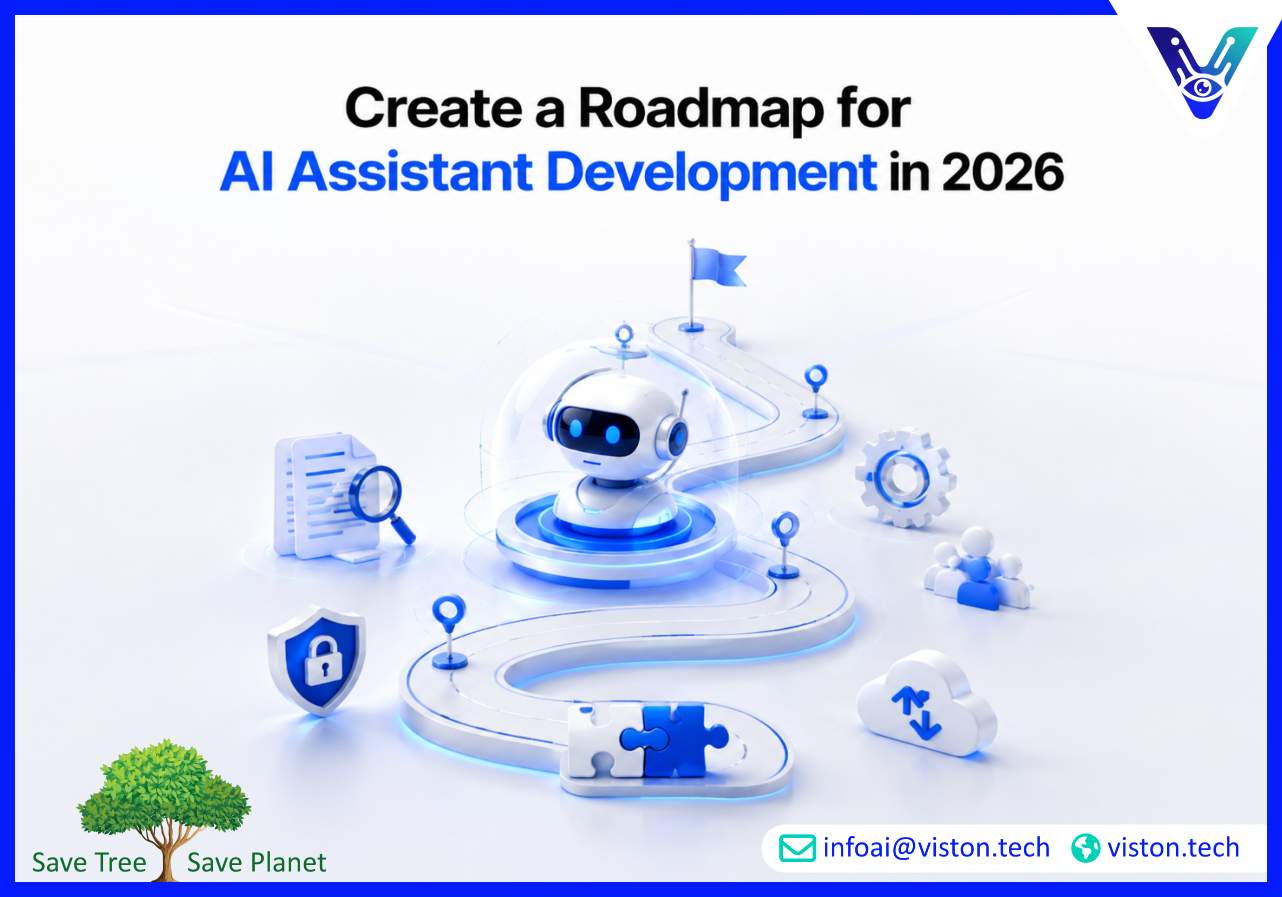
Creating a roadmap for AI assistant development helps businesses move from an idea to a reliable, secure, and useful conversational system. In 2026, AI assistants are expected to do more than answer questions; they must support workflows, integrate with business systems, protect data, and deliver measurable operational value.
An AI assistant can improve customer support, lead qualification, internal operations, employee self-service, sales enablement, onboarding, scheduling, reporting, and knowledge access. However, the success of an assistant depends heavily on how well it is planned before development begins.
Many AI chatbot and virtual assistant projects fail to deliver value because they begin with technology instead of business intent. A company may choose a large language model, connect it to a website, and expect it to perform like a trained support agent. In practice, a production-ready AI assistant needs defined use cases, accurate knowledge sources, conversation design, integration logic, guardrails, analytics, and continuous optimization.
A roadmap gives leadership, product teams, operations teams, and developers a shared path. It clarifies what the assistant should do, who it serves, what systems it connects with, how success will be measured, and how risk will be managed. This is especially important for businesses deploying assistants across multiple departments, languages, markets, or customer channels.
In 2026, the roadmap must also account for governance and security. Organizations are increasingly expected to manage AI risk through structured practices. NIST released its Generative AI Profile for the AI Risk Management Framework to help organizations identify and manage generative AI risks, while OWASP highlights LLM application risks such as prompt injection, insecure output handling, data poisoning, denial of service, and supply chain vulnerabilities.
The first stage is not model selection. It is business definition. A useful roadmap starts by answering a simple question: what business problem should the AI assistant solve?
For customer-facing teams, the goal may be to reduce support volume, improve response time, qualify leads, guide buyers, recommend products, or resolve routine requests. For internal teams, the assistant may help employees find policies, generate reports, retrieve documents, summarize tickets, update records, or trigger workflow actions.
Businesses should begin with a small number of high-value use cases rather than trying to automate every conversation at once. Strong first use cases usually have clear intent patterns, repeatable workflows, reliable data sources, and measurable outcomes.
Each use case should include user goals, business goals, conversation boundaries, escalation rules, required data access, and expected outcomes. This prevents scope creep and helps teams decide what should be automated, what should remain human-led, and what should be handled through a hybrid workflow.
An AI assistant can act as an information assistant, task assistant, workflow assistant, sales assistant, support assistant, or agentic assistant. These roles require different levels of complexity.
An information assistant retrieves and explains knowledge. A task assistant collects details and completes simple actions. A workflow assistant connects with CRM, ERP, helpdesk, calendar, payment, or ticketing systems. An agentic assistant may plan multi-step actions, use tools, and coordinate across systems with human approval where needed.
The roadmap should clearly define this role before technical architecture begins. A support chatbot and a workflow automation assistant may both use conversational AI, but their requirements for integrations, permissions, testing, monitoring, and security are very different.
Once the scope is clear, the next step is architecture. AI assistant development requires more than a front-end chat interface. A reliable assistant typically includes a language model, retrieval system, knowledge base, conversation manager, integration layer, analytics stack, security controls, and human escalation process.
Businesses need to decide how the assistant will access accurate information. For many enterprise use cases, retrieval-augmented generation, or RAG, is a practical approach. It allows the assistant to retrieve relevant content from approved sources before generating a response.
The roadmap should define which sources are trusted, how documents are cleaned, how data is chunked, how search relevance is tested, and how outdated content is removed. Poor knowledge management leads to incorrect answers, inconsistent responses, and user frustration.
For businesses with sensitive data, the roadmap should also define data permissions. The assistant should not retrieve information that the user is not authorized to access. This matters for HR, finance, healthcare, legal, customer accounts, internal policies, and confidential business documents.
AI assistants become more valuable when they can do something, not just say something. This may involve integration with CRM platforms, helpdesk systems, e-commerce platforms, inventory tools, HR systems, internal databases, calendars, communication tools, or workflow automation platforms.
Integration planning should include API availability, authentication, data formats, rate limits, error handling, logging, fallback actions, and approval workflows. For example, an assistant that creates support tickets must capture the right fields, verify user identity, avoid duplicate records, and confirm successful submission.
For more advanced deployments, tool use should be carefully controlled. The assistant should have clear permissions, limited action boundaries, and human review for high-risk tasks such as refunds, account changes, financial actions, contract updates, medical guidance, or compliance-sensitive workflows.
In 2026, many businesses need AI assistants across websites, mobile apps, WhatsApp, Slack, Microsoft Teams, contact centers, voice channels, and internal portals. A roadmap should define which channels matter first and how the assistant experience will remain consistent across them.
Voice-enabled assistants require additional planning for speech recognition, natural voice response, latency, accents, background noise, call routing, consent, recording policies, and accessibility. Multilingual assistants require localization, language detection, culturally appropriate responses, region-specific knowledge, and quality testing across languages.
A practical AI assistant roadmap should use phased development. Launching a fully automated assistant across all channels without testing creates unnecessary risk. A controlled rollout allows the team to validate usefulness, improve accuracy, identify gaps, and build stakeholder confidence.
The discovery phase defines business goals, user journeys, data sources, workflows, integrations, compliance requirements, and success metrics. Teams should document common user questions, escalation points, tone requirements, support policies, and operational constraints.
This phase should also include risk mapping. Sensitive data, regulated content, customer identity, financial decisions, and system actions must be reviewed before development begins.
The prototype phase turns the roadmap into a testable assistant. At this stage, teams create conversation flows, intent examples, prompt structures, fallback responses, escalation rules, and knowledge retrieval logic.
Conversation design matters because users rarely ask questions in perfect language. They use short phrases, incomplete details, emotional wording, typos, and follow-up questions. The assistant should handle ambiguity naturally, ask clarifying questions when needed, and avoid pretending to know what it does not know.
After the core experience is validated, the assistant can be connected to business systems. This stage should include authentication, role-based access, input validation, output filtering, API security, monitoring, audit logging, and data retention rules.
Security testing should include prompt injection attempts, unauthorized data access, harmful output scenarios, hallucination checks, tool misuse, and escalation failure cases. These risks are now central to responsible AI chatbot and virtual assistant development, especially when assistants can access internal knowledge or trigger business actions.
A pilot launch limits exposure while generating real user feedback. The pilot may cover one department, one website section, one customer segment, one language, or one support category. During this stage, teams should track answer accuracy, containment rate, escalation rate, unresolved queries, user satisfaction, response time, and business impact.
The pilot should not be judged only by automation rate. A high automation rate with poor answers can damage trust. Better indicators include successful resolution, reduced repetitive workload, improved user experience, and fewer avoidable handoffs.
Once the assistant performs reliably, it can be expanded into more channels, languages, workflows, and use cases. Production rollout should include monitoring dashboards, retraining cycles, content update workflows, model evaluation, incident response, and governance reviews.
AI assistants should be treated as living systems. Customer language changes, products change, policies change, regulations change, and business workflows evolve. Continuous optimization keeps the assistant accurate, relevant, and aligned with business priorities.
A roadmap for AI assistant development should include measurable performance indicators from the beginning. Without metrics, businesses cannot know whether the assistant is improving operations or simply adding another digital channel.
Useful metrics depend on the assistant’s purpose. A customer support assistant may track first-contact resolution, ticket deflection, escalation accuracy, customer satisfaction, response time, and cost per interaction. A sales assistant may track lead quality, conversion rate, form completion, meeting bookings, and pipeline contribution.
For internal assistants, important metrics may include employee adoption, time saved, search success rate, reduced helpdesk tickets, workflow completion rate, and fewer manual handoffs. For voice assistants, teams may also measure call containment, speech recognition accuracy, average handle time, and caller satisfaction.
AI assistants should not operate without accountability. Human oversight is essential for complex, sensitive, or high-impact interactions. The roadmap should define when the assistant escalates, who reviews unresolved conversations, how errors are corrected, and how users can challenge or clarify an answer.
This is especially important as regulatory expectations mature. The EU AI Act entered into force on August 1, 2024, with broad applicability scheduled from August 2, 2026, subject to phased exceptions. Businesses operating in or serving regulated markets should build AI governance into their roadmap rather than treating it as a late-stage legal review.
A scalable assistant requires more than cloud capacity. It needs repeatable deployment practices, version control, evaluation datasets, governance workflows, documentation, user feedback loops, and operational ownership.
As usage grows, businesses should review model performance, latency, cost, channel coverage, knowledge freshness, user trust, and integration reliability. A roadmap should define how the assistant will expand from a minimum viable solution to a broader conversational AI capability.
Viston AI is relevant to businesses planning AI assistant development because its published service offering includes AI chatbot development, enterprise AI chatbots, voice-enabled assistants, multilingual AI chatbot support, AI chatbot integration, custom AI agent solutions, agentic workflows, NLP and text analysis, MLOps, and AI strategy services. Its website positions these services around conversational AI, business system integration, enterprise-grade security, and scalable deployment across global markets.
For organizations creating a roadmap, this combination matters because AI assistants often require both strategic planning and technical execution. A business may need help defining use cases, designing the assistant architecture, preparing knowledge sources, selecting models, connecting systems, testing performance, and setting up monitoring after launch.
Viston AI’s service areas align with common roadmap requirements such as enterprise chatbot design, integration with business systems, multilingual support, voice assistant development, workflow automation, and model monitoring. Its enterprise chatbot page describes capabilities including natural language understanding, contextual memory, multi-turn dialogue management, and enterprise-grade security.
This makes Viston AI a practical development partner for companies that want an AI assistant roadmap connected to implementation, not just strategy. The strongest fit is for businesses that need assistants to support customer engagement, internal service automation, multilingual operations, voice workflows, or integrated support experiences across digital channels.
An AI assistant development roadmap is a structured plan that defines the assistant’s business purpose, use cases, architecture, integrations, data sources, security controls, launch phases, metrics, and long-term optimization process.
Timelines depend on complexity. A simple FAQ assistant may be developed faster, while an enterprise virtual assistant with integrations, multilingual support, voice features, permissions, and compliance controls may require a phased rollout over several weeks or months.
Businesses should prepare use cases, approved knowledge sources, user journeys, brand tone, escalation rules, integration requirements, data access policies, security expectations, and success metrics before development begins.
RAG helps an assistant retrieve information from approved business sources before generating responses. This improves accuracy, reduces unsupported answers, and makes the assistant easier to update as policies, products, or documents change.
Yes. AI assistants can integrate with CRMs, helpdesks, calendars, e-commerce platforms, HR systems, databases, ticketing tools, and workflow automation platforms. Integration planning should include authentication, permissions, API reliability, audit logs, and error handling.
Viston AI can support AI chatbot and virtual assistant development through services related to chatbot development, enterprise AI chatbots, voice-enabled assistants, multilingual support, business system integration, AI strategy, and custom AI solution development.
Creating a roadmap for AI assistant development helps businesses turn conversational AI from an experiment into a dependable business capability. A strong roadmap defines the assistant’s purpose, use cases, knowledge strategy, architecture, integrations, governance, launch plan, and performance metrics. In 2026, successful AI chatbot and virtual assistant development requires accuracy, security, scalability, user trust, and continuous improvement. For businesses seeking structured execution, Viston AI offers relevant capabilities across chatbot development, enterprise assistants, voice-enabled assistants, multilingual support, integrations, and AI strategy, making it a credible option for organizations planning practical AI assistant deployment.
