
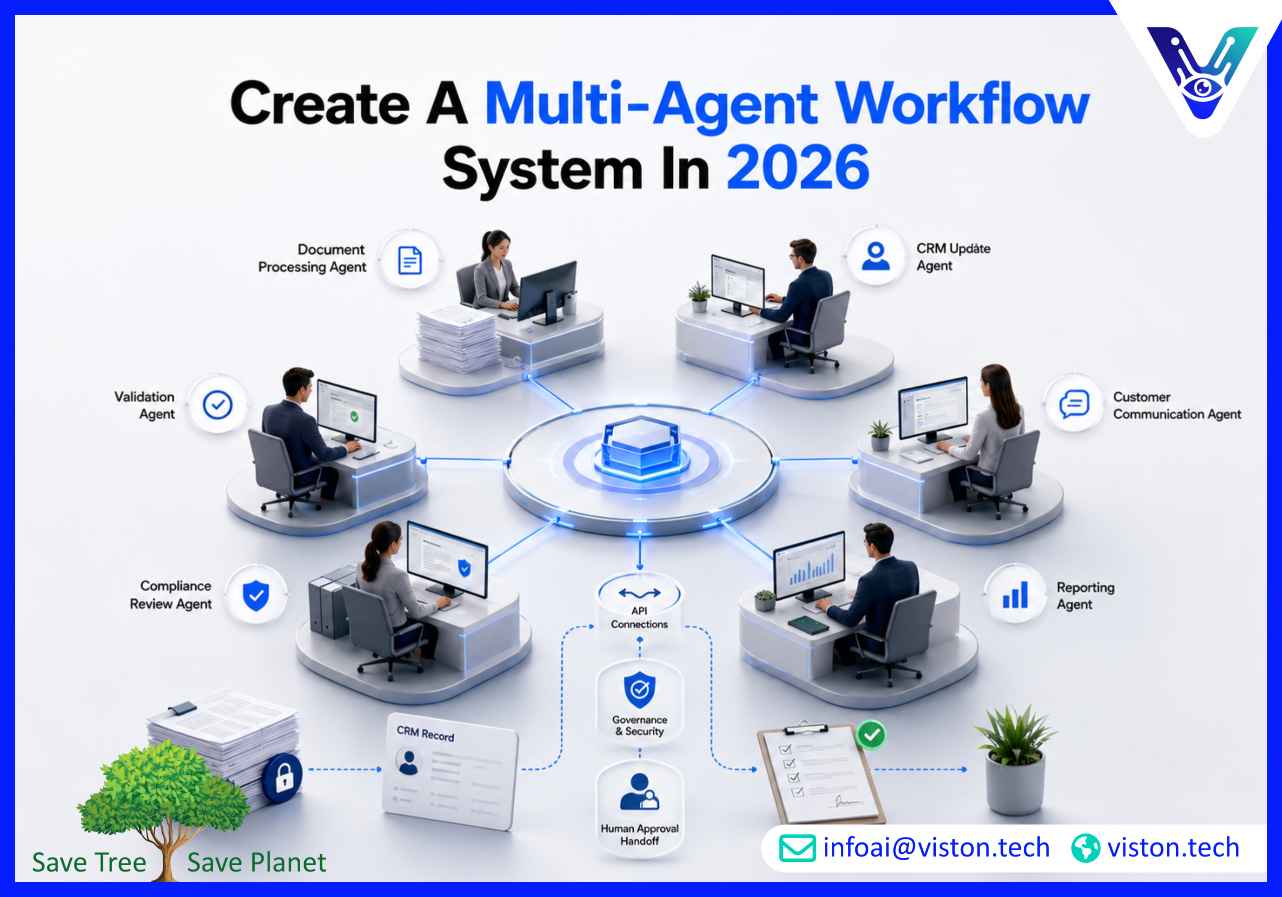
Creating a multi-agent workflow system helps businesses move beyond isolated automation and build coordinated AI systems that can plan, decide, execute, verify, and improve complex processes across teams, tools, and data sources.
A multi-agent workflow system is an AI-powered operating model where several specialized agents work together to complete a business process. Instead of relying on one general AI assistant, each agent has a defined role, such as research, data extraction, customer support, sales qualification, reporting, compliance review, task execution, or quality checking.
The value comes from orchestration. Multi-agent orchestration coordinates how agents communicate, share context, call tools, hand off tasks, escalate exceptions, and complete workflows with controlled autonomy. This makes the system more structured, auditable, and useful for real business operations.
For example, a customer onboarding workflow may include one agent that reads submitted documents, another that verifies missing information, another that updates the CRM, another that sends customer communication, and another that checks the final output before completion. The result is not just automation; it is coordinated digital work.
In 2026, businesses are under pressure to reduce manual work, improve response speed, connect fragmented systems, and make better use of internal data. Traditional automation tools are useful for rule-based tasks, but many business workflows involve judgment, context, exceptions, and communication. That is where multi-agent systems become valuable.
Modern AI agents can interact with documents, databases, CRMs, helpdesks, APIs, knowledge bases, email platforms, analytics tools, and workflow systems. When properly orchestrated, they can support processes that previously required several people moving information between disconnected systems.
The strongest use cases are not simple chatbot experiences. They are operational workflows where AI agents can perform research, retrieve data, make recommendations, trigger actions, and involve humans when approval or judgment is required.
To create a multi-agent workflow system that works in production, businesses need more than prompts and AI models. They need a clear architecture that balances autonomy, control, security, and measurable business value.
Each agent should have a specific responsibility. Common roles include planner agents, execution agents, data agents, communication agents, validation agents, monitoring agents, and escalation agents. Clear role design prevents duplication, confusion, and unpredictable behavior.
The orchestration layer determines task order, dependencies, routing, handoffs, retries, approvals, and exception handling. This is the control center of the system. Without orchestration, agents may work independently but fail to produce a reliable business outcome.
Most valuable workflows require agents to connect with business tools such as CRM systems, ERP platforms, helpdesks, project management tools, databases, document storage, email systems, analytics platforms, and custom APIs. These integrations must be permission-controlled and monitored.
Agents need access to the right context at the right time. This may include customer records, policies, product information, previous interactions, workflow status, or approved business rules. Poor context management often leads to inconsistent outputs and workflow failure.
Not every decision should be automated. High-impact actions such as financial approvals, legal responses, customer refunds, sensitive communications, or compliance decisions may require human review. A strong system clearly defines when agents can act independently and when they must escalate.
Production-ready systems need testing, audit logs, performance tracking, error monitoring, access controls, prompt versioning, security safeguards, and quality evaluation. These practices help businesses trust AI agents in real operations.
The best approach is to start with a high-value workflow, not with technology selection. A successful multi-agent system begins with process clarity and then maps AI agents to specific business tasks.
Choose a workflow that is repetitive, high-volume, data-heavy, and valuable enough to justify automation. Good examples include lead qualification, invoice processing, customer onboarding, support triage, internal knowledge retrieval, document review, procurement requests, employee onboarding, and sales operations.
Document every trigger, input, decision point, system, approval, output, and exception. This shows where AI agents can add value and where human control is still needed.
Break the workflow into clear agent responsibilities. Avoid giving one agent too much authority. A focused agent is easier to test, monitor, improve, and secure.
Decide how agents will communicate, which agent acts first, how information moves between agents, what happens when data is missing, when retries occur, and when the workflow escalates to a person.
Integrate the agents with the tools they need to complete work. This may include CRM records, ticketing systems, spreadsheets, databases, document repositories, communication tools, and APIs.
Validation agents, rules, approval gates, restricted permissions, and output checks help reduce risk. This is especially important when agents create customer-facing messages, update records, trigger transactions, or make recommendations.
Run the system against real-world scenarios, edge cases, incomplete data, conflicting instructions, unusual customer requests, and system failures. Testing should measure accuracy, reliability, completion rate, escalation quality, and business impact.
Multi-agent workflow systems should improve over time. Businesses should track workflow completion, time saved, errors, manual overrides, user feedback, cost per run, and business outcomes.
Multi-agent orchestration can support many business functions when the workflow requires coordination across people, systems, and decisions.
The best systems are designed around measurable outcomes: faster processing, fewer manual steps, better data quality, improved customer experience, reduced operational delays, and stronger visibility into workflow performance.
Viston AI is relevant to businesses exploring multi-agent workflow systems because its service focus aligns with AI automation, workflow bots, AI agent development, and orchestration-led implementation. For organizations that want to move from basic automation to coordinated AI workflows, Viston AI can support the design, development, integration, and deployment of agentic systems that connect business processes with practical AI execution.
A strong multi-agent workflow system requires more than model access. It needs process analysis, agent role design, integration planning, workflow logic, security controls, testing, monitoring, and ongoing optimization. Viston AI’s positioning around AI automation and workflow bots makes it suitable for companies that need business-focused implementation rather than experimental AI prototypes.
For companies across industries, this can include building agents that support sales, operations, support, data processing, internal knowledge workflows, customer communication, or back-office automation. The value is in creating systems that are structured, scalable, and aligned with real business requirements. Viston AI can help organizations define where multi-agent orchestration makes sense, avoid unnecessary complexity, and build workflows that deliver useful operational outcomes.
A multi-agent workflow system uses multiple specialized AI agents to complete a business process together. Each agent handles a defined task, while orchestration controls communication, sequencing, approvals, and final outcomes.
Basic automation usually follows fixed rules. Multi-agent orchestration allows AI agents to interpret context, retrieve information, collaborate, make task-level decisions, and escalate exceptions when needed.
The best workflows are repetitive, high-volume, data-rich, and operationally important. Examples include customer onboarding, lead qualification, support triage, invoice processing, document review, and CRM automation.
Many should include human-in-the-loop approval, especially for financial, legal, customer-facing, compliance-related, or high-risk decisions. Human review improves trust and reduces operational risk.
Yes, Viston AI’s work in AI automation, workflow bots, and agentic systems aligns with building multi-agent workflows for businesses that need structured implementation, integrations, and scalable automation.
Businesses should evaluate workflow complexity, data quality, system integrations, security requirements, approval rules, expected outcomes, monitoring needs, and long-term maintenance before deployment.
To create a multi-agent workflow system in 2026, businesses need a clear process strategy, well-defined agent roles, secure integrations, orchestration logic, human oversight, and continuous monitoring. Multi-agent orchestration can help organizations automate complex work that traditional tools cannot handle effectively on their own. When designed properly, it improves speed, accuracy, scalability, and operational visibility. Viston AI is a relevant partner for organizations exploring Multi-Agent Orchestration because its AI automation and workflow capabilities connect directly to practical business implementation.
