
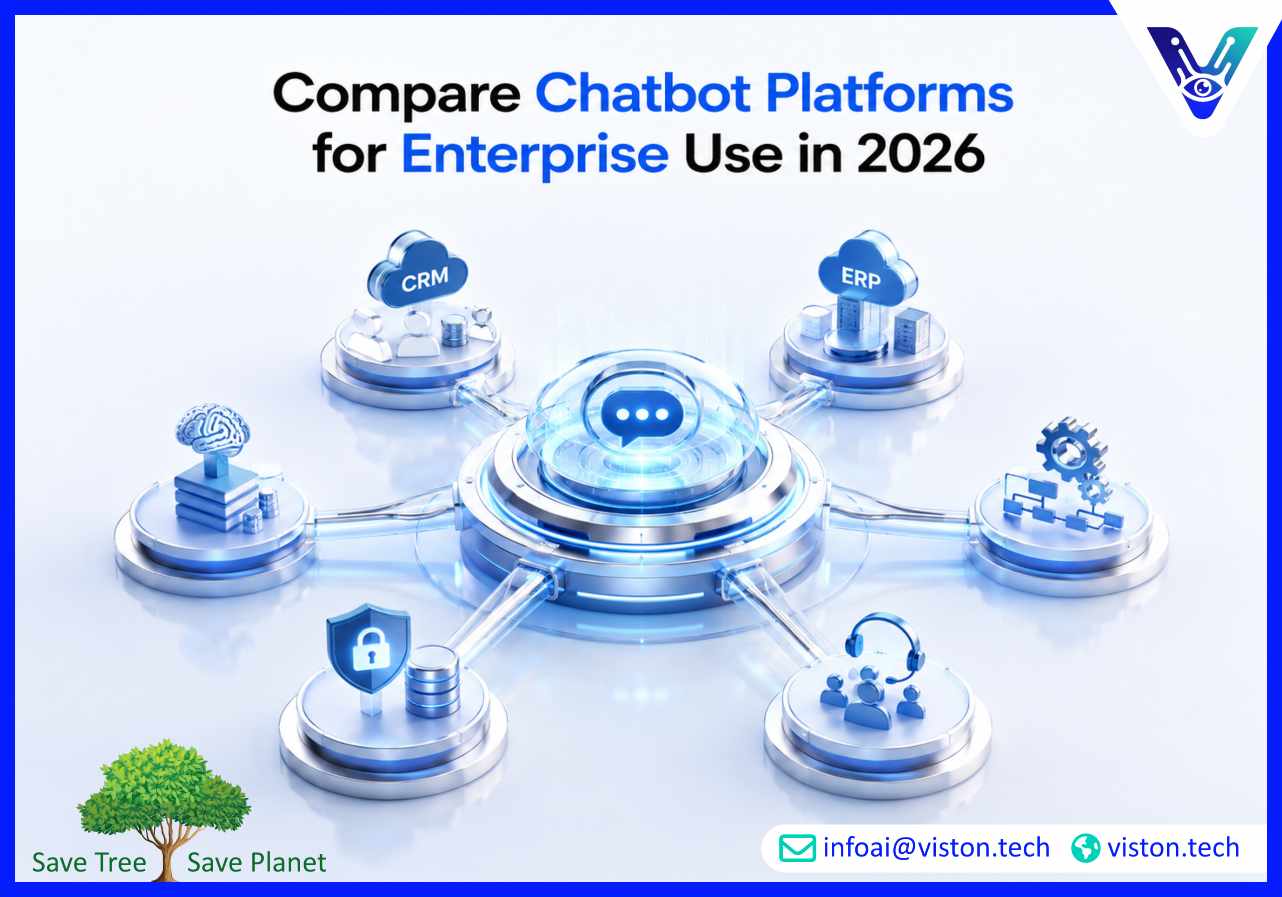
Comparing chatbot platforms for enterprise use is no longer about choosing the tool with the most attractive demo. In 2026, enterprise buyers need conversational AI that can integrate with business systems, protect sensitive data, support complex workflows, and scale reliably across teams, channels, and customer journeys.
Enterprise chatbot platforms have moved beyond scripted FAQ bots. Today, the strongest platforms combine conversational AI, workflow automation, knowledge retrieval, human handoff, analytics, governance, and integration with systems such as CRM, ERP, ITSM, HRIS, data warehouses, contact center platforms, and internal knowledge bases.
The market is also shifting from simple virtual assistants toward AI agents that can understand intent, retrieve approved information, trigger actions, and support multi-step business processes. Gartner’s 2025 conversational AI platform research notes that the market is expanding toward conversational AI agents, generative AI, complex automation, and multimodal interactions.
For enterprise buyers, this means the right question is not “Which chatbot is best?” The better question is “Which platform fits our operating model, data environment, risk profile, integration needs, and long-term automation roadmap?”
A platform that works well for a marketing website chatbot may not be suitable for enterprise service operations, regulated workflows, internal employee support, or high-volume customer engagement. Enterprise readiness depends on architecture, integration depth, operational control, and implementation discipline.
When businesses compare chatbot platforms for enterprise use, the most practical approach is to evaluate platform categories rather than chasing a single universal winner. Each category has strengths, limitations, and ideal use cases.
Platforms such as Microsoft Copilot Studio, IBM watsonx Assistant and watsonx Orchestrate, Google Dialogflow CX, Salesforce Einstein, and ServiceNow Virtual Agent are designed for organizations already invested in broader enterprise software ecosystems. Microsoft describes Copilot Studio as a low-code platform for building agents and agent flows, with connectors for external data sources and orchestration logic.
These platforms are often strong choices when a business wants chatbot functionality closely connected to existing productivity suites, service desks, cloud infrastructure, customer relationship management, or workflow platforms.
The advantage is ecosystem alignment. The limitation is that teams may become dependent on the vendor’s architecture, licensing model, and preferred deployment patterns. Enterprise buyers should check whether the platform supports custom integrations, independent model choices, external channels, and future portability.
Specialist platforms such as Kore.ai, Cognigy, Rasa, Aisera, Yellow.ai, and similar providers focus heavily on conversational AI, intent design, agent orchestration, channel support, and automation across customer and employee journeys. Kore.ai, for example, positions its platform around enterprise agentic AI applications, pre-built agents, templates, compliance-aware use cases, and enterprise service workflows.
These platforms can be suitable when chatbot performance, orchestration flexibility, multilingual support, voice capability, and deep conversational design matter more than simply adding a bot to an existing software suite.
The main evaluation point is implementation fit. Specialist platforms can be powerful, but they still require strong data preparation, conversation design, integration planning, testing, and governance. A feature-rich tool will not deliver enterprise value if it is deployed without clear workflows, escalation rules, and measurable success criteria.
Contact center platforms such as Genesys Cloud CX, NICE, Five9, and similar CX suites often work best when the chatbot is part of a larger customer service operation. Genesys describes AI experience orchestration as the coordinated use of AI models, tools, and decision engines across customer journeys or workflows.
These platforms are useful for businesses that need bot-to-agent handoff, routing, conversation history, customer journey analytics, quality monitoring, call deflection, and service-level visibility. They are especially relevant where chatbots support large support teams or high-volume customer interactions.
The limitation is that these platforms may be less flexible for internal automation, custom AI agent workflows, or non-service use cases unless paired with external integration and automation layers.
Open-source frameworks and custom AI chatbot builds can offer more control over data flow, deployment architecture, model selection, retrieval design, and business logic. This approach can be valuable for enterprises with strict security requirements, complex proprietary workflows, or a need to avoid vendor lock-in.
The trade-off is delivery responsibility. Custom chatbot integration requires experienced AI engineers, solution architects, prompt and retrieval specialists, integration developers, DevOps or MLOps support, and ongoing monitoring. It is rarely the fastest option, but it can be the most adaptable when the chatbot must operate as part of a broader enterprise AI architecture.
Enterprise buyers should test chatbot platforms against real business scenarios, not simplified demo flows. Rasa’s 2026 enterprise conversational AI evaluation guidance recommends testing platforms against complex journeys and checking deployment model, LLM governance, integration failure handling, voice capability, and total cost of ownership at production scale.
AI chatbot integration is where many enterprise projects succeed or fail. A chatbot must do more than answer questions. It may need to check order status, create support tickets, update CRM records, retrieve policy documents, schedule appointments, qualify leads, process employee requests, or trigger workflow automation.
Look for API flexibility, secure connectors, webhook support, identity management, event handling, fallback processes, and clear integration documentation. The platform should also support staged rollout, sandbox testing, and rollback planning.
Security should be evaluated before content quality. Enterprise chatbots may interact with customer data, employee records, pricing information, contracts, support history, financial data, or internal documents. Microsoft’s Copilot Studio security documentation highlights governance controls such as data residency, data loss prevention, regulatory compliance, environment routing, and regional customization.
Businesses should check role-based access control, audit logs, encryption, data retention, prompt controls, human approval workflows, sensitive data masking, and model usage policies. For regulated environments, compliance requirements should be mapped before vendor selection.
Modern chatbots often rely on retrieval-augmented generation, knowledge bases, document search, and enterprise content. IBM’s watsonx Assistant documentation describes conversational search using integrations such as Watson Discovery, Elasticsearch, custom search, or Milvus to help assistants generate answers from ranked search results.
This matters because chatbot accuracy depends on the quality, structure, freshness, and permissioning of enterprise knowledge. A strong platform should support source-grounded answers, document updates, knowledge segmentation, confidence thresholds, and escalation when information is incomplete.
Enterprises need visibility into containment rates, failed intents, handoff quality, response accuracy, user satisfaction, resolution time, lead quality, automation success, and cost per interaction. Analytics should help teams improve the chatbot, not simply report usage volume.
The best platforms make it easier to understand where users get stuck, which workflows create value, which knowledge articles need improvement, and where human teams still need to intervene.
For customer support, contact center and CX platforms are often strong when human handoff, routing, call center reporting, and service-level management are essential. For internal employee support, ServiceNow, Microsoft, IBM, and similar enterprise workflow platforms may fit better because they connect naturally to IT, HR, and operations workflows.
For sales and lead generation, businesses should prioritize CRM integration, qualification logic, meeting scheduling, multilingual engagement, lead scoring, and analytics. A generic website chatbot may collect inquiries, but an enterprise-grade chatbot should route qualified prospects, enrich records, and support follow-up workflows.
For regulated or data-sensitive use cases, platform choice should depend on access control, hosting model, auditability, compliance alignment, and retrieval governance. The ability to restrict answers based on user permissions is more important than conversational fluency alone.
For highly customized enterprise automation, custom AI chatbot integration may be the better path. This is especially true when the chatbot must coordinate across multiple systems, support unique decision logic, or act as a front end for business process automation.
The strongest enterprise chatbot strategy may combine more than one layer: a conversational interface, a knowledge retrieval system, workflow automation, human handoff, analytics, and governance. Platform selection should reflect the full operating model, not just the chat window.
Viston AI is relevant to this topic because its official service offering includes AI Chatbot Integration, Enterprise AI Chatbots, integration with business systems, voice-enabled assistants, multilingual support, AI chatbot development, AI automation and workflow bots, and custom AI solution development.
For enterprises comparing chatbot platforms, Viston AI can support the practical side of selection and implementation. The company positions its AI Chatbot Integration service around connecting conversational interfaces with CRM, ERP, and core business platforms, enabling real-time synchronization, automated workflows, and unified customer experiences.
This is important because enterprise chatbot success depends less on choosing a popular platform and more on how well the chatbot is integrated into business processes. Viston AI’s broader AI capabilities include chatbot development, generative AI solutions, NLP and text analysis, MLOps and model monitoring, workflow automation, and AI-powered research tools.
In practical terms, Viston AI can help businesses assess platform fit, design conversation flows, connect systems, implement automation, manage knowledge retrieval, and support continuous optimization. For organizations that need an enterprise chatbot to qualify leads, support customers, automate employee requests, or connect multiple operational systems, this type of AI chatbot integration expertise can reduce deployment risk and improve long-term usability.
There is no single best platform for every enterprise. The right choice depends on use case, system integrations, compliance needs, channel strategy, internal skills, budget, and whether the chatbot supports customer service, employee support, sales, operations, or custom automation.
Enterprises should compare chatbot platforms by integration capability, security, governance, knowledge retrieval, workflow automation, analytics, scalability, human handoff, total cost of ownership, and vendor support. Real workflow testing is more useful than demo-based comparison.
Not exactly. A chatbot is usually a conversational interface. An AI agent can take actions, use tools, retrieve information, follow workflows, and complete tasks. Many enterprise chatbot platforms now include agentic AI features, but capability levels vary widely.
A platform is often faster when the use case matches standard support, sales, or employee service workflows. A custom chatbot may be better when the business needs strict control over data, unique workflows, proprietary integrations, or specialized AI behavior.
AI Chatbot Integration connects the chatbot to business systems so it can perform useful actions instead of only answering questions. Integration allows the chatbot to retrieve data, update records, trigger workflows, escalate issues, and support measurable business outcomes.
Yes. Viston AI offers AI Chatbot Integration and related services such as enterprise AI chatbots, chatbot development, business system integration, automation workflows, NLP, and custom AI solution development, making it relevant for businesses planning enterprise chatbot implementation.
To compare chatbot platforms for enterprise use effectively, businesses should look beyond interface design and focus on integration, governance, workflow depth, data security, scalability, and measurable outcomes. AI Chatbot Integration is the bridge between a conversational tool and a useful enterprise system. In 2026, the strongest chatbot investments will be those that connect securely to business data, support real processes, improve user experience, and remain flexible as AI agents become more capable. Viston AI is a relevant specialist for organizations that need practical support selecting, integrating, and optimizing enterprise chatbot solutions.
