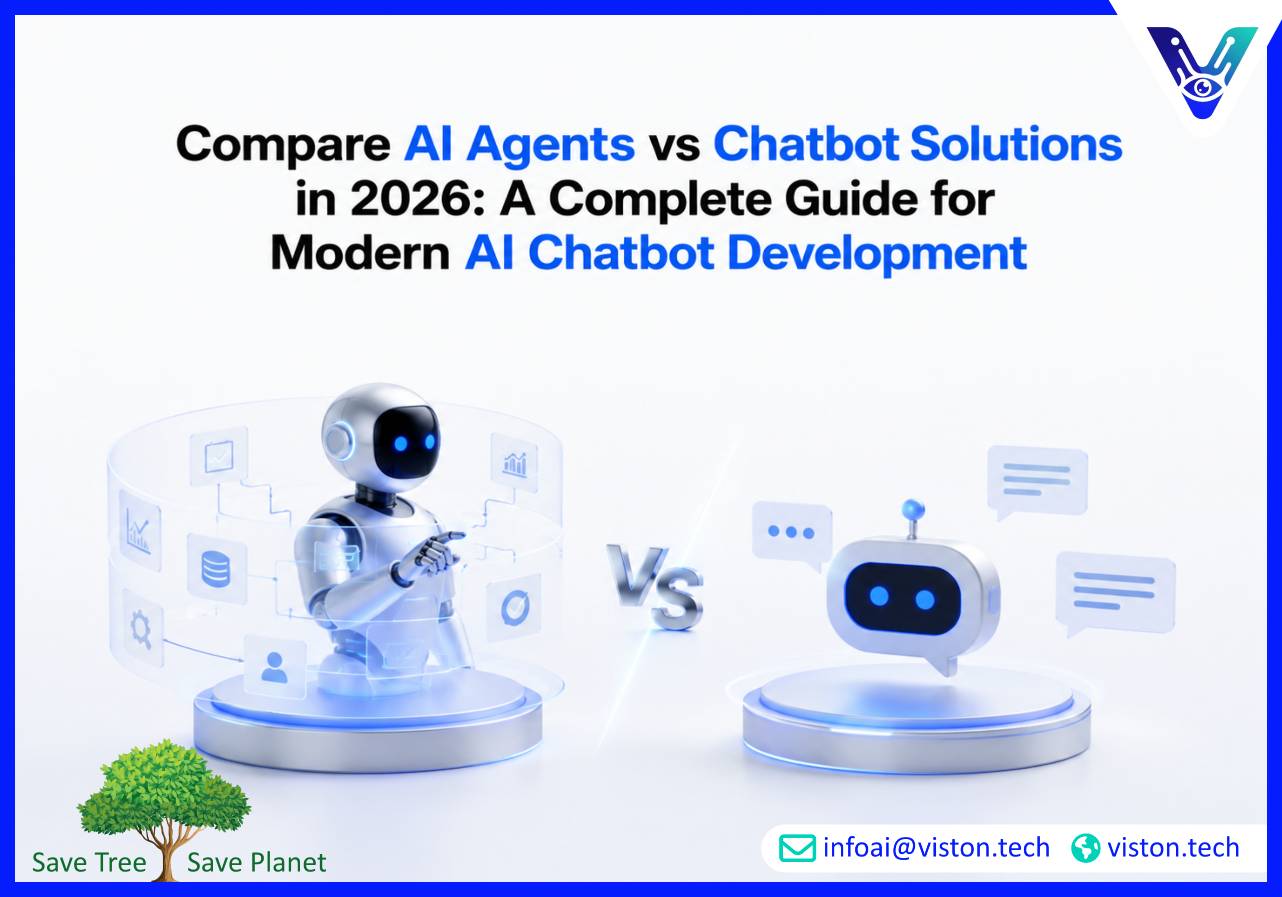
Compare AI Agents vs Chatbot Solutions in 2026: A Complete Guide for Modern AI Chatbot Development
In 2026, businesses are rapidly adopting conversational AI to improve customer engagement, automate workflows, and scale digital operations. However, there is still confusion between AI agents and chatbot solutions, especially when planning AI Chatbot Development strategies. Understanding the differences is essential for choosing the right architecture for automation, efficiency, and long-term scalability in modern business environments.
Understanding AI Agents vs Chatbot Solutions in Business Context
AI chatbots and AI agents are often grouped under the same umbrella, but they serve fundamentally different purposes in enterprise systems.A chatbot is typically designed to simulate conversation and respond to user inputs based on predefined flows, rules, or AI models. It focuses on interaction, support, and guided assistance within a defined scope.An AI agent, on the other hand, is a more advanced autonomous system capable of reasoning, planning, and executing multi-step tasks across systems and tools. It does not just respond to queries—it performs actions, makes decisions, and interacts with multiple environments to achieve goals.For businesses investing in AI Chatbot Development, this distinction determines whether they are building a conversational interface or an autonomous digital worker.
Core Differences Between AI Agents and Chatbot Solutions
1. Purpose and Functionality
Chatbots are designed primarily for communication. They assist users by answering questions, providing information, and guiding them through structured workflows such as customer support, lead generation, or onboarding.AI agents go beyond communication. They are designed to execute tasks such as data retrieval, system updates, workflow automation, and decision-making based on contextual understanding.
Chatbots = Conversation-focused assistance
AI agents = Task execution and autonomous problem-solving
2. Level of Autonomy
Chatbots operate within predefined boundaries. Even when powered by large language models, they usually depend on user prompts and structured conversation flows.AI agents operate with higher autonomy. They can break down goals into steps, decide which tools to use, and complete actions without constant user direction.This autonomy makes AI agents more suitable for complex business automation scenarios in enterprise environments.
3. System Integration Capability
Chatbots are often integrated with limited systems such as CRM platforms, helpdesk tools, or websites. Their role is to retrieve or display information.AI agents integrate deeply with multiple systems simultaneously, including APIs, databases, enterprise applications, and external services.In advanced AI Chatbot Development projects, this difference determines whether the system acts as a conversational layer or a full operational engine.
4. Decision-Making Ability
Chatbots rely on structured logic, intent recognition, or AI-driven response generation. They typically do not make independent decisions beyond their programmed scope.AI agents can evaluate multiple options, prioritize actions, and execute decisions dynamically based on context and objectives.This makes AI agents suitable for workflows such as automation orchestration, intelligent scheduling, and multi-step business processes.
5. Complexity of Tasks Handled
Chatbots handle straightforward tasks such as:
Answering FAQs
Processing simple requests
Collecting user information
Routing support tickets
AI agents handle complex tasks such as:
Automating end-to-end workflows
Managing cross-system operations
Executing business logic decisions
Coordinating multi-step processes across tools
Why Businesses Are Moving from Chatbots to AI Agents in 2026
In modern digital ecosystems, customer expectations and operational demands have evolved significantly. Businesses no longer need systems that only respond—they need systems that act.This shift is driving organizations to rethink their AI Chatbot Development strategies and move toward agent-based architectures for greater efficiency and scalability.
Demand for Automation Beyond Conversation
Traditional chatbots are effective for communication, but businesses increasingly require automation that completes tasks without human intervention. AI agents fill this gap by combining reasoning and execution.
Need for Multi-System Orchestration
Enterprises operate across multiple platforms, including CRM, ERP, analytics tools, and communication systems. AI agents can coordinate actions across these systems, whereas chatbots typically cannot.
Improved Operational Efficiency
AI agents reduce manual workload by executing tasks directly, minimizing dependency on human agents or repetitive chatbot escalation flows.
Enhanced Personalization at Scale
AI agents can analyze context, user behavior, and historical data to deliver highly personalized outcomes, not just responses.
When to Use Chatbots vs AI Agents
Use Chatbots When:
You need customer-facing conversational interfaces
Tasks are repetitive and structured
Information retrieval is the primary goal
You want quick deployment with lower complexity
Support automation is limited to FAQs and ticket routing
Use AI Agents When:
You need end-to-end workflow automation
Multiple systems must be integrated and coordinated
Tasks require reasoning and decision-making
You want autonomous task execution
You are building enterprise-grade automation systems
Impact on AI Chatbot Development Strategies
The rise of AI agents is reshaping how businesses approach AI Chatbot Development. Instead of building isolated conversational tools, organizations are now designing hybrid systems that combine chat interfaces with agent-driven automation layers.This evolution introduces new development considerations such as:
Tool integration frameworks
Agent orchestration architecture
Context memory systems
Secure API execution layers
Multi-agent collaboration systems
As a result, modern AI systems are no longer just chat interfaces but intelligent ecosystems capable of understanding, deciding, and acting across business environments.
Challenges in Implementing AI Agents and Chatbots
While both technologies offer significant value, they also present implementation challenges that businesses must carefully evaluate.
Data and Integration Complexity
AI agents require deep integration with enterprise systems, which increases implementation complexity compared to traditional chatbots.
Security and Governance
As AI agents gain autonomy, businesses must implement strict governance frameworks to control access, execution permissions, and data security.
Cost and Infrastructure Requirements
AI agents typically require more advanced infrastructure, including API orchestration layers, model management systems, and monitoring tools.
Accuracy and Reliability
Both chatbots and agents depend heavily on data quality and model performance. Poorly designed systems can lead to incorrect responses or unintended actions.
Future of Conversational AI: Convergence of Chatbots and AI Agents
The future of conversational AI is not about choosing between chatbots and AI agents—it is about combining both into unified intelligent systems.Chatbots will continue to serve as user-facing interfaces, while AI agents operate behind the scenes to execute tasks, retrieve data, and manage workflows.This hybrid model represents the next stage of AI Chatbot Development, where conversational systems evolve into full digital workforce platforms capable of handling both communication and execution.
How Viston AI Helps Businesses Build Advanced AI Systems
In modern AI Chatbot Development, organizations require more than basic conversational tools. They need scalable systems that combine chatbot interfaces with intelligent automation capabilities.Viston AI focuses on building AI-powered solutions that bridge the gap between conversational chatbots and autonomous AI agents. By integrating business systems, workflows, and APIs, Viston AI enables organizations to move beyond simple chat interactions and adopt intelligent automation frameworks.These solutions support businesses in customer engagement, workflow automation, lead generation, and operational optimization. With a focus on scalability and real-world business applications, Viston AI helps organizations transition from traditional chatbot systems to advanced AI-driven ecosystems that can reason, act, and evolve with business needs.
Frequently Asked Questions
What is the main difference between AI agents and chatbots?
Chatbots are designed for conversation and structured responses, while AI agents can perform tasks, make decisions, and execute workflows across systems.
Are AI agents replacing chatbots?
No. AI agents are not replacing chatbots but enhancing them. Many systems use chatbots as interfaces while AI agents handle backend automation.
Which is better for businesses: AI agent or chatbot?
It depends on the use case. Chatbots are ideal for customer interaction, while AI agents are better for automation and complex workflows.
Can AI agents be used in customer service?
Yes. AI agents can resolve tickets, retrieve data, and perform actions across systems, making them highly effective for advanced customer service automation.
Is AI Chatbot Development still relevant in 2026?
Yes. AI Chatbot Development remains essential, especially when combined with AI agents to create hybrid conversational and automation systems.
How does Viston AI use AI agents in its solutions?
Viston AI integrates AI agents into chatbot systems to enhance automation, system connectivity, and intelligent workflow execution for businesses.
Conclusion
The comparison between AI agents and chatbot solutions highlights a clear evolution in AI Chatbot Development. While chatbots remain essential for structured conversations and customer engagement, AI agents introduce a new level of autonomy, decision-making, and automation capability. Businesses in 2026 are increasingly adopting hybrid systems that combine both technologies to achieve scalable, intelligent, and efficient digital operations. Understanding when to use each approach is critical for building effective AI systems that align with business goals, improve productivity, and support long-term growth. Organizations that adopt this combined strategy will be better positioned to leverage the full potential of modern AI ecosystems.