
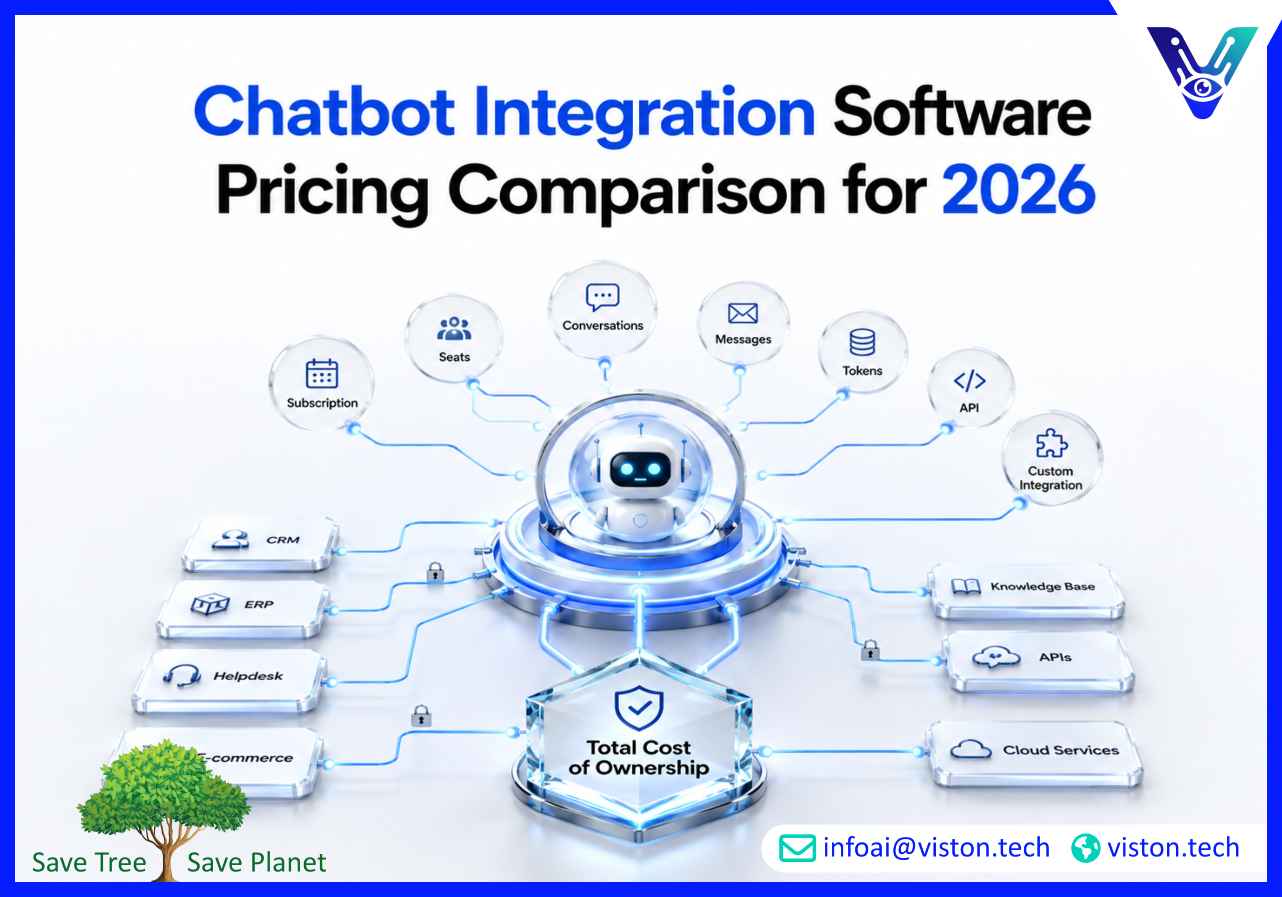
Chatbot integration software pricing comparison is difficult because vendors charge for different units: seats, conversations, resolutions, messages, tokens, channels, or custom implementation. A low monthly fee can become expensive once CRM connectivity, workflow automation, security, and ongoing optimization are included. Businesses need to compare total operating cost, not headline subscription prices.
Chatbot software is no longer priced as a single website widget. Modern platforms may combine an AI agent, helpdesk, knowledge retrieval, analytics, human handover, channel deployment, and integrations with CRM, ERP, ecommerce, ticketing, scheduling, or internal databases. Each component can use a different billing method.
Public plans in 2026 commonly range from free or low-cost starter tiers to several hundred dollars per month for team-level platforms. Advanced plans may approach or exceed $1,000 per month before enterprise security, premium channels, implementation, or usage overages. Enterprise products are frequently sold through custom quotes because conversation volume, integrations, data controls, service levels, and deployment environments vary widely.
A subscription gives the business access to a defined package of features for a monthly or annual fee. Plans may limit the number of bots, workspaces, users, conversations, knowledge sources, or channels. This model is easy to budget when usage is stable, but feature upgrades and overage packs can materially increase the real cost.
Seat-based pricing charges for each support, sales, or administrative user. It is common when chatbot software is bundled with a helpdesk or customer service platform. The model can work well for smaller teams, but costs rise as more agents, supervisors, analysts, and administrators need access.
Usage-based platforms may charge per conversation, message, request, or successfully automated resolution. Conversation pricing is straightforward when session definitions are clear. Message pricing is more variable because long conversations cost more. Resolution pricing connects fees to completed outcomes, but buyers must understand how the vendor defines a resolution, handles reopened cases, and measures human escalation.
Custom chatbot integrations often use language-model, speech, search, or cloud APIs billed by consumption. Text models may charge for input and output tokens, while voice services may charge per minute and traditional conversational platforms may charge per API request. These unit costs can look small, but total spend depends on prompt length, knowledge retrieval, response size, retries, tool calls, traffic, and model selection.
The most useful comparison is not simply which product has the lowest monthly price. It is which deployment model fits the business requirement with the least avoidable complexity and risk.
Entry-level tools are designed for FAQs, basic lead capture, website chat, and simple automation. Free plans or low-cost subscriptions may be suitable for testing demand, but they often include strict limits on conversations, branding removal, channels, data volume, analytics, or team access.
These tools are usually the lowest-cost option when the chatbot does not need sensitive data, complex workflows, or deep system access. They become less economical when businesses purchase multiple add-ons for WhatsApp, additional bots, more conversations, advanced reporting, and integrations.
Helpdesk-led platforms combine ticketing, live chat, knowledge bases, routing, agent workspaces, and AI automation. Pricing may include a fee per human agent plus separate charges for AI outcomes, premium capabilities, voice, or workflow builders.
This model is attractive when the business already needs a complete customer service suite. The main budgeting risk is paying for both seats and AI usage while also funding configuration, content preparation, and integration work. Procurement teams should model the total cost at current and projected support volumes.
AI agent platforms provide visual builders, developer tools, knowledge retrieval, channels, analytics, and automation. Mid-tier public plans commonly cost hundreds of dollars per month and include a fixed conversation allowance. Higher-volume or enterprise deployments may move to custom pricing.
This category offers more flexibility than a basic no-code bot, but implementation quality still depends on conversation design, system integration, testing, guardrails, and monitoring. Software access alone does not create a production-ready business assistant.
A custom integration connects the chatbot to the organization’s existing applications, data, identity controls, and workflows. Pricing usually includes discovery, architecture, development, API work, testing, deployment, and support. It may also include recurring cloud, model, monitoring, and maintenance costs.
Custom integration carries a higher initial investment, but it can reduce duplicate software, support specialized workflows, preserve the existing technology stack, and provide stronger control over data and automation. It is often the better fit when the chatbot must retrieve account-specific information, update records, trigger transactions, follow approval rules, or operate across several systems.
Two businesses can select the same chatbot platform and receive very different project quotes. The difference usually comes from integration depth, risk, and operational requirements rather than the chat interface itself.
Connecting one well-documented CRM is different from coordinating CRM, ERP, helpdesk, payment, inventory, identity, and custom databases. Each integration requires authentication, field mapping, error handling, rate-limit management, testing, and maintenance. Read-only access is generally simpler than allowing the chatbot to create, modify, or approve records.
A chatbot needs trusted, current, well-structured information. Costs rise when documentation is fragmented, duplicated, outdated, or permission-sensitive. Work may include content cleanup, metadata design, document ingestion, retrieval testing, source controls, and governance workflows.
A website chatbot is usually less expensive than a coordinated deployment across web, mobile apps, WhatsApp, social messaging, email, and voice. Every additional channel introduces design, integration, policy, and testing requirements. Multilingual support also requires terminology management, localized knowledge, native-language evaluation, and language-specific escalation rules.
Enterprise deployments may require single sign-on, role-based access, encryption, audit logs, data residency, private networking, retention controls, personally identifiable information redaction, and security reviews. These controls increase implementation effort but are essential when the chatbot accesses customer, employee, financial, healthcare, or contractual data.
Launch is not the end of the cost cycle. Teams must monitor failed workflows, fallback queries, model quality, latency, API errors, knowledge changes, and usage spikes. Budgeting should include ongoing improvement, vendor support, platform upgrades, model changes, and integration maintenance.
A useful chatbot integration software pricing comparison should use the same business scenario for every vendor. Comparing a starter plan from one provider with an enterprise quote from another creates a misleading result.
Document the tasks the chatbot must complete, the channels it must support, the systems it must access, expected monthly volume, security needs, escalation rules, and reporting requirements. This separates essential capabilities from attractive but unnecessary features.
Separate one-time implementation from recurring operating expenses. A practical budget should include:
Estimate costs at normal, peak, and growth volumes. Clarify whether unused allowances roll over, how overages are billed, whether annual commitments are required, and whether different channels consume different units. A pricing model that is inexpensive at 1,000 conversations may be less competitive at 50,000.
Measure more than chatbot activity. Relevant outcomes include resolved support requests, qualified leads, completed bookings, successful account updates, reduced handling time, lower repeat contact, and improved response speed. The best-value platform is the one that delivers reliable outcomes at an acceptable total cost and risk level.
A commercial proposal should explain included usage, overage rates, implementation scope, integration assumptions, premium features, support levels, renewal terms, and third-party charges. It should also identify responsibilities for content, data access, testing, and ongoing administration.
Viston AI provides AI Chatbot Integration services focused on connecting conversational systems with the applications and workflows businesses already use. Its published capabilities include integration with CRM, ERP, helpdesk, ecommerce, scheduling, knowledge, analytics, and custom data environments, alongside chatbot development, multilingual support, NLP, workflow automation, and ongoing performance improvement.
This integration-led approach is relevant to pricing because software license cost is only one part of a successful deployment. A chatbot creates business value when it can retrieve trusted information, pass context to employees, update records accurately, and complete approved workflows without introducing data or operational risk.
Viston AI can help organizations define requirements, select an appropriate architecture, connect APIs and business systems, prepare knowledge sources, design escalation paths, test workflow reliability, and monitor performance after launch. Rather than forcing every project into a single subscription tier, the delivery scope can be aligned with the number of integrations, channels, use cases, security controls, and expected usage.
For businesses comparing chatbot platforms, this provides a practical way to evaluate build-versus-buy choices and avoid selecting software solely on its advertised monthly fee. The objective is a scalable integration that fits the existing technology environment and produces measurable operational outcomes.
Basic tools may start with free or low-cost plans, while team platforms commonly cost hundreds of dollars per month. Advanced deployments can exceed $1,000 monthly before usage, implementation, integrations, security, and support. Enterprise projects usually require custom quotes.
Fixed subscriptions are easiest when usage is predictable and the required features are included. Usage-based pricing can be more efficient for variable demand, but businesses must model overages, seasonal peaks, long conversations, and AI consumption.
Per-resolution pricing can align cost with successful automation, while per-conversation pricing is often simpler to forecast. The better model depends on how each vendor defines a resolution or conversation, handles reopened issues, and charges for escalations.
Common additional costs include setup, API integration, premium channels, extra seats, overages, knowledge preparation, model usage, hosting, security reviews, analytics, training, maintenance, and renewal increases.
Standard software is suitable for common workflows and faster deployment. Custom integration is more appropriate when the chatbot needs specialized logic, multiple system connections, controlled data access, transactional actions, or integration with an established technology stack.
Viston AI can assess use cases, integration requirements, channels, data, security, and expected volume to define an appropriate AI Chatbot Integration scope. This helps businesses compare platform licensing with implementation and long-term operating costs.
A meaningful chatbot integration software pricing comparison must look beyond the advertised monthly plan. Subscription fees, seats, AI usage, integrations, channels, security, knowledge preparation, monitoring, and support all influence total cost. Businesses should compare vendors against the same requirements, model growth and overages, and connect spend to completed outcomes. AI Chatbot Integration delivers the strongest value when software, data, and workflows operate as one reliable system. Viston AI offers relevant integration expertise for organizations seeking a practical, scalable approach aligned with their existing technology and operational priorities.
