
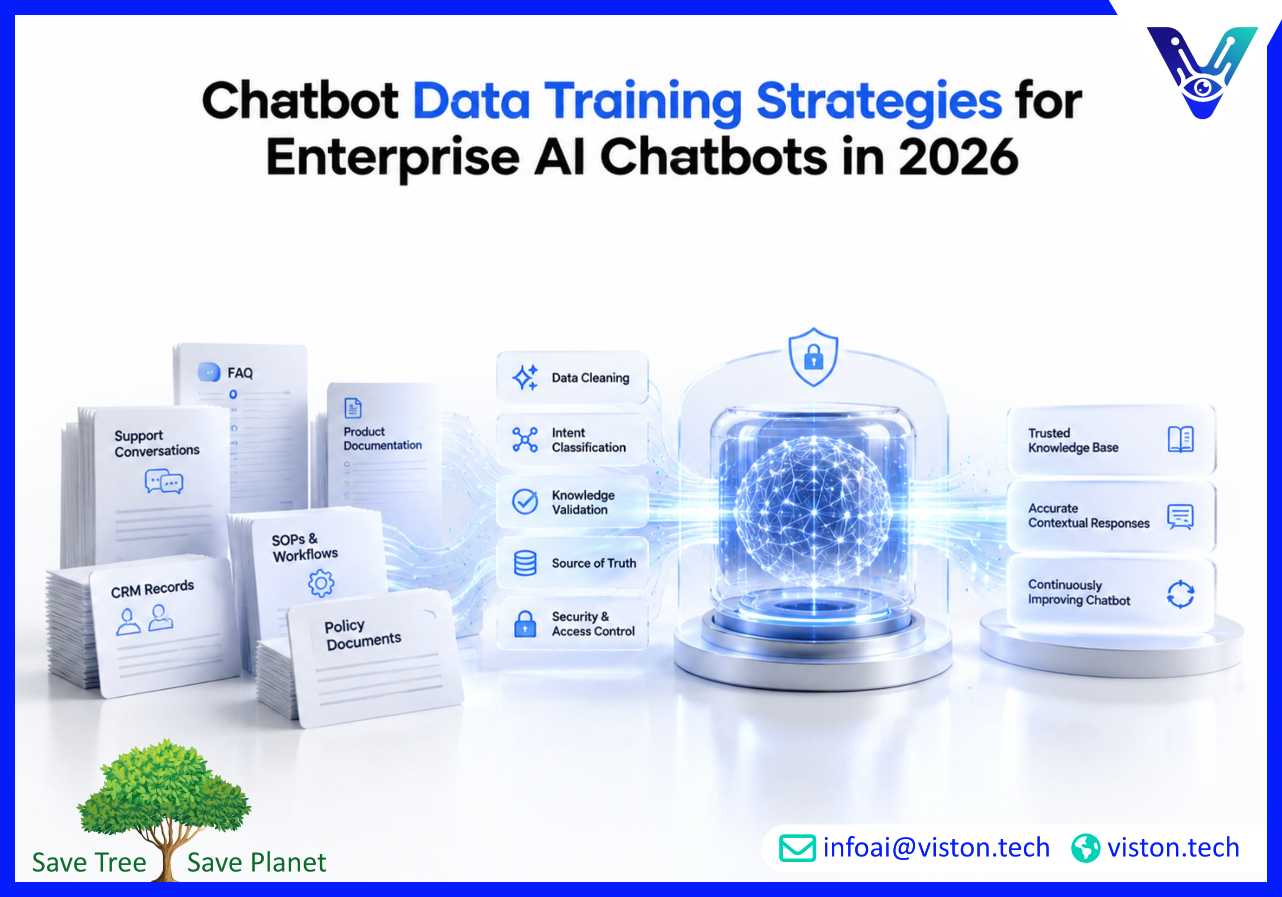
Chatbot data training strategies enterprise teams use in 2026 determine whether an AI chatbot becomes a reliable business assistant or a risky automation layer. For enterprise AI chatbots, training data quality affects accuracy, compliance, customer trust, escalation quality, workflow completion, and long-term performance.
Chatbot data training is the process of preparing, structuring, refining, and continuously improving the information an enterprise chatbot uses to understand users and respond correctly. It includes training data from support tickets, FAQs, product documentation, knowledge bases, CRM records, conversation transcripts, internal policies, service workflows, and subject matter expert input.
For enterprise AI chatbots, training is not limited to giving the bot a list of questions and answers. The system must understand user intent, business context, terminology, permissions, escalation rules, compliance limits, and the difference between general information and action-based workflows. A chatbot that supports sales, customer service, employee helpdesk, onboarding, compliance, or IT operations needs data that reflects real business conversations.
The goal is not to train the chatbot to answer everything. The goal is to train it to answer the right things accurately, ask clarifying questions when needed, use trusted sources, and hand off to human teams when the situation requires judgment or approval.
Each data source must be reviewed before use. Old, duplicated, inaccurate, or conflicting information can weaken chatbot performance. Enterprise teams should treat chatbot training as a data governance process, not a one-time content upload.
In 2026, enterprise AI chatbots are expected to do more than answer basic questions. Buyers expect secure, integrated, multilingual, context-aware, and workflow-ready systems. A chatbot may need to retrieve order details, qualify leads, summarize support cases, recommend next steps, update a ticket, trigger an internal workflow, or guide an employee through a policy process.
This level of responsibility makes training strategy critical. Poor training data can create confident but inaccurate answers, irrelevant responses, inconsistent tone, compliance exposure, customer frustration, and unnecessary escalation. In high-volume environments, even a small accuracy issue can affect thousands of interactions.
An enterprise chatbot should be trained on approved and current business knowledge. This means teams must identify source owners, remove outdated content, create clear content hierarchies, and define which systems are authoritative. For example, a pricing page may be the source of truth for public plans, while CRM or ERP systems may be the source of truth for customer-specific pricing, contracts, or account status.
Enterprise chatbot training should respect access controls. Not every user should receive the same answer. A customer should not see internal policy notes. A sales rep should not access restricted HR information. A regional team may need localized compliance guidance. Training strategy should include role-based access, data segmentation, auditability, and safe response boundaries.
Enterprise users often use internal terminology, abbreviations, product names, process codes, and industry-specific language. Generic chatbot training may fail because it does not understand how real users describe problems. A strong training strategy includes synonym mapping, intent grouping, entity extraction, and examples of natural user phrasing.
For example, users may say “cancel subscription,” “stop renewal,” “close account,” or “terminate contract.” These may belong to the same intent, but the chatbot must understand the context, required steps, and risk level before responding.
The best chatbot data training strategies enterprise teams use are structured, measurable, and connected to business outcomes. Training should begin with high-value use cases rather than every possible question. This keeps the deployment focused and helps teams validate performance before expanding.
Every chatbot should begin with a clear intent map. An intent is the user’s goal, such as checking order status, booking a demo, resetting a password, requesting a refund, finding a policy, or escalating a complaint. Enterprise teams should identify the top intents by volume, business value, risk, and automation readiness.
High-volume and low-risk intents are often good starting points. These may include FAQs, order tracking, appointment scheduling, lead capture, product guidance, internal IT support, or knowledge base search. Complex or regulated workflows should be added only after the chatbot has strong guardrails, tested data, and reliable escalation logic.
Historical conversations are useful because they show how users actually ask questions. However, they must be cleaned before training. Remove personal data where not needed, separate resolved and unresolved conversations, identify successful answers, and classify common issue types. Poor-quality transcripts can teach the chatbot bad habits if they contain incomplete responses, outdated policies, or inconsistent agent wording.
Teams should group conversations by intent, sentiment, channel, language, user type, and resolution outcome. This helps the chatbot learn not only what users ask, but also which responses lead to successful outcomes.
Enterprise chatbots should rely on approved response content. An answer library gives the chatbot a trusted base for common questions, process explanations, disclaimers, escalation triggers, and workflow instructions. These answers should be reviewed by business owners, legal teams, compliance teams, product teams, or support managers depending on the use case.
The best answer libraries are modular. Instead of writing long static responses, teams can create reusable response blocks for eligibility rules, next steps, required documents, product features, troubleshooting steps, and handoff instructions. This keeps answers consistent across channels and easier to update.
Modern enterprise AI chatbots often use retrieval-based methods to pull answers from approved knowledge sources. This works well when the knowledge base is organized, current, and searchable. The chatbot should retrieve from trusted content rather than inventing answers from memory.
Source control matters. Teams should define which documents are active, which are archived, who owns updates, how often content is reviewed, and what the chatbot should do when information is missing or conflicting. A reliable chatbot should say it cannot confirm an answer rather than provide uncertain guidance.
A chatbot should not only be trained on successful conversations. It should also be trained to detect confusion, complaints, sensitive issues, repeated failure, negative sentiment, fraud signals, legal requests, cancellation risk, and urgent support needs. These situations often require human involvement.
Strong escalation training includes routing rules, handoff summaries, user context, conversation history, and priority tagging. This prevents customers or employees from repeating themselves and helps human teams act faster.
Chatbot data training does not end at launch. Enterprise environments change constantly. Products change, policies change, workflows change, pricing changes, compliance rules change, and customer expectations evolve. A chatbot that performs well during launch can become inaccurate if its training data is not maintained.
Fallback analysis is one of the most valuable optimization practices. A fallback happens when the chatbot does not understand the user or cannot provide an answer. These conversations reveal missing intents, unclear knowledge content, poor phrasing, weak entity recognition, and gaps in training examples.
Teams should review fallback logs regularly, especially during the first few months after deployment. Each fallback should be classified as a missing intent, missing content, unclear user input, system error, integration issue, or escalation need.
Training quality should be measured through business outcomes, not only model accuracy. Useful KPIs include intent recognition accuracy, self-service resolution rate, fallback rate, escalation rate, customer satisfaction, average handling time, lead qualification rate, workflow success rate, and human handoff quality.
If the chatbot recognizes intent correctly but users still abandon conversations, the issue may be conversation design. If users are satisfied but CRM updates fail, the issue may be integration. If escalation is too high, the chatbot may need better knowledge coverage or clearer confidence thresholds.
Enterprise teams should create a formal chatbot improvement cycle. This may include weekly review during rollout, monthly optimization after stabilization, and quarterly audits for content accuracy, compliance, and performance. Each update should be documented so teams know what changed and why.
A strong governance model defines owners for training data, knowledge base content, prompts, workflow rules, analytics, compliance review, and system integrations. Without ownership, chatbot quality usually declines over time.
Training improvement should not expose sensitive customer, employee, financial, health, or contractual data unnecessarily. Teams should apply data minimization, anonymization, encryption, access control, retention limits, and audit logging where appropriate. This is especially important when using conversation transcripts for retraining or evaluation.
Viston AI is relevant to chatbot data training strategies because its Enterprise AI Chatbots service focuses on building conversational AI for complex business environments. Its offering connects chatbot development with natural language understanding, workflow automation, knowledge integration, multilingual support, system integration, and ongoing optimization.
For enterprise teams, this matters because chatbot quality depends on more than the chatbot interface. A successful deployment requires clean data preparation, intent design, business-specific terminology, approved knowledge sources, CRM or knowledge base connectivity, escalation logic, testing, and performance monitoring. Viston AI’s enterprise AI chatbot capabilities are aligned with these needs, especially for companies that want chatbots to support customer service, sales operations, internal helpdesks, knowledge search, and process automation.
The company’s broader AI service portfolio also includes AI chatbot integration, NLP and text analysis, AI strategy development, MLOps and model monitoring, multilingual support, voice-enabled assistants, and automation workflows. This gives businesses a practical foundation for building chatbots that are trained on relevant data, connected to enterprise systems, and improved through continuous performance review.
For organizations operating across multiple teams, regions, or business units, Viston AI can be positioned as a specialist partner for designing chatbot training workflows that balance accuracy, scalability, security, and business usability.
The best data includes approved FAQs, help center content, product documentation, support tickets, resolved conversation transcripts, CRM fields, internal SOPs, and expert-reviewed answers. The data should be accurate, current, structured, and relevant to real user intents.
The amount depends on the chatbot’s scope. A focused FAQ chatbot may need fewer examples, while a multilingual, workflow-based enterprise chatbot requires broader intent coverage, more conversation examples, tested knowledge sources, and continuous improvement data.
No. Training a chatbot on all documents can create confusion and security risk. Enterprises should use approved, current, access-controlled sources and clearly define which content is suitable for customer-facing, employee-facing, or internal-only use.
Training data should be reviewed regularly. During launch, weekly reviews are useful. After stabilization, monthly optimization and quarterly content audits help maintain accuracy, compliance, and business relevance.
They often fail because of poor training data, weak intent mapping, outdated knowledge, missing integrations, unclear escalation rules, or lack of governance. A strong AI model still needs accurate business context and reliable operational design.
Yes. Viston AI’s Enterprise AI Chatbots service is aligned with chatbot training strategy because it covers chatbot development, NLP, knowledge integration, business system integration, workflow automation, and ongoing optimization for enterprise use cases.
Chatbot data training strategies enterprise teams choose in 2026 directly shape the reliability, usefulness, and business value of enterprise AI chatbots. Strong training starts with clean data, approved knowledge, clear intent mapping, secure access controls, realistic testing, and continuous improvement. The most effective chatbots are not trained once and forgotten; they are governed, measured, refined, and connected to real workflows. For businesses investing in Enterprise AI Chatbots, a disciplined training strategy helps reduce automation risk, improve response quality, support better handoffs, and create scalable conversational experiences. Viston AI offers relevant capabilities for organizations that want chatbot training, integration, and optimization handled with an enterprise-focused approach.
