
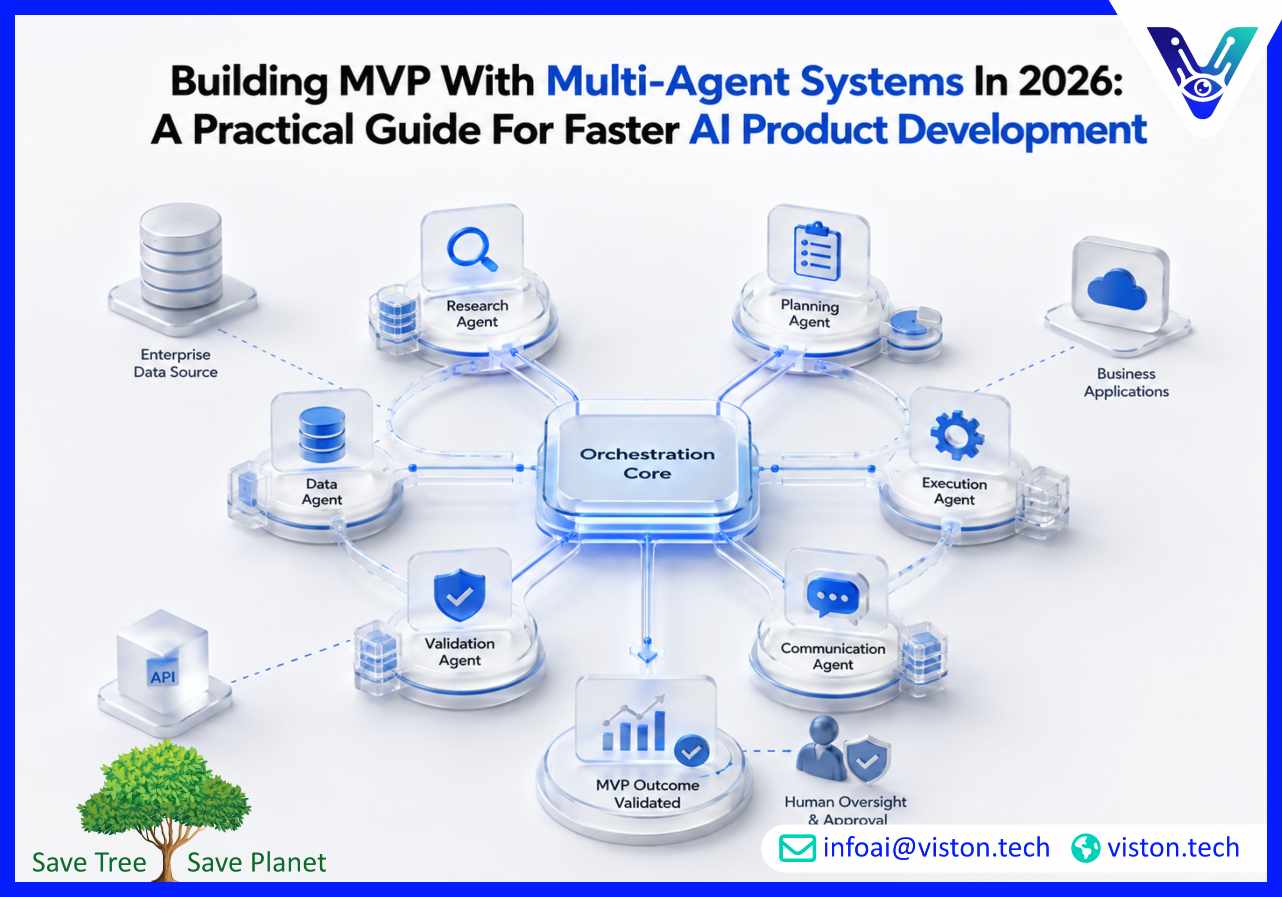
Businesses exploring AI products often face a difficult challenge: how to validate complex AI-driven ideas quickly without investing heavily in full-scale development. Building MVP with multi-agent systems has emerged as a practical approach for organizations that want to test advanced AI workflows, automate decision-making processes, and evaluate real-world business value before scaling.
A Minimum Viable Product (MVP) is the simplest version of a product that allows businesses to validate assumptions, gather feedback, and assess market demand. When AI agents are involved, an MVP can go beyond traditional prototypes by demonstrating autonomous workflows, task coordination, and intelligent decision-making.
Building MVP with multi-agent systems involves creating a network of specialized AI agents that collaborate to perform specific business functions. Rather than relying on a single AI model, multiple agents are assigned distinct responsibilities such as planning, research, data retrieval, validation, execution, reporting, or customer interaction.
The objective is not to create a perfect enterprise-grade system immediately. Instead, the focus is on proving that a coordinated agent architecture can solve a meaningful business problem efficiently and reliably.
AI adoption has shifted from experimentation toward measurable business outcomes. Organizations increasingly want AI systems that can handle workflows, integrate with business tools, and support operational processes rather than simply generate content or answer questions.
Multi-agent systems enable MVPs to simulate realistic business environments by allowing different AI agents to perform specialized tasks while working together toward a common objective.
For startups and enterprises alike, MVPs built with multi-agent architectures provide a clearer understanding of scalability, governance requirements, operational risks, and long-term implementation costs.
Building an effective MVP requires balancing simplicity with enough functionality to demonstrate meaningful value.
Each agent should perform a specific task within the workflow. Common MVP agent types include:
Limiting responsibilities helps improve predictability and simplifies testing.
Orchestration is the foundation of any multi-agent MVP. It determines how agents communicate, share context, transfer tasks, and resolve dependencies.
A well-designed orchestration layer ensures agents work together coherently rather than operating as isolated AI components.
Most MVPs require connections to business applications such as CRMs, databases, document repositories, ticketing systems, project management tools, APIs, or analytics platforms.
Even during MVP development, integration planning is important because it often reveals technical constraints and operational requirements.
Agents need access to relevant information throughout the workflow. Shared memory and context management prevent duplicated work and improve decision quality.
For example, if one agent qualifies a sales lead, downstream agents should access that information without repeating the same evaluation process.
MVPs should include approval workflows where appropriate. Human review helps evaluate agent performance, identify errors, and build stakeholder confidence before automation expands.
Successful implementation starts with business objectives rather than technology selection.
Select a business process where AI coordination can create measurable value. Common examples include:
The best MVP candidates involve repetitive processes with clear outcomes.
Document every step in the process, including inputs, outputs, decision points, approvals, integrations, and exceptions.
This mapping exercise helps determine where individual agents can contribute and how orchestration should function.
Create focused agents that perform narrow tasks effectively. Avoid building one overly complex agent that attempts to manage the entire workflow.
Specialization improves maintainability and makes performance evaluation easier.
Define how agents exchange information, when handoffs occur, and how workflow state is managed.
Clear communication protocols reduce inconsistencies and improve workflow reliability.
Connect the MVP to the minimum number of systems required to demonstrate value.
This approach keeps development manageable while providing realistic business functionality.
Include validation checks, approval requirements, access controls, monitoring, and error handling.
Responsible AI implementation should be considered from the earliest MVP stages.
Evaluate the MVP using actual workflows whenever possible.
Testing should assess:
Insights gathered during MVP deployment help determine whether the solution should be expanded, modified, or repositioned.
Organizations that invest time in evaluation often achieve more sustainable long-term AI adoption.
While multi-agent architectures offer significant potential, businesses should understand common implementation challenges.
Attempting to automate too many processes simultaneously often increases development time and reduces MVP effectiveness.
Start with a focused use case and expand gradually.
Business systems may have API restrictions, inconsistent data quality, or security requirements that affect agent performance.
Without proper context sharing, agents may produce conflicting outputs or duplicate work.
Organizations must establish clear controls around data access, decision authority, audit logging, and compliance requirements.
Defining success metrics early helps stakeholders assess whether the MVP delivers meaningful business value.
Metrics may include processing speed, accuracy improvements, operational efficiency gains, or cost reduction opportunities.
For organizations evaluating multi-agent orchestration, Viston AI provides services aligned with the design, development, and implementation of coordinated AI systems. Building MVP with multi-agent systems requires more than selecting AI models; it involves workflow analysis, orchestration planning, integration strategy, governance controls, testing frameworks, and operational alignment.
Viston AI’s Multi-Agent Orchestration expertise helps businesses transform conceptual AI ideas into practical MVPs capable of demonstrating measurable outcomes. This includes defining agent responsibilities, creating orchestration logic, connecting business systems, implementing safeguards, and establishing performance monitoring processes.
Organizations exploring AI-powered products, internal automation initiatives, operational workflows, or customer-facing solutions can benefit from structured multi-agent architectures that support scalability from the earliest development stages. By focusing on practical business objectives rather than technology experimentation alone, Viston AI helps companies evaluate feasibility, reduce implementation risk, and accelerate informed decision-making around AI investments.
A multi-agent MVP is an early-stage product that uses multiple AI agents working together to validate a business concept, workflow, or automation process before full-scale development.
Multi-agent systems allow specialization. Different agents can handle planning, execution, validation, research, and communication tasks, creating more structured and scalable workflows.
Development timelines vary depending on workflow complexity, integrations, governance requirements, and testing needs. Simpler MVPs can often be developed significantly faster than full enterprise deployments.
Industries such as SaaS, finance, healthcare, professional services, logistics, retail, manufacturing, and customer support operations can benefit from multi-agent workflow validation.
Yes. Viston AI’s Multi-Agent Orchestration services align with designing, developing, testing, and deploying MVPs that demonstrate practical AI workflow capabilities and business value.
Key metrics include workflow completion rates, accuracy, user satisfaction, operational efficiency, response quality, escalation performance, and overall business impact.
Building MVP with multi-agent systems offers businesses a practical way to validate AI-driven workflows before committing to large-scale implementation. By combining specialized agents, orchestration logic, integrations, governance controls, and measurable objectives, organizations can evaluate real-world feasibility while minimizing risk. As AI adoption continues to mature in 2026, multi-agent architectures provide a structured path toward scalable automation and intelligent business operations. For companies exploring Multi-Agent Orchestration, Viston AI offers expertise that helps transform promising concepts into functional MVPs capable of delivering meaningful operational insights and long-term growth opportunities.
