
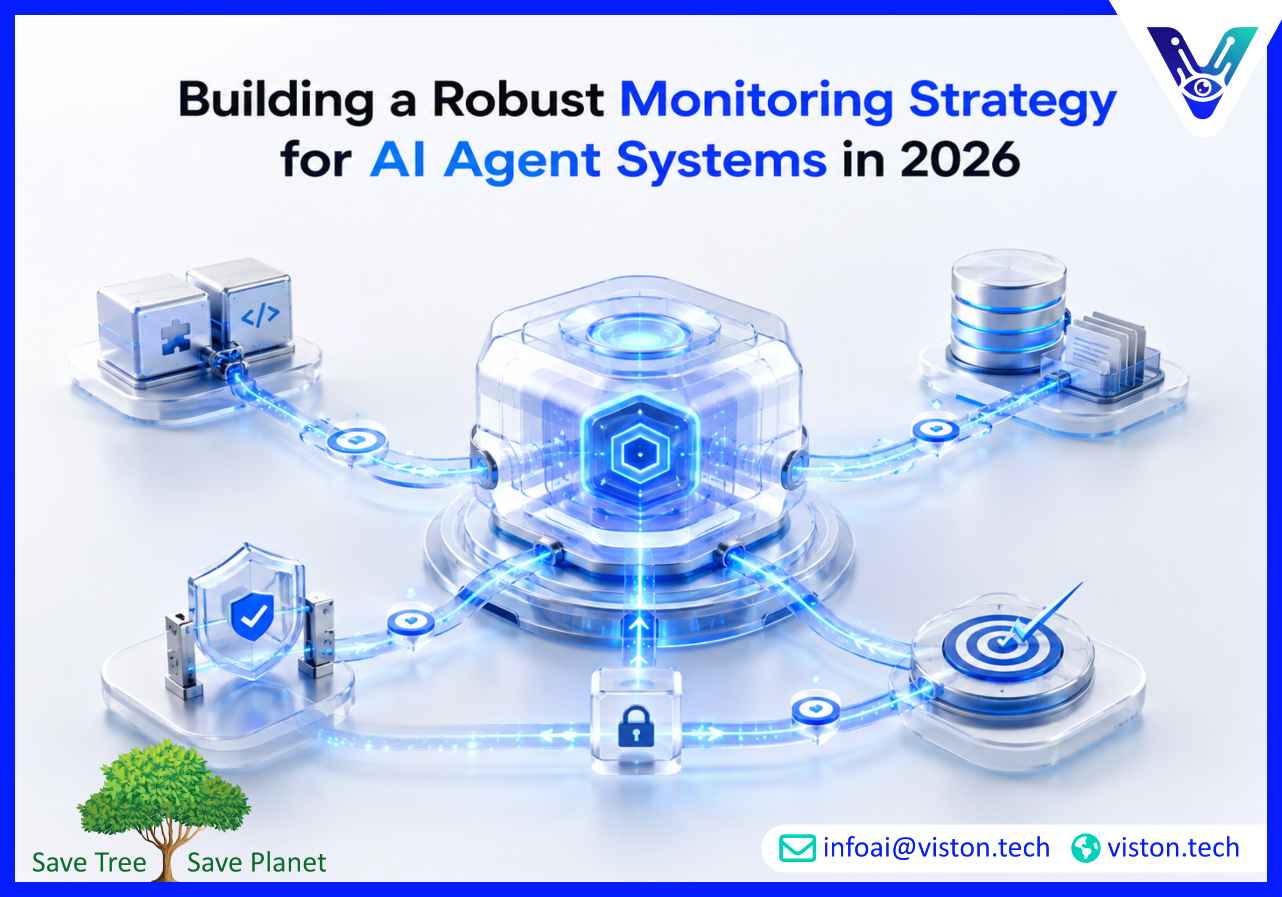
In 2026, the difference between a successful AI agent deployment and a costly failure often comes down to one thing: observability. Unlike traditional applications that fail with clear error codes, AI agents can produce plausible but wrong answers, loop endlessly on tasks, burn through API budgets, or quietly drift off-policy while appearing to function normally . For business leaders and technology decision-makers, this creates a fundamental challenge. How do you trust an autonomous system when you cannot see what it is doing, why it made a decision, or whether it actually completed the task you assigned?
This is why a monitoring strategy for AI agent systems has become a prerequisite for production deployment, not an afterthought. Whether you are rolling out customer support automation, autonomous data analysis workflows, or agentic process automation across enterprise systems, you need the ability to track, debug, and govern agent behavior in real time. This guide outlines what an effective monitoring strategy looks like in 2026, the metrics that actually matter, and how businesses can implement governance-by-architecture rather than relying on post-hoc audits
Conventional monitoring tools were built for deterministic systems. A server either responds or it doesn’t. An API returns a 200 or a 500. These binary signals tell you nothing about whether an agent understood the user’s intent, used the correct tool, retrieved the right knowledge, or produced a hallucinated response that looks authoritative but is factually wrong .
AI agents introduce three layers of complexity that legacy observability cannot handle. First, behavior is non-deterministic. The same input can produce different outputs depending on context, model version, or even randomness in sampling. This means you cannot simply define “normal” behavior and alert on deviations. Second, agents interact with external tools, APIs, and databases. A failure could originate in the agent’s reasoning, a broken API integration, stale context, or a permissions issue. Third, multi-agent workflows create cascading failures. One agent misinterprets a handoff, another stalls on a task, and errors propagate across the system before anyone notices .
The 2026 market reality is that fewer than one in ten enterprise applications are fully observable, according to recent industry analysis . For agentic systems, that number is even lower. Without a deliberate monitoring strategy, organizations face compliance risks, runaway costs, and the slow erosion of user trust as undetected failures accumulate.
An effective monitoring strategy for AI agent systems rests on four pillars: instrumentation, metrics, tracing, and governance enforcement. Each component addresses a specific dimension of agent behavior that must be visible to operations teams.
The first decision in any monitoring strategy is how you collect data. In 2026, OpenTelemetry has emerged as the industry standard for vendor-neutral observability . By instrumenting agents with OTel-compliant spans and traces, you keep the ability to switch backends without re-instrumenting code. Every agent interaction should generate structured telemetry that includes prompts, responses, reasoning steps, tool calls with parameters and results, latency breakdowns, token usage, and cost attribution per session .
For multi-agent workflows, instrumentation must preserve attribution across handoffs. You need to know which agent made which decision, which parent agent spawned a child, and how permissions flowed through the system. Without this, root cause analysis becomes guesswork.
Beyond basic uptime and error rates, agent monitoring requires metrics that reflect whether agents are working as intended. Latency and response time remain important for user-facing agents. But the more telling signals are task completion rate, tool call success rate, and intent accuracy. Is the agent actually finishing the jobs you give it? Is it calling the right tools with the right parameters? Is it understanding user requests correctly ?
Cost efficiency has become a critical metric as organizations scale agent deployments. Tracking token usage per task, per session, and per agent helps identify inefficient loops or overly verbose models that burn through budgets. Some organizations report up to forty percent reductions in token waste after implementing proper observability .
Safety and compliance metrics complete the picture. Content filters, PII detection, and policy adherence checks should generate signals that feed into monitoring dashboards. When an agent attempts to access restricted data or produce non-compliant output, that event must be logged, alerted, and traceable back to the specific decision path that led to the violation .
When an agent fails, you need to replay exactly what happened. This requires capturing the full decision chain: the input prompt, the retrieval results, the model’s reasoning, each tool call and its response, and the final output. Teams using comprehensive tracing report saving an average of three hours per day in debugging time . The ability to visualize how a request moved through prompts, tool calls, memory retrieval, and multi-agent handoffs transforms debugging from a forensic exercise into a systematic process .
For enterprises operating in regulated industries, tracing also serves an audit function. Maintaining immutable records of agent decisions, including which policies were evaluated and what outcomes were produced, creates the evidence layer required for compliance with frameworks like the EU AI Act .
The most significant shift in agent monitoring for 2026 is the move from reactive to proactive governance. Traditional approaches attach compliance to prompts, dashboards, or post-hoc documentation. By the time a human reviews what happened, the agent has already taken action. In high-stakes environments where agents can initiate payments, update production systems, or access sensitive data, this is unacceptable .
Governance-by-architecture means embedding constraints directly into the agent runtime. Before an agent calls a tool, a pre-action gate evaluates whether the request complies with defined policies. During execution, monitors track whether the agent stays within its bounds. After completion, auditors verify that outcomes match expectations. When violations occur, escalation routers determine whether to retry, halt, or hand off to a human .
This approach aligns with emerging standards like AIUC-1, the first compliance standard built specifically for AI agents. The Q2 2026 update to AIUC-1 introduced requirements for unique cryptographic agent identities and just-in-time permissions management . Every agent should have a verifiable identity. No agent should hold standing access to anything. Permissions are provisioned at the moment they are needed and revoked immediately after. This Zero Trust architecture for agents is becoming the baseline expectation for enterprise deployments .
Monitoring is not an end in itself. The data you collect should feed back into agent development. When observability surfaces a failure mode, that scenario becomes a test case. When drift detection catches degrading performance, that triggers model or prompt updates. When cost metrics reveal inefficiencies, that drives optimization work .
Organizations that treat monitoring as part of the agent development lifecycle build competitive advantage over time. They catch problems before users do. They optimize costs continuously. They pass audits with confidence. And they scale agent deployments without scaling risk.
The 2026 benchmark for mature agent operations includes automated evaluation in CI/CD pipelines. Before deploying a model update or prompt change, teams run synthetic tests against known failure cases. If too many responses drift from expected baselines, the deployment halts. This prevents regressions from reaching production and keeps agent behavior consistent over time .
Building a monitoring strategy for AI agent systems requires deep expertise in agent architecture, observability tooling, and production operations. Viston AI delivers custom, enterprise-focused AI agent development and deployment solutions that help organizations turn complex automation goals into practical business outcomes . Its offerings include AI strategy and consulting, agentic AI development and integration, and end-to-end deployment support for production environments.
Viston AI’s approach to agent development incorporates observability-by-design from the start, not as an afterthought. The company emphasizes ISO-certified security, data governance, and compliance for enterprise deployments, serving industries including finance, healthcare, retail, manufacturing, and logistics. For organizations building agent systems that must perform reliably at scale, Viston AI provides the specialized expertise needed to instrument, monitor, and govern autonomous workflows effectively. Its focus on measurable ROI and faster time-to-value means clients get monitoring strategies that protect both performance and budgets .
Traditional monitoring tracks whether systems are running. It answers questions like “is the server online?” AI agent observability tracks whether agents are working correctly. It answers questions like “did the agent understand the user’s intent, call the right tool, and produce an accurate result?” Observability captures behavior, reasoning, and outcomes, not just uptime.
Start with five core metrics: task completion rate (did the agent finish what it started?), tool call success rate (are external integrations working?), cost per task (is token usage under control?), latency per step (where are bottlenecks occurring?), and policy adherence rate (is the agent staying compliant?). These give you immediate visibility into whether agents are delivering business value.
Without unique, verifiable agent identities, you cannot attribute actions to specific agents or detect unauthorized behavior. Emerging standards like AIUC-1 require cryptographic identities for every agent and just-in-time permissions. This enables granular monitoring, audit trails, and Zero Trust enforcement across multi-agent workflows.
Traditional APM tools provide a foundation but are insufficient alone. You need AI-native capabilities: prompt and response logging, tool call tracing, cost attribution, hallucination detection, and policy enforcement. Many organizations adopt OpenTelemetry for portability and layer AI-specific observability on top using platforms designed for agentic workloads.
Governance-by-architecture means embedding compliance constraints directly into the agent runtime rather than relying on post-hoc reviews. Pre-action gates, runtime monitors, and escalation routers enforce policies at the moment of execution. This is essential for high-stakes environments where agents can take irreversible actions like payments or production changes.
Begin with instrumentation. Add OpenTelemetry traces to capture prompts, responses, tool calls, and cost data. Define your core metrics based on business outcomes, not just technical signals. Set up basic dashboards for task completion, error rates, and cost. Then iteratively add tracing, alerting, and governance enforcement as you scale.
As AI agents move from pilots to production, a monitoring strategy for AI agent systems is no longer optional. Organizations that invest in observability gain the ability to trust their autonomous systems, control costs, pass audits, and scale with confidence. Those that do not face silent failures, budget overruns, and compliance exposure. The path forward is clear. Instrument with OpenTelemetry, track behavior metrics that matter, implement governance-by-architecture, and close the feedback loop from monitoring to improvement. For enterprises seeking specialized expertise in AI agent development and deployment, Viston AI offers the technical depth and production experience to build agent systems that are not just powerful but observable, governable, and trustworthy.
