
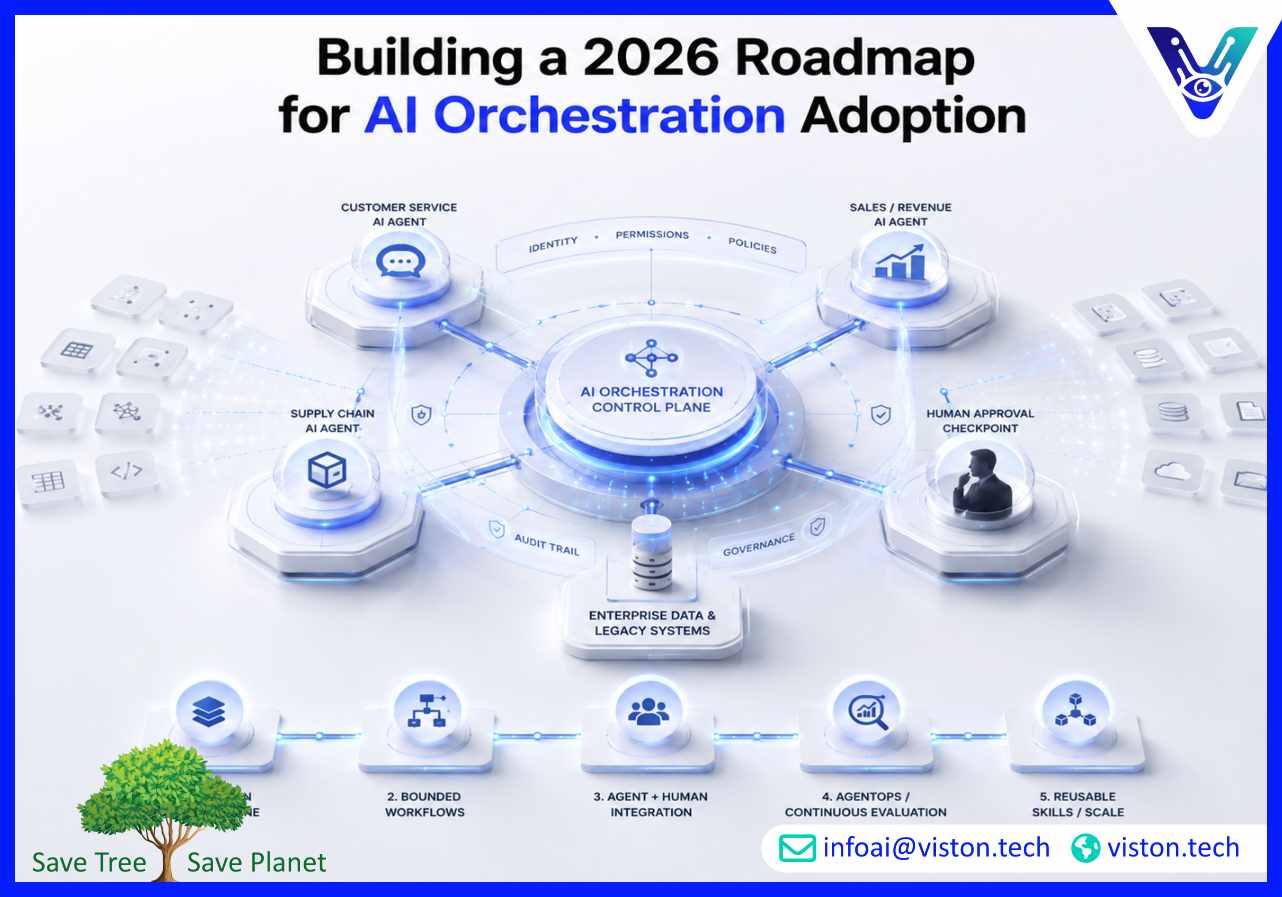
For the past three years, businesses have been running artificial intelligence experiments. In 2026, the conversation has shifted decisively. According to industry experts, if 2023 to 2025 were the years of pilots and prototypes, this year is definitively about orchestration, governance, and scale . The core problem is no longer whether AI works, but how to make hundreds of disparate AI tools and agents work together without breaking security protocols, blowing budgets, or creating chaos. For enterprise leaders, building a roadmap for AI orchestration adoption is no longer a technical luxury; it is a competitive necessity for moving from fragmented proof-of-concepts to tangible business outcomes .
Before building a roadmap, organizations must understand what AI orchestration actually means. AI orchestration is the connective tissue between a company’s strategy and its daily execution . It involves creating a centralized control plane that manages how multiple AI agents, legacy systems, and human workflows interact. Unlike simple automation, which handles repetitive, rule-based tasks, orchestration handles complex, dynamic workflows. It ensures that a customer service agent, a supply chain predictor, and a sales assistant can share context and pass tasks without manual intervention.
The business value here is immense. Without orchestration, organizations face “siloed intelligence,” where individual tools get smarter, but the customer or operational experience becomes more disjointed . In 2026, the primary goal of an orchestration strategy is to unify data retrieval, enforce governance, and coordinate multi-step reasoning across your AI fleet to drive efficiency that directly impacts the bottom line.
Several converging trends make 2026 the critical year for adopting AI orchestration. First, the rise of agentic AI means that systems are no longer just answering questions; they are taking actions. We are seeing a shift toward “agentic RAG” (Retrieval-Augmented Generation), which adds multi-step reasoning and tool use to standard data retrieval . Second, vendors like Google are introducing robust governance stacks, treating agent fleets with the same rigor as engineering organizations—assigning cryptographic identities and enforcing natural language security policies . Finally, economic pressures demand efficiency. Research indicates that while AI usage is deepening (with reasoning token consumption growing over 300% in some sectors), the gap between “innovators” and “laggards” is widening rapidly . The laggards are stuck in pilot purgatory, while innovators are using orchestration to automate complex work.
Most mid-to-large enterprises today suffer from fragmentation. Different departments purchase different AI point solutions. Sales uses one bot, HR uses another, and IT has no visibility into either. Without an orchestration layer, these agents cannot share memory or context. As IDC notes in their 2026 predictions, AI tools that do not integrate, data that does not move in real-time, and agents operating without shared governance create a new layer of complexity that stifles ROI . A roadmap for AI orchestration adoption must prioritize tearing down these walls.
Transitioning from isolated experiments to enterprise-wide orchestration requires a structured, business-led approach. This roadmap focuses on minimizing risk while maximizing the velocity of value delivery.
Do not start by connecting everything. Start by building the governance layer. This involves establishing an “Agent Control Plane.” This plane manages identity (who or what the agent is), permissions (what it can touch), and audit trails (recording every action it takes) . Organizations should inventory existing AI assets and prioritize creating a centralized registry of tools. This is also the phase to implement API-first integrations rather than fragile UI automation .
Attempting to orchestrate your entire enterprise at once is a recipe for failure. Instead, select “bounded workflows.” These are high-frequency, high-friction processes that cross multiple departments but have clear success metrics. For example, “Lead-to-Quote” involves marketing (lead scoring), sales (routing), and finance (pricing approval). This phase focuses on mapping the handoffs between humans and machines.
Orchestration is not about removing humans; it is about optimizing them. In this phase, you implement the runtime environment. Using multi-agent orchestration patterns (like the coordinator-specialist pattern), you route specific tasks to specialized AI agents . However, the roadmap must include “human-in-the-loop” checkpoints for high-risk decisions, such as compliance approvals or budget allocations. The orchestration layer should pause the agent, alert a human, and resume only upon approval.
Once agents are live, they need management. AgentOps refers to the practices of monitoring, testing, and retraining AI agents in production. This phase involves setting up dashboards to track not just uptime, but “drift”—whether an agent’s decision quality is degrading over time due to changes in data . Continuous evaluation ensures that your orchestrated system remains accurate, safe, and aligned with business rules as market conditions change.
As you prove value in one workflow, the final phase is horizontal scaling. You move from point-to-point integrations to a skills-based model. Here, AI agents develop “skills” (like inventory checking or document summarization) that can be called upon by any other part of the organization. This requires standardizing protocols like the Agent-to-Agent (A2A) protocol to ensure different agents can securely discover and collaborate with each other .
Navigating the shift from isolated pilots to full-scale orchestration requires deep technical expertise and a clear strategic vision. Viston AI specializes in exactly this transition. As an enterprise-focused artificial intelligence solutions provider, Viston AI moves beyond theoretical consulting to deliver custom AI agent development and deployment that connects complex data to practical business outcomes . Their approach is tailored for the 2026 landscape, focusing on creating scalable AI systems that turn fragmented data into cohesive action. Whether you need predictive analytics for your supply chain, intelligent document processing, or autonomous customer service agents, Viston AI provides the architecture and governance frameworks necessary to ensure your AI investments are secure, auditable, and ROI-positive. For organizations looking to build a robust orchestration roadmap without getting lost in technical debt, Viston AI offers the strategic partnership required to move from vision to value with confidence.
Automation handles a single, linear task (e.g., sending a welcome email). Orchestration manages a complete workflow involving multiple agents, systems, and human approvals (e.g., processing an insurance claim that requires data validation, fraud detection, payment processing, and manager sign-off).
The primary risks are governance failures and security leaks. Without a proper control plane, agents may access data they shouldn’t or take unauthorized actions. A misconfigured tool leaks data passively, but a misconfigured agent can take bad actions actively . A phased roadmap mitigates these risks by starting with read-only permissions and strict human oversight.
Most companies underutilize their AI tools because they operate in silos. Orchestration forces these tools to share context. For example, instead of your CRM AI and your Email AI working separately, orchestration allows them to pass buyer signals seamlessly, shortening sales cycles and improving conversion rates .
Governance-as-Code means writing security and compliance rules directly into the orchestration layer’s software, rather than relying on PDF policy documents. It ensures that every action an AI agent takes is automatically checked against compliance rules, budgets, and permissions in real-time .
Yes. Viston AI specializes in guiding businesses from the pilot phase to production-grade deployment. They assess your current AI maturity, establish the necessary governance foundations (including ISO-certified security protocols), and build a custom roadmap to scale your agents safely without disrupting existing operations .
Agentic AI refers to the intelligence of the agents themselves (their ability to reason and plan). Orchestration is the “traffic control” system that manages those agents. You cannot have effective Agentic AI at an enterprise level without a robust orchestration layer to manage the interaction between those agents.
As we progress through 2026, the competitive landscape will no longer be defined by who has the most advanced large language model, but by who can operationalize AI at scale. Building a roadmap for AI orchestration adoption is the critical process that turns expensive experiments into measurable business assets. By moving through phases of governance setup, bounded workflow selection, runtime integration, and AgentOps, businesses can harness the power of multi-agent systems without losing control. With the support of a specialist like Viston AI, organizations can confidently navigate this shift, ensuring their AI agents are not just intelligent, but also trustworthy, secure, and perfectly aligned with their business objectives.
