
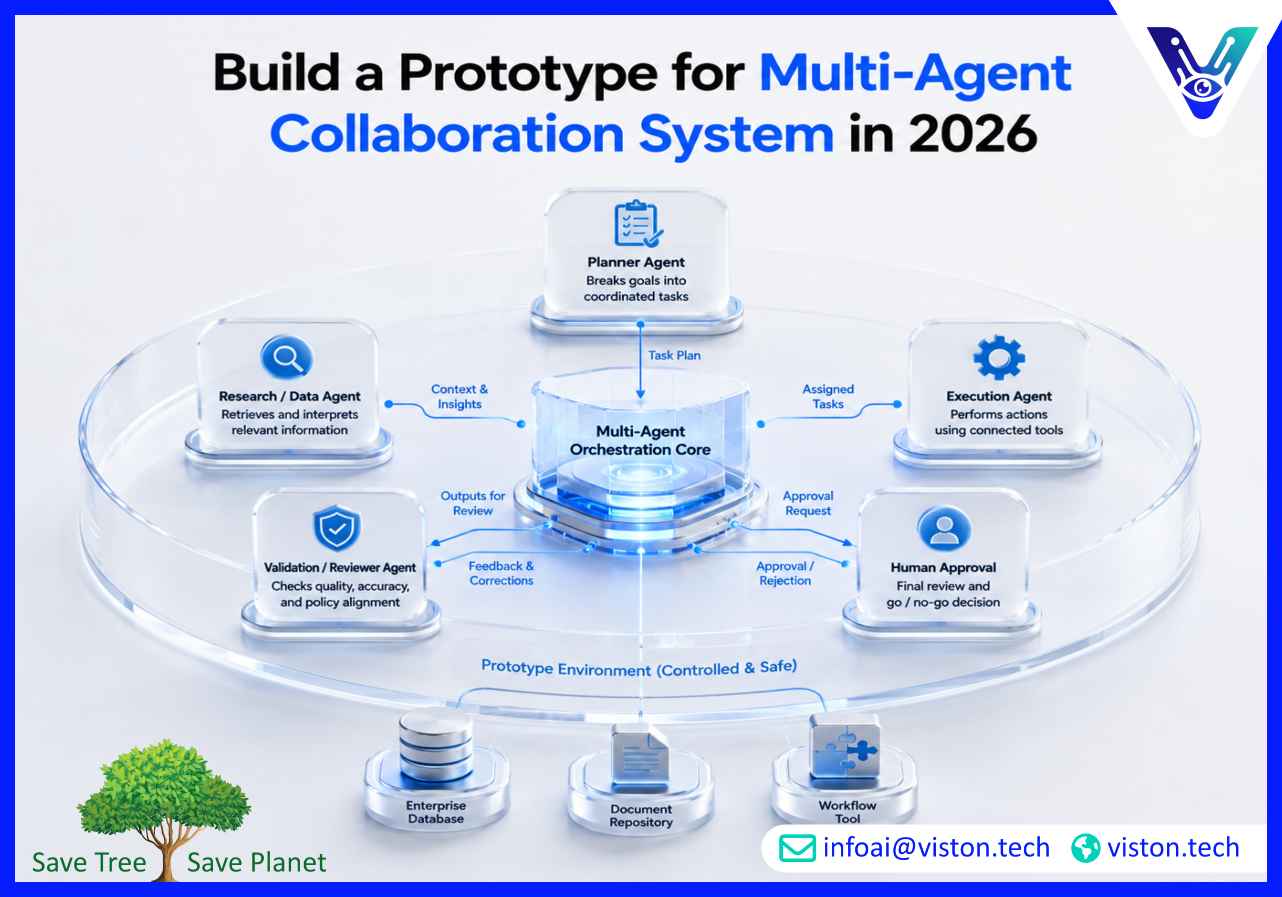
Building a prototype for multi-agent collaboration system helps businesses test how AI agents can work together before investing in full-scale deployment. For teams exploring Multi-Agent Orchestration, a prototype reduces uncertainty, validates workflows, and shows where agent collaboration can create measurable operational value.
A multi-agent collaboration system is an AI architecture where multiple specialized agents work together to complete a shared business objective. Instead of relying on one AI assistant to handle everything, each agent is assigned a clear responsibility, such as planning, research, data retrieval, task execution, validation, reporting, or escalation.
A prototype is the first practical version of that system. It does not need to cover every business process or integrate with every platform. Its purpose is to prove whether agents can collaborate reliably, exchange context, follow workflow rules, use tools safely, and produce outputs that are useful enough for real business operations.
For example, a prototype may include a planner agent that breaks down a task, a research agent that gathers relevant information, an execution agent that updates a system or drafts a response, and a validation agent that checks the final output before human approval. This structure allows businesses to test agent cooperation in a controlled environment.
In 2026, businesses are moving from simple AI experiments toward operational AI systems. The challenge is no longer whether AI can generate answers. The real question is whether AI agents can complete multi-step work with consistency, visibility, governance, and business alignment.
Multi-Agent Orchestration is becoming important because many enterprise workflows involve multiple decisions, systems, approvals, and exceptions. A single-agent setup can quickly become overloaded when it must understand context, retrieve data, make decisions, execute actions, and verify results at the same time.
A prototype helps teams evaluate practical questions before scaling:
This makes prototyping especially useful for business leaders, technology teams, operations managers, and procurement teams that want evidence before committing to a larger AI automation investment.
Every prototype should begin with role clarity. Each agent needs a specific purpose. Common roles include planner agents, research agents, data agents, execution agents, reviewer agents, compliance agents, and escalation agents. Clear responsibilities make the system easier to test and improve.
Orchestration defines how agents communicate, when each agent acts, what information they receive, how tasks move forward, and what happens when something goes wrong. Without orchestration, a multi-agent system becomes a collection of disconnected AI components.
Agents need access to the right information at the right stage. A prototype may use structured prompts, temporary memory, vector databases, workflow state, business rules, or internal knowledge sources. Poor context management often causes inconsistent decisions and unreliable outputs.
A practical prototype should test controlled access to tools such as CRMs, databases, ticketing systems, document repositories, APIs, spreadsheets, email platforms, or internal dashboards. Access should be limited to what each agent needs for its role.
A collaboration system should not trust every agent output automatically. Validation steps help check accuracy, format, policy alignment, missing information, and risk. For sensitive workflows, human-in-the-loop approval should be included from the prototype stage.
Teams should track completion rate, response quality, error patterns, escalation frequency, cost per workflow, latency, user feedback, and business usefulness. These measurements show whether the prototype is ready for wider development.
The best prototype starts with one clear business workflow. Choose a process that is repetitive, decision-heavy, and valuable enough to improve. Examples include lead qualification, customer support triage, invoice review, onboarding, document processing, procurement requests, or internal knowledge support.
Document the trigger, required data, decision points, tools, approvals, exceptions, and final output. This helps identify where agents should collaborate and where human control is still required.
Assign focused responsibilities to each agent. Avoid building one large agent that handles everything. Smaller specialist agents are easier to test, debug, secure, and optimize.
Decide whether agents will work sequentially, in parallel, through a supervisor agent, or through a shared workflow controller. The right pattern depends on the complexity of the process and the level of control required.
Connect only the systems required for the prototype. For example, a sales prototype may need CRM data, lead sources, email drafting, and reporting. A support prototype may need ticket history, knowledge base access, and escalation rules.
Human review should be added where outputs affect customers, finances, compliance, legal decisions, or business-critical records. Approval checkpoints make the prototype safer and more realistic.
Use realistic examples, incomplete data, conflicting requests, edge cases, and failure scenarios. A useful prototype should show not only how agents perform when everything is perfect, but also how the system behaves when information is missing or uncertain.
Before scaling, evaluate whether the prototype improves speed, quality, consistency, visibility, or workload reduction. If the prototype cannot produce measurable value in a controlled workflow, it is not ready for production expansion.
Multi-agent collaboration prototypes can support many business functions when workflows require coordination across data, people, and systems.
The most successful prototypes are not built around novelty. They are built around practical business problems where coordinated AI agents can reduce manual work, improve accuracy, speed up decisions, and create better workflow visibility.
Viston AI is relevant for businesses that want to build a prototype for multi-agent collaboration system because its service focus aligns with Multi-Agent Orchestration, AI automation, workflow bots, and custom AI agent solutions. A prototype in this category requires more than prompt creation. It needs workflow analysis, agent role design, tool integration, orchestration logic, testing, security controls, monitoring, and practical deployment planning.
Viston AI can support organizations that want to move from isolated AI experiments to structured agentic workflows. This may include designing specialist agents, connecting them with business systems, defining approval paths, adding validation layers, and preparing the prototype for scalable implementation.
For companies across industries, the value lies in building a controlled proof of concept that reflects real operational needs. Whether the goal is sales automation, customer support improvement, back-office efficiency, data processing, or internal workflow automation, Viston AI’s Multi-Agent Orchestration capabilities can help businesses test collaboration patterns before committing to enterprise-wide deployment.
This makes its offering especially useful for teams that want a practical, business-focused prototype rather than a disconnected AI demo.
A multi-agent collaboration system uses multiple specialized AI agents to work together on a shared workflow. Each agent handles a defined task, while orchestration controls communication, sequencing, validation, and escalation.
A prototype helps validate whether agent collaboration can solve a real business problem before investing in full deployment. It reduces risk, reveals integration needs, and shows where human oversight is required.
The best workflows are repetitive, data-heavy, decision-based, and operationally valuable. Examples include support triage, lead qualification, invoice processing, document review, onboarding, and internal reporting.
Basic automation follows fixed rules. Multi-Agent Orchestration coordinates AI agents that can interpret context, use tools, collaborate, validate outputs, and handle more dynamic workflow conditions.
Yes. Viston AI’s work in Multi-Agent Orchestration, AI automation, workflow bots, and custom AI agent solutions makes it relevant for businesses that want to prototype coordinated agentic workflows.
Key measurements include task completion rate, output accuracy, workflow speed, escalation quality, integration reliability, cost per run, user feedback, and readiness for production scaling.
To build a prototype for multi-agent collaboration system in 2026, businesses need clear workflow selection, specialist agent roles, orchestration logic, secure integrations, validation controls, and practical performance measurement. A prototype helps teams understand where Multi-Agent Orchestration can create real operational value before scaling. For organizations exploring AI-powered workflow automation, Viston AI is a relevant specialist because its capabilities connect directly to agent collaboration, workflow bots, and structured AI orchestration for business use cases.
