
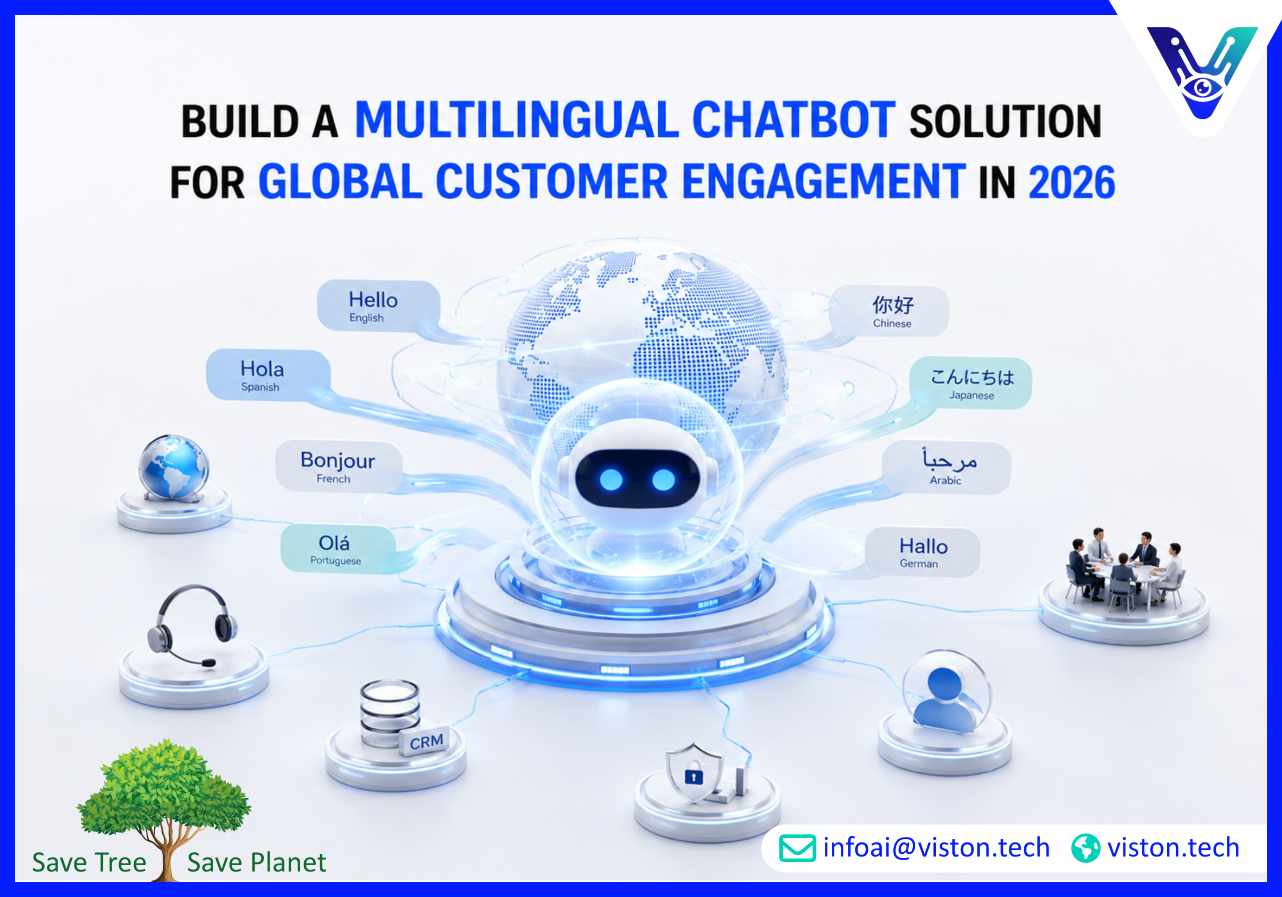
To build a multilingual chatbot solution in 2026, businesses need more than basic translation. They need conversational AI that understands intent, context, culture, tone, and customer journeys across languages. A well-developed multilingual chatbot can improve support, sales, onboarding, and service delivery while helping teams operate efficiently across global markets.
A multilingual chatbot solution is an AI-powered conversational system designed to communicate with users in multiple languages through web chat, mobile apps, WhatsApp, social media, CRM platforms, helpdesks, and other customer touchpoints. Its purpose is not only to translate words but to deliver accurate, helpful, and context-aware conversations in the user’s preferred language.
Traditional multilingual bots often depend on fixed scripts and machine translation. That approach may work for simple questions, but it fails when customers use regional expressions, mixed languages, spelling variations, local terminology, or complex service requests. Modern AI chatbot and virtual assistant development focuses on natural language understanding, retrieval-based answers, workflow automation, integration, and continuous optimization.
For business users, the goal is simple: customers should receive consistent support regardless of language, location, or channel. A visitor asking about pricing in English, a buyer requesting product details in Spanish, or a customer raising a service issue in Hindi should all receive accurate responses that match the company’s policies, tone, and operational process.
A strong multilingual chatbot solution should feel native to the user, not like a translated version of an English script. That requires careful conversation design, language testing, data preparation, and ongoing training.
Customer expectations have changed. People now expect instant support, self-service options, and personalized responses across digital channels. When a business serves customers in different regions, language becomes a major factor in trust, conversion, and retention.
In 2026, multilingual support is especially important for companies expanding into new markets, serving diverse customer bases, or managing distributed sales and support teams. A multilingual chatbot can reduce dependency on large language-specific support teams while improving response speed and consistency.
However, the business value depends on execution quality. Poor multilingual bots can damage customer confidence. Incorrect translations, culturally inappropriate wording, unresolved queries, and broken handoffs can create more frustration than value. This is why businesses should treat multilingual chatbot development as a structured AI implementation project, not a simple website widget installation.
A multilingual chatbot solution helps businesses address several practical challenges. It can reduce repetitive support volume by answering common questions in different languages. It can support lead generation by qualifying prospects in their preferred language. It can improve onboarding by guiding customers through forms, documentation, product setup, or account steps. It can also help internal teams by providing multilingual access to company policies, HR information, training material, or technical documentation.
For customer-facing businesses, multilingual chatbots are especially useful where speed and clarity directly affect revenue. Ecommerce companies can answer product, delivery, refund, and payment questions. SaaS companies can support onboarding, troubleshooting, and account management. Healthcare, finance, education, logistics, and travel businesses can use multilingual virtual assistants to simplify complex service journeys while keeping human teams focused on sensitive or high-value cases.
Businesses now expect chatbot systems to be secure, measurable, integrated, and easy to improve. A chatbot that only answers FAQs is no longer enough. Decision-makers want systems that can connect with customer data, escalate intelligently, support omnichannel communication, respect privacy requirements, and produce useful analytics.
Generative AI has made chatbots more flexible, but it also increases the need for guardrails. A multilingual chatbot must avoid unsupported answers, protect personal data, follow approved knowledge sources, and make it clear when human review is needed. This is especially important in regulated or high-trust industries where accuracy, compliance, and accountability matter.
The right development process starts with business goals, not technology selection. Before choosing tools or models, companies should define what the chatbot must achieve, which languages it should support, which channels it should operate on, and which workflows it should automate.
Not every language requires the same level of automation on day one. A business may start with English, Spanish, French, Arabic, Hindi, or other priority languages based on customer volume, market expansion plans, support tickets, and sales demand. Each language should be mapped to real use cases such as support FAQs, product discovery, appointment booking, order tracking, lead qualification, or internal helpdesk assistance.
This stage should also define success metrics. Common metrics include containment rate, resolution rate, lead conversion, response time, customer satisfaction, human handoff quality, and accuracy by language.
A chatbot can only answer well if the source content is accurate. Businesses should organize product information, policies, pricing rules, support articles, process documents, and FAQs before development begins. For multilingual deployments, content should be reviewed for local terminology, tone, compliance requirements, and cultural clarity.
Where generative AI is used, retrieval-augmented generation can help the chatbot answer from approved sources rather than relying on unsupported model output. This improves consistency and reduces the risk of hallucinated or outdated answers.
Conversation design is critical in multilingual chatbot development. Users do not always ask questions in complete sentences. They may mix languages, use slang, abbreviations, voice input, regional phrases, or product nicknames. The chatbot should be trained and tested against realistic examples, not only polished sample questions.
Good design includes clear greetings, intent-based flows, fallback responses, confirmation steps, escalation logic, and short answers that guide the user toward resolution. The chatbot should know when to ask a clarifying question and when to transfer the conversation to a human agent.
A multilingual chatbot becomes far more valuable when it connects with business systems. CRM integration allows the chatbot to capture and update lead information. Helpdesk integration enables ticket creation and status updates. Ecommerce integration supports order tracking, returns, and product recommendations. Calendar, payment, ERP, or knowledge management integrations can automate more advanced workflows.
Integration must be planned carefully because errors can affect customer data, operational processes, and team productivity. API reliability, authentication, permissions, logging, and fallback handling should be part of the development roadmap.
Testing should happen across every supported language, channel, and workflow. Businesses should test not only grammar and translation, but also intent detection, context retention, escalation, response accuracy, and tone. Native-language review is valuable because direct translation often misses cultural nuance and market-specific wording.
After launch, chatbot performance should be monitored continuously. Teams should review unresolved queries, incorrect responses, drop-off points, language-level satisfaction, and handoff patterns. This helps improve training data, content coverage, and automation quality over time.
When evaluating how to build a multilingual chatbot solution, businesses should focus on long-term reliability rather than only launch speed. A chatbot may look impressive in a demo but fail in production if it cannot handle messy user behavior, high traffic, integrations, or multilingual edge cases.
Language coverage should match business demand. Supporting many languages is useful only when the chatbot can answer accurately in each one. Localization depth matters because users expect responses that reflect local vocabulary, tone, formats, currencies, date styles, service rules, and cultural expectations.
The chatbot should use approved business knowledge and provide controlled responses for sensitive topics. For enterprise use, teams should be able to update knowledge sources, review answer quality, restrict certain responses, and define escalation rules. This is especially important where pricing, legal terms, healthcare information, financial guidance, or technical support are involved.
Multilingual chatbot development must account for customer data protection. Businesses should define what data the chatbot collects, where it is stored, who can access it, and how long it is retained. Strong authentication, encryption, permission controls, audit logs, and privacy-aware design are important for enterprise deployments.
Customers may contact a business through a website, WhatsApp, Instagram, Facebook Messenger, mobile app, voice assistant, or helpdesk portal. A scalable chatbot strategy should support the channels where customers already interact. The experience should remain consistent even when users switch between channels.
A chatbot should not trap users in loops. When confidence is low or the request is sensitive, the system should transfer the conversation to the right human team with conversation history, detected language, user intent, and collected details. This improves agent productivity and avoids forcing customers to repeat themselves.
Analytics should show how the chatbot performs by language, channel, use case, and customer segment. Business teams need visibility into automation rates, unresolved queries, lead quality, customer satisfaction, peak demand, and content gaps. These insights turn the chatbot into a continuous improvement tool rather than a one-time automation project.
Viston AI is relevant to businesses exploring multilingual chatbot solutions because its public service positioning includes AI strategy, AI/ML development and integration, and AI-powered chatbots and virtual assistants. For organizations that need more than a basic chatbot plugin, this type of capability matters because multilingual chatbot development often requires planning, data preparation, model configuration, system integration, testing, deployment, and ongoing optimization.
In practical terms, Viston AI can support businesses by helping define chatbot goals, design conversational workflows, connect the assistant with business systems, and structure AI responses around approved company knowledge. This is especially useful for companies that want to automate customer engagement, internal assistance, lead qualification, or support operations across multiple languages and channels.
The company’s broader AI focus also aligns with enterprise expectations around secure implementation, data governance, compliance-aware delivery, and scalable AI systems. For multilingual chatbot projects, those factors are important because the assistant may process customer questions, personal details, transaction requests, support tickets, or region-specific service information. A business-focused development approach helps ensure the chatbot is not only conversational, but also reliable, measurable, and aligned with operational outcomes.
For growing companies and enterprise teams, Viston AI’s AI chatbot and virtual assistant development services can be a practical fit when the goal is to build a multilingual chatbot solution that supports real workflows, improves customer accessibility, and scales across markets.
A multilingual chatbot solution is an AI-powered assistant that can understand and respond to users in multiple languages. It helps businesses provide support, sales assistance, onboarding, and self-service experiences across different regions and customer groups.
A translated chatbot usually converts fixed content from one language to another. A multilingual chatbot is more advanced because it can detect language, understand intent, manage context, retrieve approved knowledge, and respond naturally across different languages.
Businesses serving customers across regions, languages, or cultural markets can benefit from multilingual chatbot development. It is useful for ecommerce, SaaS, healthcare, finance, education, travel, logistics, retail, real estate, and customer service operations.
Yes. A well-built chatbot can integrate with CRM systems, helpdesk platforms, ecommerce systems, booking tools, internal databases, and communication channels. These integrations allow the chatbot to capture leads, create tickets, check order status, and support automated workflows.
The best approach is to start with the languages that have the highest customer demand or business value. Companies can launch with priority languages first, measure performance, and then expand language coverage based on real usage data.
Yes, Viston AI’s AI chatbot and virtual assistant development focus makes it relevant for businesses planning multilingual chatbot solutions. Its AI development and integration capabilities can support chatbot strategy, workflow design, system integration, and scalable deployment.
To build a multilingual chatbot solution successfully in 2026, businesses need a clear strategy, reliable AI chatbot and virtual assistant development, accurate multilingual knowledge, strong integrations, and continuous performance improvement. The best solutions do more than translate conversations; they help customers complete tasks, get answers, and move through business journeys in their preferred language. For companies planning global or multilingual customer engagement, Viston AI offers relevant expertise in AI chatbot development, virtual assistants, and AI integration that can support practical, scalable, and business-focused chatbot deployment.
