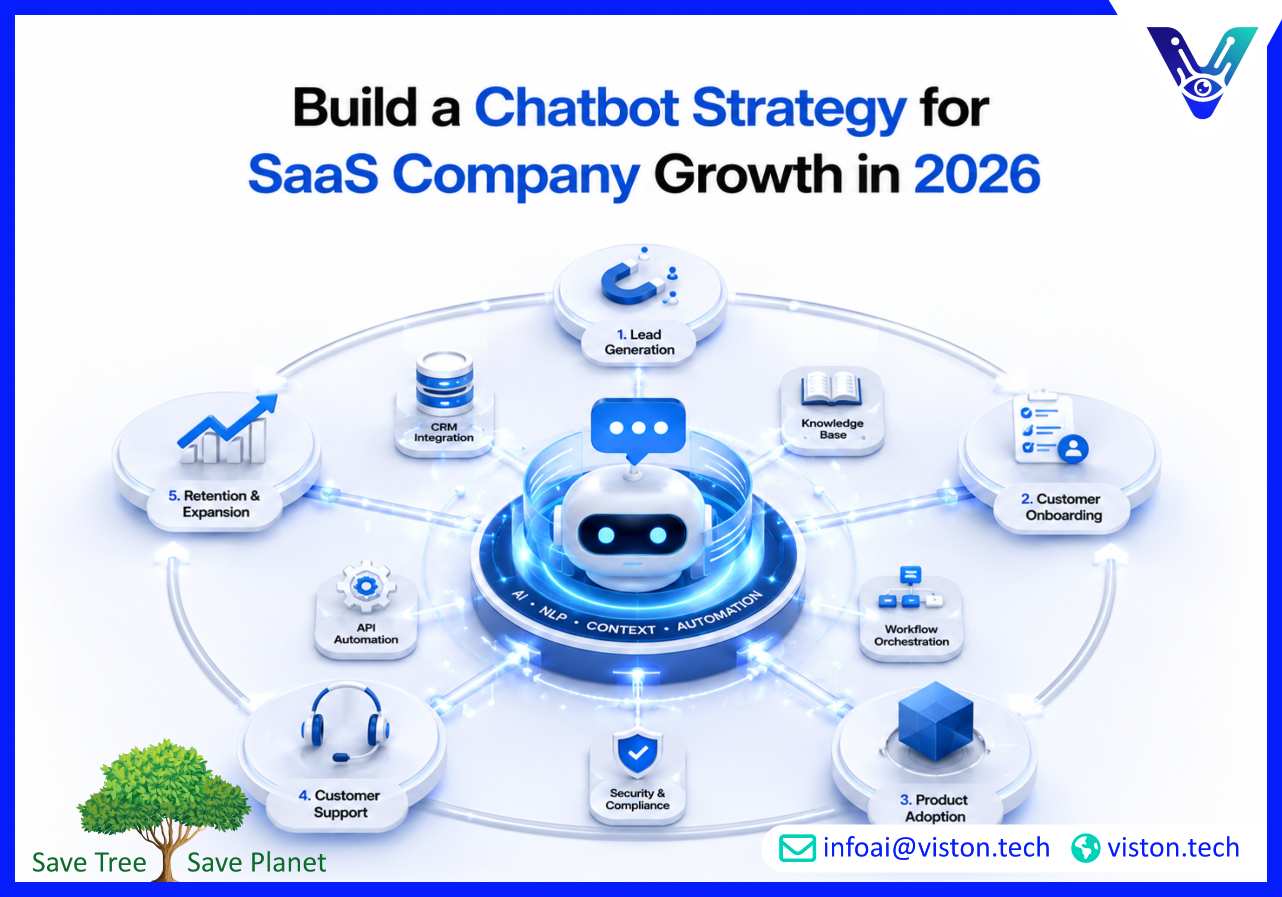
Build a Chatbot Strategy for SaaS Company Growth in 2026
For SaaS companies, chatbot strategy is no longer just about answering basic support questions. In 2026, a well-planned chatbot strategy helps improve onboarding, reduce support pressure, qualify leads, support product adoption, and create faster customer experiences across the full user lifecycle.
What It Means to Build a Chatbot Strategy for SaaS Company Success
To build a chatbot strategy for SaaS company growth, businesses need to define how conversational AI will support acquisition, activation, retention, expansion, and customer success. The strategy should connect chatbot workflows with real SaaS goals rather than treating the chatbot as a standalone website feature.A strong SaaS chatbot strategy usually covers:
Lead qualification and demo booking
Product onboarding support
Self-service customer support
Feature education and adoption
Account management assistance
Renewal and expansion workflows
Knowledge base automation
CRM, helpdesk, and product data integration
For SaaS companies, the chatbot must understand user intent, product context, pricing questions, technical issues, account status, and customer journey stage. A generic chatbot cannot deliver this effectively. The strategy should be built around the SaaS product, its users, support model, sales process, and customer success objectives.
Why SaaS Companies Need a Clear Chatbot Strategy in 2026
SaaS buyers and users expect instant, accurate, and personalized support. They do not want to search through long documentation pages, wait for manual responses, or repeat information across different channels. A chatbot can help, but only when it is designed around clear business logic and reliable AI chatbot development.Without a strategy, SaaS companies often face problems such as poor chatbot adoption, irrelevant responses, disconnected systems, weak lead qualification, and frustrated users. These issues usually happen when the chatbot is launched before the business defines use cases, data sources, escalation rules, and performance metrics.In 2026, chatbot expectations are higher. SaaS companies need chatbots that can work with product documentation, customer data, CRM records, support tickets, usage signals, and secure authentication where needed. The goal is not just automation. The goal is useful automation that improves customer experience and operational efficiency.
Core Elements of an Effective SaaS Chatbot Strategy
Define the Main Business Objective
A SaaS chatbot should begin with a clear purpose. Some companies need more qualified demos. Others need fewer repetitive support tickets. Some need better onboarding completion or stronger product adoption. The primary goal determines the chatbot’s workflows, integrations, tone, and success metrics.
Map the SaaS Customer Journey
The chatbot should support users at different stages, including first website visit, free trial signup, onboarding, product usage, support request, upgrade consideration, and renewal. Each stage requires different conversation logic and content.
Connect the Right Systems
AI chatbot development for SaaS often involves integration with tools such as CRM platforms, helpdesk systems, product analytics, billing tools, knowledge bases, and customer communication platforms. These integrations help the chatbot provide relevant answers instead of generic replies.
Design Human Escalation Paths
Even advanced AI chatbots need clear handoff rules. SaaS companies should define when the chatbot should escalate to sales, support, customer success, or technical teams. This protects user experience and prevents automation from becoming a blocker.
Measure Performance Continuously
Important chatbot metrics for SaaS include conversation completion rate, demo booking rate, support deflection rate, escalation rate, trial activation impact, customer satisfaction, and resolution accuracy. These metrics help improve the chatbot over time.
How AI Chatbot Development Supports SaaS Growth
AI chatbot development gives SaaS companies the ability to create custom conversational workflows that match their product, audience, and operating model. Instead of relying on fixed scripts, modern AI chatbots can support more flexible conversations, interpret user intent, retrieve relevant knowledge, and guide users toward the next best action.For sales teams, chatbots can qualify leads, answer pricing questions, identify company size, capture use cases, and route prospects to the right demo flow. For support teams, chatbots can answer common product questions, suggest documentation, collect issue details, and create support tickets. For customer success teams, chatbots can help users discover features, complete setup steps, and understand product value faster.For SaaS companies with technical products, chatbot development should include careful content structuring, fallback handling, API logic, role-based access controls, and secure data handling. Accuracy matters because incorrect answers can create confusion, increase support workload, and damage trust.
How Viston AI Helps SaaS Companies Build Practical Chatbot Strategies
Viston AI supports businesses with AI chatbot development focused on practical automation, customer engagement, and workflow efficiency. For SaaS companies, this means developing chatbot experiences that align with the way users discover, evaluate, adopt, and continue using software products.A SaaS chatbot strategy requires more than conversation writing. It needs planning around onboarding flows, lead qualification logic, customer support automation, knowledge base use, CRM integration, helpdesk workflows, analytics, and ongoing optimization. Viston AI can help structure chatbot systems around these requirements so the chatbot supports real business outcomes rather than becoming a disconnected automation tool.For SaaS teams looking to improve user experience, reduce repetitive support work, and create scalable customer communication, Viston AI’s AI chatbot development approach is relevant because it connects chatbot design with business process needs. This helps companies build chatbot strategies that are practical, scalable, and suitable for modern SaaS operations in 2026.
Frequently Asked Questions
What is a chatbot strategy for a SaaS company?
A chatbot strategy for a SaaS company is a structured plan for using conversational AI across sales, onboarding, support, customer success, and product adoption workflows.
Why do SaaS companies need AI chatbot development?
SaaS companies need AI chatbot development to create tailored chatbot systems that understand product workflows, customer questions, support processes, and business goals.
Can a chatbot improve SaaS onboarding?
Yes. A chatbot can guide new users through setup steps, answer product questions, recommend features, and reduce friction during the early stages of product adoption.
What systems should a SaaS chatbot integrate with?
A SaaS chatbot may integrate with CRM software, helpdesk tools, billing systems, product analytics platforms, knowledge bases, and customer communication channels.
Can Viston AI help build a SaaS chatbot strategy?
Yes. Viston AI provides AI chatbot development support that can help SaaS companies plan chatbot workflows, automation logic, integrations, and customer engagement experiences.
Conclusion
To build a chatbot strategy for SaaS company growth, businesses need a clear plan that connects AI chatbot development with real customer journeys, product workflows, and operational goals. A successful chatbot should support sales, onboarding, support, customer success, and retention without creating disconnected or unreliable experiences. In 2026, SaaS companies that invest in structured chatbot planning will be better positioned to improve user experience, reduce manual workload, and scale customer communication. Viston AI can support this process with practical AI chatbot development focused on useful, business-aligned automation.