
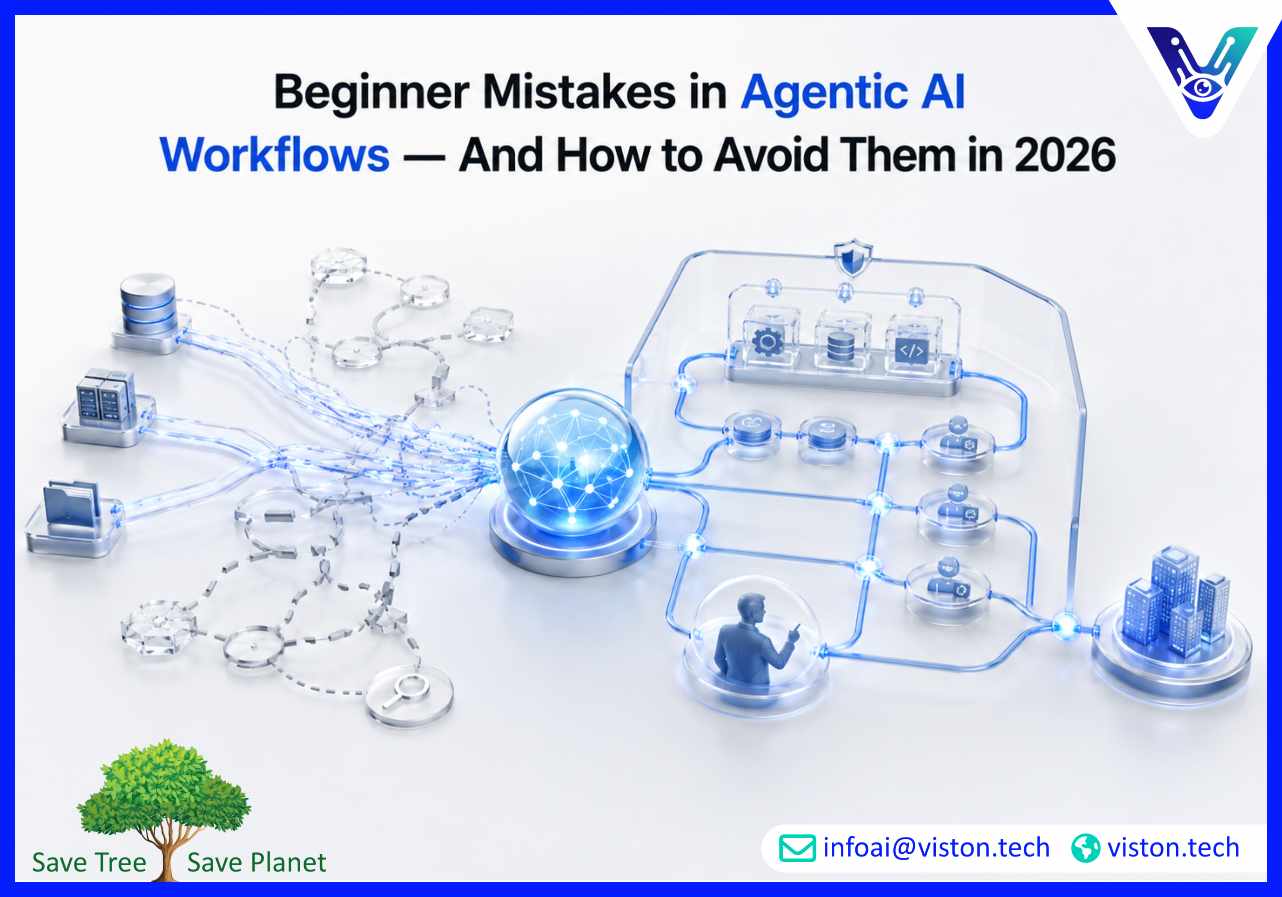
Agentic AI workflows promise a genuine step change in how businesses automate complex operations. But for every team that deploys a well-functioning agent, others encounter costly failures rooted in avoidable early mistakes. Understanding where beginners commonly go wrong — and why — is essential before committing significant resources to any agentic AI build
Most organisations approaching agentic AI for the first time have some prior experience with conventional automation. Whether that means rule-based tools, simple API integrations, or no-code platforms, those experiences shape expectations — and often in the wrong direction.
Agentic AI workflows are not an extension of traditional automation. They involve systems that perceive inputs, reason through context, plan sequences of actions, call external tools and APIs, and adapt their behaviour based on intermediate results. This perceive-reason-act loop introduces a layer of complexity that has no direct equivalent in deterministic automation. Treating an agentic system like a more capable version of a rule-based workflow is itself one of the most common beginner mistakes — and it tends to produce architectures that are fragile, unpredictable, or simply unfit for production.
The mindset shift required is significant. You are not configuring a sequence of instructions. You are designing a system with agency — one that makes decisions, consumes resources, interacts with live systems, and produces outputs that may be difficult to reverse. Getting that design right from the outset requires understanding where beginners most frequently make costly errors.
One of the earliest and most consequential mistakes is providing agents with underspecified objectives. Telling an agent to “handle customer enquiries” or “process incoming documents” without precise success criteria, scope boundaries, and escalation conditions is a recipe for unpredictable behaviour. Agents operating with vague goals will fill gaps with assumptions — and those assumptions may not align with business requirements.
Effective agentic workflow design starts with clearly defined task boundaries: what the agent is responsible for, what falls outside its scope, what constitutes a successful outcome, and under what conditions it should pause and request human input. Without this specificity, even technically capable agents produce inconsistent results.
Beginners frequently underestimate how much persistent memory and state management matter in agentic systems. An agent without properly designed memory has no continuity across interactions. It cannot track the status of an ongoing process, recall what actions it has already taken, or build on prior context. In customer-facing workflows, this produces jarring experiences. In operational workflows, it risks duplicating actions, missing steps, or losing track of multi-stage processes entirely.
Designing for memory from the outset — deciding what the agent needs to remember, for how long, and in what format — is a foundational requirement, not an afterthought.
The principle of least privilege is well understood in traditional software security, but beginners building agentic workflows often grant their agents broad access to systems and data in the interest of reducing friction during development. This creates serious risks. An agent with unnecessary access to live databases, communication channels, or financial systems can cause significant damage when it misinterprets a task or encounters an edge case it was not designed to handle.
Production-ready agentic AI workflows should be designed with access controls scoped precisely to what the agent needs to complete its assigned tasks — nothing more. Permissions should be expanded deliberately and incrementally, with careful evaluation at each stage.
Unlike conventional automation, where failures are typically binary — a workflow either runs or produces a logged error — agentic AI systems can fail subtly. An agent might technically complete its task while producing outputs that are contextually wrong, structurally inconsistent, or operationally harmful. Without proper observability tooling, these failures go undetected until they cause downstream problems.
Beginners often build and deploy without tracing, logging, or evaluation frameworks in place. Production agentic workflows require deep observability from day one: the ability to trace exactly what the agent reasoned, what tools it called, what decisions it made at each step, and what outputs it produced. Frameworks such as LangSmith for LangGraph-based systems exist precisely for this purpose, and skipping them is a significant operational risk.
Many teams assume that connecting a capable language model to tools and data is sufficient to produce reliable agent behaviour. It is not. The quality of an agentic system’s reasoning is heavily dependent on the quality of its prompts — the instructions, context, constraints, and output formatting requirements embedded in the system design.
Poorly structured prompts produce inconsistent reasoning, incorrect tool selection, and outputs that drift from the intended objective. Effective prompt engineering for agentic workflows is a distinct discipline that involves systematic testing, iteration, and version control — not a one-time configuration step.
As workflows grow in complexity, beginners often attempt to scale by adding agents without adequate thought given to orchestration. Multi-agent architectures — where specialised agents collaborate toward a shared goal — introduce coordination challenges that are qualitatively different from single-agent design. Without clear protocols for how agents communicate, hand off tasks, resolve conflicts, and handle failures, multi-agent systems become difficult to debug and unreliable in production.
Frameworks such as LangGraph, AutoGen, and CrewAI provide structured approaches to multi-agent orchestration, but they require careful architectural decisions around agent roles, communication patterns, state sharing, and error recovery — none of which can be improvised effectively.
Avoiding these mistakes is not simply a matter of caution. It requires a systematic approach to workflow design that addresses architecture, governance, and operational continuity from the outset.
Reliable agentic AI workflows are built on a foundation of clearly scoped objectives, well-designed memory and state management, access controls aligned with the principle of least privilege, and observability tooling that enables continuous monitoring and iteration. They are tested rigorously before production deployment — including edge case handling, failure mode analysis, and human-in-the-loop checkpoints where autonomous decision-making carries meaningful risk.
Compliance and data governance must also be addressed at the design stage. Agents that interact with customer data, financial records, or regulated business processes must operate within frameworks aligned with applicable standards — whether that means GDPR data minimisation requirements, HIPAA access controls, or internal governance policies. Embedding these constraints into the agent architecture is far more reliable than attempting to impose them retrospectively.
The organisations that deploy agentic AI workflows most successfully treat the initial build as the beginning of an ongoing operational practice, not a one-time project. Agents require monitoring, evaluation, and continuous refinement as business contexts evolve, data changes, and edge cases emerge that were not anticipated at design time.
Framework selection is a decision that has long-term consequences. LangGraph, AutoGen, and CrewAI each represent different approaches to agent orchestration, and the right choice depends on the complexity of the use case, the required degree of agent autonomy, the orchestration patterns needed, and the technical capability of the team responsible for ongoing support.
LangGraph suits workflows requiring fine-grained control over agent state and conditional execution paths. AutoGen and AutoGen Studio offer collaborative multi-agent capabilities with structured communication patterns. CrewAI provides a role-based agent model well suited to workflows where distinct areas of responsibility need to be modelled explicitly. Choosing a framework based on familiarity rather than suitability is itself a common beginner mistake — one that tends to become apparent only after significant development investment.
For many organisations, particularly those deploying agentic AI in enterprise environments for the first time, working with a specialist partner substantially reduces the risk of foundational mistakes and accelerates the path to a reliable production deployment.
Viston AI specialises in enterprise-grade agentic AI workflow design, development, and deployment. Their work is specifically focused on the areas where beginner mistakes are most costly: architectural design, framework selection, multi-agent orchestration, observability, compliance, and ongoing governance.
Their team builds agentic systems using LangGraph, AutoGen Studio, and CrewAI, selecting the architecture based on the specific requirements of each workflow rather than defaulting to a single approach. For organisations integrating agents with legacy ERPs, proprietary internal systems, or complex API environments, Viston’s API-first connectivity methodology ensures that integration depth is assessed and validated before any build begins.
Security and compliance are embedded throughout their delivery process. Their Responsible AI at Scale framework addresses data privacy controls, access governance, ethical decision-making guardrails, and regulatory alignment with GDPR, HIPAA, and CCPA — making it directly relevant to organisations operating in regulated environments where autonomous agent behaviour must remain auditable, bounded, and safe.
For teams encountering agentic AI workflows for the first time, Viston AI provides the architectural expertise and enterprise governance framework that reduces the risk of costly early mistakes and supports reliable, scalable production deployments. Their methodology is designed to deliver proof-of-concept results within two to four weeks while maintaining the rigour that enterprise environments demand.
The most common mistake is treating agentic AI like conventional automation — defining vague objectives, skipping observability tooling, and granting excessive system permissions during development. Agentic systems require precise goal definition, careful access controls, and robust monitoring from the outset.
Agentic systems can fail subtly — producing outputs that appear complete but are contextually wrong or operationally harmful. Observability tooling allows teams to trace agent reasoning, monitor tool calls, and evaluate outputs continuously. Without it, failures go undetected until they cause downstream operational or compliance problems.
Access permissions should follow the principle of least privilege: agents should have access only to the systems, data, and tools required to complete their assigned tasks. Permissions should be scoped tightly at design time and expanded incrementally only after careful evaluation, particularly in enterprise environments with sensitive data.
LangGraph, AutoGen, AutoGen Studio, and CrewAI are among the most widely used frameworks for agentic workflow design and multi-agent orchestration. The right choice depends on the complexity of the use case, required orchestration patterns, and the degree of agent autonomy the workflow demands.
Viston AI provides end-to-end support across agent architecture, framework selection, enterprise system integration, observability implementation, and compliance. Their Responsible AI at Scale framework is designed to reduce the risk of foundational mistakes and accelerate reliable production deployment for organisations in regulated and enterprise environments.
Yes, particularly in early deployments and in workflows where decisions carry meaningful operational, financial, or compliance risk. Human-in-the-loop checkpoints should be designed into the workflow architecture wherever autonomous action could produce difficult-to-reverse outcomes. Oversight requirements can be reduced progressively as agent behaviour is validated through observation and testing.
Beginner mistakes in agentic AI workflows are common, but they are not inevitable. The teams that avoid them do so by treating agent design as a serious architectural discipline — one that demands precise objective definition, robust memory and state management, carefully scoped permissions, observability from day one, and a rigorous approach to multi-agent orchestration. Getting these foundations right determines whether an agentic AI workflow becomes a genuine operational asset or a source of ongoing instability. For organisations building for the first time, working with a specialist such as Viston AI significantly reduces the risk of foundational errors and creates the conditions for deployments that are not just functional, but reliable, compliant, and built to scale.
