
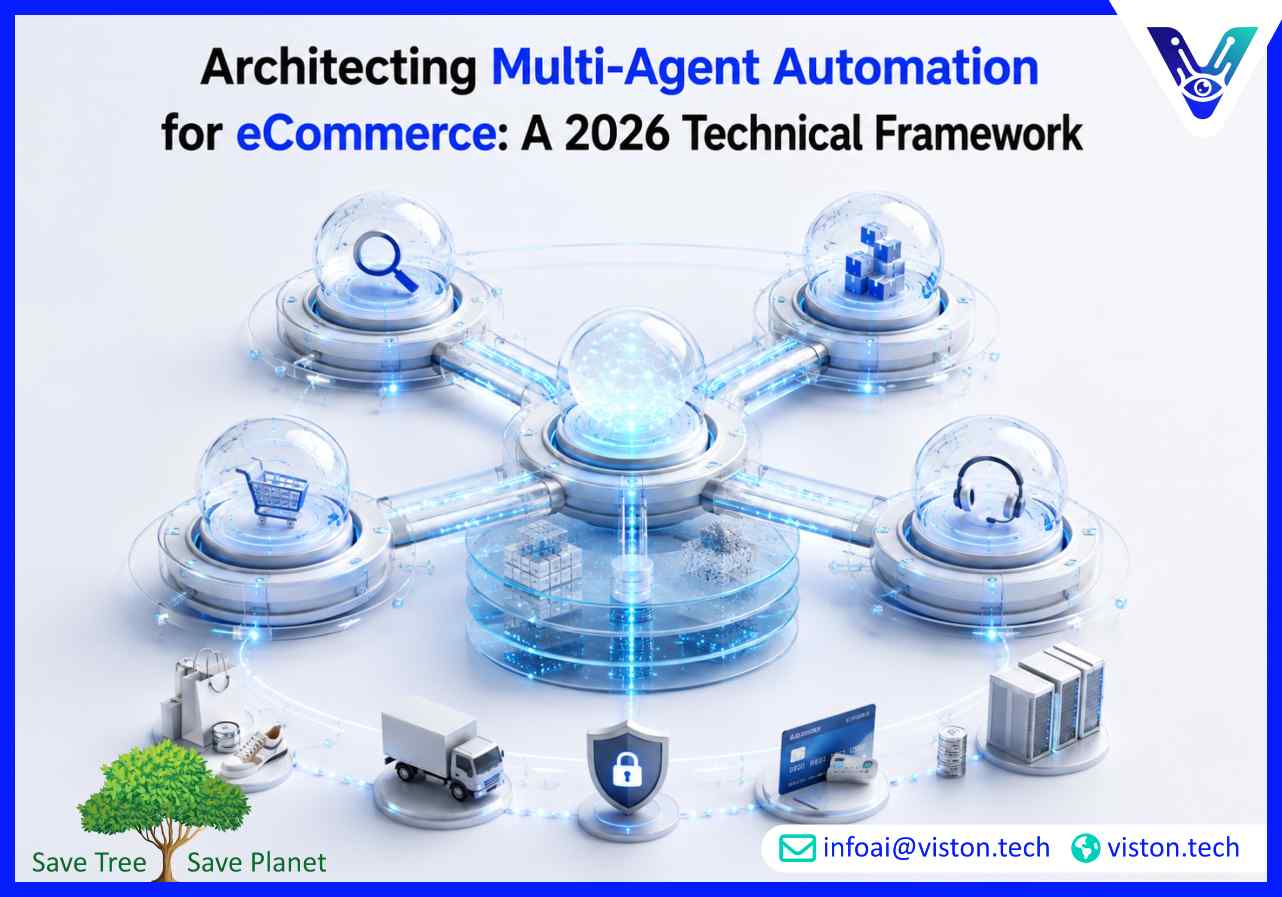
In 2026, agentic commerce has moved beyond experimental chatbots into operational infrastructure. For eCommerce leaders, the question is no longer whether AI agents will mediate discovery and purchase, but how to architect the underlying systems that make this work reliably. Multi-agent automation—where specialized AI agents collaborate across product discovery, inventory validation, checkout, and customer support—requires deliberate architectural planning to avoid the fragmentation and failure points that plague rushed implementations.
Traditional eCommerce automation relied on rigid APIs and single-threaded rule engines. Multi-agent systems introduce fundamental differences: agents make autonomous decisions, interact with each other, and adapt to real-time conditions. According to recent research from JD.com and the University of Melbourne, hierarchical multi-agent systems with a master agent coordinating specialized sub-agents have become the dominant paradigm for eCommerce AI assistants, with benchmarks like HiMA-Ecom now providing standardized evaluation frameworks for these architectures .
The core challenge lies in orchestration. Without a deliberate architecture, agents generate conflicting outputs—one agent marking inventory available while another reports it sold, or a pricing agent undercutting margins that a procurement agent already committed. Amazon Bedrock’s AgentCore documentation emphasizes that successful deployments require human-in-the-loop capabilities, session persistence, and real-time monitoring precisely because agent autonomy introduces non-deterministic behavior that traditional systems cannot handle.
The orchestration layer serves as the system’s nervous system, managing how tasks break down and flow between agents. At minimum, production architectures require a master agent that handles intent recognition, task decomposition, and result aggregation. Research from the global eCommerce search relevance team demonstrates that automated case-driven pipelines—where agents handle annotation, optimization, and user interaction—can operate effectively when orchestration includes explicit state management and memory sharing across specialized agents .
Critical requirements include a directed acyclic graph (DAG) scheduler for dependency management, priority-based task queues, and asynchronous messaging that prevents any single agent failure from cascading through the system. Cross-border eCommerce implementations documented in 2026 show that Redis-based message brokers with persistence and dead-letter queues are now standard for production multi-agent deployments .
Effective multi-agent automation depends on clear role definitions. The CogSearch framework for eCommerce search demonstrates that four specialized agents—intent decomposer, knowledge fusion, actionable insight generator, and response synthesizer—achieve measurable improvements in decision-heavy queries while maintaining clean separation of concerns .
For most eCommerce operations, essential agent roles include:
Each agent requires bounded context—explicit knowledge of its domain and clear handoff protocols to adjacent agents. The most common failure point in multi-agent systems is scope creep, where agents begin operating outside their designated capabilities.
Multi-agent systems fail without consistent state management across distributed agents. Short-term memory handles current session context—cart contents, current query, user preferences expressed during the interaction. Long-term memory retains historical patterns, past purchases, and behavioral signals that inform agent decisions.
The HiMA-Ecom benchmark data reveals that effective multi-agent training requires memory-aware supervised fine-tuning, with 17.7K of its 22.8K training instances incorporating explicit memory structures . For production systems, this translates to vector databases for semantic memory, key-value stores for conversational context, and relational databases for transactional state. Crucially, all agents must reference the same memory sources rather than maintaining independent copies that drift out of sync.
Multi-agent systems are only as reliable as the data they access. The 2026 NRF Retail Show emphasized that product information management (PIM) is becoming the governance layer for machine-led commerce, with Akeneo and similar platforms positioning structured product data as essential infrastructure for AI-mediated transactions .
Practical integration requirements include real-time catalog synchronization, attribute normalization across platforms, and inventory heartbeat mechanisms that prevent agents from attempting purchases on out-of-stock items. Forter’s documentation specifies that production integrations must support continuous catalog sync via APIs like Shopify Admin API or SFCC OCAPI, with fallback options for custom feed-based implementations .
Security considerations are equally critical. Agentic commerce platforms now implement delegated payment models where customer payment data never touches merchant servers, removing PCI scope while maintaining transaction integrity .
Deploying multi-agent automation requires infrastructure decisions that directly impact reliability and maintenance costs. Containerized deployments using Docker and orchestration platforms like Kubernetes have become standard, with each agent running in isolated environments that support independent scaling and health monitoring .
Monitoring requirements extend beyond traditional system metrics. You need visibility into agent decision trails, inter-agent communication latency, and outcome quality. Production implementations documented in 2026 include WebSocket connections for real-time session viewing, session replay capabilities for debugging, and configurable human-in-the-loop triggers that escalate ambiguous situations to human operators .
Error handling demands explicit design. Multi-agent systems encounter failure modes that single-agent systems do not: negotiation deadlocks, contradictory outputs, and infinite retry loops. Robust architectures implement timeout policies, circuit breakers, and fallback behaviors at both agent and orchestration levels.
Viston AI delivers agent integration services that translate architectural principles into production reality. Our focus is on connecting existing eCommerce infrastructure—Shopify, Salesforce Commerce Cloud, and custom backends—to multi-agent automation frameworks without requiring platform migration or codebase rewrites. We specialize in the integration layer: catalog synchronization, real-time inventory propagation, order webhook implementation, and checkout flow adaptation that makes merchant systems discoverable and actionable by AI agents across ChatGPT, Gemini, Perplexity, and emerging agentic commerce protocols.
Our approach prioritizes operational continuity. We implement inventory heartbeat mechanisms that respect your configured safety buffers, preventing agent-driven purchases from overselling limited stock. Payment integration follows delegated models that remove PCI scope while maintaining your existing processor relationships. For merchants scaling internationally, our integration architecture supports multi-currency pricing, tax calculation with nexus awareness, and region-specific compliance requirements. Organizations evaluating agentic commerce in 2026 work with Viston AI because we reduce multi-agent integration from a risky R&D project to a measured, executable deployment with clear performance metrics and fallback procedures.
What distinguishes multi-agent automation from traditional eCommerce automation?
Traditional automation uses deterministic rules and single-threaded APIs. Multi-agent systems employ autonomous agents that make decisions, collaborate, and adapt in real-time, requiring orchestration layers, state management, and different error-handling approaches.
Which eCommerce platforms support multi-agent integration in 2026?
Shopify, Salesforce Commerce Cloud, and custom API-first backends are the primary supported platforms. Integration occurs through existing APIs—Shopify Admin API, SFCC OCAPI, or custom feed endpoints—not platform replacement.
How does inventory management work with autonomous purchasing agents?
Production architectures implement inventory heartbeat synchronization with configurable safety buffers. When physical stock drops to your defined threshold, the system marks items unavailable to agents, preventing race conditions between agent and human purchases.
What security and compliance requirements apply to agentic commerce?
Delegated payment models remove PCI scope by ensuring customer payment data never touches merchant servers. Additional requirements include encrypted credential storage, audit trails for agent decisions, and compliance with regional data protection regulations.
How do you measure multi-agent automation success?
Key metrics include semantic hit rate (how often agents discover your products), checkout completion rates, inventory accuracy, and reduction in manual intervention for routine transactions, not abstract engagement metrics.
Can multi-agent systems integrate with existing fraud detection and payment processors?
Yes. Production architectures support your existing fraud rules and payment providers. The integration layer proxies orders to your systems for validation and processing rather than replacing your security infrastructure.
Multi-agent automation in eCommerce requires deliberate architecture, not ad-hoc experimentation. The 2026 landscape demands orchestration layers that manage specialized agents, consistent state management across distributed components, and integration approaches that work with existing infrastructure rather than against it. Organizations that succeed approach agentic commerce as an integration and governance challenge—structured data, clear agent boundaries, and reliable handoffs between systems—not as a conversational UI problem. Multi-agent automation delivers measurable operational efficiency when built on these foundations, whether you are scaling discovery, automating transactions, or reducing manual oversight across customer interactions. Viston AI provides the integration expertise that makes this architecture operational, connecting your eCommerce backend to the agentic ecosystem without disrupting the business you already run.
