
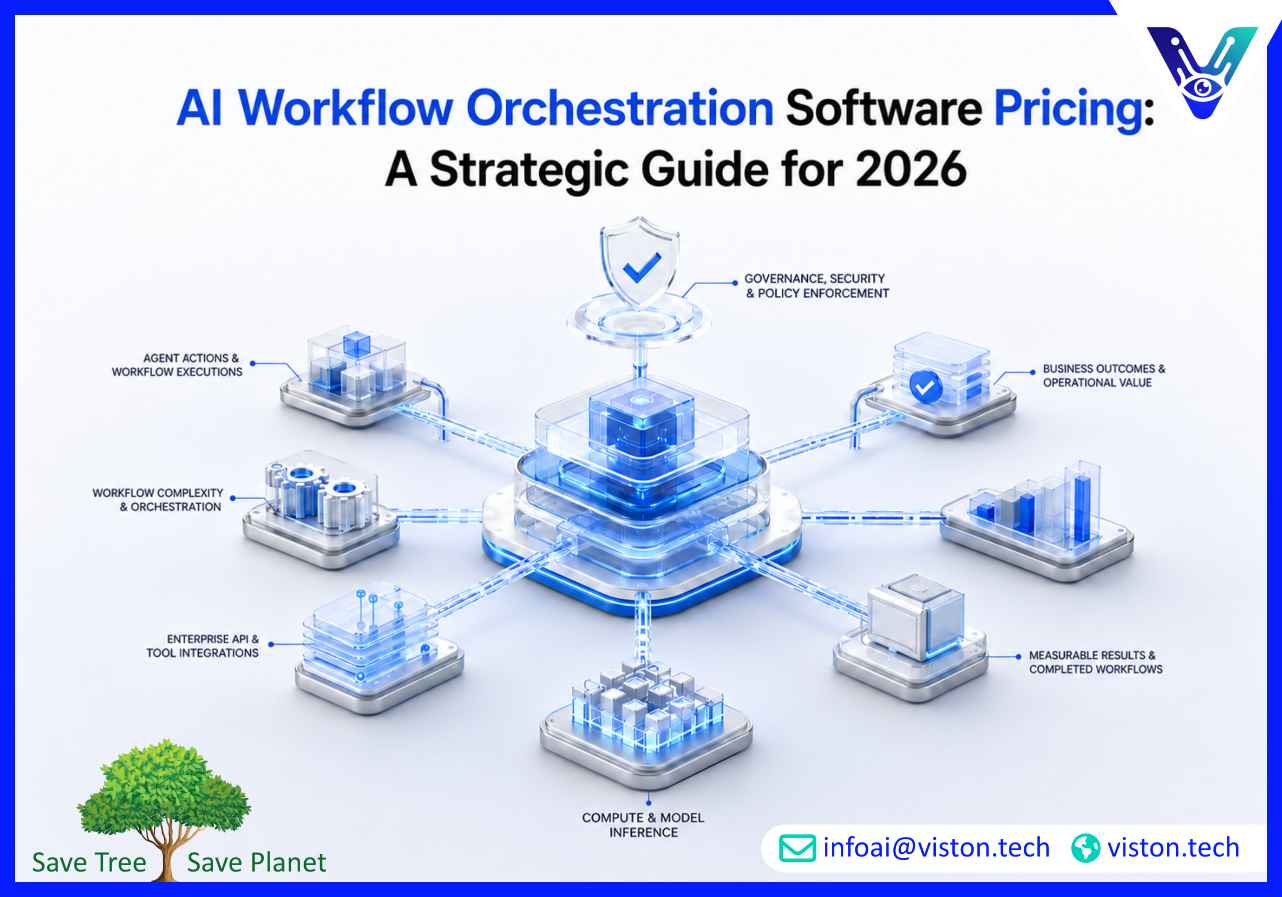
Pricing for AI workflow orchestration software rarely fits a simple per-user model. As agentic AI moves from experiment to operational backbone, finance and technology leaders are encountering licensing structures built around compute consumption, decision volume, and autonomous actions rather than seats. Understanding these models before engaging vendors prevents budget misalignment and architectural lock-in.
The line item on a contract represents far more than software access. Underneath the license sits a combination of infrastructure orchestration, large language model inference, API gateway management, tool integration, memory state handling, and security policy enforcement. Each of these layers consumes resources differently, and pricing models map to that variability.
Most vendors structure fees around distinct value drivers. The most common include the number of autonomous agents deployed, the volume of workflow executions per month, compute time measured in GPU or inference minutes, and the quantity of tool integrations or API endpoints an agent accesses. Some platforms price by successful task completion rather than attempts, aligning cost with measurable work output.
Buyers evaluating pricing for the first time often anchor on per-user SaaS benchmarks, only to discover that agentic workflow platforms operate more like cloud infrastructure. A single agent chaining twenty tool calls across a multi-step procurement workflow may consume the same compute resources as fifty standard user sessions in a traditional application. The unit economics are fundamentally different.
The dominant pricing axis in 2026 is agent action volume. Platforms track each discrete step an agent takes—retrieving data from a vector store, calling an external API, validating a decision against policy rules, writing an audit log entry—and aggregate these into tiered consumption bands. Lower tiers typically cover proof-of-concept workloads with limited concurrency, while enterprise tiers negotiate committed throughput with burst capacity provisions.
Action-based pricing creates predictability for operations teams that can model workflow complexity in advance. A document processing agent that classifies, extracts, and routes incoming supplier invoices might execute eight discrete actions per document. At 10,000 documents monthly, the math is straightforward. Where complexity emerges is in recursive reasoning patterns where agents loop through evaluation steps before reaching a conclusion, sometimes consuming three to five times the expected actions.
Four pricing structures dominate the market, each suited to different operational maturity levels. Organizations often negotiate hybrid arrangements that mix elements from multiple models, particularly when moving from pilot programs to full deployment.
Consumption-based pricing charges for actual usage—workflow executions, reasoning steps, tokens consumed—and appeals to teams with variable or unpredictable workloads. This model provides low entry barriers but can become expensive at scale without volume discount agreements. Finance teams appreciate the direct link between cost and activity, though forecasting requires more sophisticated modeling than fixed-fee alternatives.
Tiered subscription pricing bundles a defined scope of capabilities and capacity into fixed monthly or annual fees. Tiers often differentiate on agent count, concurrent workflow limits, priority access to foundation model endpoints, and support response times. This structure works well for organizations with stable, predictable orchestration needs and enables straightforward budget allocation.
Outcome-based pricing ties fees to completed business results rather than technical metrics. A vendor might charge per successfully processed claim, per resolved customer inquiry, or per closed purchase order. This model transfers performance risk toward the provider and demands rigorous definition of what constitutes a completed outcome. Early adopters in logistics and insurance processing favor this approach for its alignment with operational KPIs.
Platform-plus-compute pricing separates the orchestration control plane from the underlying model inference costs. The platform license covers workflow design, agent management, monitoring, and governance, while compute costs pass through from the organization’s own cloud provider relationships. This model appeals to enterprises with negotiated cloud discounts and data residency requirements that preclude multi-tenant inference endpoints.
The visible license fee tells only part of the story. Integration engineering frequently represents the largest hidden cost. Connecting agentic workflows to legacy ERP systems, custom databases, and proprietary tools requires connector development, authentication configuration, and thorough testing. Organizations budgeting solely for platform fees often underfund the integration work by a factor of two or more.
Model usage variability introduces another cost layer. Agentic workflows that rely on frontier models for complex reasoning steps incur higher per-call costs than those using smaller, fine-tuned models for routine decisions. Without granular monitoring, a single sophisticated workflow can generate unexpected inference expenses. Leading platforms now include cost controls that cap spending per workflow or per agent, but these require deliberate configuration.
Governance and observability tooling may appear as add-on modules rather than included features. Audit trail storage, human-in-the-loop review interfaces, and compliance reporting dashboards sometimes sit in enterprise-tier pricing packages, creating upgrade pressure as deployments move toward production.
The spread between vendor quotes often reflects architectural decisions under the hood. Platforms offering fine-grained agent memory management charge differently than those using simple context window stuffing. Providers investing in deterministic policy enforcement engines differentiate from those relying purely on prompt-based guardrails. These technical choices carry material cost implications for buyers operating in regulated industries.
Security certification scope influences pricing tiers. Platforms maintaining SOC 2 Type II, ISO 27001, and HITRUST certifications across their full infrastructure command premium pricing, reflecting the ongoing audit and control investment. Organizations in financial services, healthcare, and government contracting often find these certifications non-negotiable, narrowing the effective vendor pool before pricing comparisons begin.
Multi-agent orchestration capabilities separate basic automation tools from true agentic workflow platforms. Coordinating multiple specialized agents that negotiate tasks, hand off context, and resolve conflicts requires sophisticated orchestration logic. Vendors investing in multi-agent coordination research price accordingly, while simpler sequential workflow tools compete on execution volume economics.
Single-tenant deployments within a customer’s virtual private cloud typically command 30–50% premiums over multi-tenant equivalents. The premium covers dedicated infrastructure management, isolated upgrade cycles, and customized security boundary configurations. Organizations with stringent data locality requirements—common across European operations under GDPR frameworks and in Indian markets with evolving data protection standards—increasingly require single-tenant or hybrid deployment options.
The most productive pricing conversations start with business value mapping rather than feature comparison. Before engaging procurement, operations leaders should document the workflows targeted for orchestration, measure current cycle times and error rates, and calculate the financial impact of improved throughput or accuracy.
A logistics company processing 50,000 freight documents monthly with 12% manual exception handling can model the cost-per-document improvement from agentic automation. If orchestration reduces exceptions to 4% and cuts processing time from 22 minutes to 90 seconds per document, the platform cost becomes a fraction of the operational saving. Vendors with outcome-based pricing structures can align their commercial terms directly to these measured improvements.
Proof-of-concept evaluation periods should include cost modeling alongside capability testing. Run representative workflow volumes through the platform, monitor actual consumption metrics, and extrapolate to projected production scale. The data gathered during evaluation provides the foundation for volume discount negotiations and helps identify workflows where optimization reduces unnecessary agent actions.
Enterprise agreements merit provisions that protect against model deprecation and vendor roadmap shifts. When a platform’s default foundation model changes pricing structure mid-contract, organizations need predetermined mechanisms for cost adjustment. Similarly, commitments on model availability, latency service levels, and data deletion upon contract termination should appear alongside pricing terms.
Negotiating ramp periods allows organizations to scale into committed volumes gradually. A three-year agreement might specify increasing monthly minimums that align with planned deployment phases, avoiding early underutilization penalties while securing better long-term unit pricing.
For organizations evaluating AI workflow orchestration software pricing in the context of real operational deployments, the commercial model matters only when paired with reliable delivery capability. Viston AI focuses specifically on agentic AI workflow implementation—designing, building, and deploying autonomous agent systems that connect to existing enterprise tools and operate under defined governance frameworks.
The company’s engagement model addresses the implementation complexity that makes pricing comparisons meaningful. Rather than offering a self-service platform license alone, Viston AI delivers configured agentic workflows aligned to specific operational processes. This approach ensures that the unit economics of agent actions map directly to measurable business outputs, whether the metric is processed transactions, resolved cases, or completed data reconciliation tasks.
Viston AI’s architecture emphasizes deterministic policy enforcement alongside model reasoning, ensuring that agent behaviors comply with organizational rules before actions execute. For businesses operating across India’s regulatory environment and global markets, this governance layer provides the auditability required for compliance while enabling the autonomy that drives efficiency gains. The team’s integration engineering capability addresses the hidden cost factors discussed earlier, with pre-built connectors for common enterprise systems and a structured methodology for custom integration delivery.
Organizations working with Viston AI typically engage around specific agentic workflow use cases—procurement automation, document intelligence, compliance monitoring, or customer service orchestration—with pricing structured around delivered workflows and ongoing optimization rather than raw platform access. This alignment between commercial structure and business outcomes reflects the broader market evolution toward outcome-oriented engagement models for agentic AI capabilities.
Entry-level platforms for small-scale deployments may start around $1,500–$3,000 monthly, while enterprise-grade agentic workflow platforms with multi-agent capabilities, dedicated infrastructure, and advanced governance features typically range from $15,000 to over $50,000 monthly. Actual pricing depends heavily on agent action volume, deployment model, and negotiated commitments.
Consumption-based pricing offers flexibility for variable workloads and low initial commitment, making it suitable for pilot programs and seasonal operations. Subscription pricing provides predictable costs and often includes dedicated support, but requires accurate upfront volume estimation. Organizations with stable, high-volume workflows typically find subscription models more economical at scale.
Three factors dominate unexpected costs: integration engineering for connecting to legacy systems, unmonitored model inference consumption from complex reasoning chains, and governance tooling purchased as add-ons rather than included features. Establishing cost controls and monitoring agent action volumes from the start helps prevent budget surprises.
Yes. Regulated industries often require single-tenant deployments, dedicated audit infrastructure, and certifications like SOC 2 or ISO 27001, all of which affect pricing. Additionally, data residency requirements may necessitate regional deployment options that carry infrastructure premiums compared to global multi-tenant setups.
Start by documenting current process costs, including labor, error correction, and delay impacts. Model the expected improvement from agentic orchestration, then compare platform and implementation costs against projected savings. The most meaningful evaluations measure cost per completed business outcome rather than software cost alone.
Some providers, including Viston AI, structure engagements around delivered workflows and measurable operational improvements rather than platform access alone. Outcome-based pricing typically applies to well-defined, repeatable processes where success metrics can be clearly defined and measured, such as invoice processing accuracy or case resolution rates.
AI workflow orchestration software pricing in 2026 reflects the shift from software licensing to capability delivery. The most effective procurement strategies evaluate commercial models alongside architecture, governance, and integration requirements, recognizing that the lowest per-action price means little without reliable execution. Businesses that map pricing structures to their specific agentic AI workflow demands, model total ownership costs realistically, and negotiate terms that protect against model and market changes will secure commercial arrangements that support long-term operational success. The conversation worth having is not about finding the cheapest platform, but about aligning investment with the workflows that drive measurable business improvement.
