
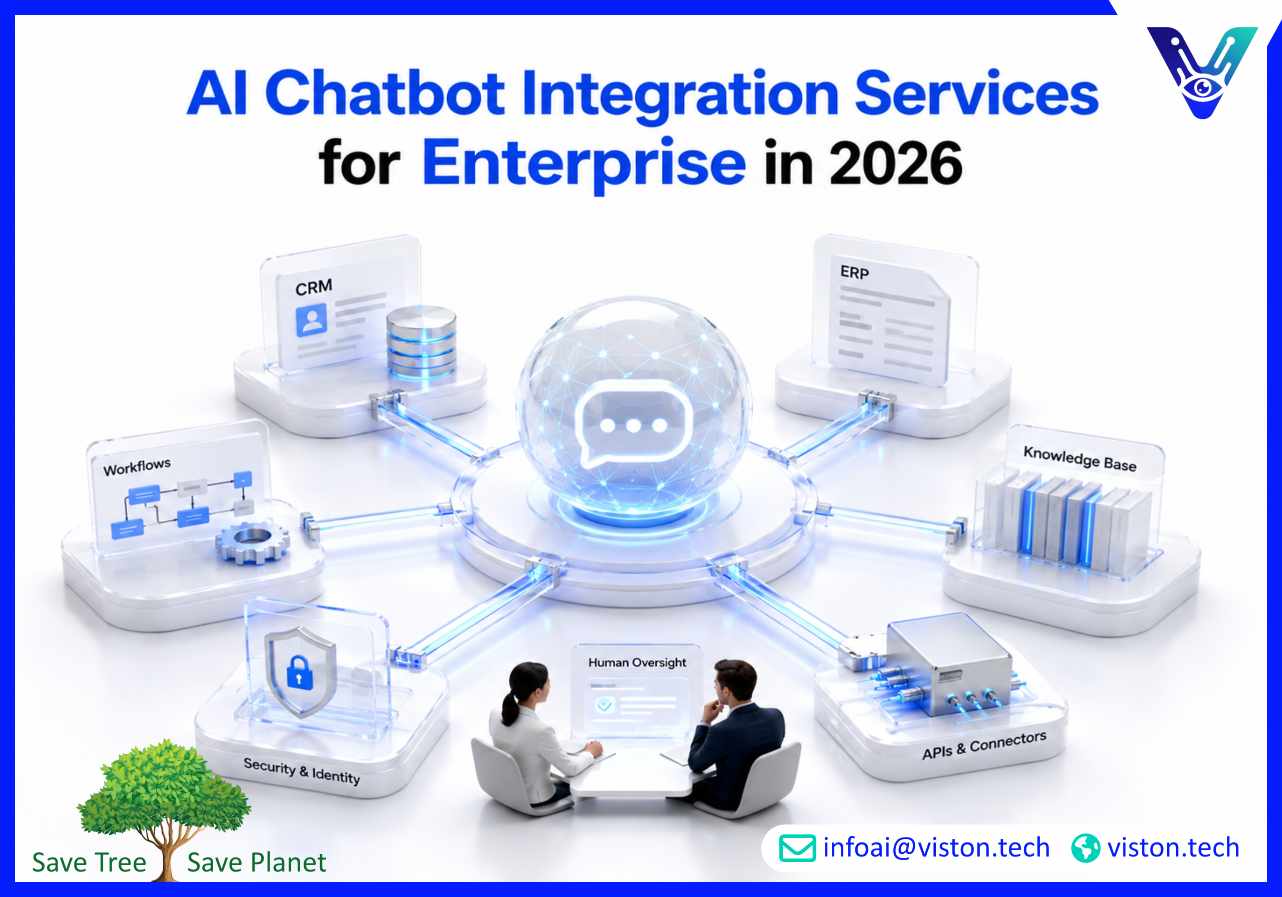
AI chatbot integration services for enterprise teams matter because modern chatbots must do more than answer questions. They need to connect with business systems, understand context, trigger workflows, protect data, support human teams, and deliver measurable operational value across departments.
Enterprise AI chatbot integration services involve connecting conversational AI systems with the platforms, data sources, applications, workflows, and governance layers that a business already uses. This may include CRM platforms, ERP systems, helpdesk tools, ecommerce platforms, HR systems, knowledge bases, data warehouses, identity providers, analytics dashboards, communication channels, and internal workflow applications.
For enterprise organizations, a chatbot cannot remain a disconnected chat window. It must become part of the operating environment. When a customer asks about an order, the chatbot may need to check inventory, verify account details, retrieve shipping status, update a ticket, notify an agent, and log the interaction in the CRM. When an employee asks an internal assistant for policy guidance, the chatbot may need to search approved documents, apply access controls, summarize relevant information, and route sensitive requests to the right team.
This is why Agent Integration Services are increasingly important. Instead of treating a chatbot as a basic response engine, agent integration connects AI agents to business logic and execution layers. The result is a chatbot that can understand intent, retrieve trusted information, perform approved actions, escalate exceptions, and support workflows across multiple systems.
In 2026, enterprise buyers are evaluating chatbot integration through a more mature lens. They are asking whether the solution can scale, whether it is secure, whether it fits existing infrastructure, whether it supports auditability, whether it can handle multilingual or multi-channel interactions, and whether it improves measurable outcomes such as response time, ticket deflection, lead qualification, customer satisfaction, and employee productivity.
Chatbot development focuses on building the conversational experience. Integration focuses on making that chatbot useful inside real business operations. A well-designed chatbot may understand user questions, but without integration it cannot access live data, update records, trigger workflows, respect permissions, or support end-to-end process automation.
Enterprise integration requires technical and operational planning. Teams must consider APIs, authentication, data mapping, role-based access, system reliability, monitoring, fallback rules, human handover, compliance requirements, and long-term maintenance. The value comes from turning conversational AI into a connected business capability.
Enterprise expectations for AI chatbots have changed. Businesses no longer want isolated bots that provide generic answers. They want AI systems that can support sales, customer service, operations, HR, finance, IT, procurement, and management workflows without creating risk or operational confusion.
The growth of agentic AI has increased this expectation. AI agents are designed to reason through tasks, use tools, access systems, and coordinate multi-step actions. For enterprises, this creates new opportunities but also new responsibilities. A chatbot that can take action must operate within clear guardrails. It must know what it is allowed to do, when it should ask for human approval, how to handle incomplete information, and how to document the outcome.
AI chatbot integration services help enterprises bridge the gap between conversational intelligence and operational execution. Instead of forcing employees or customers to move between disconnected systems, the chatbot can serve as a single conversational layer across many tools. This can reduce repetitive manual work, shorten response cycles, improve data consistency, and make business processes easier to access.
Many enterprise chatbot projects underperform because the chatbot is not connected to the systems that matter. Common problems include incomplete answers, repeated customer questions, manual data entry, poor escalation context, duplicate CRM records, weak reporting, and limited workflow automation.
Integrated chatbots solve these problems by connecting conversations to live business data and approved actions. A support chatbot can create or update tickets. A sales chatbot can qualify leads and sync them to CRM. An HR chatbot can answer policy questions using approved internal documents. A finance assistant can route invoice queries to the right workflow. An IT chatbot can help employees troubleshoot issues, create service requests, and escalate incidents with full context.
The business value is not only faster responses. The larger value is process consistency. When the chatbot follows approved workflows and logs every interaction, enterprises gain better visibility, cleaner data, and more reliable service delivery.
Traditional automation works well when rules are fixed and inputs are predictable. Enterprise conversations are different. Customers and employees ask questions in varied ways, provide incomplete context, switch topics, and expect personalized support. AI chatbots can interpret natural language, but they still need structured integration to act safely and accurately.
This is where Agent Integration Services become valuable. They allow AI chatbots and agents to operate across systems while maintaining control. The service layer can define what data the agent can access, which actions require approval, how errors are handled, where logs are stored, and how performance is monitored over time.
Strong Agent Integration Services combine conversational AI, system connectivity, workflow orchestration, security, observability, and continuous optimization. The goal is not only to connect software tools but to create a reliable AI-powered operating layer for enterprise tasks.
Enterprise chatbots often need to connect with CRM, ERP, helpdesk, ecommerce, HR, payment, analytics, and communication platforms. Integration may involve REST APIs, webhooks, database connectors, middleware, event streams, message queues, or custom adapters for legacy systems.
The integration must also handle authentication, authorization, API limits, data formatting, retry logic, error handling, and synchronization. Without this foundation, chatbot performance can become unreliable when systems are slow, unavailable, or inconsistent.
Enterprise chatbot integration should support multi-step workflows. For example, a chatbot may capture a customer issue, verify identity, check product eligibility, search a knowledge base, create a ticket, assign priority, notify a support team, and confirm the next step to the customer.
Workflow orchestration ensures these steps happen in the correct order, with the right business rules and escalation paths. This is especially important for regulated, high-volume, or multi-department environments where mistakes can create compliance, revenue, or customer experience risks.
AI chatbots need access to trusted knowledge. This may include product documentation, service policies, internal SOPs, compliance documents, training materials, contracts, help center articles, and customer records. For enterprise use, knowledge integration should include source control, permissions, update processes, and quality review.
Retrieval-augmented generation can help chatbots provide answers from approved content rather than relying only on model memory. However, enterprises should still define content governance, answer validation, and escalation rules for uncertain or sensitive queries.
Security is central to enterprise chatbot integration. AI agents may interact with personal data, commercial data, financial records, health information, customer histories, or internal documents. Integration design must account for encryption, identity management, access control, audit logs, data retention, permission boundaries, and approval workflows.
Governance also matters because AI systems can make mistakes. Enterprises need confidence scoring, human-in-the-loop review, rollback options, monitoring alerts, and clear accountability for business-critical actions. A chatbot should not be allowed to change sensitive records, approve transactions, or disclose confidential data without appropriate control.
Integrated chatbots should be measured continuously. Important metrics include conversation completion rate, fallback rate, escalation rate, customer satisfaction, first-contact resolution, workflow success rate, lead qualification rate, CRM update accuracy, response time, and cost per resolved interaction.
Performance monitoring helps teams identify failed intents, broken integrations, slow APIs, inaccurate responses, and workflow bottlenecks. It also supports continuous improvement as business processes, customer needs, and enterprise systems evolve.
AI chatbot integration services can support a wide range of enterprise use cases. The best projects usually begin with high-volume, repeatable, measurable workflows where the chatbot can reduce friction without replacing necessary human judgment.
Customer support is one of the strongest use cases for enterprise chatbot integration. A connected chatbot can answer common questions, check order status, retrieve account information, create tickets, suggest next steps, and transfer complex issues to human agents with full context.
The most important factor is quality. A chatbot that deflects tickets but frustrates customers is not successful. Enterprise support bots should be measured by resolution quality, escalation accuracy, customer satisfaction, and the completeness of handover data.
Sales chatbots can qualify prospects, recommend services, book meetings, collect requirements, and sync lead data to CRM systems. For B2B teams, integration is especially important because sales value depends on accurate data capture and timely follow-up.
A properly integrated sales chatbot can route leads by territory, company size, service interest, urgency, budget range, or buyer intent. It can also trigger alerts for high-value prospects and ensure that sales teams receive structured conversation summaries instead of unorganized chat transcripts.
Enterprise AI chatbots are also valuable for internal teams. HR assistants can answer policy questions, support onboarding, and route employee requests. IT assistants can help with password issues, software access, service tickets, and troubleshooting. Operations assistants can help teams retrieve SOPs, update workflow records, and check process status.
Internal chatbot integration is often easier to justify when it saves time across large employee groups. However, it still requires strong access controls because employees in different roles should not see the same data or perform the same actions.
AI chatbots can support invoice inquiries, vendor onboarding, purchase request routing, compliance checks, document collection, and approval workflows. In these areas, integration must be precise because errors can affect payments, reporting, audits, and regulatory obligations.
Human approval should remain part of high-risk workflows. The chatbot can prepare information, validate documents, identify missing fields, and recommend actions, while authorized employees approve final decisions.
Selecting a partner for AI chatbot integration services enterprise teams can rely on requires more than reviewing chatbot design skills. The provider must understand enterprise architecture, workflow complexity, security expectations, business process design, AI governance, and long-term optimization.
A strong provider should be able to connect the chatbot with real business systems, not just embed it on a website. Ask how the provider handles APIs, webhooks, data mapping, authentication, legacy platforms, system errors, and multi-step workflows.
Enterprise chatbots need clear permission structures. The provider should understand role-based access, single sign-on, audit logs, data protection, encryption, and human approval requirements. The more sensitive the use case, the more important these controls become.
Good integration partners ask detailed questions about how the business actually operates. They should map user journeys, system dependencies, exceptions, escalation rules, and reporting needs before building the chatbot. Poor discovery often leads to bots that look polished but fail in production.
Enterprise chatbot integration is not a one-time launch. Systems change, products change, customer expectations change, and AI models improve. The provider should support monitoring, testing, prompt refinement, knowledge updates, integration maintenance, and KPI reporting after deployment.
Viston AI is relevant to AI chatbot integration services because its Agent Integration Services are positioned around connecting autonomous AI agents with enterprise systems, workflows, and data ecosystems. Its official service pages describe capabilities across AI agent development, enterprise AI chatbots, business system integration, workflow bots, LLMOps, multi-agent orchestration, and AI automation.
For enterprise buyers, this alignment matters because chatbot integration is no longer limited to conversation design. Businesses need AI agents that can authenticate into systems, retrieve approved data, update records, coordinate workflows, and support human teams with reliable context. Viston AI describes integration support for CRM, ERP, data warehouses, cloud platforms, legacy systems, APIs, webhooks, message queues, database connectors, and middleware.
Viston AI’s approach is especially relevant for organizations that want chatbots to perform practical work across customer service, sales operations, HR, finance, manufacturing, healthcare, retail, logistics, and technology workflows. The company’s stated capabilities include workflow orchestration, human-in-the-loop governance, security architecture, monitoring dashboards, multilingual operations, and integration with enterprise platforms.
For companies evaluating Agent Integration Services, Viston AI may be a suitable partner when the goal is to move from basic chatbot responses to connected, measurable, and scalable enterprise automation. The strongest fit is for businesses that need AI chatbots and agents to work inside existing systems while maintaining oversight, reporting, and operational control.
AI chatbot integration services connect conversational AI with enterprise systems such as CRM, ERP, helpdesk, HR, ecommerce, analytics, and workflow platforms. The goal is to help chatbots retrieve data, update records, trigger actions, escalate issues, and support business processes securely.
Chatbot development focuses on the conversation interface and user experience. Agent Integration Services focus on connecting AI agents to systems, data, workflows, permissions, monitoring, and business logic so the chatbot can perform useful tasks inside enterprise operations.
AI chatbots can integrate with CRM platforms, ERP systems, helpdesk tools, knowledge bases, ecommerce systems, HR platforms, data warehouses, communication tools, identity providers, and legacy applications through APIs, connectors, middleware, webhooks, and custom integrations.
Successful integration requires clear use cases, reliable system connectivity, secure access controls, accurate data mapping, strong escalation logic, approved knowledge sources, performance monitoring, and continuous optimization after launch.
Yes. Many enterprise chatbots work best as human support tools. They can collect information, summarize conversations, retrieve records, suggest responses, route cases, and handle repetitive tasks while human agents manage complex, sensitive, or high-value interactions.
Viston AI offers Agent Integration Services and related AI chatbot capabilities that align with enterprise chatbot integration needs. Its services focus on connecting AI agents with business systems, workflows, data sources, and operational processes.
AI chatbot integration services for enterprise organizations are becoming essential for businesses that want conversational AI to support real operational outcomes. A chatbot is most valuable when it can access trusted data, follow business rules, trigger workflows, escalate intelligently, and create measurable improvements across customer service, sales, employee support, and internal operations.
Agent Integration Services help enterprises move beyond basic automation by connecting AI agents with existing systems and governance structures. With the right integration strategy, businesses can build chatbots that are practical, secure, scalable, and aligned with long-term process improvement. Viston AI’s service focus on enterprise agent integration makes it relevant for organizations exploring connected AI chatbot automation.
