
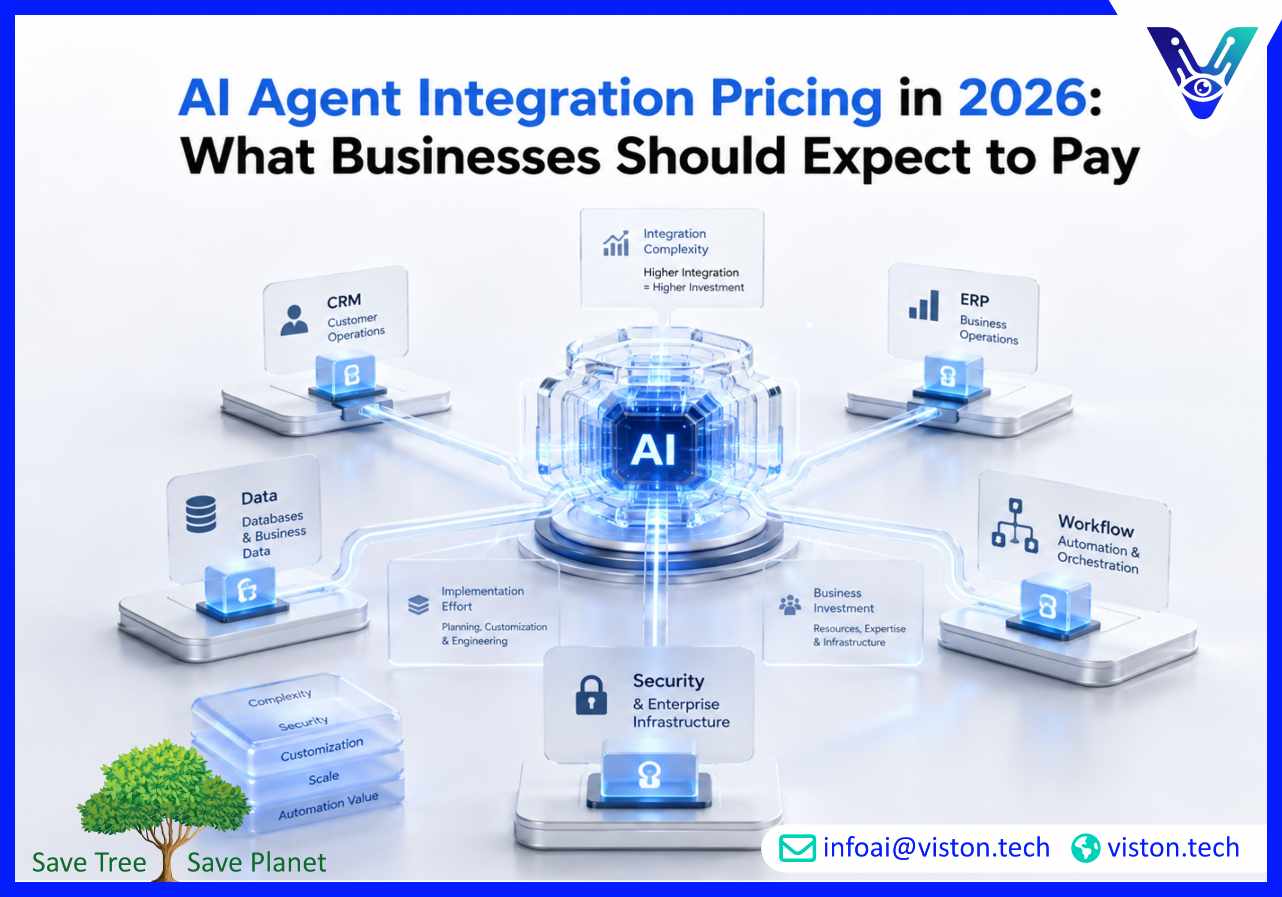
As AI adoption moves from experimentation to operational deployment, many organizations are evaluating the cost of integrating AI agents into existing business systems. Understanding AI agent integration pricing is essential for businesses that want to automate workflows, improve productivity, and connect AI capabilities with real-world operations. In 2026, pricing is influenced by factors such as workflow complexity, integration requirements, security needs, and long-term scalability.
AI agent integration is more than deploying a chatbot or connecting a language model to a single application. Businesses typically require AI agents that can interact with internal systems, access business data, automate workflows, trigger actions, and collaborate with employees or other AI agents.
As a result, AI agent integration pricing often includes multiple components beyond model usage fees.
The final investment depends on the complexity of the business environment and the desired level of automation.
Organizations often ask why AI agent integration costs can vary significantly between projects. The answer lies in the technical and operational requirements involved.
A simple AI agent connected to a single CRM system is generally less expensive than a solution that integrates with multiple platforms such as customer support software, ERP systems, document repositories, analytics tools, and internal databases.
Basic workflows with straightforward actions require less development effort. More advanced workflows involving approvals, conditional logic, exception handling, escalation paths, and multi-step processes typically increase implementation costs.
AI agents often need access to structured and unstructured business data. The effort required to prepare, clean, secure, and organize this information can affect overall pricing.
Industries handling sensitive information may require enhanced security controls, audit logging, role-based access, data governance, and compliance measures. These requirements add development and testing effort.
Organizations seeking highly customized AI agent behavior, proprietary workflows, or specialized integrations should expect higher implementation costs compared to standard deployment models.
Projects involving multiple collaborating AI agents often require orchestration layers, communication protocols, workflow management, and monitoring systems. These additional components contribute to overall project pricing.
Most AI agent integration providers use one or a combination of the following pricing structures.
This model is commonly used when project requirements are clearly defined. Businesses receive a scoped implementation plan and a predetermined project cost.
Best suited for:
Some organizations require continuous optimization, support, monitoring, and expansion of AI capabilities. In these situations, providers may offer monthly service agreements.
Best suited for:
Certain AI solutions incorporate usage-based fees linked to API calls, model consumption, workflow executions, or transaction volumes. Businesses should evaluate these operational costs separately from implementation fees.
Many enterprise projects combine implementation fees with ongoing support and usage-related costs. This structure provides flexibility while supporting long-term scalability.
Organizations often achieve better ROI by approaching AI agent integration strategically rather than attempting large-scale deployments immediately.
Focus on processes where automation can generate measurable operational improvements. Common examples include customer support, lead qualification, document processing, internal knowledge retrieval, and workflow coordination.
Projects with clearly defined outcomes are easier to scope, implement, and measure. This reduces unnecessary development costs and project delays.
Well-organized data, documented workflows, and clearly identified system dependencies help reduce implementation complexity.
Building a scalable foundation allows businesses to expand AI capabilities over time without redesigning the entire architecture.
Implementation costs represent only one part of the investment. Businesses should also consider maintenance, monitoring, model usage, support, governance, and future enhancements.
While pricing is an important consideration, organizations should evaluate AI agent integration based on business outcomes rather than implementation costs alone.
Well-designed AI agent systems can support:
The strongest ROI often comes from integrating AI directly into operational workflows where it can create measurable improvements in productivity and service delivery.
Organizations exploring AI agent integration often need guidance beyond technical implementation. Viston AI provides Agent Integration Services designed to help businesses connect AI agents with operational workflows, enterprise systems, business applications, and internal data environments.
Successful AI agent integration requires careful planning around workflow design, system connectivity, orchestration logic, security controls, governance requirements, and long-term scalability. Viston AI supports businesses in evaluating integration opportunities, defining implementation roadmaps, and identifying where AI agents can deliver meaningful operational value.
Whether the goal is workflow automation, customer support enhancement, internal productivity improvement, or multi-agent orchestration, a structured integration strategy helps organizations avoid unnecessary complexity while maximizing business outcomes. By focusing on practical implementation and business alignment, Viston AI helps organizations make informed investment decisions around AI agent adoption.
Pricing is influenced by workflow complexity, number of integrations, data requirements, security needs, customization levels, and ongoing support requirements.
AI agent integration may involve higher initial implementation costs, but it can automate more complex workflows that traditional rule-based automation cannot easily handle.
Not always. Some use cases can be addressed using standard configurations, while others require custom development to support specific business processes and integrations.
Yes. In addition to implementation expenses, organizations should account for maintenance, monitoring, support, model usage, governance, and future optimization.
Yes. Well-designed AI agent architectures can support additional workflows, integrations, users, and automation capabilities as business needs evolve.
Viston AI’s Agent Integration Services help businesses assess opportunities, define integration strategies, connect AI agents with existing systems, and build scalable automation solutions aligned with operational goals.
AI agent integration pricing in 2026 depends on far more than software licensing or model access. Factors such as workflow complexity, system integrations, security requirements, orchestration needs, and scalability objectives all contribute to overall investment levels. Businesses that approach AI agent integration strategically can achieve stronger operational outcomes while controlling implementation costs. Through specialized Agent Integration Services, Viston AI helps organizations evaluate opportunities, design effective integration strategies, and implement AI-powered workflows that support long-term business value.
