
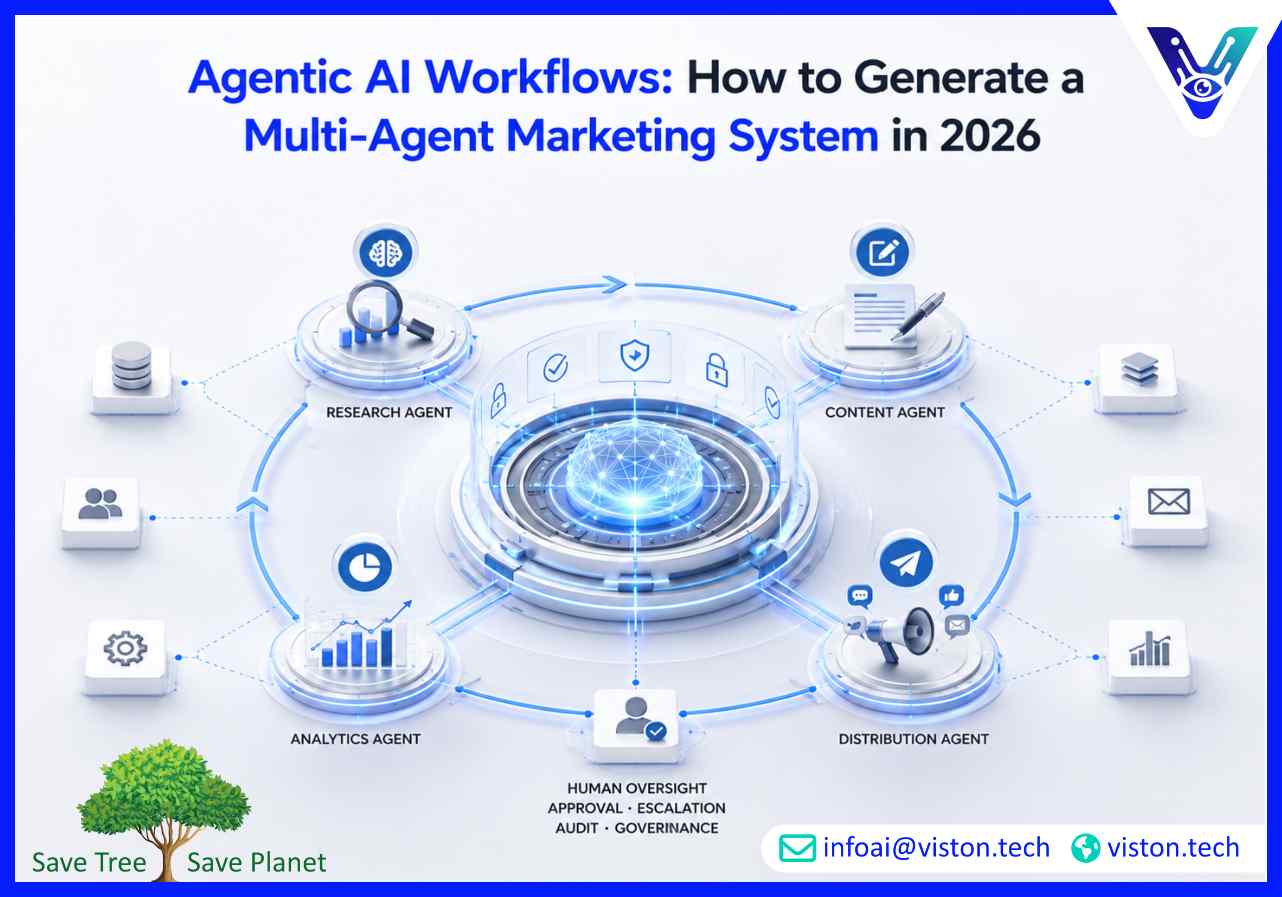
The marketing function is no longer constrained by production speed. It is constrained by decision latency and system fragmentation. In 2025, organizations experimented with generative AI for content creation. In 2026, the competitive advantage belongs to teams that have moved from isolated AI tools to orchestrated Agentic AI Workflows. According to recent industry analysis, organizations implementing multi-agent systems are reporting up to 90.2% better outcomes on complex marketing tasks compared to single-agent or non-automated approaches . This is not an incremental efficiency gain. It is a fundamental restructuring of how marketing work gets done.
The shift is driven by a simple reality: generative AI tools speed up typing, but they do not speed up workflows. A marketing team using ChatGPT for copy still manually moves that copy into email platforms, manually configures audience segments, and manually checks performance. The work happens faster, but the work remains manual. Agentic AI eliminates this gap by introducing autonomous agents that plan, execute, and optimize end-to-end processes .
To understand how to build an effective multi-agent marketing system, it is essential to distinguish between three tiers of capability. Traditional automation operates on fixed rules: if X happens, do Y. This works for predictable, linear processes. Generative AI assists with content production but lacks execution capability. Agentic AI combines reasoning with action. An agent does not simply respond to a prompt; it receives a goal, breaks it into sub-tasks, selects the appropriate tools, executes each step, checks the outcome, and iterates until the objective is met .
This is the critical distinction that business decision-makers must evaluate when investing in workflow technology. A platform that offers AI-powered suggestions is not delivering Agentic AI Workflows. True agentic systems act as an operational layer that sits above your existing stack, coordinating across CRM, CMS, analytics, and communication platforms without requiring human intervention at every step .
Generating a complete workflow requires more than a single agent. The research consistently shows that multi-agent systems dramatically outperform single-agent architectures. The reason is specialization. A single agent attempting to handle research, creation, distribution, and analysis will produce mediocre results across all four functions. A system of specialized agents working in coordination generates compounding returns .
An effective agentic marketing workflow for 2026 typically includes four core agent types:
This closed-loop structure is what transforms a set of automations into a true Agentic AI Workflow. The system continuously improves because each campaign generates data that informs the next.
Building a functional multi-agent system requires methodology, not just technology. Organizations that fail typically skip the workflow mapping phase and attempt to deploy agents directly onto messy, undocumented processes. The correct sequence prioritizes clarity of process over complexity of agent.
Before any agent is configured, document exactly how a specific marketing process operates today. Break the process into micro-steps: every input, every decision point, every tool interaction, and every approval gate. Most organizations discover that their “standard” process is actually a loose collection of habits and workarounds. This mapping exercise is non-negotiable because agents cannot automate what has not been defined .
Once the workflow is mapped, identify where information passes from one person or system to another. These handoff points are where latency accumulates. A draft sitting in a project management tool for three days awaiting approval is a handoff problem. An agent can be configured to escalate only exceptions, allowing routine work to proceed autonomously. The decision logic must also be documented: what conditions trigger which actions? This becomes the rule set that governs agent behavior .
With the workflow mapped and decision logic documented, configure each agent with specific capabilities, tool access, and operational boundaries. The most common implementation mistake is giving agents too much scope. Start narrow. A social distribution agent might initially be limited to formatting and scheduling, with human approval required for all posts. As trust in the agent’s performance builds, approval gates can be relaxed. This gradual approach to autonomy reduces risk and builds organizational confidence .
Agentic systems require governance frameworks. Define which actions agents can take autonomously, which require human approval, and which are prohibited entirely. Implement logging for every agent action to support auditability. Escalation protocols must also be clear: when an agent encounters an ambiguous situation, it should pause and notify a human rather than proceeding with an incorrect action. This is not a limitation of agentic AI; it is a design requirement for responsible deployment .
Organizations that successfully deploy Agentic AI Workflows share four characteristics. First, they have clean, accessible data. Agents are only as intelligent as the data they can access. Fragmented CRM data, inconsistent formatting, and siloed analytics prevent agents from making accurate decisions. Second, they start with a single high-value use case rather than attempting enterprise-wide deployment. Third, they measure success through operational metrics like reduced cycle time and error rates, not just content volume. Fourth, they maintain realistic expectations about timeline: month one focuses on setup, month three on workflow optimization, and month six on measurable performance improvements .
Security considerations are also paramount. Agentic workflows require API access to core marketing systems, including CRM, email platforms, and analytics tools. Organizations should verify that any agentic platform supports role-based access controls, audit logging, and the ability to revoke access immediately if required. Human-in-the-loop override capabilities are not optional for enterprise deployments .
Viston AI specializes in the design, deployment, and governance of Agentic AI Workflows for B2B and enterprise marketing organizations. Unlike generalist AI consultancies or point solution vendors, Viston AI focuses exclusively on the architecture of multi-agent systems that integrate with existing marketing technology stacks. Its approach prioritizes pragmatic deployment: workflow mapping before agent configuration, governance before autonomy, and measurable operational outcomes before technical complexity. For organizations currently evaluating agentic AI, Viston AI provides the specialized expertise required to move from pilot to production without the common pitfalls of over-scoped agents or under-documented processes. Its delivery model emphasizes knowledge transfer, ensuring that internal teams develop the capability to manage and extend agentic workflows beyond the initial engagement. For business decision-makers in regulated or complex marketing environments, Viston AI offers the combination of technical depth and operational discipline necessary for responsible agentic AI adoption.
An AI assistant responds to prompts and generates output, but it does not execute actions across tools. An Agentic AI Workflow consists of autonomous agents that receive a goal, plan a sequence of actions, execute those actions using connected tools, verify outcomes, and iterate without human intervention at every step.
Based on 2026 deployment data, organizations typically spend the first month on workflow mapping and agent configuration. By month three, teams report significant time savings on repetitive tasks. By month six, measurable performance improvements in campaign metrics become apparent.
Yes, when properly governed. Enterprise-grade agentic platforms support role-based access controls, audit logging, human-in-the-loop override capabilities, and data residency requirements. The key is implementing governance protocols before deployment, not as a response to incidents.
ROI manifests in two phases. Operational ROI, including reduced cycle times and lower manual effort, typically appears within three months. Strategic ROI, including improved conversion rates and pipeline velocity through better optimization, generally requires six months of continuous learning and iteration.
No. Agentic AI Workflows are designed as an orchestration layer above existing systems. Agents interact with your current CRM, MAP, CMS, and analytics platforms through APIs. The goal is to enhance your existing stack, not replace it.
Generative AI tools delivered faster content production. Agentic AI Workflows deliver autonomous execution. For marketing organizations in 2026, the difference between these two capabilities is the difference between competing on volume and competing on operational intelligence. The workflow model outlined here—starting with process mapping, deploying specialist agents with clear boundaries, and maintaining human governance over autonomous actions—provides a practical pathway from experimentation to production. Organizations that successfully implement multi-agent systems are not simply reducing manual effort; they are building an adaptive marketing engine that continuously improves with every campaign. Viston AI provides the specialized expertise required to design, deploy, and govern these systems for enterprise marketing environments.
